

Use Spotify for Artists to pitch one unreleased track directly to Spotify’s editorial playlist editors. Go to artists.spotify.com, sign in, navigate to Music → Upcoming, select your song, and fill out the pitch form. That’s the whole official process, and it costs nothing.
Before you start, run through this checklist:
- Verified Spotify for Artists account with Admin or Editor access on your team
- Release delivered to Spotify by your distributor or label (the track must appear in your Upcoming tab)
- One song selected — you can only pitch one track per release, so choose your strongest
- Submitted at least 7 days before release to qualify for Release Radar exposure
Submitting is a request for editorial consideration, not a guaranteed placement. What is guaranteed: pitch at least 7 days out and your song automatically lands on your followers’ Release Radar playlists. Editorial placement depends entirely on the editors.
Pro Tip: Submit as early as possible. Spotify editors review thousands of pitches weekly, and earlier submissions get more consideration time.
Table of Contents
- How do you submit an unreleased song through Spotify for Artists?
- What should you actually write in your editorial pitch?
- Who’s eligible, when should you submit, and what if something goes wrong?
- How do you pitch a music video separately?
- What other playlist routes can you run alongside editorial pitching?
- How do you spot a legitimate playlist-pitching service?
- Key Takeaways
- What curators actually read first
- Intonality takes the curator outreach off your plate
- Useful sources to read next
How do you submit an unreleased song through Spotify for Artists?
The pitch flow runs on desktop only. Mobile access is limited, so open the dashboard on a laptop or desktop before you start.
- Deliver your release to Spotify through your distributor (DistroKid, TuneCore, CD Baby, or similar). The track won’t appear in your dashboard until Spotify ingests it.
- Log in at artists.spotify.com.
- Go to Music → Upcoming. If your track isn’t there yet, your distributor hasn’t delivered it or Spotify hasn’t processed it.
- Select your song and click Get started.
- Fill out the pitch form. Required fields include genre, mood, instrumentation, and a free-text pitch. Optional fields matter too — fill them all.
- Review and submit. You’ll get a confirmation. After that, it’s in the editors’ hands.
For albums and EPs, you pitch one track only. Pick the song that best represents the release and has the clearest playlist fit.
Troubleshooting checklist:
- Can’t see the release? Check your distributor’s delivery status. Processing can take 2–5 business days after delivery.
- No Upcoming tab? Confirm your account has Admin or Editor access on the artist team.
- Metadata mismatch? If the track name or artist credit doesn’t match what’s in your distributor account, contact your distributor first, then Spotify support.
- Label-delivered release? Your label’s team must have the correct access level. Contact them directly if the pitch option isn’t appearing.
Pro Tip: Don’t wait for your distributor’s default delivery schedule. Manually set your delivery date 3–4 weeks before release so the track appears in Spotify for Artists with enough time to write a strong pitch.

What should you actually write in your editorial pitch?

The pitch form is the primary instrument editors use to find context and fit for a song. Spotify’s matching systems use every field you fill in — genre tags, mood descriptors, instrumentation, location, and the free-text pitch — to route your song to the right editorial teams. Vague entries don’t help anyone.
Fields that matter most:
- Genre/subgenre (up to three): Be specific. “Indie Folk” beats “Indie.” “Dark Pop” beats “Pop.”
- Mood and style tags: Choose the tags that match the listener experience, not just the production style.
- Instrumentation: List the key instruments and production elements (e.g., acoustic guitar, layered synths, live drums).
- Hometown and current base: Editors sometimes look for sounds tied to specific scenes or regions.
- Free-text pitch (400–500 characters): This is your one shot to speak directly to an editor.
A strong example pitch:
“A slow-burning indie folk track built around fingerpicked acoustic guitar and close-mic’d vocals, recorded live in a cabin in Vermont. Written during a cross-country move, it sits at the intersection of quiet grief and forward momentum — fits playlists like ‘Sad Indie’ or ‘Late Night Drive.’ Features harmonies from Nashville-based vocalist Mara Linn. Premiered on KEXP.”
Notice what that pitch does: it describes the sound concretely, names a context, signals playlist fit, mentions a collaborator, and includes a press credential. It doesn’t ask for placement, doesn’t include a bio, and doesn’t make vague claims like “this song will resonate with everyone.”
What not to write:
- Long artist bios or career histories
- “Please add this to your playlist” or any entitlement language
- Vague descriptors (“emotional,” “powerful,” “unique”)
- Comparisons to other artists (Spotify’s form discourages this)
Pro Tip: Treat the free-text field like a short press release written for a music journalist who has 30 seconds. Concrete details about sound, story, and context beat any amount of hype.
Who’s eligible, when should you submit, and what if something goes wrong?
Eligibility and timing
Only unreleased tracks qualify for editorial pitching. Once a song is live on Spotify, the pitch window closes. The track must be delivered by your distributor or label and visible in your Spotify for Artists dashboard before you can submit.
| Stage | Recommended timing | What happens |
|---|---|---|
| Deliver to distributor | 3–4 weeks before release | Gives Spotify time to process without rushing |
| Track appears in Spotify for Artists | Usually 2–5 days after delivery | You can now access the pitch form |
| Submit pitch | At least 7 days before release | Secures Release Radar; earlier improves editorial odds |
| Editorial review | Varies, no guaranteed timeline | Editors consider the pitch; no placement is promised |
| Release day | — | Release Radar fires; editorial adds (if any) may appear |
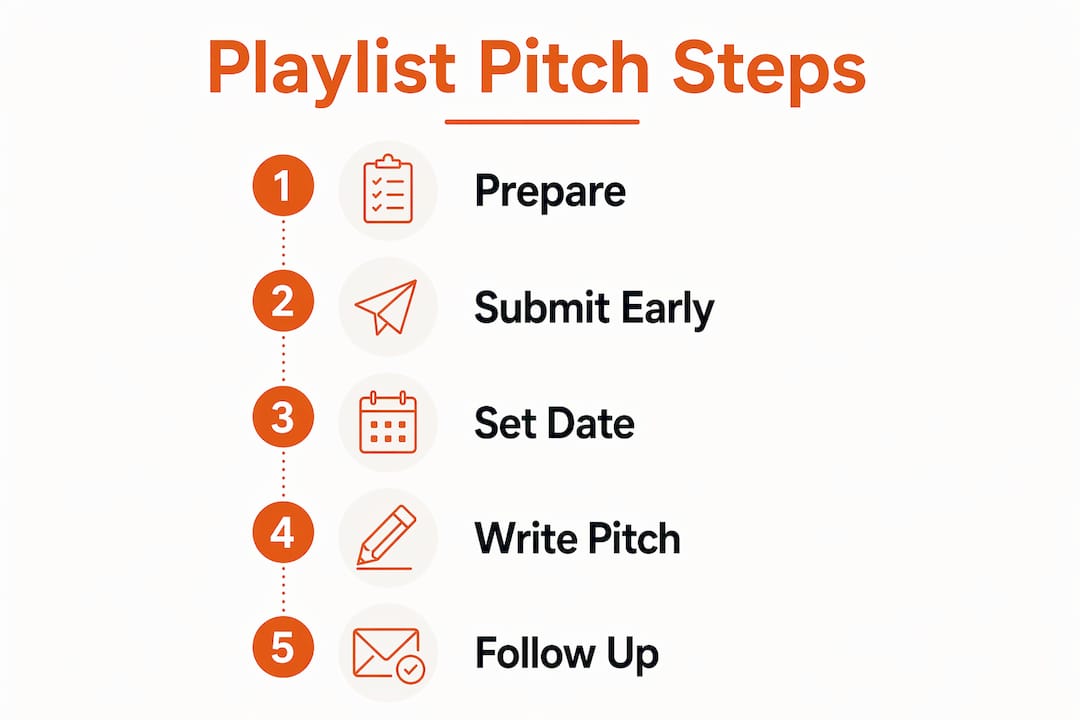
The 7-day minimum is a hard floor for Release Radar. For editorial consideration, practitioners recommend 3–4 weeks of lead time. That buffer absorbs distributor delays and gives editors more time with your pitch.
Common technical problems
- Track not appearing in Upcoming: Verify delivery status in your distributor dashboard. If it shows “delivered,” allow 2–5 business days.
- Pitch form greyed out or missing: Check your team role. You need Admin or Editor access.
- Release delivered by a label: The label’s team controls pitching access. Coordinate with your label contact.
- This Is playlist pin: If you’re eligible for a “This Is [Artist]” playlist, you can pin the pitched song to it. You can only submit one pin request at a time.
How do you pitch a music video separately?
Song and video pitches are completely separate processes. If you’re releasing both, submit each one independently for maximum editorial consideration. Missing the video pitch means missing editorial video playlist opportunities entirely.
Where to find the video pitch flow:
- Log in at artists.spotify.com on desktop.
- Go to Video & Visuals.
- Under Actions, click Pitch your videos. This option only appears if you have an eligible video ready.
- Click Get started, complete the form, and submit.
Video eligibility:
- Official music videos or live performances delivered by your distributor or label
- Must be unreleased or submitted within 7 days of release
- Your team needs the correct access level (same Admin/Editor requirement as song pitches)
What to include in a video pitch:
- Visual style and aesthetic (cinematic, performance-based, animated, etc.)
- Story or concept behind the video
- Director or notable collaborators
- Marketing plans tied to the video (tour, press, sync opportunities)
Quick access check:
- Confirm your distributor has delivered the video to Spotify
- Verify your team role in Spotify for Artists settings
- If Pitch your videos doesn’t appear, the video may not yet be processed or your access level may need updating
What other playlist routes can you run alongside editorial pitching?
Editorial pitching through Spotify for Artists is free and reaches the most impactful playlists. It should always be your first move. But it’s not the only move.
Three routes you can run in parallel:
- Editorial pitch (Spotify for Artists): Free, official, highest upside. Do this first, every time.
- Direct outreach to independent curators: Research playlist owners on social platforms, find contact info, and send personalized pitches. Target 10–20 well-matched playlists rather than blasting 200 generic ones. A genre-specific indie playlist with 2,000 engaged followers will often outperform a massive but mismatched playlist.
- Pay-for-listen platforms: Services that charge per submission and guarantee a curator will listen and respond. They don’t guarantee placement, but they do guarantee feedback.
Best practices for direct curator outreach:
- Research recent playlist adds to confirm your genre fits before reaching out
- Write one personalized sentence about why your song fits that specific playlist
- Include a private streaming link (Spotify pre-save or SoundCloud)
- Follow up once, politely, after 10–14 days. Never twice.
- Keep a simple spreadsheet tracking who you contacted, when, and what they said
Hard rules:
- Never pay for guaranteed placement. Spotify explicitly prohibits it, and services that promise it are violating Spotify’s terms.
- Never buy streams or use bot-driven services. Fake engagement damages your algorithmic profile and can get your account flagged.
- Never mass-spam curators with the same copy-pasted message. Curators talk to each other.
How do you spot a legitimate playlist-pitching service?
Legitimate services connect your music to real curators and deliver feedback. They don’t promise editorial placements, and they don’t manufacture streams.
What honest services actually deliver:
- Targeted outreach to vetted, genre-matched curators
- Written feedback from curators who reviewed your track
- Campaign reporting showing which curators responded and how
- A human curation network, not an automated bot system
Transparency checklist — ask any service these questions before paying:
- How do you source your curators, and how often is the network updated?
- Are playlist adds organic, or are curators incentivized to add tracks?
- What reporting do I receive, and how detailed is it?
- Do I get written curator responses, or just aggregate numbers?
Red flags to walk away from:
- Guarantees of editorial playlist placement (Spotify’s own editors don’t even promise this)
- Large, sudden stream spikes with no corresponding listener engagement or saves
- No curator-level reporting, only total stream counts
- Vague answers about how curators are sourced
If you notice a sudden spike in streams after a campaign with no matching increase in saves, listener retention, or profile follows, that’s a signal worth investigating. Non-organic traffic suppresses your algorithmic performance over time.
Pro Tip: Before paying any service, ask for recent case studies that show specific curator placements with playlist names and follower counts, not just aggregate stream totals. Any legitimate service can provide this.
Key Takeaways
Spotify for Artists is the only official channel to pitch unreleased music to editorial editors, and submitting at least 7 days before release is the minimum required to secure Release Radar placement.
| Point | Details |
|---|---|
| Official pitch channel | Spotify for Artists (artists.spotify.com) is the only way to reach editorial editors — it’s free. |
| 7-day minimum rule | Submit at least 7 days before release to guarantee Release Radar; earlier improves editorial odds. |
| One track per release | You can only pitch one song per EP or album, so choose the track with the clearest playlist fit. |
| Pitch quality matters | Fill every field with specific subgenres, mood tags, and a concrete free-text pitch — vague entries hurt your match quality. |
| Intonality for curator outreach | For human-driven outreach to vetted independent curators with written feedback, Intonality runs genre-matched campaigns alongside your editorial pitch. |
What curators actually read first
Most artists spend their energy worrying about whether their song is good enough. Curators have already decided that in the first 15 seconds. What they’re actually reading is fit: does this song belong in the context I’ve built for my listeners?
That’s the thing most pitching advice gets wrong. The pitch isn’t a persuasion exercise. It’s a matching exercise. A curator running a late-night ambient playlist doesn’t need to be convinced your track is great. They need to know, in two sentences, that it sounds like it belongs next to the other songs they’ve already chosen. The artists who understand that write shorter, more specific pitches. They name the tempo. They describe the texture. They mention the scene or setting the song evokes. They don’t compare themselves to famous artists, and they don’t ask for anything.
Post-release analytics are underused for this. After a release, check which playlists drove the highest save rates and listener retention, not just raw streams. A playlist that generates saves means the listeners were genuinely engaged. That data tells you which curators’ audiences actually match your music, and those are the relationships worth maintaining. A quick, genuine thank-you message after a successful add, followed by a heads-up on your next release, is how long-term curator relationships get built. Most artists never do it.
Intonality takes the curator outreach off your plate
Editorial pitching through Spotify for Artists handles the official side. Independent curator outreach is a separate job entirely, and doing it well takes time, research, and follow-through that most artists don’t have during a release cycle.
Intonality runs personalized campaigns to vetted, genre-matched curators on your behalf. Every curator decision comes with written feedback, so you learn what’s working and what isn’t, not just a stream count at the end. Campaigns include pre-release submission capability, real-time updates, and curator-level reporting. No bots, no fake playlists, no inflated numbers.
What to expect when you start a campaign:
- Genre-matched curator targeting based on your specific sound, not a broad category
- Written feedback from every curator who reviews your track
- Campaign reporting with placement details, not just aggregate metrics
- 4–11 playlist placements per campaign depending on your tier
Whether you’re releasing indie folk, dark pop, or anything in between, Intonality matches your track to curators who are already building playlists in your space. Submit your track to get started before your next release.
Useful sources to read next
- Pitching music and videos to Spotify playlist editors — Spotify Support: The official step-by-step guide covering song and video pitch flows, Release Radar eligibility, This Is playlist pinning, and access requirements. Start here to verify any rule before you submit.
- Playlisting — Spotify for Artists: Spotify’s own editorial landing page explaining what editors look for, how the pitch form works, and why detailed entries improve your chances. Includes direct quotes from Spotify’s playlist editors.
- Spotify Playlist Submission: The Complete Process — Orphiq: A detailed third-party walkthrough covering pitch-writing examples, distributor timing recommendations, and a comparison of third-party submission platforms. Useful for deeper examples and independent curator outreach strategy.


