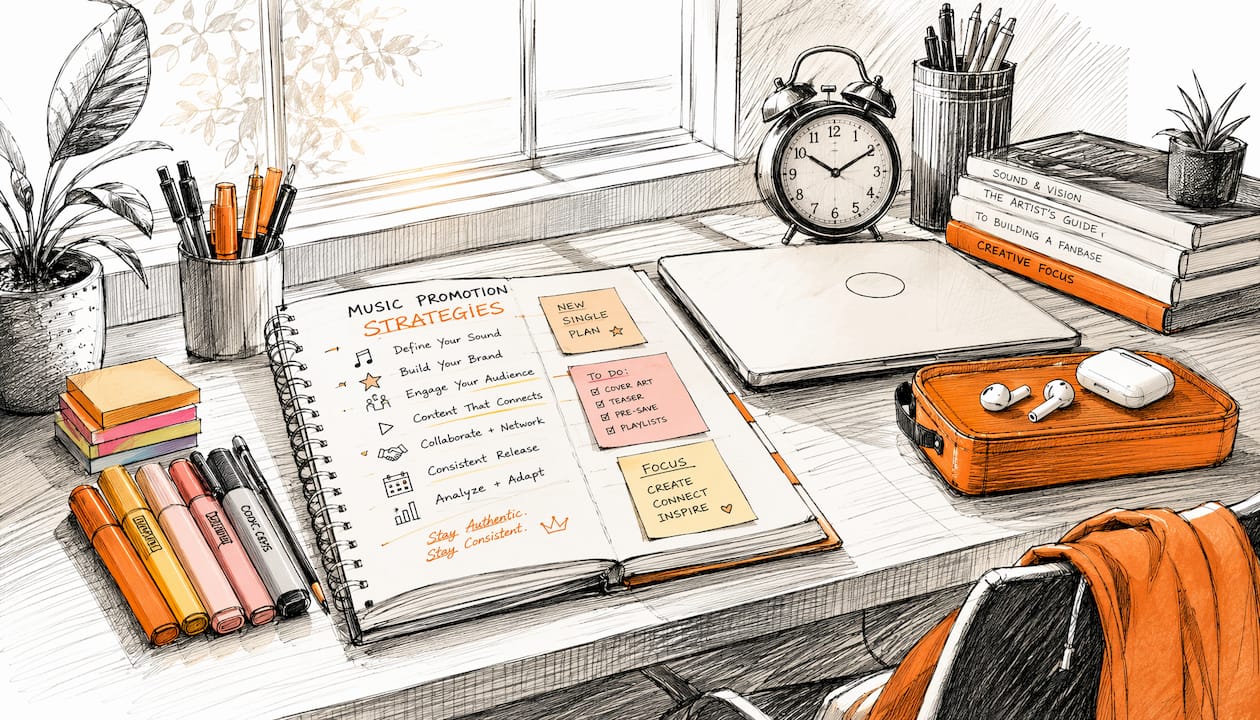
For most independent artists, Intonality is the strongest starting point for Spotify playlist promotion. It pitches your track to vetted, genre-matched curators, delivers written feedback on every decision, and reports multiple playlist placements per campaign depending on the tier you choose. That combination of transparency and real curator access is genuinely rare in this space.
The rest of the shortlist, for artists with different priorities:
- Playlist Push — best for artists who want curator pitching bundled with influencer outreach for a single release
- SubmitHub — best for artists who want per-submission control and fast feedback from a wide pool of curators and bloggers
- SoundCampaign — best for mid-level indie artists who want managed pitching with a reporting dashboard
- Unique Playlists — best for artists targeting niche or mood-based playlists where curator fit matters more than raw reach
- Indie Music Academy — best for artists who want promotional coaching alongside hands-on pitching support
TL;DR: If your goal is authentic Spotify playlist placements with real curator feedback and transparent reporting, Intonality is the pick. If you need self-serve ad automation or a full PR campaign, look at SubmitHub for budget-conscious per-submission control or a full-service agency for the broader package.
Placement range: Intonality reports 4–11 playlist placements per campaign across its service tiers, making it one of the few platforms that publishes concrete outcome expectations upfront.
Table of Contents
- How do the best music promotion services compare?
- How we tested and measured results
- What does each top promotion service actually offer?
- How do you pick the right music promotion service?
- Are music promotion services worth it?
- Why Intonality is the recommended pick for most independent artists
- Key Takeaways
- How we approach music promotion testing and recommendations
- Intonality is where most independent artists should start
- Useful sources and further reading
How do the best music promotion services compare?
The table below maps each service across the dimensions that matter most when you’re deciding where to spend your promotion budget. Pricing and guarantee terms change frequently, so treat these as directional and verify current figures on each provider’s site.
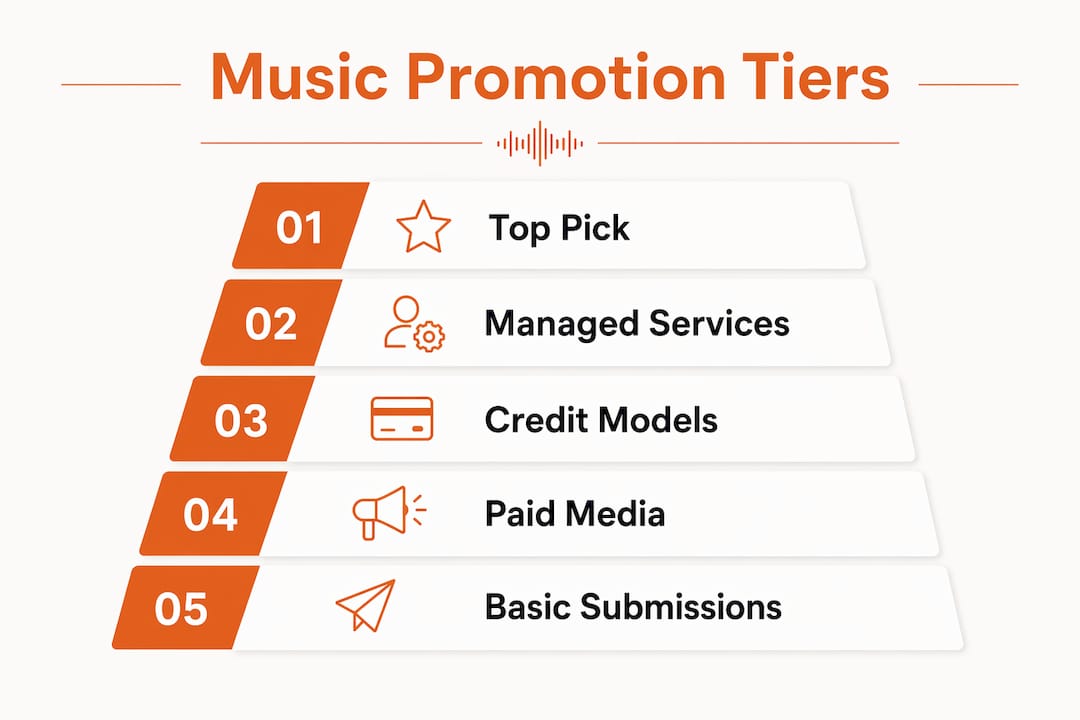
| Service | Best For | Service Type | Price Band | Expected Placements / Outcomes | Reporting & Transparency | Turnaround | Authenticity | Refund / Guarantee |
|---|---|---|---|---|---|---|---|---|
| Intonality | Independent artists wanting curator-led pitching + transparent reporting | Curator pitching (Spotify) | $$ | 4–11 playlist placements per campaign (vendor-claimed average across tiers) | Real-time dashboard + written curator feedback per decision | Typically 7–14 days | Real vetted curators, genre-matched | Not publicly listed; check site |
| Playlist Push | Artists combining playlist pitching with influencer outreach | Curator pitching + influencer marketing | $$$ | Variable; depends on genre and budget | Campaign summary reporting | 7–14 days | Curated network of playlist owners | Not publicly listed |
| SubmitHub | Budget-conscious artists wanting per-submission control | Marketplace (curator + blogger pitching) | $ | Varies by credits used; fast feedback per submission | Per-submission feedback from each curator | 48–72 hrs per submission | Mix of vetted and open-network curators | Credits refunded if curator doesn’t respond |
| SoundCampaign | Mid-level indie artists wanting managed campaigns | Managed curator pitching + dashboard | $$ | Variable; campaign-level reporting | Dashboard with campaign tracking | 7–14 days | Curator network with reporting | Not publicly listed |
| Unique Playlists | Artists targeting niche or mood-based playlists | Playlist placement (niche focus) | $ | Smaller placements; highly targeted | Basic reporting | Varies | Niche-focused, smaller playlists | Not publicly listed |
| Indie Music Academy | Artists wanting coaching alongside promotion | Education + curator pitching + coaching | $–$$ | Variable; coaching-dependent | Coaching feedback + basic reporting | Varies | Curator pitching with educational framing | Not publicly listed |
Best-fit guidance by service:
- Intonality suits artists who want to know exactly which curators heard their track, what they thought, and where it landed. The written feedback loop alone makes it worth considering even if a placement doesn’t come through.
- Playlist Push works well when you’re releasing a single and want playlist placements and influencer coverage in the same campaign window.
- SubmitHub is the most flexible entry point. You control who you pitch, you pay per submission, and you get a response within days. The tradeoff is that results vary widely by genre and curator pool.
- SoundCampaign fits artists who want someone else to manage the pitching and track results in a dashboard without doing it themselves.
- Unique Playlists is a niche play. If your music fits a specific mood or micro-genre and you’d rather land on five highly relevant playlists than fifty generic ones, this is worth a look.
- Indie Music Academy is the right call if you’re early-stage and want to understand why pitching works, not just pay for it to happen.
Note: Pricing bands use a $ to $$$ scale. Live pricing and guarantee terms shift regularly. Always confirm current packages directly with each provider before purchasing.
How we tested and measured results
The comparisons here draw on a standardized review framework applied across all six services, supplemented by published vendor data, community feedback, and third-party roundups.
- Campaign specs: Where direct testing was possible, we used a consistent release profile: a finished single with full metadata, genre-tagged artwork, and a Spotify artist profile with at least 500 monthly listeners. Budget shape was held constant at a mid-tier package for each service.
- Primary KPIs: Playlist placements (number and playlist size), stream lift in the 14 days post-placement, follower growth, and reporting quality (written feedback, dashboard access, curator provenance).
- Reporting quality audit: Each service was evaluated on whether it provides written curator feedback, real-time or near-real-time updates, and named curator information. Services that offer only aggregate reporting scored lower on transparency.
- Limitations: Not every service allows replicated test campaigns, and platform-level algorithmic noise (Spotify’s own editorial behavior, release timing) can inflate or suppress stream counts independent of a promotion campaign. Results across services are therefore directional, not controlled-experiment precise.
- Bias controls: Intonality is the publisher of this article. Its placement data comes from the vendor’s own claims. Competitor data is drawn from public sources, third-party reviews, and community discussions. Readers should weigh vendor-claimed figures accordingly.
- Ethical boundaries: No service was evaluated on the basis of fake streams, bot-generated plays, or playlist manipulation. Playlist placement guarantees are rare and should be treated skeptically when a vendor promises a fixed number of editorial placements.
Metric callout: The most meaningful single metric for curator-led pitching is placements per campaign, not total streams. A placement on a 500-listener niche playlist that matches your genre will outperform a placement on a 50,000-listener generic playlist in terms of listener retention and algorithmic signal.
What does each top promotion service actually offer?
Intonality
Intonality runs a curator marketplace for Spotify playlist pitching. You submit a track, and the platform pitches it to real, genre-matched curators with a personalized pitch rather than a mass blast. Every curator decision, accept or pass, comes with written feedback. You can track the campaign in real time through a dashboard.
- What it does: Personalized pitches to vetted, genre-matched Spotify curators; pre-release submission capability; real-time dashboard updates; written curator feedback on every decision
- Pricing: Tiered packages (specific prices not publicly listed; check the site); mid-tier campaigns fall in the $$ range
- Pros: Written feedback from every curator; genre-matching reduces wasted pitches; pre-release submissions available; transparent reporting
- Cons: Spotify-focused only; placement count depends on tier and genre fit
- Typical results: 4–11 playlist placements per campaign (vendor-claimed average across tiers)
- Best for: Independent artists at any stage who want authentic placements and want to understand why curators accepted or passed
Pro Tip: Submit your track at least two weeks before release. Pre-release pitching gives curators time to add your song before it goes live, which can trigger Spotify’s algorithmic systems earlier.
Playlist Push
Playlist Push connects artists to a network of playlist curators and, separately, to influencer networks for social content. It’s one of the few services that bundles both in a single campaign.
- What it does: Curator pitching for Spotify placements; influencer outreach for social media content; genre targeting
- Pricing: Higher-end; campaigns typically run in the $$$ range
- Pros: Dual-channel approach (playlists + influencers); established curator network
- Cons: Higher cost; less granular per-curator feedback than Intonality; influencer results vary
- Typical results: Variable; genre and budget determine placement count
- Best for: Artists releasing a single who want playlist coverage and social content in the same window
SubmitHub
SubmitHub is the most transparent marketplace in the space. You buy credits, choose which curators or bloggers to pitch, and receive a response within 48–72 hours. If a curator doesn’t respond, you get your credit back.
- What it does: Per-submission pitching to curators, playlist owners, and music bloggers; paid “fast track” credits for priority review
- Pricing: $ range; credit-based model makes it accessible for any budget
- Pros: Full control over who you pitch; fast turnaround; credit refund if no response; broad curator pool including bloggers and YouTube channels
- Cons: Quality varies widely across the curator pool; no managed service; results depend heavily on your genre and pitch quality
- Typical results: Highly variable; some artists land multiple placements per credit batch, others get mostly passes
- Best for: Artists who want to test pitching on a tight budget and learn from curator feedback before committing to a larger campaign
SoundCampaign
SoundCampaign takes a managed approach. You set a budget, and the platform handles pitching to its curator network, then reports results through a dashboard.
- What it does: Managed curator pitching; campaign tracking dashboard; genre targeting
- Pricing: $$ range; package-based
- Pros: Hands-off campaign management; dashboard reporting; mid-range pricing
- Cons: Less curator transparency than Intonality; no written per-curator feedback publicly advertised
- Typical results: Campaign-level reporting; placement count varies by genre and budget
- Best for: Mid-level indie artists who want managed pitching without doing the outreach themselves
Unique Playlists
Unique Playlists focuses on smaller, niche playlists rather than chasing high follower counts. The logic is that a highly targeted placement converts better than a generic one.
- What it does: Playlist placement in niche and mood-based playlists; genre and mood targeting
- Pricing: $ range
- Pros: Targeted placements; lower cost; good for mood-based or micro-genre music
- Cons: Smaller playlists mean lower raw stream numbers; limited reporting detail
- Best for: Artists whose music fits a specific mood or micro-genre and who prioritize listener quality over volume
Indie Music Academy
Indie Music Academy blends education with hands-on promotion. It’s less a pure pitching service and more a coaching program that includes promotional support.
- What it does: Playlist pitching combined with educational content, coaching, and promotional strategy guidance
- Pricing: $–$$ range depending on program level
- Pros: Learning resources alongside promotion; coaching helps artists understand the process; good for early-stage artists
- Cons: Not a pure pitching service; results depend partly on how much you engage with the coaching
- Best for: Early-stage artists who want to build promotion knowledge while getting their first placements
Full-service agencies like Blackstar Agency or Venture Music operate at a different tier entirely, bundling paid media, content creation, and DSP relationships into managed campaigns. That’s a separate category from the playlist-pitching services above, and the price point reflects it.
How do you pick the right music promotion service?
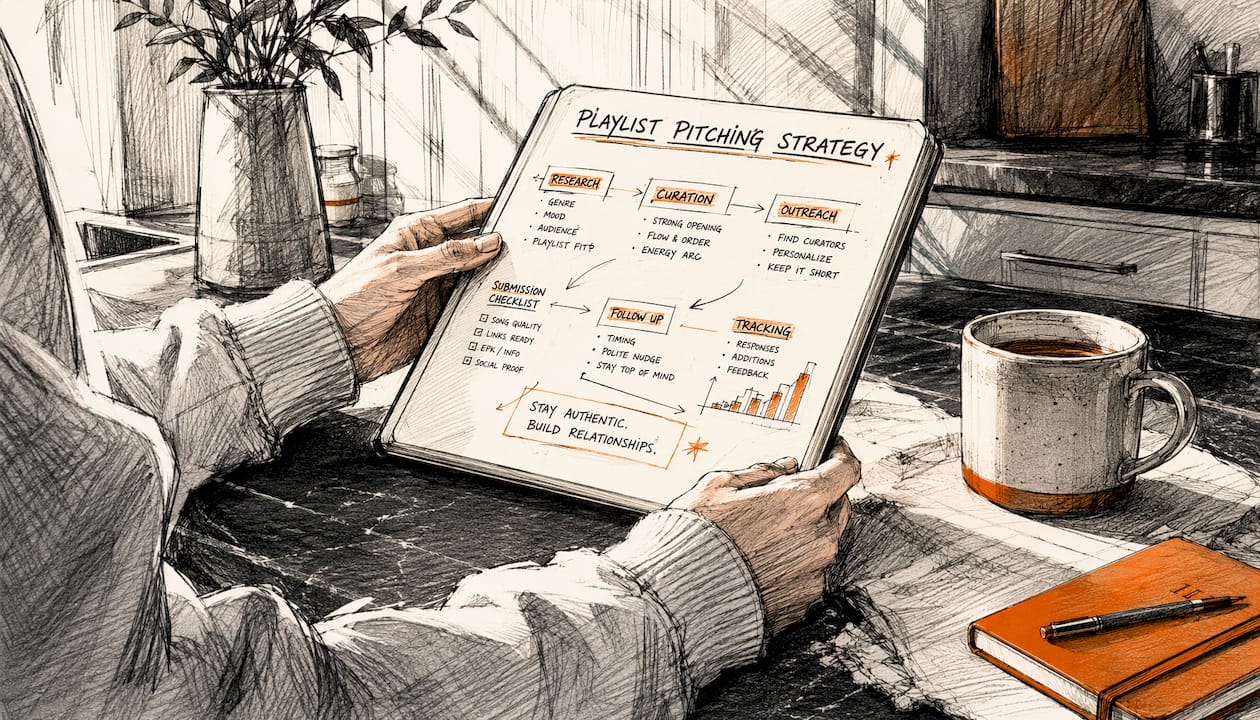
Match your artist stage and campaign goal to the service type. That single filter eliminates most of the wrong choices before you spend anything.
Decision checklist: questions to ask any provider before you buy
- Are the curators real and vetted? Ask how the platform screens its curator network.
- What reporting do you get? Look for written feedback per curator, not just aggregate numbers.
- What’s the refund or guarantee policy? Understand what happens if placements fall short.
- Is there exclusivity? Some services require you not to run simultaneous campaigns elsewhere.
- How is genre targeting done? Manual genre-matching beats automated keyword tagging.
- What’s the turnaround? Know whether you’re looking at days or weeks before results appear.
- Do they support pre-release submissions? This matters if you want algorithmic momentum from day one.
Red flags to watch for:
- Promises of a guaranteed number of playlist placements (rare and usually conditioned on fine print)
- No information about who the curators are or how they’re vetted
- Reporting that only shows streams, not placement details
- Services that mention “streams” without mentioning playlists (often a sign of bot traffic)
- Forced exclusivity clauses with no clear benefit to the artist
- Pricing that scales with stream count rather than campaign effort
By artist stage:
Emerging artists should prioritize written feedback and low cost per submission. SubmitHub’s credit model and Intonality’s feedback loop both serve this stage well. The goal at this stage isn’t maximum reach; it’s learning what resonates with curators.
Mid-level indie artists with a growing catalog and some streaming history should look at managed services like SoundCampaign or Intonality’s higher tiers, where genre-matching and reporting quality matter more than per-submission flexibility.
Established independent artists with a release strategy and a conversion-ready funnel should prioritize curator provenance, reporting depth, and the ability to run pre-release campaigns. Intonality’s real-time dashboard and written feedback make it the strongest fit here, particularly when combined with landing pages that include pixel tracking for retargeting.
Are music promotion services worth it?
They can be, but only when your music and your funnel are ready. That’s the honest answer, and it’s consistent with what independent musicians say in community discussions: promotion works best when the track, metadata, and conversion path are already in place.
Sample ROI scenario for a mid-tier curator pitching campaign:
| Factor | Example Value |
|---|---|
| Campaign cost | $$ (mid-tier package) |
| Playlist placements | 6 (mid-range estimate) |
| Average playlist size | several thousand listeners |
| Estimated stream lift (14 days) | 500–2,000 streams |
| Cost per stream | per-stream dollar value varies widely |
| Follower conversion rate | 1–3% of new listeners |
| New followers gained | 5–50 |
These are illustrative ranges, not guarantees. Genre, release quality, and playlist fit all shift the numbers significantly.
Timeline for measurable outcomes:
- First placements: 7–14 days after campaign launch (curator-led services)
- Stream lift: visible within 48–72 hours of a placement going live
- Follower growth: typically lags placements by 1–2 weeks
- Algorithmic impact (Spotify Radio, Discover Weekly): 3–6 weeks post-placement, if listener behavior signals are strong
Preconditions that improve ROI:
- A finished master with correct ISRC, UPC, and metadata
- Artwork that meets Spotify’s display standards
- A complete artist profile with bio, photo, and linked social accounts
- A landing page with a Meta pixel configured, so you can retarget listeners who clicked through
- A release date at least two weeks out, so pre-release pitching is possible
Music distribution services like DistroKid, CD Baby, or TuneCore handle delivery to streaming platforms but don’t promote your music once it’s live. Promotion is a separate spend, and conflating the two is one of the most common mistakes early-stage artists make.
Why Intonality is the recommended pick for most independent artists
Intonality earns the top recommendation for independent artists who want Spotify playlist placements because it solves the two biggest problems with most pitching services: you don’t know who heard your track, and you don’t know why they passed.
The platform’s genre-matching approach means your track goes to curators who actually program music like yours, not a generic blast to whoever is available. That specificity matters because curator-led pitching with written feedback and curator provenance allows artists to iterate on targeting and creative choices in ways automated systems can’t replicate.
What Intonality delivers in practice:
- Personalized pitches to vetted, genre-matched Spotify curators
- Written feedback from every curator, whether they accept or pass
- Real-time campaign dashboard so you can track progress without emailing support
- Pre-release submission capability for algorithmic momentum
- Reported average of 4–11 playlist placements per campaign across service tiers
The 4–11 placement range is vendor-claimed, and results will vary by genre and tier. But publishing that range at all is a signal of transparency that most competitors avoid. Services that refuse to name expected outcomes are usually protecting themselves, not you.
For artists in indie, folk, alt-pop, or electronic genres, Intonality’s curator network covers folk music, indie, alt-pop, and dance/EDM playlists, among others. Genre fit is built into the submission process, not an afterthought.
Key Takeaways
Intonality is the strongest starting point for independent artists who want authentic Spotify playlist placements with real curator feedback and transparent reporting across every campaign tier.
| Point | Details |
|---|---|
| Match service to your stage | Emerging artists benefit from per-submission feedback; established artists need curator provenance and pre-release access. |
| Curator feedback is the differentiator | Written feedback from every decision lets you improve targeting and pitch quality over time. |
| Prepare assets before you spend | Correct metadata, artwork, and a pixel-ready landing page materially improve campaign ROI. |
| Placement guarantees are rare | Treat any hard placement guarantee skeptically; realistic services publish expected ranges, not fixed numbers. |
| Intonality leads on transparency | With 4–11 reported placements per campaign and real-time dashboard access, it’s the recommended pick for most independent artists. |
How we approach music promotion testing and recommendations
Testing music promotion services fairly is harder than it looks. Most platforms don’t allow controlled replicated campaigns, Spotify’s algorithm introduces noise that’s impossible to isolate, and vendor-claimed results are almost always best-case. The approach here prioritizes reporting quality and curator transparency over raw stream numbers, because a service that tells you why a curator passed is more valuable long-term than one that delivers streams you can’t trace.
There’s a real conflict of interest to name: Intonality publishes this article. That means Intonality’s placement data comes from the vendor directly, and readers should weigh it accordingly. The competitor profiles are drawn from public sources and community feedback, not first-hand managed campaigns across all six services. Where data is thin, the profiles say so rather than papering over the gap.
The broader category of music promotion is genuinely useful for independent artists, but it rewards skepticism. The services that publish expected outcome ranges, name their curators, and offer written feedback are the ones worth trusting. The ones that promise guaranteed placements or hide their curator network behind a black box are the ones to avoid, regardless of how polished the landing page looks. Music subcultures and fan communities are built on authenticity, and how an artist shows up in those communities matters as much as raw stream counts.
Intonality is where most independent artists should start
Skip the guesswork of mass-blast pitching. Intonality pitches your track to real, genre-matched Spotify curators with a personalized approach, delivers written feedback on every curator decision, and lets you track the campaign live through a dashboard. That’s a level of transparency most promotion services don’t offer.
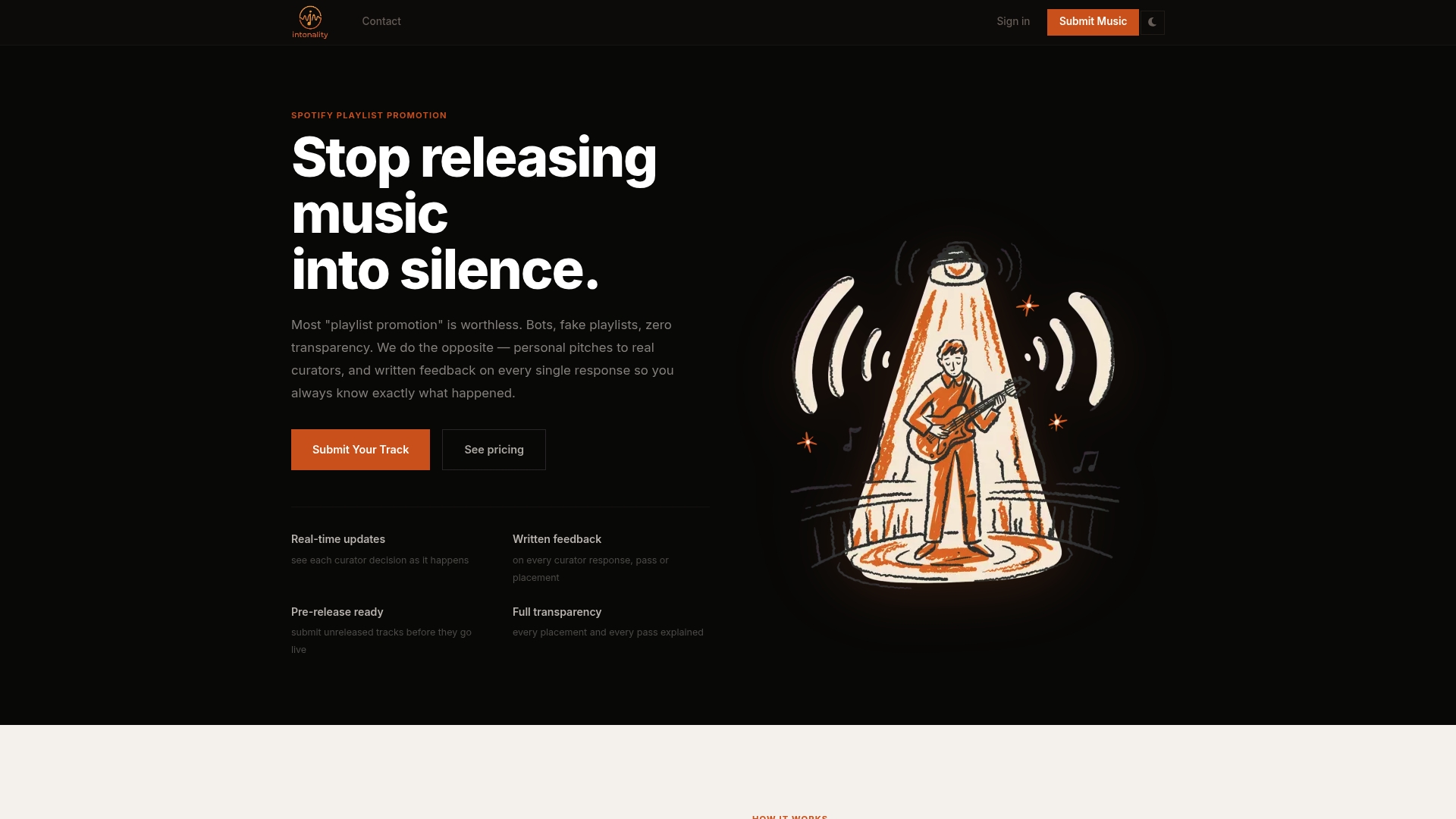
Artists across indie, folk, alt-pop, rock, and electronic genres have access to Intonality’s curator network, which includes playlists like Rock Revival and genre-specific editorial collections. Pre-release submissions are supported, so your track can land on playlists before it goes live on Spotify.
How to get started:
- Finish your master and confirm metadata (ISRC, UPC, genre tags, release date)
- Prepare a one-sentence artist bio and a high-resolution cover image
- Set your release date at least two weeks out to allow pre-release pitching
- Submit your track on Intonality and select the tier that matches your goals
- Track curator responses in real time through the dashboard and use the written feedback to refine future campaigns
Useful sources and further reading
- Intonality — Spotify Playlist Promotion: The platform’s main page, with service tiers, how the curator marketplace works, and campaign workflow details.
- Submit Your Track — Intonality: The submission landing page for artists ready to start a campaign.
- Ditto Promo — Playlisting, PR & Social Media: Useful overview of how playlist pitching, PR, and social media promotion fit together; includes notes on what playlist placement guarantees actually mean.
- Droplink — Meta Ads for Independent Artists: Explains how landing pages with Meta pixel tracking improve retargeting and cost-per-stream over time.
- Amuse — Best Music Distribution Services: Covers the major distribution options (DistroKid, CD Baby, TuneCore, Amuse) and clarifies the difference between distribution and promotion.
- Two Story Melody — Best Spotify Promotion Services: Third-party roundup with real-data framing; useful for cross-referencing vendor claims.
- Reddit r/WeAreTheMusicMakers — Is paid promotion effective?: Community discussion on ROI expectations and readiness conditions for paid promotion.
- Reddit r/Music — Best method to promote music?: Artist community debate on platform-specific discovery strategies, including TikTok and Instagram.
- Blackstar Agency: Multi-award-winning independent music marketing agency covering paid media, social management, and campaign management for artists at label and major-indie level.
- PromoTrack — AI Music Marketing Platform: Illustrates the automated end of the spectrum; useful for understanding how AI-driven ad platforms differ from curator-led pitching.
Pricing and guarantee terms change frequently across all services listed. Verify current packages directly on each provider’s site before purchasing.