

Pitch your song in Spotify for Artists at least 7 days before release. That is Spotify’s hard minimum, and it is also what gets your track onto your followers’ Release Radar. For better odds, aim for two weeks or more, and work backward from release day so your distributor delivery, your pitch and your outreach to independent curators all land in the right order.
This guide gives you a working timeline, explains what each deadline actually does, and covers the mistakes that cost artists their window.
TL;DR
- Spotify’s minimum is 7 days before release; a song can no longer be pitched once it is live.
- Spotify’s own release guide suggests pitching at least two weeks ahead, and distributors often advise 3 to 4 weeks for delivery and planning.
- Pitching 7+ days out puts your chosen song on followers’ Release Radar, but it never guarantees an editorial playlist.
- Spotify allows one pitch at a time, so choose the song that best represents the release.
- Independent curators work on their own schedule, so pitching them before release day lets you build early momentum while you wait on editors.
Table of Contents
- The short answer: 7 days is the floor, not the target
- Why you cannot pitch the day you finish the song
- A working timeline, from 4 weeks out to release day
- What the pitch does, and what it does not
- What to put in the pitch
- Our perspective on pitch timing
- Pitching independent curators alongside Spotify
- How Intonality fits into your release plan
- Common timing mistakes
- What to do while you wait
- FAQ
- Sources
The short answer: 7 days is the floor, not the target
Spotify’s support page says an unreleased song should be delivered and pitched at least 7 days before release so editors have time to listen. Once the song is live, it is no longer eligible for the pitch form.

That number is a cutoff for the system, not a recommendation for the best result. Spotify’s release guide recommends pitching at least two weeks before release to improve the chance of playlist consideration. And Spotify says its editors receive thousands of pitches per week, which is why pitching earlier is the advice it gives.
So you have three numbers to hold in your head:
| Lead time | What it gives you |
|---|---|
| 7 days | The minimum. Pitch accepted, Release Radar eligible. |
| 2 weeks | Spotify’s own recommendation for better playlist consideration. |
| 3 to 4 weeks | Comfortable room for distributor delivery, fixes and outreach. |
The 3 to 4 week figure comes from distribution planning rather than from Spotify. LabelGrid’s release-planning help page recommends submitting singles 3 to 4 weeks ahead ideally, while separately listing the 7-day mark for Spotify editorial pitching. Treat the two as different jobs: one is about getting your files delivered cleanly, the other about when Spotify’s editors can see your song.
Why you cannot pitch the day you finish the song
You do not upload a song to Spotify for Artists. You pitch a song that has already been delivered by your label or distributor. Spotify says unreleased music appears in the Upcoming tab after delivery, and it can take around 48 hours to show up after you submit it to your distributor.
That means your real deadline is earlier than the pitch deadline. If you want to pitch exactly 14 days out, you need the song delivered to your distributor well before that, with margin for rejected artwork, metadata errors or a slow review. Many artists lose their pitch window not because they forgot, but because the song was not in Upcoming yet.
Two more practical points:
- Claim your profile first. Spotify’s onboarding page advises claiming your artist profile and allowing at least 7 days before release to pitch a song and prepare the profile. Do this weeks ahead, not the night before.
- Check your release date and time zone. Spotify defines the Upcoming release date as the earliest date the release becomes available in any country. A globally simultaneous release at 12:00 AM UTC can display as the previous local date in western time zones, such as the US. Count your 7 days from the date Spotify shows, not the one on your calendar.
A working timeline, from 4 weeks out to release day
Here is a schedule that respects the official minimum and gives you slack. Shift it earlier if your release is important to you.

4 weeks before
Finish the master and artwork, pick your release date (Friday is the day new music is released and the day Release Radar refreshes), and send the song to your distributor. Claim or check your Spotify for Artists profile. Write down your genres, mood, instruments and the story of the song, because you will need them for the pitch.
3 weeks before
Confirm the song appears under Music > Upcoming in Spotify for Artists. If it does not, you still have time to fix delivery problems without panic. Draft your pitch and have someone else read it.
2 weeks before
Submit your pitch. This is Spotify’s recommended lead time, and it leaves room to edit the pitch later. Spotify says admins and editors on the account can edit a pitch up to release day, though it gives no guarantee that editors will see late changes. So treat the first version as final.
1 to 2 weeks before
Start outreach to independent playlist curators who match your genre. Most curators play released music, but some accept pre-release submissions, and the ones that do can place you from day one. This is also when you tell your existing audience the date.
Release day and the weeks after
Share the link, check your stats, and keep pitching independent curators as responses come in. Once the pitched song is live, Spotify lets you pitch another song, which matters if you are rolling out a run of singles.
What the pitch does, and what it does not
Pitching does two separate things, and artists often confuse them.
It makes your song visible to Spotify’s editors. They decide whether it fits an editorial playlist. Spotify is clear that submitting does not guarantee placement: editors may select another song, and an unselected track may still be discovered later.
It sets which song reaches your followers’ Release Radar. Release Radar updates every Friday. Spotify says pitching at least 7 days before release lets your chosen song be included in followers’ Release Radar. Without a pitch, Spotify chooses which song from the release to place. If you are releasing an EP or album, that difference matters: you want the song you picked, not the one Spotify guessed.
A Release Radar song can be included for up to 4 weeks if a listener has not heard it, but each listener receives only one song per artist per week. That is another reason to space singles instead of dropping them days apart.
One song at a time
Spotify allows only one pitch at a time. If you have an EP or album, choose the track that best represents the release. Spotify’s playlisting guide says you can pitch one song from an EP or album. If you plan several singles, we cover the sequencing in our piece on pitching multiple tracks one song at a time.
What to put in the pitch
Timing gets your pitch seen; content decides whether it works. Spotify’s playlisting guidance asks for your hometown or current location, up to three genres, the sound of the track, the story and meaning behind the song, and any collaborators. Its release guide adds that including details such as genre and mood helps suitable playlist matching.
The field is short. We work with a 500-character budget when drafting, so every phrase has to say something concrete about sound, mood or context. Lead with what the song sounds like, then why it exists. Skip adjectives like “amazing” and skip your life story. For wording you can adapt, see our 500-character pitch examples with editor annotations and our guide to writing a playlist pitch.
Our perspective on pitch timing
We spend our days on the other side of the pitch: sending songs to vetted, genre-matched curators and reading what they say back. Here is what that has taught us about timing.
The Spotify pitch is one door, not the whole building. Editorial pitching is free and worth doing every release, but thousands of pitches compete for a limited number of slots. Treating it as your entire plan means putting your release on a lottery ticket. The artists who build momentum are the ones who pitch editors on time and also get the song in front of real curators who run playlists in their exact genre.
Curators do not share Spotify’s calendar. Editors need the song before it is live. Independent curators are different: some will consider unreleased tracks, many prefer a song that is already out, and all of them respond on their own schedule. So we plan around two clocks. The editorial clock runs backward from release day. The curator clock runs forward from it, with a pre-release window for those who accept it.
Early responses are information. When curators decline, the written reason tells you whether the problem is genre fit, production or the pitch itself. If you only start outreach on release day, you learn this late. Starting a week or two earlier lets you adjust your genre tags and description before your Spotify pitch is final, as long as you are still inside the window.
Avoid anything that fakes the signal. Bought streams and bot-fed playlists do not build a real audience and can hurt the data Spotify uses to understand your music. We only work with manually screened curators, and every placement and decline is published, so you can see what happened to your song.
— Einars
Pitching independent curators alongside Spotify
Once your editorial pitch is in, the waiting period is the best time to work on playlists you can actually influence. A song that starts collecting real listens from genre-matched playlists gives you early proof that people want it, and that is the kind of engagement worth building around. We explain the mechanics in how curator pitching can trigger the Spotify algorithm and in our guide to submitting to Spotify playlists.
A few timing rules we follow:
- Send the editorial pitch first. It has the hardest deadline.
- Match genres before you submit anywhere. A pitch to the wrong playlist wastes a curator’s attention and your budget.
- Use one clean link. Make sure the link you share is the right track, and vet the playlist before you pitch. Our note on one clean playlist pitch link covers the process.
- Keep follow-ups short. If a curator has not answered, wait before nudging, and never send the same message twice.
How Intonality fits into your release plan
If you want curator outreach handled for you, Intonality sends personalized pitches to real, manually screened curators matched to your genre. You get real-time campaign updates, written feedback on every curator decision, and the option to submit before release. Campaigns come in four tiers, Starter, Standard, Pro and Max, and we state an average of 4 to 11 playlist placements per campaign depending on the tier. Our positioning is simple: no fake streams, no bots, and automatic refunds for inadequate reviews.
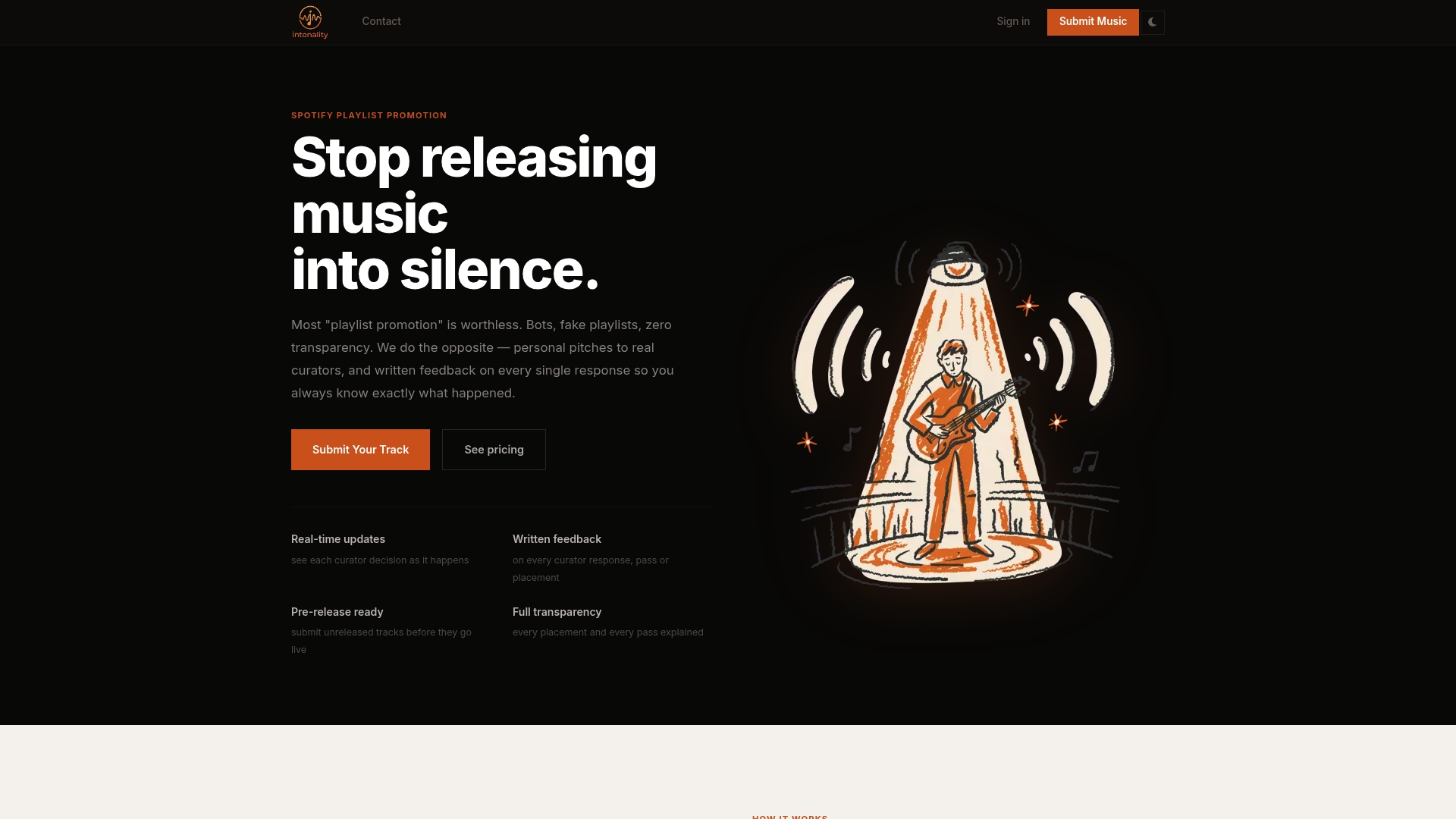
See the tiers on the Intonality homepage, or look at how public campaigns with real curator feedback look before you decide. If you are comparing us with other submission platforms, our SubmitHub alternative page explains the difference in approach.
Common timing mistakes
Pitching on exactly day 7. It is technically allowed, but a distributor delay or a time-zone confusion can push you out of the window. Give yourself a buffer.
Waiting for the song to be live. Once it is released, the pitch form is closed to that song. Editors can still discover music in other ways, but you lose the Release Radar control that a pitch gives you.
Pitching the wrong track. With one pitch at a time, a weak choice costs you. Pick the song that represents the release best, not the one you like most.
Making a late edit and counting on it. Edits are allowed until release day, but Spotify does not promise editors will see them. Finish your pitch before you submit it.
Expecting an answer. Spotify does not promise feedback on a pitch. After you submit, editors review it, and you can check the result under Music > Playlists once the song goes live, according to Spotify’s pitching page. Do not pause your promotion while you wait.
What to do while you wait
Spotify itself recommends building your fanbase and engaging with your audience on Spotify and beyond. Eligible artists can also pin a pitched song to a This Is playlist once it is available; Spotify says pinning takes around 3 days and lasts up to 28 days, per its pitching page.
Beyond that, use the pre-release window for work that compounds: tell your followers the date, set up your pre-save, line up curators, and prepare your release-day post. For the editorial side, our guide to the Spotify editorial pitch and the piece on editorial playlist categories show what editors tend to look for. If you want a closer look at how single-song outreach works, read about manual playlist pitching.
FAQ
How early should I pitch a song to Spotify?
The minimum is 7 days before release. Spotify’s release guide recommends at least two weeks to improve your chances of playlist consideration. Many distributors suggest 3 to 4 weeks for delivery planning, so work backward from that.
Can I pitch a song after it is released?
No. Spotify says a song is no longer eligible for the pitch once it is live. After it goes live, you can pitch a different upcoming song, since only one pitch is allowed at a time.
Does pitching guarantee a playlist?
No. Spotify states that submitting does not guarantee placement and that editors may choose another song. What it does give you is control over which song goes to followers’ Release Radar, as long as you pitch at least 7 days ahead.
Can I edit my pitch after submitting it?
Yes, admins and editors on the account can edit it up to release day. Spotify gives no guarantee that editors will see late changes, so get it right before you submit.
Why is my song not in the Upcoming tab?
Upcoming shows songs after your label or distributor has delivered them, and Spotify says this can take around 48 hours after submission to the distributor. If it still is not there, check the delivery status with your distributor and confirm you are logged into the right artist profile.
Sources
- Pitching music and videos to Spotify playlist editors, Spotify support
- Unreleased music in Spotify for Artists, Spotify support
- Getting music on Release Radar, Spotify support
- Playlisting, Spotify for Artists
- Get started, Spotify for Artists
- Preparing for Release Day and Beyond, Spotify for Artists
- Release-Date Planning, LabelGrid Help Center


