

Triggering the Spotify algorithm, in the sense that actually matters for your release, means getting personalized, pre-release pitches in front of real human curators and Spotify’s own editorial system before your song goes live. That’s it. There’s no secret setting, no trick playlist bot, no magic stream count that flips a switch. What moves the needle is a properly timed pitch through Spotify for Artists combined with genre-matched outreach to curators who actually listen.
The mechanics that make this work:
- Submit your pitch through Spotify for Artists at least 7 days before release to stay eligible for editorial consideration and Release Radar.
- Pair that official pitch with outreach to vetted, genre-matched curators who run independent playlists.
- Track curator responses and playlist placements directly in your Spotify for Artists dashboard.
- Expect trackable feedback and real placements, not guaranteed editorial slots. Services like Intonality build campaigns around genre-matched curator pitches with real-time updates and written feedback on every decision.
Key Takeaways
Triggering real playlist consideration comes down to timing your pitch correctly and putting your song in front of curators who genuinely match your genre.
| Point | Details |
|---|---|
| Meet the 7-day rule | Submit your Spotify for Artists pitch at least 7 days before release to stay eligible for Release Radar and editorial review. |
| Complete every metadata field | Accurate genre, mood, and culture tags directly affect whether editors see your submission at all. |
| Fewer, sharper curator pitches win | Ten personalized outreach messages outperform mass submissions to unrelated playlists. |
| Verify everything yourself | Confirm placements in Music > Playlists rather than trusting a promoter’s report alone. |
| Choose curator-based campaigns over marketplaces | Intonality averages 4 to 11 verified placements per campaign through genre-matched human curators with written feedback. |
Table of Contents
- What Triggers Spotify Playlist Placement, Exactly?
- Pre-Release Checklist: What To Do and When
- What Curated Pitch Campaigns Actually Deliver
- How To Vet a Curator-Pitch Service Before You Pay
- Verifying Placements and What Comes Next
- Why Intonality Bets on Real Curators, Not Shortcuts
- Ready To Get Your Track In Front of Real Curators?
- Sources
What Triggers Spotify Playlist Placement, Exactly?
Two separate systems decide whether your song gets seen: Spotify’s own editorial team and independent human curators who run their own playlists. Both respond to the same basic input, a well-timed, well-tagged pitch, but they work through different channels.
Spotify for Artists pitching is the official route. You log into your dashboard, pitch an unreleased track, fill out metadata, and Spotify’s editors decide whether to add it to a playlist like Fresh Finds or a genre-specific editorial list. Submitting at all also unlocks Release Radar eligibility for your existing followers.
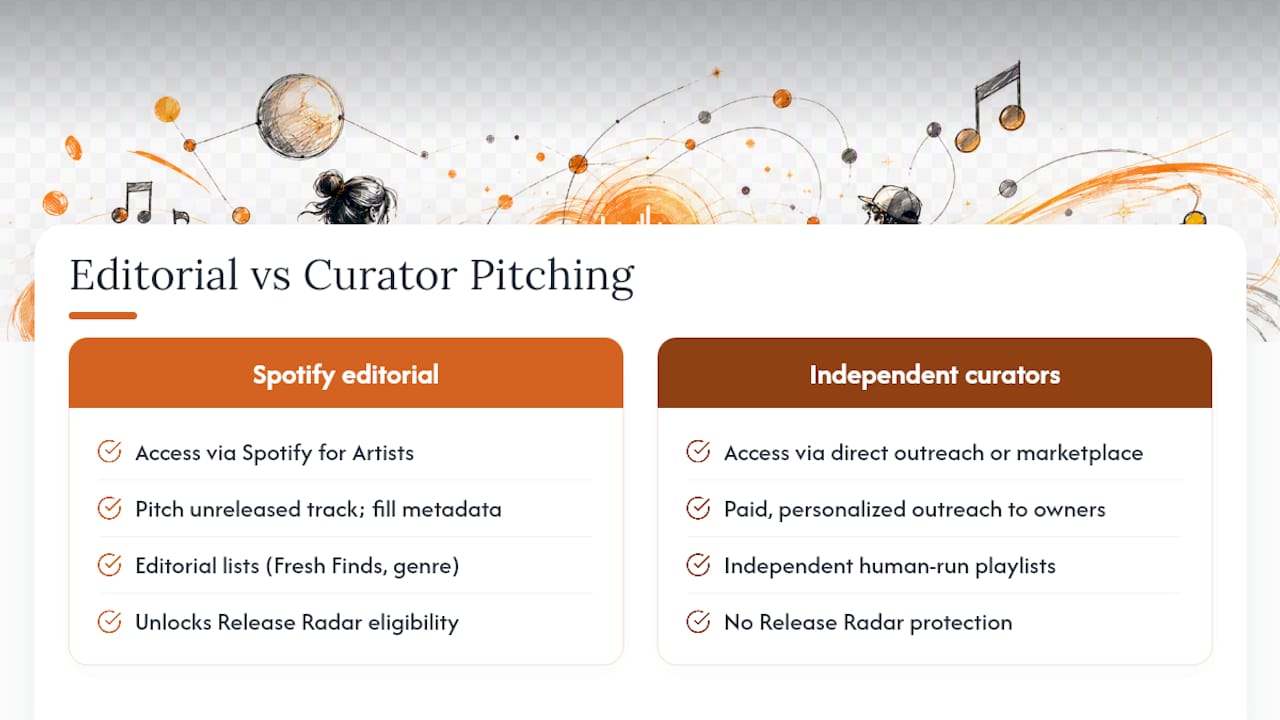
Independent curator outreach is the paid, personalized side. This means reaching individual playlist owners directly, or through a marketplace like Intonality, to get a human ear on your track outside Spotify’s internal editorial team.
The two aren’t competitors. A pre-release Spotify pitch protects your Release Radar spot while curator placements add real listener signals, saves, follows, repeat plays, that both human editors and Spotify’s systems notice over time.
Pro Tip: Submit your official Spotify for Artists pitch and start curator outreach in the same week. Keep your bio, genre tags, and pitch story identical across both so you’re not sending mixed signals about what your song actually is.
Pre-Release Checklist: What To Do and When
Most artists lose their shot at playlist consideration simply by moving too late. Curators and editors both need lead time to actually listen, not just receive your link.
- 28 days out: Lock your final master, get your ISRC code, and finalize high-resolution cover art. Nothing gets pitched with placeholder assets.
- 21 days out: Build a target list of 8 to 12 genre-matched curators. Skip generic “all genres welcome” playlists; they rarely convert to real listens.
- 14 days out: Start curator outreach. Send a private streaming link, a short bio, a press photo, and one sentence explaining why the song fits that specific playlist, not why it’s good in general.
- 7 days out (hard minimum): Submit your official pitch via Music > Upcoming in Spotify for Artists. Complete every field: genre, mood, culture tags, and story context. Incomplete metadata is the single easiest way to get skipped.
- 3 days out: Follow up once with curators who haven’t replied. One follow-up, not three.
- Release day: Track responses, confirm placements in your dashboard, and thank every curator who added the track.
Accurate metadata matters more than artists usually assume; for deeper insight, visit PTT Music’s overview of Spotify algorithm responses. Spotify’s own editorial pitching guidance confirms genre, mood, and culture tags directly shape which editors see your submission. Get those wrong and you’re pitching into the void.
Pro Tip: Send fewer, better pitches. Ten personalized messages that reference a curator’s actual recent playlist additions will outperform 200 copy-pasted submissions almost every time, a point echoed in curator outreach research.

One caveat worth flagging: you can edit your official Spotify pitch up until release day, but editors who already reviewed it may never see the update. Get it right the first time.
What Curated Pitch Campaigns Actually Deliver
A paid curator-pitch campaign, the kind Intonality runs, buys you outreach work and human consideration. It doesn’t buy you a guaranteed spot on any specific playlist.
Here’s what a legitimate campaign actually includes:
- Genre-matched outreach to a vetted network of independent curators, not a blast to every playlist in existence.
- Private streaming links delivered directly to curators before your release date.
- Written feedback from curators on every decision, yes and no alike.
- Real-time updates so you can watch responses roll in instead of waiting weeks for a report.
- A final tally of confirmed placements you can verify yourself.
Intonality reports an average of 4 to 11 playlist placements per campaign, depending on the tier, a range that reflects genre demand and curator availability rather than a fixed guarantee.
Spotify itself is explicit that pitching does not guarantee editorial placement; submitting on time simply gets your song in front of the right eyes and secures Release Radar eligibility for your current followers. The same logic applies to human curator campaigns. You’re paying for genre-matched exposure and a real listen, not a promised outcome.
Verification is simple: open Spotify for Artists, go to Music > Playlists, and confirm each placement yourself. Written feedback matters here too, a curator’s specific notes on why a song didn’t fit tells you more about your next release than a placement ever could.
How To Vet a Curator-Pitch Service Before You Pay
Before handing over money for any curated campaign, ask the seller these questions directly:
- Can you show me examples of curator profiles or playlists you’ve placed tracks on?
- Do curators provide written feedback, or just a yes/no?
- How exactly do you match curators to my genre?
- Can I verify past placements myself through Spotify for Artists?
Red flags show up fast once you know what to look for. Walk away from any service that guarantees a specific stream count, promises “guaranteed editorial placement” (Spotify controls that, no third party does), or can’t name a single curator you could research independently. Playlists with tens of thousands of followers but almost no listener activity are a classic sign of a fake or bot-inflated network.
Legitimate services accept scrutiny. They’ll let you verify placements through playlist links or your own Spotify for Artists data, and they’ll send a follow-up metrics report two to four weeks after the campaign ends. Independent curator guides consistently recommend targeting playlists in the 500 to 50,000 follower range, since curators at that size are still reachable and their followers tend to be genuine listeners rather than inflated numbers. It’s also worth checking how often a playlist actually updates. A curator who hasn’t refreshed a list in six months isn’t actively curating anything.
Verifying Placements and What Comes Next
Once outreach ends, the real work of proving impact starts. Open Spotify for Artists, click into Music > Playlists, and confirm each claimed placement is live and matches what your promoter reported.
From there, watch the metrics that actually indicate curator and editor interest going forward:
- Save rate, which curators and editors weigh more heavily than raw play counts when deciding whether to keep a song on a list, according to Wisseloord’s curator research.
- Profile follows generated directly from playlist listeners.
- Playlist follower growth over the two weeks following your placement.
- Completion rate, since skips early in a track tell curators something a play count never will.
- Listener geography, useful for planning where to focus future outreach or shows.
After a placement lands, thank the curator publicly, share the playlist on your socials, and ask your promoter for a short metrics update after two to four weeks. That follow-up habit, recommended by curator-relationship guides, is what turns a one-time placement into a curator who considers your next release without a fresh pitch from scratch.
Why Intonality Bets on Real Curators, Not Shortcuts
Fake playlists and inflated follower counts are cheap to fake and easy to sell. Intonality built its model around the opposite bet: that written feedback from a real curator, even a rejection, is worth more to an artist’s career than a placement nobody can verify.
That approach favors artists thinking past a single release. A curator who remembers your last track and liked it is worth more long-term than any one-off placement…
Ready To Get Your Track In Front of Real Curators?
Intonality replaces guesswork with genre-matched pitches sent directly to vetted human curators, not automated blasts or pay-per-listen marketplaces. Every campaign comes with real-time updates and written feedback on each curator decision, so you know exactly why a track landed or didn’t.
Campaigns average 4 to 11 confirmed playlist placements, with results trackable in your own Spotify for Artists dashboard. Depending on your tier, you get:
- Pre-release submission support timed to Spotify’s 7-day pitch window
- A live campaign dashboard with curator responses as they happen
- Written feedback from every curator, whether the answer is yes or no
- Genre-specific targeting, from folk and indie playlists to dark pop networks
To start, submit your track, choose the campaign tier that fits your release, and let the outreach reports come to you.
Sources
- Playlisting – Spotify for Artists
- Pitching music and videos to Spotify playlist editors - Spotify
- How to pitch your music to playlist curators - Wisseloord
- Independent Playlist Curators: How to Find and Pitch Them | Orphiq


