
The most effective Spotify marketing strategy for independent artists sequences Spotify-native tools (Discovery Mode, Marquee, Showcase) with targeted paid playlist placements to maximize engagement signals — saves, playlist adds, and listener retention — that drive algorithmic visibility.
Your immediate action steps:
- Submit an optimized pre-release pitch to Spotify editorial via Spotify for Artists
- Enable Discovery Mode on catalog tracks where eligible
- Book a short paid curator-pitch campaign with clear KPIs (saves, playlist adds, follow rate)
- Set a 30–90 day monitoring window before evaluating results
Table of Contents
- What is an engagement-first Spotify marketing strategy?
- How the three-stage fan funnel maps to Spotify tactics
- What paid playlist promotion actually delivers
- How do you evaluate a playlist promotion service before paying?
- How to prepare your track and pitch before submitting
- What KPIs should you track and how long does a campaign take?
- Red flags and mistakes that cost artists money
- How to budget for paid Spotify marketing campaigns
- What do successful Spotify campaigns actually look like?
- How organic marketing amplifies paid playlist promotion
- Key Takeaways
- Why sequencing and curator relationships are the real edge
- Intonality places your music with curators who actually listen
- Useful sources
What is an engagement-first Spotify marketing strategy?
Spotify’s recommendation engine runs on behavioral signals, not raw play counts. Spotify’s data-driven approach treats skip rates, save frequency, and listener retention as the real currency of promotion — what the platform calls “data-as-marketing.” When listeners save a track, add it to a playlist, or return to it within 30 days, Spotify reads those actions as quality signals and rewards the track with wider algorithmic distribution.
Reach-first tactics — social ads that drive clicks off-platform — often produce one-off streams with low completion rates. Those streams hurt more than they help. Marquee delivers an average of 10x more Spotify listeners per dollar than comparable social ads precisely because it reaches listeners already in-stream, primed to engage.
The practical implication: design every campaign to generate repeat listens and playlist adds, not just volume. A small cohort of highly engaged “super listeners” drives long-term catalog lift far more reliably than a spike of passive streams.
Pro Tip: Identify your super listeners in Spotify for Artists’ audience data and target them first with Showcase campaigns. Their engagement signals amplify algorithmic reach for your entire catalog.
How the three-stage fan funnel maps to Spotify tactics
Spotify for Artists frames marketing as a continuous cycle across three audience goals: Growth, Reactivation, and Engagement. Each stage calls for different tools.
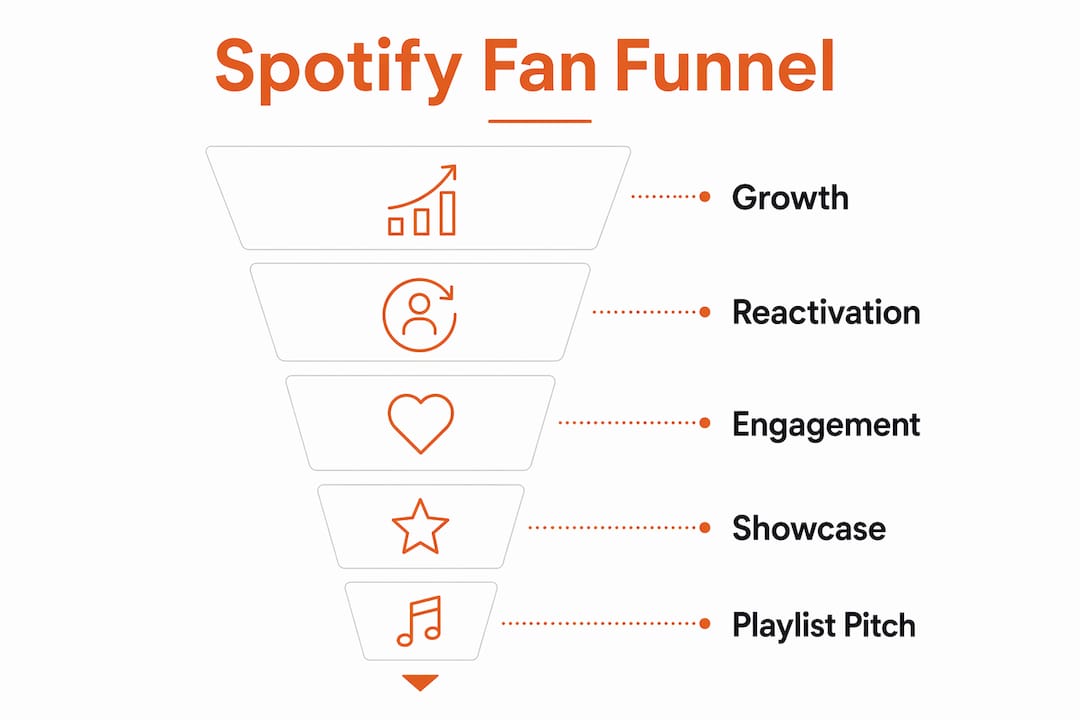
| Stage | Tactic | Target Audience | Expected Outcome | When to Run |
|---|---|---|---|---|
| Growth | Discovery Mode, editorial pitching, paid curator pitches | Light/new listeners | New listener adds, first saves | 3–6 weeks pre-release |
| Growth | Marquee | Active listeners at release | Streams, saves, playlist adds | Release week |
| Reactivation | Showcase, Marquee | Previously active listeners | Return streams, follow rate lift | 2–3 weeks post-release |
| Engagement | Canvas, pre-save campaigns, sustained curator pitching | Engaged fans, super listeners | Deeper catalog streams, merch clicks | Ongoing post-release |

The sequencing matters as much as the tools. Discovery Mode pre-release warms up light listeners; Marquee converts them at release; Showcase re-activates lapsed fans two to three weeks later. Paid curator pitches fit as a targeted booster at the Growth and Engagement stages, placing your track in front of genre-matched playlist audiences that Spotify’s own tools may not reach.
Pro Tip: Select Discovery Mode tracks by catalog performance data, not gut instinct. Tracks with the highest Discovery Mode intent rates tend to see nearly 40% higher display campaign intent rates during the same period.
What paid playlist promotion actually delivers
Paid playlist promotion through personalized curator pitches is not a shortcut to fake streams. A legitimate service pitches your track to real, genre-matched curators who decide independently whether to add it. You pay for the outreach and placement effort, not a guaranteed outcome.
Realistic outcomes from a well-run campaign include increased saves, playlist adds, and follow rate growth — the exact signals Spotify’s algorithm rewards. Intonality, for example, claims an average of 4–11 playlist placements per campaign depending on the service tier, with written feedback from every curator decision and real-time dashboard updates.
Pros of paid curator pitching:
- Genre-matched placement in front of listeners who already like your sound
- Written curator feedback that tells you how your track is perceived
- Transparent reporting on placements, saves, and streams
- Pre-release submission capability to build momentum before launch
Cons to weigh:
- No guaranteed charting or viral lift
- Cost varies significantly by tier and vendor quality
- Low-quality vendors place tracks on inactive or fake playlists
Statistic callout: Marquee + Showcase sequences produce a 40x lift in new active listeners versus Marquee alone. Paid curator pitching works best alongside these native tools, not as a standalone replacement.
Curator pitching makes the most sense for targeted catalog pushes, pre-release momentum building, and geography-specific targeting where Spotify’s own display campaigns have limited reach.
How do you evaluate a playlist promotion service before paying?
- Ask for curator opt-in proof. A legitimate service can show that curators voluntarily joined the network and actively accept or decline submissions.
- Request sample written feedback. Real curators leave specific comments about why they passed or placed a track. Generic “not a fit” responses are a red flag.
- Verify playlist activity. Check follower counts, listen to sample playlists, and confirm the curation quality matches your genre.
- Confirm reporting access. You should receive time-stamped data linking playlist adds and saves back to your campaign window — this isolates campaign signal from organic growth.
- Understand the pricing model. Per-placement pricing and campaign packages both exist; ask about refund or guarantee policies before committing.
- Check pre-release capability. Can you submit before your release date to build early momentum?
Intonality’s vetting process covers curator opt-in, genre-matching, written feedback on every decision, and a real-time dashboard — the trust signals that separate legitimate services from mass-blast operations.
Pro Tip: Prioritize vendors that provide written curator feedback and time-stamped reporting. Those two features alone tell you whether placements are real and whether the campaign signal is measurable.
How to prepare your track and pitch before submitting
A strong campaign starts before you hit submit. Curators and algorithms both respond to quality signals.
Track quality checklist:
- Master loudness appropriate for streaming (typically around -14 LUFS integrated)
- Clean 16-bit/44.1kHz export delivered through a licensed distributor
- Proper fades, no clipping, and EQ clarity across earbuds and speakers
Step-by-step pre-submission checklist:
- Confirm ISRC and UPC codes are registered and accurate.
- Complete all metadata: credits, genre tags, mood tags, and release date.
- Write a 2–3 sentence pitch blurb: hook (what makes the track distinctive), context (recording story or influences), and target (comparable artists, playlist types, or regions).
- Upload high-resolution cover art (minimum 3000×3000 px).
- Create a Spotify Canvas (short looping video, 3–8 seconds) to lift engagement on mobile.
- Submit to Spotify editorial via Spotify for Artists at least seven days before release.
- Submit to paid curator pitching service with your targeting notes (genre, mood, geography).
Timing matters. Editorial pitches require submission before release; curator pitching services like Intonality accept pre-release submissions, so you can coordinate both tracks simultaneously.
What KPIs should you track and how long does a campaign take?
| Phase | Duration | Key Actions |
|---|---|---|
| Pre-release prep | 3–6 weeks | Finalize assets, submit editorial pitch, book curator campaign |
| Pitching window | 2–4 weeks | Curator outreach active, pre-save campaign live |
| Campaign live | Release through week 6 | Monitor saves, playlist adds, streams per listener |
| Post-campaign analysis | 2 weeks | Evaluate KPIs, plan Showcase or follow-up campaign |
Primary KPIs to track:
- New listeners and monthly listener growth
- Saves and playlist adds (the highest-intent signals)
- Streams per listener (measures depth of engagement)
- Follow rate and 30/60/90-day return rate
- Conversion to super listeners
Secondary KPIs:
- Geographic spread of new listeners
- Playlist follower counts for placements received
- Curator feedback quality scores
- Downstream clicks (merch, tickets) if tracked
Statistic callout: Marquee + Showcase sequences average a 40x lift in new active listeners versus Marquee alone — 5x the effect of a single-tool campaign. Sequencing paid curator pitching into that window amplifies the effect by adding genre-specific playlist reach.
Discovery Mode alone averages +50% saves, +44% playlist adds, and +37% follows in the first month. Use those figures as baseline targets when setting KPI expectations for a combined campaign.
Red flags and mistakes that cost artists money
Red flags before you pay:
- Guaranteed viral charting or specific stream counts
- No curator names, bios, or opt-in documentation
- Placement on playlists with suspiciously round follower numbers and no listener activity
- No written curator feedback, only a placement count
- No dashboard or time-stamped reporting
Mistakes artists commonly make:
- Buying reach-only packages without checking genre fit
- Skipping pre-release prep and submitting an unmastered track
- Failing to define KPIs before the campaign starts
- Treating paid promotion as a one-time fix rather than a sequenced tactic
If you suspect fraud:
- Pause all future spend with that vendor immediately.
- Request detailed, time-stamped placement reports.
- Cross-reference playlist URLs against Spotify’s actual listener activity.
- Demand a refund per the vendor’s stated policy and escalate in writing if refused.
How to budget for paid Spotify marketing campaigns
Budget planning for independent artists should start with the Spotify-native tools, which carry lower entry costs. Discovery Mode operates on a royalty-share model with no upfront fee. Marquee and Showcase campaigns require a minimum spend (check current Spotify for Artists eligibility requirements, as minimums change). These tools should form the base layer of any campaign budget.
Paid curator pitching sits on top of that base. Entry-level campaign packages from vetted services typically run from around $50 to several hundred dollars depending on the number of curators contacted and the tier of service. Higher tiers generally mean more curator contacts, more placements, and more detailed reporting. Budget for at least one full release cycle (pre-release through six weeks post-release) before evaluating ROI.
A practical split for an independent artist with a modest budget: allocate roughly half to Spotify-native display campaigns (Marquee at release, Showcase two to three weeks later) and the remainder to a targeted curator-pitch campaign timed to the pre-release and release windows. That sequencing maximizes the engagement signals each tool generates.
What do successful Spotify campaigns actually look like?
The NERIAH case study from Spotify’s Campaign Kit documentation illustrates the sequencing model clearly. Before her debut album Cause of Death, her team selected an average of 20 songs per month for Discovery Mode in the three months before launch, reaching nearly half a million new listeners — roughly 25% of her total listeners during that period. At release, they ran Marquee to convert active listeners, then followed with Showcase for the deluxe version. The result: fans who streamed nearly four times more than her other listeners.
Jay Wheeler’s team at EMPIRE used a similar approach for two Latin albums, combining Marquee with playlist pitching to land the track “TRAPPii” on Spotify’s Trap Land playlist. That single editorial placement generated nearly 100,000 streams, and nearly one in four Marquee listeners went on to save or playlist a song. The lesson: editorial pitching and paid curator outreach work as multipliers when the genre targeting is precise.
Both cases confirm the same principle. Volume without fit produces passive streams. Fit plus sequencing produces saves, playlist adds, and fans who come back.
How organic marketing amplifies paid playlist promotion
Paid playlist promotion generates placement and initial streams. Organic marketing converts those streams into lasting fans. The two work best when they run in parallel.
Social media integration: Post short-form content (Reels, TikToks, YouTube Shorts) timed to your release week and curator campaign window. Use Spotify’s Canvas as the visual anchor — it loops natively in the app and increases mobile engagement. Share playlist placement announcements as social proof; listeners who see a track featured on a curated playlist treat it as a credibility signal.
Email marketing: Build a pre-save campaign through your mailing list before release. Direct fans to your Spotify profile link, not just a streaming aggregator page. After the campaign, send a follow-up with playlist placement results and a direct link to the track. Fan engagement platforms built for independent artists can help automate this sequence without requiring a label’s infrastructure.
Community building: Active participation in online music communities drives organic playlist adds from listeners who discover you through peer recommendation rather than algorithmic push. Those adds carry the same engagement weight as curator-placed adds in Spotify’s system.
The integration point is timing. Run social content and email outreach during the same two-to-four week window as your curator campaign. The combined signal — playlist adds from curators, saves from social traffic, and return streams from email subscribers — tells Spotify’s algorithm that multiple independent listener cohorts value the track.
Key Takeaways
A sequenced Spotify marketing strategy that combines Discovery Mode, Marquee, Showcase, and genre-matched paid curator pitching consistently outperforms any single-tool approach for independent artists.
| Point | Details |
|---|---|
| Prioritize engagement signals | Track saves, playlist adds, and return rate — not raw streams — as your primary success metrics. |
| Sequence native tools first | Run Discovery Mode pre-release, Marquee at launch, and Showcase two to three weeks later for maximum lift. |
| Vet every curator service | Require written curator feedback, time-stamped reporting, and verifiable playlist activity before paying. |
| Prepare before you pitch | Finalize mastering, metadata, Canvas, and your pitch blurb before submitting to any curator service. |
| Intonality for curator pitching | Intonality’s genre-matched, vetted curator pitching with real-time dashboard updates fits the paid-promotion slot in this sequenced strategy. |
Why sequencing and curator relationships are the real edge
Most artists treat paid playlist promotion as a lottery ticket: buy placements, hope for a viral moment, move on. That framing misses what actually compounds over time.
The NERIAH and Jay Wheeler cases are instructive not because of the raw numbers but because of the structure behind them. Both teams sequenced tools by audience segment — light listeners first, active listeners at release, previously active listeners after. They used playlist pitching to give Spotify editors context about the music’s sound and influences, which is how “TRAPPii” landed on Trap Land. That placement wasn’t luck; it was a well-written pitch matched to the right editorial context.
Curator relationships work the same way. A personalized pitch that explains a track’s mood, comparable artists, and target listener gives a curator something to work with. A mass-blast submission gives them nothing. The difference shows up in placement quality, not just placement count. Written feedback from a real curator — even a pass — tells you something about how your music lands with a specific audience. That information has value beyond the campaign itself.
The artists who build lasting Spotify presence treat every campaign as data collection, not just distribution. They track which playlist types generate saves versus passive streams, which geographic markets respond to which sounds, and which curator relationships are worth nurturing. That discipline, more than any single tool or budget level, is what separates artists with growing catalogs from those chasing one-off spikes.
Intonality places your music with curators who actually listen
If the sequencing strategy above describes where you want to go, Intonality handles the curator-pitch layer with the specificity that mass-blast services skip. Every campaign starts with genre-matching: your track goes to curators who already program music that sounds like yours, whether that’s dark pop, indie, metal, or another genre. Curators are vetted, opt-in, and real.
Every curator decision comes with written feedback, so you learn how your track is perceived, not just whether it placed. The real-time dashboard shows placements, saves, and streams as they happen. Campaigns average 4–11 placements depending on the tier, and pre-release submission is available so your curator campaign runs in parallel with your Spotify editorial pitch.
Submit your track at Intonality and put your next release in front of curators who are already looking for music like yours.
Useful sources
- How to meet your music goals with Campaign Kit — Spotify for Artists
- New study: Marquee delivers 10x more listeners per dollar than social ads — Spotify for Artists
- Campaign Kit: Seven success stories — Spotify for Artists
- Promoting music on Spotify — Spotify Support
- Spotify case study: data-as-marketing — NōGood
- Campaign Kit tools overview — Spotify for Artists
- Spotify Playlist Promotion — Intonality