

The right first move is simple: pitch one unreleased song through Spotify for Artists at least seven days before release, then spend the rest of your time on vetted curator outreach instead of chasing guaranteed placements. Fill the 500-character pitch note with real context about the track, not marketing copy. Save your paid or free energy for curators who actually fit your sound.
TL;DR:
- Pitch your song at least seven days before release to qualify for Release Radar and editorial consideration, but remember it does not guarantee placement.
- Use detailed metadata fields and a well-crafted 350-500 character note to give editors clear context about your track and its story.
- Focus your outreach efforts on genuine, active curators with a track record, avoiding services promising guaranteed streams or placements.
- Building pre-release buzz through social teasing and coordinating release timing improves your chances of earning real playlist placements.
- Track listener behavior after release, especially saves and follower growth, to measure the true value of playlist placements and avoid inorganic activity.
Table of Contents
- How to submit via Spotify for Artists (step-by-step)
- What to include in your pitch: metadata, story, and the 500-character note
- Timing and playlist types: editorial vs algorithmic vs user-curated
- Independent curator outreach: how to find and vet real playlists
- Pitch templates and outreach cadence you can copy
- After release: what to track and how to judge a placement’s value
- What pitching can and can’t promise: policy, fraud signals, and decision checklist
- Legal and copyright considerations when submitting music for playlist inclusion
- Common mistakes to avoid in indie playlist pitching
- Alternative playlist pitching platforms beyond Spotify
- Pre-release marketing strategies that improve pitch success
- Crafting an artist brand narrative that fits what curators look for
- Understanding what curators actually want from a pitch
- What I’d do with a new single starting today
- A managed, transparent option if you would rather not do outreach alone
- FAQ
- Sources
How to submit via Spotify for Artists (step-by-step)
The editorial pitch tool lives inside your Spotify for Artists dashboard, under Music, then Upcoming. You need a claimed artist profile and at least one unreleased track scheduled with your distributor before the tool will let you submit anything.
Pick your single best song to pitch, not necessarily your favorite one. Editors review thousands of submissions, so the track that most clearly represents your sound in the first fifteen seconds has the better shot. You get to pitch only one unreleased song per release, so choose carefully.
- Go to Music > Upcoming and select the release you want to pitch.
- Choose the one track from that release you want editors to hear.
- Fill in genre, mood, instrumentation, and the written pitch fields.
- Submit at least seven days before the release date.
- Edit details as needed before release; changes after that window are limited.
Spotify explains that pitching early enough makes your song eligible for Release Radar distribution to your existing followers, and that editors worldwide review pitched songs using the context you provide. The seven-day minimum does not guarantee an editorial placement. It guarantees your shot at that baseline distribution, which is worth claiming every time you release something new.
What to include in your pitch: metadata, story, and the 500-character note
Spotify’s submission tool asks for more than a genre tag. According to the Spotify for Artists blog, the form collects genre, up to three subgenres, music cultures, mood, song style, instruments, and flags for whether the track is a cover, remix, or a particular recording type. Each field gives an editor another reason to place your song in the right context.
- Pick subgenres that describe the song, not your whole catalog.
- Name the instruments and recording setup if they are distinctive.
- Note your location or scene if it is relevant to the sound.
- Mention collaborators, producers, or notable credits by name.
- Describe promo plans briefly: a video, a tour date, a press feature.
The written note is capped at 500 characters, and independent coverage of editorial curation suggests editors respond better to specific, contextual pitches than to generic marketing language. Aim for 350 to 500 characters: enough to say who made the song, what it is about, and why it matters right now, without padding.
Pro Tip: Write the pitch like you are briefing a colleague who has never heard your music, not like you are writing ad copy.
Timing and playlist types: editorial vs algorithmic vs user-curated
Spotify runs three separate systems, and pitching only touches one of them directly.
- Editorial playlists are hand-built by Spotify’s staff. Your pitch enters a review pool, and one unreleased track submitted seven or more days ahead gets considered for these.
- Algotorial and algorithmic playlists, like Discover Weekly and Daily Mix, respond to listener behavior: saves, skips, repeat plays, and who already follows you. Pitching does not feed these directly.
- User-curated playlists are built by independent curators and fans, and they are reached through outreach, not the official pitch tool.
Pitching guarantees Release Radar eligibility for your current followers and a shot at an Is playlist pin if you already have traction, but it never guarantees an editor’s pick. Once a song is out, algorithmic placement depends on how real listeners behave, which is exactly why save rate and completion rate matter more over time than the pitch itself. Split your effort: use the official pitch for baseline reach, and put sustained energy into curator outreach and pre-release marketing to drive the behavior signals that algorithmic playlists reward.
Independent curator outreach: how to find and vet real playlists
Spotify’s editorial pitch reaches one system. Independent, user-curated playlists are a separate universe, and NotNoise notes that curator outreach is a distinct path focused on fit rather than volume.
Start by finding curators who are real people with a track record, not anonymous accounts promising reach.
- Search playlists in your genre and open the curator’s profile for a bio, website, or social link.
- Check whether the curator posts updates, responds to comments, or has any public footprint beyond the playlist itself.
- Look at the playlist’s follower count against its average plays per track; a huge gap suggests inflated followers.
- Confirm recent activity. A playlist last updated eight months ago is not actively curated.
- Verify genre consistency across the last 20 to 30 tracks before you pitch.
Once you have a shortlist, work it like a small sales process: research each curator’s taste, personalize a short message, include a clean streaming link, and send exactly one polite follow-up if you hear nothing back. Keep a simple log of who you contacted and when.
The same source warns that services or curators promising guaranteed placements or guaranteed streams are high risk and can run against Spotify’s own rules against inorganic engagement. Anonymous curator networks, implausible follower counts, and fixed-stream guarantees are the clearest red flags. A clean pitch link and a short, specific message, like the workflow we outline for pitch links, beats a scattershot blast to a hundred strangers every time.
Pro Tip: A curator who writes back with specific feedback, even a decline, is worth more long term than one who never responds at all.
Pitch templates and outreach cadence you can copy
Having a template removes the guesswork from both the Spotify pitch note and curator outreach messages.
- Spotify pitch note (350 to 500 characters): Who you are, what the song is about, one notable collaborator or credit, your location or scene, and any promo plan tied to the release.
- One-line artist bio: A single sentence combining genre, location, and one distinguishing detail, reusable across pitches and outreach.
- Curator outreach message: A short subject line, one sentence on why the song fits their specific playlist, the streaming link, and a direct, low-pressure ask.
- Follow-up: One message, five to seven days later, restating the link and adding a single new detail, like a release date or a recent milestone.
- Track every send with at minimum: date contacted, curator or playlist name, platform used, response received, and outcome.
- Keep the outreach message under 100 words; curators skim.
- Never copy-paste the exact same message to every curator; swap the fit sentence each time.
This structure mirrors the pitch-length patterns in our own research on curator-tested pitch lengths, which found the 350 to 500 character range practical for both the Spotify field and outreach messages.
After release: what to track and how to judge a placement’s value
A placement only matters if it changes listener behavior. Track four things after release:
- Save rate, the share of listeners who save the track after hearing it.
- Completion rate, how often listeners finish the song rather than skip early.
- Follower growth, specifically any lift right after a placement goes live.
- Listener geography, to confirm a playlist’s audience matches your actual fan base.
A playlist placement that produces a low save-to-stream ratio or unusually concentrated listening in one unfamiliar region is a signal worth investigating, according to Soundiiz’s breakdown of fake-stream detection, since those patterns are also what platforms use to flag inorganic activity.
Raw play counts tell you almost nothing on their own. A placement that generates plays but no saves and no follower growth is not building an audience. Route playlist traffic into something you own: a smart link with UTM tracking can capture that traffic and funnel it toward a follow, a mailing list signup, or a social follow, turning a one-time listen into a relationship. Log every curator’s response, whether accepted or declined, so your next pitch gets sharper.
What pitching can and can’t promise: policy, fraud signals, and decision checklist
The editorial pitch is free, and it is also not a guarantee. Spotify for Artists is clear that pitching early makes you eligible for Release Radar and editorial consideration, nothing more. Release Radar visibility to your existing followers is the one outcome you can count on every time you pitch on time.
Fraud detection works against inflated promises. Soundiiz reports that platforms flag low save-to-stream ratios, poor completion rates, and geographic anomalies as signs of inorganic streaming, and that these patterns can lead to demonetization or content removal.
Before paying for any playlist service, check for these red flags:
- Promised placements or a guaranteed stream count.
- An opaque curator network with no named playlists or curators.
- A playlist theme that does not actually match your genre.
- No written feedback or reporting on what happened to your submission.
Legal and copyright considerations when submitting music for playlist inclusion
Before you pitch anywhere, confirm you actually hold the rights to the recording and the composition, or that you have clear, written permission from whoever does. A pitch is a representation that the music is yours to distribute, and that applies to samples, co-writes, and any session musician contributions baked into the final mix.

If your track contains an uncleared sample or interpolation, pitching it to curators does not make the underlying rights issue disappear. Spotify and curators both assume the person submitting has sorted out ownership, and a rights dispute after placement can mean a takedown, a stream freeze, or a payout clawback, none of which help a release that was just starting to build momentum.
Split sheets matter more than most new artists expect. If you co-wrote a song or brought in a producer who contributed melodic or lyrical ideas, document the percentage split in writing before release, not after a playlist placement makes the song financially relevant. Verbal agreements among friends are the most common source of later disputes.
Cover songs need mechanical licensing in most markets before you distribute them commercially, separate from any performance rights your streaming service handles on your behalf. Check your distributor’s own policy on covers, since many will not deliver a cover to stores without proof of a license.
None of this is a substitute for legal advice specific to your situation and your country’s copyright law, since rules on sampling, mechanical licensing, and co-writer rights vary by jurisdiction. When a release involves real money or real collaborators, a short consultation with a music attorney before release is cheaper than a dispute after a playlist has already driven your biggest streaming week.
Common mistakes to avoid in indie playlist pitching
The most common mistake is pitching too late. Submitting three days before release, or after release, forfeits editorial eligibility entirely since the window closes once the track goes live.
The second is writing a generic pitch. A note that just restates the genre tag and says “please add to your playlist” gives an editor or curator nothing to work with. Specific details about collaborators, location, recording choices, or the story behind the song are what separate a forgettable pitch from a memorable one.
Pitching the wrong track is another frequent error. Artists sometimes submit a deep cut instead of the song that best represents their current sound, which wastes the one pitch slot a release gets.
Blasting the same message to a hundred mismatched playlists is a mistake that looks like effort but produces little. A curator running a folk playlist does not want a pop single, no matter how well-written the pitch is, and sending it anyway damages your credibility for future pitches to that same curator.
Ignoring metadata fields is a quieter version of the same problem. Leaving subgenre, mood, or instrument fields blank removes information editors use to sort submissions, and it signals a rushed, low-effort pitch.
Finally, chasing guaranteed placements from paid services is the costliest mistake, since it risks both wasted money and policy violations tied to inorganic engagement. A placement that was bought rather than earned rarely brings real listeners, and the streaming patterns it creates can draw exactly the kind of fraud scrutiny described in Spotify’s enforcement of inorganic activity.
Alternative playlist pitching platforms beyond Spotify
Spotify is not the only platform with an editorial team worth reaching. Apple Music for Artists includes its own pitching tools for upcoming releases, letting artists flag tracks for Apple’s editorial consideration alongside access to listener analytics. The submission logic is similar in spirit to Spotify’s: give editors context, submit ahead of release, and treat it as one channel among several rather than the only one.
Deezer runs its own editorial playlist system and accepts submissions through its artist dashboard, with a particular focus on regional and genre-specific playlists that can be a better fit for artists outside English-language markets.
Amazon Music for Artists offers playlist and editorial submission tools as well, tied into Amazon’s own recommendation and playlist ecosystem, which reaches a different listener base than Spotify or Apple.
None of these platforms replace the work of independent curator outreach, since their editorial teams, like Spotify’s, review a large volume of submissions and cannot place every pitch. Treat each platform’s official pitch tool as a free, low-effort step worth doing every release, and reserve the bulk of your outreach time for genre-matched independent curators who will actually listen to the full song before deciding.
Pre-release marketing strategies that improve pitch success
A pitch lands better when it is not the first time anyone has heard of the song. Building a small amount of buzz before release gives both Spotify’s editors and independent curators more context, and it gives your own audience a reason to stream and save the track the moment it is live, which is exactly the early behavior signal that algorithmic playlists respond to.
Start teasing two to three weeks ahead with short clips on social platforms, focusing on the song’s hook or most distinctive moment rather than a generic announcement. A single compelling 15-second clip shared consistently outperforms a flood of unfocused posts.
Line up a release-day plan before you pitch, not after. If you have a video, a tour date, or a press mention, include it in the pitch note itself, since editors and curators read pre-release momentum as a signal that a song is worth their attention.
Coordinate your release timeline with your distributor early, since pitching deadlines, cover art, and metadata all need to be locked well ahead of the seven-day pitch window. A practical release-timeline breakdown for independent artists can help you map out what needs to happen and when, so the pitch is not the only thing rushed at the last minute.

Save-worthy songs get saved regardless of hype, but hype gets more people to listen in the first place, and that first listen is the only chance a song has to prove itself to the algorithm.
Crafting an artist brand narrative that fits what curators look for
Curators are not just evaluating a song in isolation. They are deciding whether an artist fits the identity of their playlist, and a clear, consistent narrative makes that decision easier.
Your narrative does not need to be elaborate. It needs to be specific and repeatable: where you are from, what you sound like, and one detail that makes you memorable, whether that is an unusual instrument, a scene you are part of, or a story behind your sound. Substream Magazine’s coverage of editorial curation points to exactly this kind of cultural and locational context as something editors actively look for when placing songs.
Consistency across your pitch note, your social bio, and your artist profile matters more than polish. A curator who checks your Instagram after reading your pitch should see the same story, not a contradictory one.
Avoid overclaiming. A narrative that promises more than the music delivers, like describing a modest home recording as a major production, erodes trust the moment a curator plays the track. The goal is alignment: a curator should finish listening and feel the song matched what the bio promised.
Understanding what curators actually want from a pitch
Most independent curators are not running playlists as a business. They are building a listening experience for a specific audience, often one they are personally part of, and their main motivation is keeping that audience engaged, not discovering the next big name.
That means fit matters more than fame. A curator running a 40,000-follower indie folk playlist is looking for songs that sound like they belong next to the tracks already on it, not for an artist with the biggest numbers. Pitching a song that does not match the playlist’s established sound, even with a polished bio, wastes both your time and theirs.
Curators also value being treated as people rather than targets. A message that shows you listened to their actual playlist, not just the genre tag on it, reads differently than a generic blast. Referencing a specific track already on the list, and explaining briefly why your song sits next to it, signals real research.
Finally, curators who respond with written feedback, even a decline, are often doing so because they care about maintaining relationships with artists, which is worth recognizing and not spamming in return.
What I’d do with a new single starting today
I would pitch through Spotify for Artists on time, then send personalized outreach to 8 to 12 genre-matched curators, tracking saves and follower growth from each. The one habit I would not skip: routing every playlist listener through a smart link into an email list before the attention fades.
— Einars
A managed, transparent option if you would rather not do outreach alone
Finding, vetting, and messaging a dozen real curators takes real hours every release, and most independent artists are already short on time between recording, mixing, and everything else a release demands. If you would rather hand that part off, we build genre-matched pitches and send them to real, vetted curators on your behalf, the same curators you would otherwise be researching one by one.
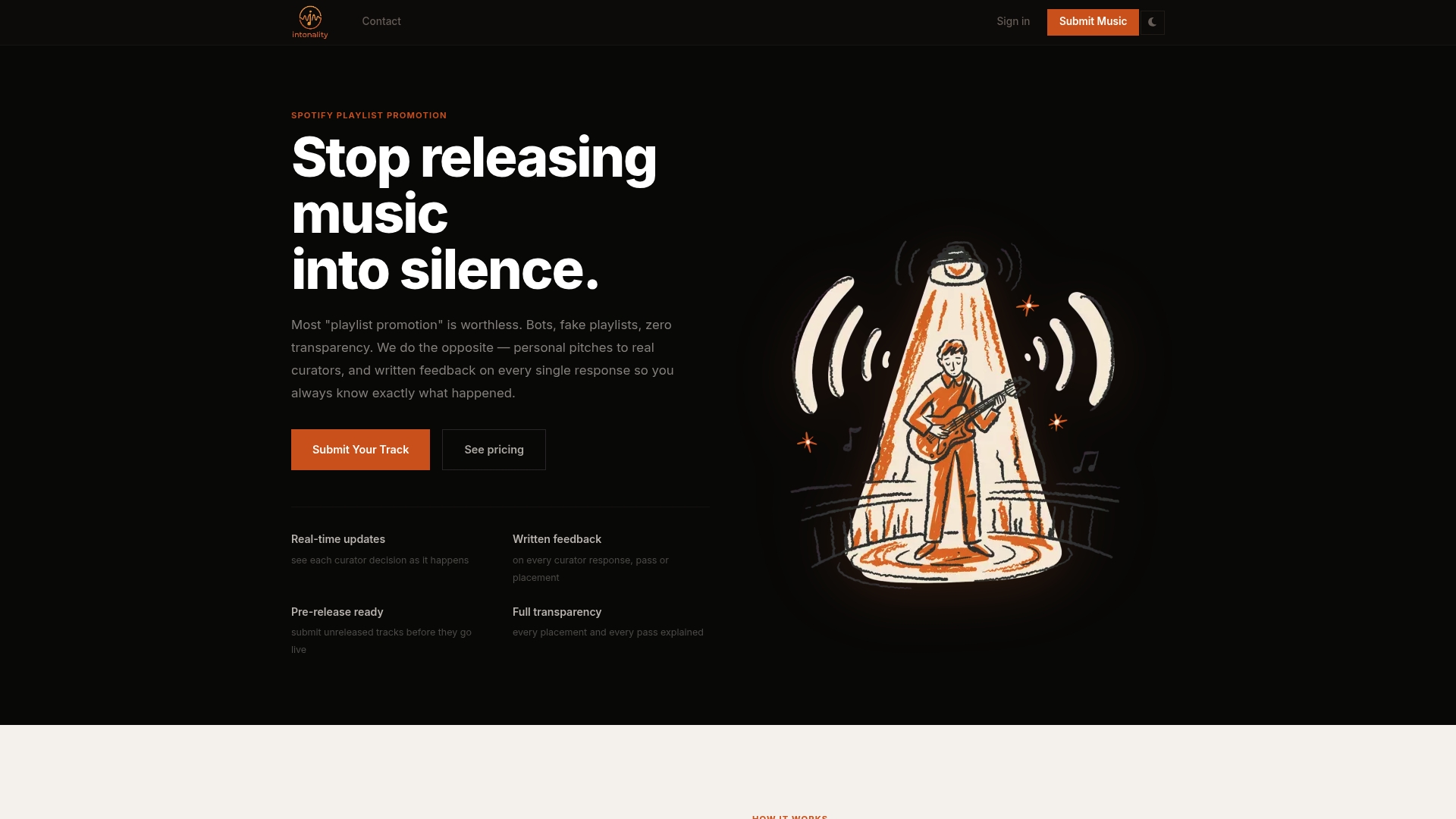
We provide updates and feedback from each curator decision, so you can see who reviewed your track and their response, not just a summary after the fact. That transparency is also what separates a genre-matched placement strategy from a service that just promises numbers and delivers silence.
We offer four campaign tiers, Starter, Standard, Pro, and Max, each scaled for different release goals, with pricing available on our campaign packages page. If you want to see what real outreach looks like before committing, our public campaigns with curator feedback are worth a look.
FAQ
How long before release should I pitch to Spotify?
Pitch at least seven days before your release date through Spotify for Artists, since that is the minimum window for editorial review and Release Radar eligibility. Submitting later than that forfeits your chance at editorial consideration for that release.
Can I pitch more than one song per release?
No, Spotify’s editorial pitch tool allows only one unreleased track per release, according to DIY Musician’s walkthrough of the pitching process. Choose the track that best represents your current sound rather than a deeper cut.
What should I write in the 500-character pitch note?
Keep it specific: who made the song, what it is about, any notable collaborators, your location or scene, and your promo plans, ideally within 350 to 500 characters. Spotify’s own guidance on the submission feature notes that filling in detailed metadata fields gives editors more context to work with.
Is it safe to pay for guaranteed playlist placements?
Services promising guaranteed placements or guaranteed stream counts carry real risk, since independent analysis flags that kind of guarantee as a sign of low-quality or policy-violating networks. Favor services built on genre-matched outreach to real curators with transparent, written feedback instead.
How do I know if a curator or playlist is legitimate?
Check for an active posting history, a consistent genre across recent tracks, and a follower count that roughly matches typical play counts, since a large gap between the two is a common red flag. A curator with a public bio or social presence who responds to messages is generally more trustworthy than an anonymous account promising reach.
Sources
For the official rules and deeper reading behind this guide, start here:
- Playlisting — Spotify for Artists
- NotNoise — What ‘Spotify Playlist Submission’ Actually Means in 2026
- Soundiiz — How platforms detect fake streams (2026)


