
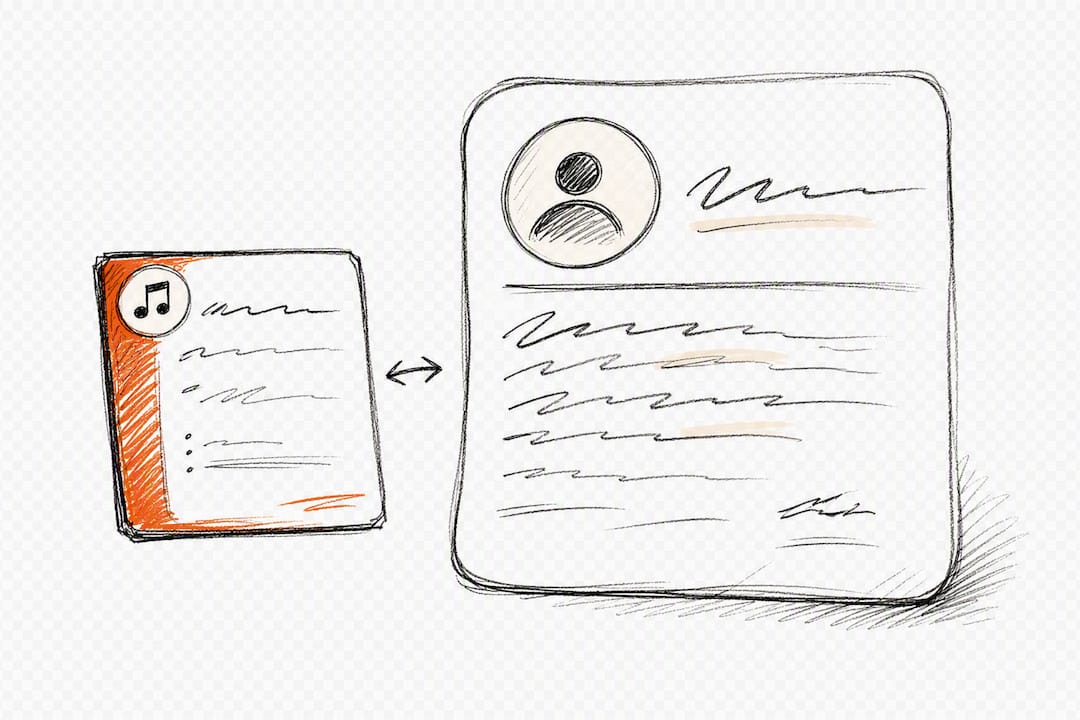
Your Spotify pitch needs one sentence: song, genre and mood descriptors, why it fits a named playlist, submitted through Spotify for Artists at least 7 days before release, in within Spotify’s strict character limit. Your career story stays on your profile, not in the pitch field. Example: “Indie folk with brushed drums and warm tape hiss, in the vein of Bon Iver’s quieter cuts. Would fit Fresh Finds Folk alongside tracks by Novo Amor.”
TL;DR:
- Avoid vague descriptors and focus on specific genre, instrumentation, and production hooks to catch curator attention within Spotify’s character limit.
- Personalize the playlist fit sentence by naming the actual playlist and referencing similar tracks or artists already featured on it.
- Keep your artist profile complete with current photo, bio, and recent activity, but do not include your career story in the pitch itself.
- Submit your pitch at least 7 days before release and build your metadata, artwork, and profile to streamline acceptance chances.
- When reaching out outside Spotify, reference specific tracks and playlist details to demonstrate genuine familiarity and avoid generic mass messaging.
Table of Contents
- Quick Pre-Pitch Checklist Before You Submit an Artist Bio for Playlist Pitch
- Bio Vs. Pitch: What Belongs Where?
- How Do You Fill Out Each Pitch Field Correctly?
- Copy-Paste Bio and Pitch Templates You Can Adapt Today
- Common Pitch Mistakes That Get an Artist Bio for Playlist Pitch Ignored
- Timing Rules and a Simple Follow-Up Plan
- Personalizing Curator Outreach Beyond the Spotify Pitch
- An Artist’s Take on Learning to Pitch and Fixing What Doesn’t Work
- A Managed Alternative for Artists Who’d Rather Skip the Trial and Error
- Where to Read More on Playlist Pitching
- Sources
Quick Pre-Pitch Checklist Before You Submit an Artist Bio for Playlist Pitch
Curators reject pitches for boring reasons before they ever judge the song. Most of those reasons are fixable in an afternoon.
Run through this before you touch the pitch field:
- Claim and verify your Spotify for Artists profile, and confirm you’re logged in as the right account.
- Add a profile photo and a short bio. A blank or outdated profile reads as a risk signal to a curator scanning for activity.
- Lock your release date and fill out metadata precisely: genre, mood, BPM, and language, since detailed metadata helps both editorial teams and Spotify’s algorithm route your track correctly.
- Confirm your artwork meets Spotify’s image specs before upload, not after rejection.
- Have your streaming link, press photos, and any recent write-ups ready to reference.
- Use a professional email address for any outreach that happens outside Spotify itself.
- Schedule your pitch submission for at least 7 days before release, and check that every required field is actually filled in, not just started.
None of this guarantees a placement. It just removes the reasons a curator would pass on your song before hearing a single second of it.
Bio Vs. Pitch: What Belongs Where?
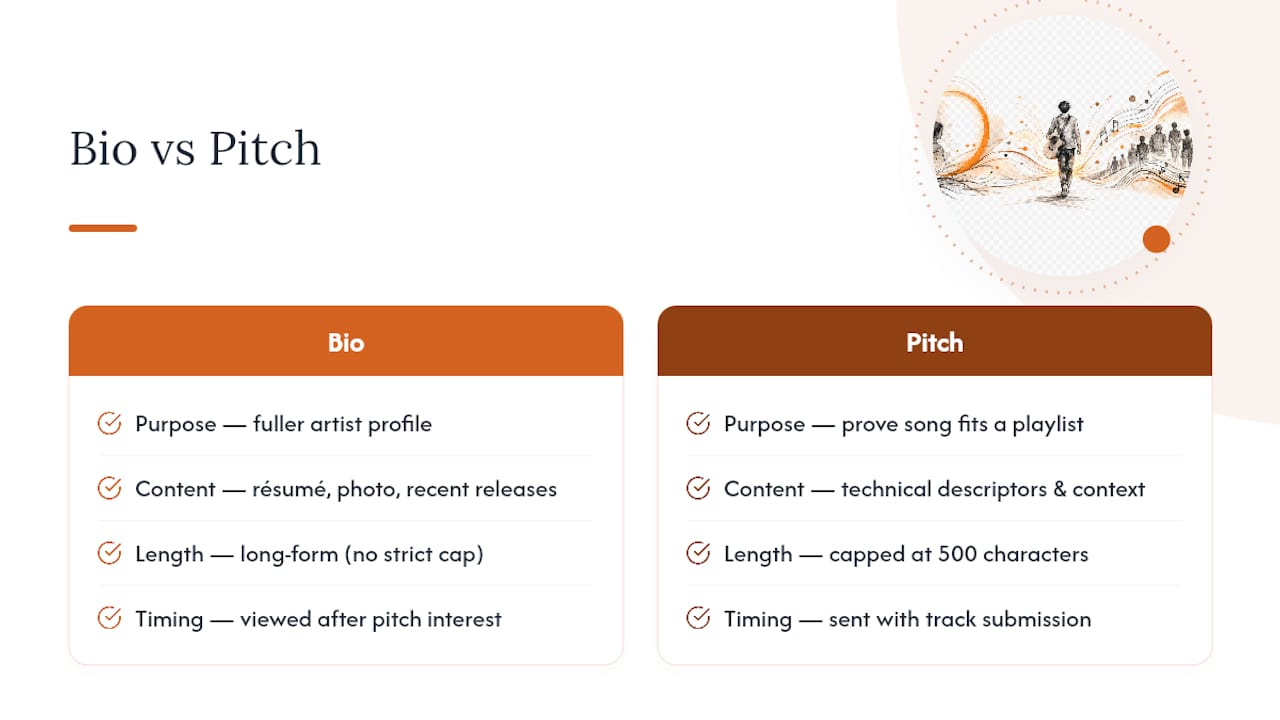
Spotify caps the editorial pitch field at 500 characters, and that number is not arbitrary padding. It forces you to lead with the song, not your résumé. Spotify’s own guidance is explicit that editors prefer technical descriptors and song context over a pasted career history, and a 500 character limit physically cannot hold both.
That means your years of gigging, your old EP, your influences growing up, none of that belongs in the pitch box. Save it for your artist profile, where curators actually go to check you out once your song has caught their attention. A well-written bio there, paired with a real photo and recent release activity, works as a trust signal that a curator uses to validate the pitch they just read. An empty or stale profile does the opposite. It makes a curator second-guess a pitch that might otherwise have earned a slot.
If you feel you absolutely must include a shred of context in the pitch itself, one short clause is the ceiling, something like “third single off my debut EP,” not a paragraph.
Curators reading dozens of these a day aren’t looking for your life story. They’re looking for a fast, confident answer to “does this song belong on my playlist,” and everything else is noise competing with that answer. Keep the pitch lean and let your Spotify for Artists profile carry the weight of who you are.
How Do You Fill Out Each Pitch Field Correctly?
Every field in Spotify’s pitch form exists to answer a specific question a curator is silently asking. Skip a field or fill it with filler, and you’ve handed them a reason to move on.
- Sonic descriptor. Combine genre, substyle, and one production or instrumentation hook. “Bedroom pop with acoustic warmth and lo-fi synth textures” tells a curator more in seven words than “chill vibes” does in a paragraph. Vague, mood-board language (“dreamy,” “vibey,” no specifics) is the single fastest way to get skimmed past.
- Context and momentum line. One sentence showing you’re actively building something: a video release, a press mention, an upcoming tour date. This isn’t about padding your ego, it’s a signal that a curator’s slot is going to an artist who’s already generating attention elsewhere, not a dormant profile that vanishes after release week.
- Playlist-fit sentence. Name the actual playlist you’re pitching and reference one or two artists or tracks already on it that share your song’s sound. Naming the specific playlist and comparable tracks reads as research, not a mass blast, and curators respond to that difference.
- Collaborators, if relevant. Only mention a producer, feature, or co-write if that name carries weight for the specific genre or playlist you’re targeting. A random co-writer credit nobody’s heard of just eats characters.
Field-level don’ts matter as much as the do’s. Skip empty superlatives like “amazing” or “must-hear.” Skip vague genre tags when a specific substyle exists. And unless a stream count is genuinely striking, leave it out entirely. A pitch that says “50 streams in the first week” reads as a red flag, not a flex.
Pro Tip: Write your playlist-fit sentence first, then work backward. If you can’t name a specific playlist and two comparable tracks on it, you haven’t done enough homework to pitch yet.
Copy-Paste Bio and Pitch Templates You Can Adapt Today
Templates save you from staring at a blank pitch box at 11pm the night before your submission deadline. Adapt the specifics, keep the structure.
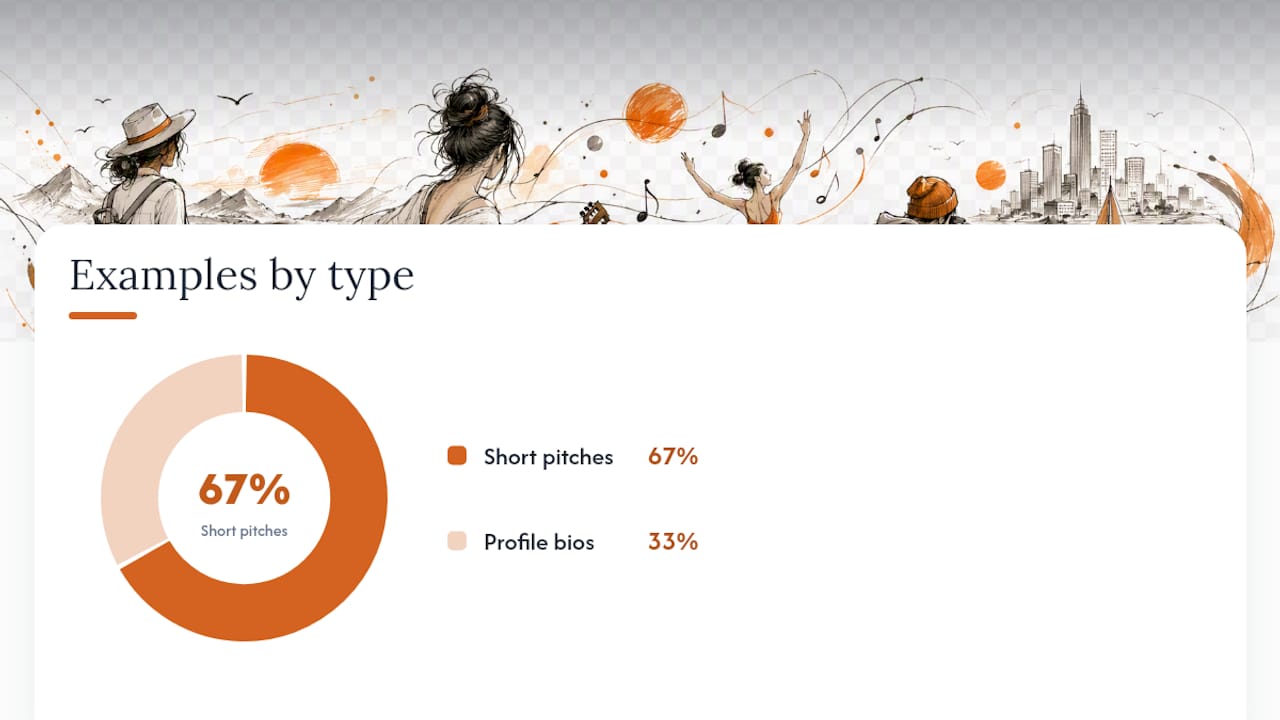
Short pitch examples, each written to sit comfortably under Spotify’s cap:
- “Melodic house with warm analog bass and a rising synth hook, close to what’s on Mint. Would fit alongside tracks like recent Lane 8 cuts.”
- “Alt R&B with sparse production and a falsetto lead, third single off my debut EP. Fits the tone of Left From Center.”
- “Folk-pop duo, acoustic guitar and close harmonies, filmed a live session dropping the same week. Would sit well on Wild Country next to Ward Thomas.”
- “Dark pop with distorted 808s and a minor-key hook, following a feature on a regional radio show. A fit for Dark & Twisty.”
- “Instrumental lo-fi hip hop, tape-warped piano loop, built for focus playlists. Similar tempo and texture to what’s already on Lofi Beats.”
- “Emo revival with gang vocals and a key change in the bridge, second single ahead of a fall tour. Fits Emo Forever’s tone.”
Profile bio templates run longer, 100 to 200 words, because this is where curators actually check your story:
Template 1 (Solo artist): “[Name] is a [genre] artist from [city] known for [specific sound trait]. Since [year], [he/she/they] has released [number] singles/EPs, most recently [title], which [notable detail: press mention, sync, feature]. Drawing from [2 to 3 influences], [Name]'s current project explores [theme]. [He/She/They] is currently [touring/writing/collaborating with X].”
Template 2 (Band): “[Band name] formed in [city] in [year], blending [genre 1] and [genre 2] into a sound built around [specific hook: harmonies, production style, instrumentation]. The band’s latest release, [title], follows [prior momentum detail]. [Band name] has been compared to [1 to 2 comparable acts] and is currently [touring/working on next release].”
Template 3 (Producer/electronic): “[Name] is a producer and [genre] artist whose work spans [subgenres]. Known for [signature production element], [Name] has [notable placement, remix, or release] and continues to release music that leans into [specific mood/theme]. [Name]'s newest single, [title], marks [context: first vocal track, new label, collaboration].”
The 500 character pitch cap and the 7-day minimum submission window aren’t suggestions buried in fine print, they’re the two constraints that shape every template above. Miss either one and the rest of your effort doesn’t matter.
Common Pitch Mistakes That Get an Artist Bio for Playlist Pitch Ignored
Most rejected pitches share the same handful of problems, and every one of them is fixable in under ten minutes.
- Overlong pitch text. If you’re pasting your full bio into the pitch field, cut it down to the sonic descriptor and playlist-fit line only. Move the rest to your profile.
- Missing or thin profile. No photo, no bio, no recent activity. Fix it before you submit anything, since a thin profile undermines a strong pitch.
- Generic, copy-paste pitches sent to every playlist. If your pitch would work unchanged for five different playlists, it’s not personalized enough for any of them. Rewrite the fit sentence for each submission.
- Irrelevant or weak metrics. Dropping a tiny stream count or follower number that doesn’t actually impress anyone. Cut it unless the number is genuinely notable.
- Wrong or vague metadata. Loose genre tags or missing mood/BPM fields. Go back and tighten these before resubmitting on your next release.
Pro Tip: Keep a running “winning pitch” file. Every time a pitch lands a placement, save the exact wording. Over a few releases, you’ll notice which phrasing and which playlist-fit angles actually convert.
Timing Rules and a Simple Follow-Up Plan
Spotify’s editorial timing rule is not flexible: submit your pitch at least 7 days before release, and earlier is better because editorial teams review submissions weeks in advance. Submitting closer to the deadline puts you at the back of a very long line.
- Two to three weeks out: finalize metadata, artwork, and your profile bio so nothing changes after you submit.
- 7 to 10 days out: submit your song pitch through Spotify for Artists. If you also have a video, pitch it separately, since song and video submissions run through different processes.
- Release week: don’t resubmit or edit the pitch. Let it sit in the review queue.
- Post-release: if you’re following up with a curator directly (outside Spotify’s system), wait at least a week and keep it to one short, polite check-in. Don’t chase a second time.
Submitting a full week or two early isn’t just about avoiding a missed deadline. It’s a real competitive edge, since editorial teams are often reviewing weeks of submissions at once, and an early pitch has more time to surface in that queue.
Personalizing Curator Outreach Beyond the Spotify Pitch
Spotify’s own pitch tool isn’t the only channel worth using, and plenty of independent curators run blogs, playlists, and radio shows outside that ecosystem entirely. When you’re reaching out directly by email or social media, the rules change slightly, but the core discipline stays the same: specificity wins, generic loses.
Open with the curator’s name and one concrete detail proving you actually listened to their playlist, not just skimmed the title. Reference a specific track they’ve featured recently and explain in one sentence why your song sits in similar territory. That single detail does more work than three paragraphs of self-promotion.
Keep the message itself short, roughly 80 to 150 words, following the same structure that works for Spotify’s own pitch field: who you are, which song, why it fits, and how to reach you. Attach a streaming link directly, don’t make the curator hunt for it, and skip attachments they didn’t ask for.
Never send the identical message to twenty curators in one afternoon. It’s obvious when you do, and it costs you credibility with every single one of them. A curator who runs a niche playlist can tell within a sentence whether you actually know their page or just found it on a spreadsheet somewhere.
An Artist’s Take on Learning to Pitch and Fixing What Doesn’t Work
Pitching is a skill you build through repetition, not a form you fill out once and forget. Treat every pitch like a small campaign: write it, send it, track what happens, and adjust.
The artists who improve fastest keep a record of which phrasing landed and which fell flat. A playlist-fit sentence that worked for one submission might completely miss for the next genre or curator, so the templates above are a starting point, not a script to run unedited forever. Curator feedback, when you get it, is data. Use it.
That’s the same principle behind managed outreach services like Intonality, which run personalized curator pitching at scale and pass real, written feedback back to the artist after every decision. The mechanics are identical to what you’d do by hand, just with more curator relationships and faster iteration behind them.
— Einars
A Managed Alternative for Artists Who’d Rather Skip the Trial and Error
Writing and tracking your own pitches works, but it takes time you might not have between releases. Intonality runs that process for you: personalized pitches sent to real, genre-matched curators, not automated blasts or pay-to-play playlists, with real-time updates and written feedback on every single curator decision.
That feedback loop is the part most services skip entirely. Instead of a placement or silence, you get a written reason either way, which means you actually learn what’s landing instead of guessing. Intonality reports an average number of playlist placements per campaign depending on the service tier you choose, giving you a concrete range to weigh against the hours you’d otherwise spend cold-pitching curators yourself. If you’d rather hand off the outreach and keep the insight, check current campaign options at Intonality and see which tier fits your release timeline.
Where to Read More on Playlist Pitching
For the official rules straight from the source, Spotify’s own pitching guidance covers timing, character limits, and the song versus video submission split in full detail. Berklee Online’s guide to Spotify playlists adds useful context on profile upkeep, and MusicTech’s pitching tips break down what curators actually scan for before opening a pitch. Between the three, you’ve got the full picture: the rules, the reasoning, and the practical checklist to work from on your next release.
Sources
- Pitching music and videos to Spotify playlist editors
- How to get playlisted on streaming services: 7 playlist pitching tips | MusicTech
- Submit music to Spotify playlists in 2026 | Playlist Atlas
- Pitch to Playlist Curators: 10 Simple Steps | LordReverb


