
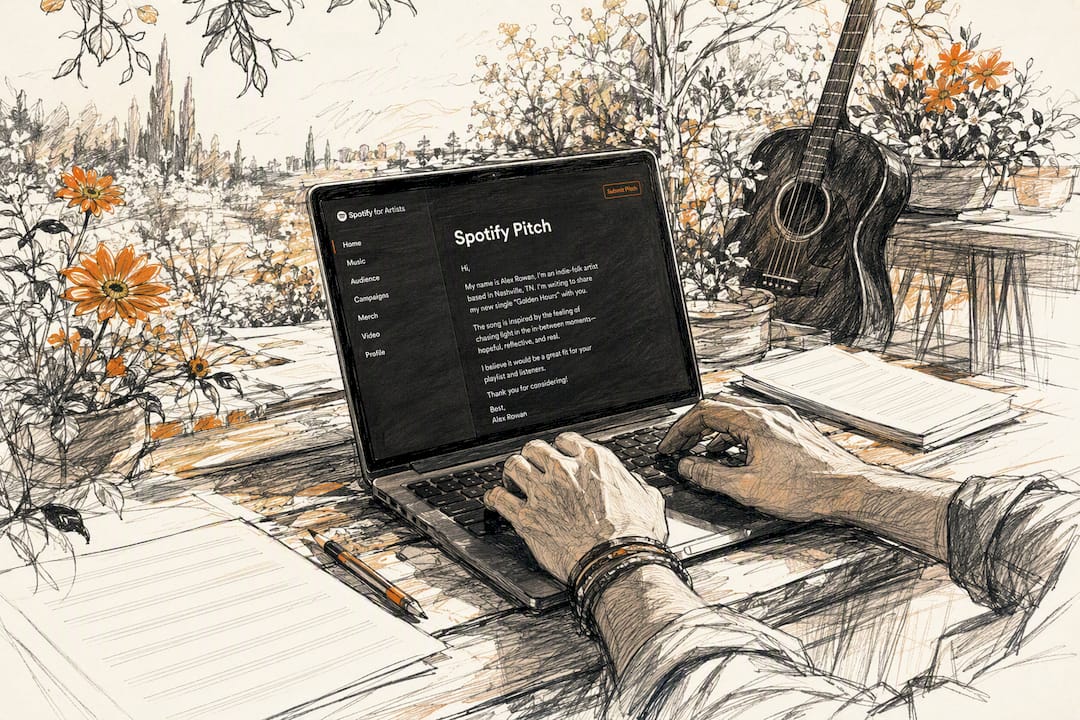
Keep your pitch to independent Spotify curators around 100 words, one short paragraph, no more. Your first sentence has to earn the second one by naming your genre, mood, instrumentation, and the exact reason your track fits that specific playlist. That’s it. That’s the format.
This guide is about pitching real independent curators, the people running genre-specific Spotify playlists as a side hustle or a passion project, not Spotify for Artists’ editorial pitch tool, which uses its own 500-character field for a completely different audience.
- Length: 50 to 120 words, one paragraph
- First sentence: genre + mood/instrumentation + placement reason
- Link: one clean streaming link, nothing else attached
According to LordReverb’s curator outreach guide, independent curators respond best to a pitch that reads like a short message, not a press release, capping out near 100 words.
Key Takeaways
A short, fact-first pitch built around genre, mood, and a specific placement reason consistently outperforms long bios and mass-blasted generic submissions.
| Point | Details |
|---|---|
| Keep it to ~100 words | One paragraph, lead sentence plus two supporting sentences, nothing longer. |
| Lead with fit, not hype | State genre, mood, instrumentation, and why the track fits that exact playlist. |
| Match the link to release status | Public Spotify link once released; private SoundCloud or Stream link pre-release. |
| Pitch 2 to 4 weeks early | Follow up once after 5 to 7 days, then stop regardless of response. |
| Target 10 to 20 curators, not 100 | Personalized outreach to a small list beats mass blasts to a large one. |
| Intonality handles this end-to-end | Personalized pitches to genre-matched curators, with written feedback and an average number of placements per campaign. |
Table of Contents
- How Long Should Your Spotify Pitch Actually Be?
- What to Write: A 3-Sentence Pitch Template
- When to Pitch and How to Follow Up
- Show the Curator You Actually Listened
- Common Pitch Mistakes and a Pre-Send Checklist
- Why Most Pitch Advice Undersells Precision
- How Intonality Handles Curator Pitching for You
- Sources
How Long Should Your Spotify Pitch Actually Be?
Curators reading submissions for a genre-specific playlist often make a keep-or-reject call in 15 to 30 seconds. They’re scanning, not reading. A pitch that opens with several sentences of backstory before mentioning the song’s genre has already lost.
The math is simple: one lead sentence, up to two supporting sentences, done. That’s your entire pitch. Stretch past 150 words and you’re asking a volunteer curator to do homework for a track they haven’t even heard yet.
What that structure looks like in practice:
- Sentence 1: Genre, mood, and why it fits this playlist specifically
- Sentences 2 to 3: One proof point (traction, press, a tour date) plus your ask
- No bios. Curators care about the song, not your press kit history
- No hype-only language. “This track is fire” tells a curator nothing about fit
Link selection matters as much as word count. If the track is already live, send the standard Spotify public link. If you’re pitching pre-release, a private SoundCloud or Stream link works, but never send a downloadable file or a link requiring a login. Curators won’t chase access. Symphonic’s pitch guide makes the same point: friction kills conversions faster than a mediocre pitch ever will.
What to Write: A 3-Sentence Pitch Template
You don’t need a creative writing degree for this. You need three sentences that do specific jobs, in this order.
- The lead sentence. State genre, mood, and instrumentation, then connect it to the playlist. “This is a moody, guitar-driven indie folk track that would sit well next to your recent late-night acoustic additions.”
- The proof sentence. One data point that signals momentum, a recent placement, a support slot, a Bandcamp sale streak, anything concrete. Skip this if you have nothing real to add. A weak proof point is worse than none.
- The ask. Request consideration politely, drop the link, and include the release date if it hasn’t dropped yet.
Pro Tip: Write your lead sentence last. Once you know exactly why the song fits the playlist, that reason becomes your opening line instead of an afterthought buried in sentence three.
Here’s how that looks for two different genres:
Indie/folk example: “This is a warm, fingerpicked folk tune with a female lead vocal that would fit right alongside the Phoebe Bridgers style tracks on your playlist. It’s picked up over 30,000 organic streams since release with zero paid promotion. Would love for you to give it a listen and consider it for an upcoming update, link here.”
Electronic/pop example: “This is a high-energy electro-pop track built around a pulsing synth hook, similar in tempo and energy to the closing run of your playlist. It just landed a sync placement in a mid-size streaming show. Pre-release, dropping March 6, private link attached, would appreciate a listen before then.”
Both examples sit comfortably under 120 words. Neither wastes a sentence on adjectives that don’t tell the curator anything.
When to Pitch and How to Follow Up
Timing changes your odds more than most artists realize. Pitch 2 to 4 weeks before release when you can. Symphonic’s research on curator outreach notes that independent curators are more flexible than editorial teams, they’ll consider same-day or even post-release submissions, but earlier pitches give them room to plan the track into an upcoming update instead of scrambling.
- Ideal window: 2 to 4 weeks pre-release
- Acceptable: pre-release with less lead time, or release-day
- Riskier: pitching weeks after release, when momentum has already cooled
If you haven’t heard back, wait 5 to 7 days before a single, polite follow-up. One nudge, then stop. A curator who hasn’t responded after two attempts isn’t going to respond to a third, and repeated follow-ups tend to get you quietly blacklisted rather than reconsidered. For a full follow-up script, see Intonality’s guide to following up with curators.
Show the Curator You Actually Listened
Personalization is the single fastest way to separate your pitch from the hundred others hitting that curator’s inbox this week. It takes maybe 60 seconds and it changes everything.
- Name a track already on the playlist. Reference a specific song or a recent addition, and describe where your track would sit in that flow.
- Run a 30-second listening check. Note the tempo, the mood, the lead instrument, and one comparable artist you can drop into a sentence.
- Send it to 10 to 20 curators, not 100. Orphiq’s data on curator outreach shows that a small batch of genuinely targeted pitches consistently outperforms mass blasts, because curators can tell the difference between a pitch written for their playlist and one copy-pasted into fifty inboxes.
Pro Tip: Check the genre tags on the playlist itself before you pitch. A mismatch there is often the fastest way to get an automatic pass, no matter how good your pitch reads. For help nailing genre language, see Intonality’s guide to Spotify genre tags.
Common Pitch Mistakes and a Pre-Send Checklist
Most rejected pitches fail for the same handful of reasons: generic hype with no specifics, a three-paragraph bio nobody asked for, the wrong link type, zero targeting, or a curator who got followed up with four times in a week.
Run this checklist before you hit send:
- First-sentence test: does it name genre, mood, and placement reason?
- Link test: public Spotify link if released, private link if not, nothing behind a login
- Personalization check: does it reference an actual track on the playlist?
- Release date confirmation: stated clearly if the track hasn’t dropped
- Tone check: polite ask, no hype adjectives doing the heavy lifting
Curators who decide in 15 to 30 seconds don’t have time to dig for the information a sloppy pitch buries.
Why Most Pitch Advice Undersells Precision
Most advice on this topic treats pitch length like a formality, hit somewhere under 150 words and you’re fine. That misses the actual lesson buried in how curators operate: length is a symptom, not the cause. A pitch that’s too long is almost always too long because the artist hasn’t figured out what makes the song fit that specific playlist. Word count is just where that confusion becomes visible.
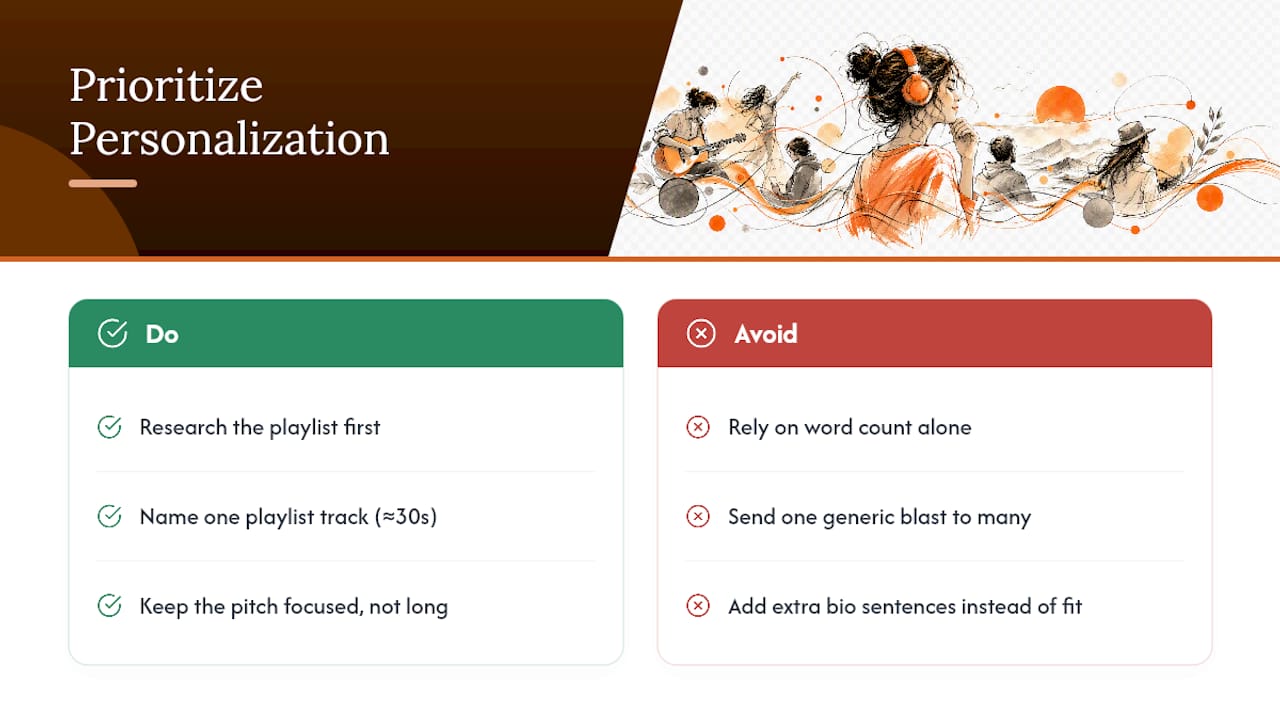
The conventional wisdom also underrates how much personalization work can happen in under a minute. Artists assume real customization means writing a unique email from scratch for every curator, so they skip it entirely and send one generic blast to 200 addresses. That’s backward. Naming one track already on the playlist takes 30 seconds and does more work than three additional sentences of biography ever will.
If there’s one thing worth prioritizing above all else, it’s this: know the playlist before you write the pitch. Everything else, the word count, the link format, the follow-up timing, is secondary to whether you actually understand where your song belongs.
— Einars
How Intonality Handles Curator Pitching for You
Writing a tight, genre-specific pitch for one curator is manageable. Writing twenty different ones, each personalized, each sent to the right genre-matched playlist, at the right time relative to your release, is a full-time job most independent artists don’t have room for.
That’s the gap Intonality closes. Every campaign sends personalized pitches to vetted, genre-matched curators, built using the same fit-first approach this guide just walked through, genre, mood, and a clear reason your track belongs on their playlist. You’re not getting a form letter blasted to a purchased list.
Campaigns also include real-time updates and written feedback from every curator decision, so when a curator passes, you actually learn why instead of hearing silence. Intonality reports an average number of placements per campaign depending on the tier you choose., with pre-release submission built into the process so timing never becomes the reason your track missed its window.
If you’d rather have someone else handle the pitch writing and curator relationships, submit your track to start a campaign and see which genre-matched playlists your sound fits.
Sources
- How to Write a Stronger Playlist Pitch That Editors Understand
- Pitch to Playlist Curators: 10 Simple Steps | LordReverb


