Fake streams on Spotify are real, they violate Spotify’s terms of service, and you should never buy them. Artificial streaming is defined by Spotify as any stream that doesn’t reflect genuine user listening intent, and confirmed cases result in royalty withholding, metric corrections, and reports sent directly to your distributor. The practical tools you need instead: Spotify for Artists for monitoring and editorial pitching, Discovery Mode for algorithmic reach, and Intonality for genre-matched curator placements with written feedback on every decision. If you’ve already run a campaign with guaranteed streams, pause it now, download your Spotify for Artists audience reports, and contact your distributor with that documentation before they contact you.
Table of Contents
- How Spotify catches fake streams and what happens next
- Red flags that a service is producing fake plays on Spotify
- Why artificial Spotify streams damage your career, not just your metrics
- How to vet a playlist-promotion vendor before you pay
- Legitimate ways to get more Spotify streams without the risk
- Which metrics tell you a promotion actually worked
- What to do if you receive an artificial-streaming notice
- Legal implications of buying fake streams
- How fake streams erode fan trust and your long-term reputation
- Intonality pitches your track to real curators, not bots
- Key Takeaways
- Why shortcuts always cost more than they save
- Useful sources
How Spotify catches fake streams and what happens next
Spotify doesn’t wait for artists to self-report. The platform runs daily data cleaning that removes confirmed artificial streams, sometimes before they ever appear in your public dashboard. Detection signals include bot-driven automated patterns, sudden location spikes that don’t match your prior audience geography, and engagement profiles with zero saves, near-instant skips, or abnormal stream-to-listener ratios.
When Spotify confirms manipulation, the consequences stack up fast:
- Royalties are withheld for the affected streams
- Public metrics are adjusted or corrected downward
- Playlist placements can be removed
- Distributors receive monthly reports of confirmed artificial streaming and may issue warnings, apply penalty charges, suspend accounts, or remove content in repeated cases
- In extreme situations, content removal or full account suspension follows
The distributor’s hands are often tied. Spotify shares limited detail in those monthly reports, so your distributor typically passes the notice along without much additional context. That’s exactly why keeping your own campaign records matters.
Red flags that a service is producing fake plays on Spotify
Sudden spikes without engagement, guaranteed stream numbers, opaque reporting, and mismatched listener geography are the clearest warning signs. Any service promising guaranteed streams or placements is violating Spotify’s terms, full stop.
Watch for these specific red flags:
- Guaranteed numbers: Any vendor promising a specific stream count is selling something Spotify explicitly prohibits.
- No curator names or verifiable profiles: Legitimate services can tell you who is listening to your pitch.
- One-size-fits-all playlist fits: A hip-hop track landing on a classical playlist is a dead giveaway.
- Abnormal traffic sources in Spotify for Artists: Check the “Listeners” tab. If streams are flooding in from a single city or country with no prior audience there, something is wrong.
- Zero engagement signals: Streams with no saves, no playlist adds, and no follower growth are bot traffic.
- Refusal to provide campaign logs: Transparent services document every curator interaction.
Pro Tip: Before paying any promotion service, open Spotify for Artists and screenshot your current save rate, listener geography, and stream sources. Run the campaign, then compare those same metrics at the 7-day mark. A real campaign moves saves and listener retention. A fake one moves only the stream counter.
Why artificial Spotify streams damage your career, not just your metrics
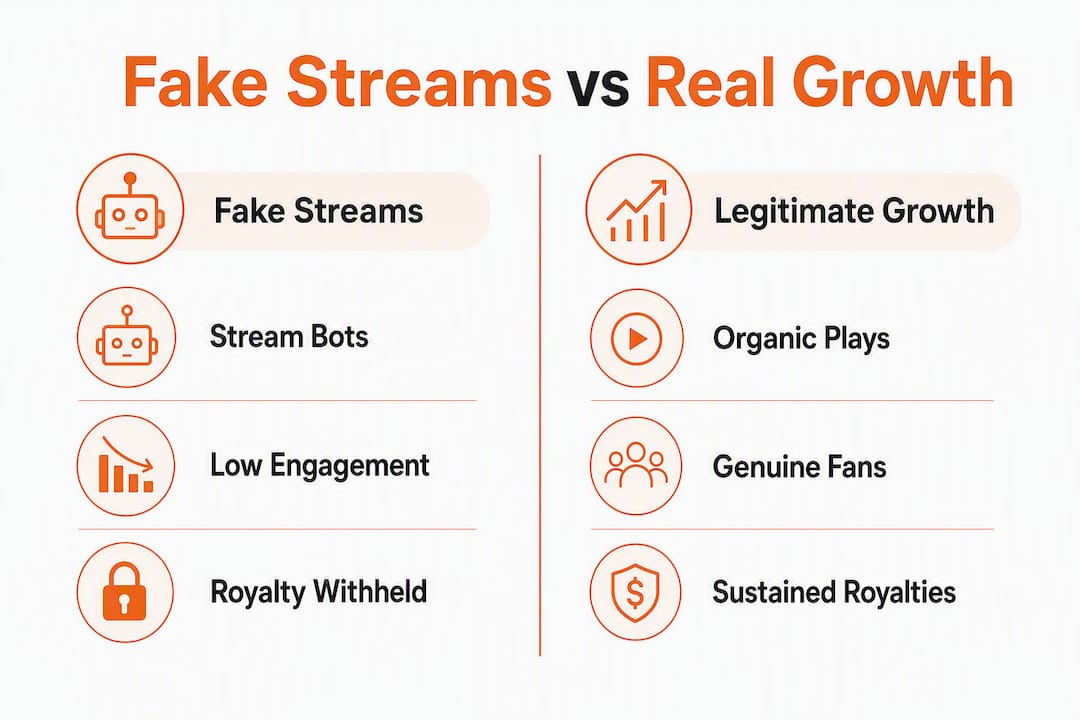
Bot streams produce zero engagement, and zero engagement is an active negative signal in Spotify’s recommendation engine. When the algorithm sees a track with thousands of streams and almost no saves, it reads that as a song real listeners don’t want to hear. The result: fewer algorithmic recommendations, not more.
The concrete harms go beyond the algorithm:
- Withheld royalties on any streams Spotify confirms as artificial
- Corrected public metrics that can drop your stream count visibly
- Playlist removals if a playlist curator is implicated
- Distributor penalties ranging from warning letters to account suspension
- Reputational damage if the manipulation becomes public
High-profile cases illustrate the scale. Spotify deleted 500,000 bot streams tied to one artist in a single enforcement action, drawing legal commentary about data manipulation risks and potential regulatory consequences in US markets.
Music marketing strategist Bryant Lloyd puts it plainly:
Chasing raw stream volume instead of engagement produces weaker, short-lived results. Organic growth is slower, but it compounds through Spotify’s recommendation systems in ways that inflated numbers never can.
How to vet a playlist-promotion vendor before you pay
Demand curator transparency, written placement feedback, campaign dashboards, and a clear refusal policy on manipulative tactics. Authentic promotion depends on genre-matched manual connections, not opaque automated services.
Step-by-step vetting checklist:
- Ask for curator names and verifiable profiles. A real service knows who is in its network.
- Request a sample campaign report with anonymized curator responses. If they won’t show you one, walk away.
- Require that the contract contains no performance guarantees on stream counts.
- Insist on a written clause prohibiting artificial tactics and stating the refund policy if manipulation is detected.
- Check that the service matches your genre specifically, not just broadly.
- Confirm you’ll receive written feedback on every curator decision, accepted or declined.
Red flags that should end the conversation immediately:
- Guaranteed stream numbers or placement counts
- Secret or unverifiable playlists
- Refusal to name curators
- No campaign logs or dispute resolution process
Pro Tip: Ask the vendor for one real recent placement and check that playlist directly on Spotify. Look at follower count, how often it’s updated, and whether the other tracks fit the genre. A playlist with 50,000 followers that hasn’t been updated in eight months and has no engagement is a ghost playlist.
Legitimate ways to get more Spotify streams without the risk
Platform tools, genre-matched curator pitching, PR, and paid ads produce sustainable growth that Spotify’s algorithm can actually act on. There is no safe shortcut that bypasses detection and delivers real results.
| Tactic | Transparency | Curator authenticity | Reporting detail | Refund/policy stance | Cost expectations | Typical timeline |
|---|---|---|---|---|---|---|
| Spotify editorial pitching | High | Spotify editorial team | Limited | N/A (free) | Free | 4–6 weeks pre-release |
| Discovery Mode | High | Algorithmic | Dashboard data | N/A (royalty share) | Royalty reduction | 2–4 weeks |
| Manual curator outreach | Variable | Direct contact | Self-tracked | No contract | Low to moderate | 2–6 weeks |
| Paid ads (Spotify/Meta) | High | None | Full ad analytics | Platform refund policies | Moderate to high | 1–2 weeks |
| Transparent curator marketplace | High | Vetted, named curators | Written feedback per pitch | Refund on manipulation | Moderate | 2–4 weeks |
Discovery Mode is worth understanding specifically. You opt a track in through Spotify for Artists, accept a reduced royalty rate on those streams, and Spotify’s algorithm tests the song against new listeners in Radio and Autoplay. It’s transparent, it’s on-platform, and the engagement signals it generates are real.
Which metrics tell you a promotion actually worked
Real promotions increase saves, playlist adds, listeners-per-stream, repeat listens, and consistent geography signals. Raw stream counts alone prove nothing.
Monitor these specific signals in Spotify for Artists after any campaign:
- Save rate: The percentage of listeners who hit save. A meaningful campaign moves this number.
- Listeners vs. streams ratio: A ratio close to 1:1 suggests listeners aren’t replaying. A ratio of 1:2 or higher suggests genuine interest.
- Average completion rate: Tracks with high skip rates at 15–30 seconds are being penalized algorithmically.
- Source breakdown: Streams sourced from “Playlists” with named playlist titles confirm real placements. “Other” or “Unknown” sources warrant scrutiny.
- Follower growth: Real placements often produce a small but measurable follower uptick.
- Referrer geographies: New listeners should come from markets that make sense for your genre and prior audience.
Pro Tip: Capture your baseline metrics in Spotify for Artists the day before a campaign launches. Then check at 7, 14, and 30 days. A real campaign shows a gradual lift across saves and listener retention, not a single-day spike followed by a flatline.
What to do if you receive an artificial-streaming notice
Pause paid campaigns immediately, preserve every campaign record you have, and notify your distributor with documented evidence before they reach out to you.
- Stop all active campaigns with the suspect vendor right now.
- Download your Spotify for Artists reports: audience data, stream sources, and timestamps covering the campaign period.
- Collect vendor invoices, contracts, and all written communication with the service.
- Contact your distributor and send the documentation. A straightforward email works:
“I received an artificial-streaming notice and believe it may be connected to a third-party promotion campaign I ran between [dates]. I’m attaching my Spotify for Artists reports, vendor invoices, and campaign correspondence. Please advise on next steps and let me know what additional documentation you need.”
- If a specific playlist is involved, use Spotify’s playlist reporting tool to flag it.
Note: if your music is removed, some distributors allow re-upload using the same ISRC to generate a new Spotify URI. But as DistroKid’s guidance makes clear, re-uploading does not automatically repair your account standing. Resolve the active issue with your distributor first.
Pro Tip: Campaign IDs, curator feedback emails, and timestamped invoices are the evidence that actually helps investigations. Screenshot everything before you cancel any vendor accounts.
Legal implications of buying fake streams
Stream manipulation carries legal risk beyond Spotify’s own enforcement. In the US, artificially inflating streaming numbers to collect royalties could be characterized as wire fraud or music industry fraud under federal law, depending on the scale and intent. The Benzinga investigation into deleted bot streams drew commentary from an SEC attorney about potential federal-crime exposure for large-scale manipulation. Artists are ultimately responsible for their distribution choices under Spotify’s terms, meaning you can’t shift liability to a vendor by claiming you didn’t know the streams were fake. The artist account, not the promotion service, is what Spotify and distributors act against.
This article is general information, not legal advice. Consult a qualified attorney for guidance specific to your situation.
How fake streams erode fan trust and your long-term reputation
Inflated stream counts create a credibility gap that real fans notice. An artist with 2 million streams and 400 monthly listeners raises immediate questions among industry contacts, playlist curators, and journalists. Sync licensing teams, booking agents, and label A&R staff all cross-reference streaming data against social engagement and live draw. A manipulated Spotify profile that doesn’t match any other metric is a red flag that closes doors. Beyond industry gatekeepers, fans who discover an artist bought streams often feel deceived, and that feeling spreads quickly on social media. The short-term vanity number costs the long-term relationship.
Intonality pitches your track to real curators, not bots
If you’ve read this far, you already know what to avoid. Intonality is built around the opposite of everything described above: personalized, genre-matched pitches sent manually to vetted curators, with written feedback on every decision and a real-time dashboard so you can see exactly what happened to your track.
Here’s how a campaign works. You submit your track and select your genre. Intonality matches it to curators whose playlists fit your sound specifically, not just your broad category. Each curator receives a personalized pitch. Whether they place your track or pass, you get written feedback explaining why. Campaigns typically result in 4–11 playlist placements depending on the tier you choose, and every placement is documented in your dashboard. No guaranteed stream counts. No secret playlists. No artificial tactics.
Submit your track and see which curators are a fit for your sound. If you want to browse the playlists in Intonality’s network first, the Spotify playlist promotion page shows active placements across genres.
Key Takeaways
Fake streams violate Spotify’s terms, trigger royalty withholding and distributor penalties, and actively damage the algorithmic signals that drive real discovery.
| Point | Details |
|---|---|
| Never buy guaranteed streams | Any service promising a specific stream count violates Spotify’s terms and puts your account at risk. |
| Engagement signals matter more than volume | Save rate, completion rate, and listener-to-stream ratio are what Spotify’s algorithm actually rewards. |
| Pause and document if notified | Stop suspect campaigns immediately, download Spotify for Artists reports, and contact your distributor with evidence. |
| Use platform tools for safe growth | Spotify for Artists editorial pitching and Discovery Mode are free, transparent, and algorithm-aligned. |
| Intonality offers curator-verified campaigns | Genre-matched manual pitching with written feedback and 4–11 typical placements per campaign, no artificial tactics. |
Why shortcuts always cost more than they save
The artists I see struggle most with Spotify growth are the ones who spent money on the wrong thing first. Not because they were naive, but because the fake-streams industry is genuinely good at sounding legitimate. Guaranteed placements, “real listener” packages, dashboards full of impressive-looking numbers. It all looks like promotion until you check your save rate.
Bryant Lloyd’s point about volume versus engagement isn’t just strategic advice. It describes how the algorithm is actually built. Spotify isn’t counting listeners; it’s measuring what listeners do. A track with 500 saves from 1,000 plays gives the system better signal than one with 200 saves from 50,000 plays, because the ratio proves the song connects with the people who find it. You can’t fake that ratio into existence. You can only earn it by putting the right song in front of the right listeners.
The curator relationship model works precisely because it targets fit over volume. A placement on a folk music playlist whose followers actually listen to folk creates a listener profile Spotify can act on. A placement on a ghost playlist with inflated followers creates noise the algorithm ignores or penalizes. The difference compounds over months, not days. That’s why sustainable growth feels slow at first and then suddenly doesn’t.
Useful sources
Authoritative sources on Spotify’s policies and distributor responses are the first place to go when you need policy text or want to report suspicious activity.
- Artificial Streaming — Spotify for Artists: Spotify’s own policy page defining artificial streams, explaining detection, and outlining consequences. Read this before running any paid promotion.
- Third-Party Services That Guarantee Streams — Spotify Support: Spotify’s explicit warning about guaranteed-stream services and what using them risks. The clearest statement of the platform’s position.
- Artificial Streaming Notice — DistroKid Help Center: Step-by-step guidance from DistroKid on what to do if you receive a notice, including re-upload options and their limits.
- Promoting Music on Spotify — Spotify Support: Overview of legitimate promotion tools including Discovery Mode, stream counting rules, and source-of-streams data.
- How to Get Spotify Streams Organically — liminl.: A detailed breakdown of how Spotify’s recommendation engine actually works, including save rate, completion rate, and why fake growth poisons organic discovery.