
Spotify genre tags are proprietary labels that Spotify’s internal systems attach to artists and tracks. They power recommendations, editorial playlist routing, and ad targeting — and you can view them right now in three ways: check the artist page in the app (limited), pull the genres array from the Spotify Web API, or browse a community-maintained dataset.
Three quick ways to see genre tags today:
- Spotify app: Open an artist’s profile. On desktop, genre labels sometimes appear under the artist name. This is the least complete view.
- Spotify Web API: Call
GET /artists/{id}and read thegenresfield. Example response:["indie pop", "bedroom pop", "lo-fi"]. Requires a free developer account. - Community lists: Browse repos like the Tiraya/spotify-genres project, which catalogs thousands of genre identifiers with localized names and hierarchy data.
To act immediately:
- Go to Spotify for Developers and create a free app to get your API credentials.
- Call
GET /artists/{id}with any artist’s Spotify ID to see their current genre array. - Cross-reference with a community dataset to map microgenres to broader categories for pitching.
Table of Contents
- How Spotify genre tags actually work inside the platform
- How to find an artist’s genre tags: three concrete methods
- Limitations and common misunderstandings about genre tags
- How artists can influence genre signals and use them for pitching
- How curators and promotion services use genre tags
- Where to find compiled genre lists and datasets
- Key Takeaways
- Genre metadata is the part most artists skip
- Genre-matched playlist promotion that actually reaches real curators
- Useful sources
How Spotify genre tags actually work inside the platform
Spotify does not let artists type in their own genre. The tags come from Spotify’s internal systems, which combine audio analysis, release metadata, and listener behavior signals to assign labels algorithmically. That process is opaque by design, and academic research on streaming-era genre classification documents thousands of identifiers with no single canonical public list from Spotify.
The genre labels you see in the app’s Browse section are not the same thing. Those are platform-curated UI groupings, essentially marketing folders Spotify uses to organize content for casual listeners. The internal taxonomy used by the recommendation engine is far more granular. An artist tagged “indie folk” in the algorithm might appear under a broad “Folk & Acoustic” browse category, but the two systems operate independently.
Inside the platform, genre tags serve four distinct functions: they seed the recommendation engine (Spotify’s Discover Weekly and Radio features use genre as one input), they route tracks to editorial playlists, they filter results in Spotify’s search when users or developers apply a genre field, and they define audience segments for ad targeting through the Ads API genre targets endpoint.
Pro Tip: Never assume the genre label visible in the app reflects the full tag set Spotify uses internally. The Browse categories are a UI shortcut. The real genre signal lives in the API’s genres array and in the recommendation engine’s internal taxonomy — neither of which is fully public.
How to find an artist’s genre tags: three concrete methods
Method A: The Spotify app
Open any artist’s profile on Spotify desktop. Genre labels occasionally appear as small clickable chips below the artist name. The mobile app shows them less consistently. This view is useful for a quick sanity check, but it only surfaces a handful of top-level labels and gives you no way to export or compare data.

Method B: The Spotify Web API
This is the most reliable method for anyone who wants accurate, structured data.
Step-by-step:
- Create a free developer account at developer.spotify.com and register an app to get a Client ID and Client Secret.
- Authenticate using the Client Credentials flow (no user login required for artist data).
- Call
GET https://api.spotify.com/v1/artists/{id}— replace{id}with the artist’s Spotify ID (found in the share link). - The response includes a
genresarray:["prog rock", "art rock", "post-punk"].
For recommendations, a separate endpoint — GET /recommendations/available-genre-seeds — returns the genre seeds Spotify accepts as recommendation inputs. That list is intentionally narrow, returning broad labels like "alternative" or "samba" rather than the thousands of microgenres in the full taxonomy. It is useful for building recommendation queries, not for mapping an artist’s actual tag set.
Pro Tip: The genres field on an artist object can be empty, especially for newer or less-streamed artists. If you hit an empty array, try pulling genre data from related artists or cross-referencing with a community dataset.
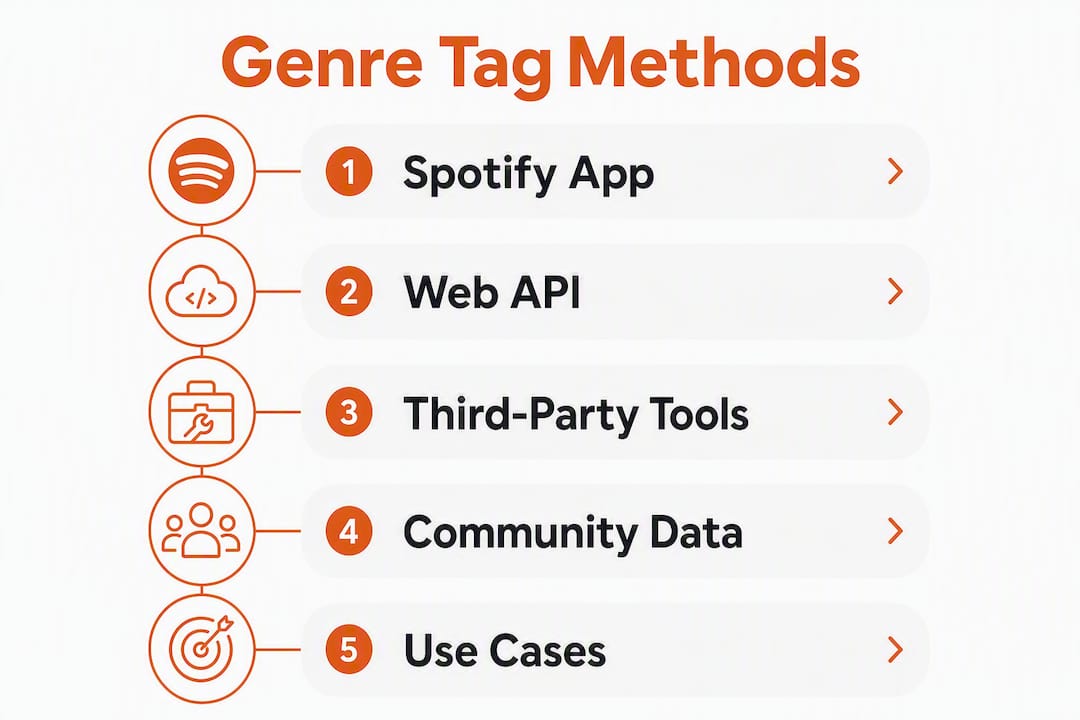
Method C: Third-party tools and community datasets
When the API returns limited data or you need bulk genre mapping, community tools fill the gap. Soundcharts and Chartmetric both surface genre data alongside streaming analytics, making them practical for curators and A&R teams who need genre context at scale. Every Noise at Once (built by former Spotify data engineer Glenn McDonald) maps the genre space visually and is widely referenced by curators and researchers as an approximation of Spotify’s internal taxonomy.
| Method | Access required | Accuracy / granularity | Best use case |
|---|---|---|---|
| Spotify app UI | Free Spotify account | Low — top labels only | Quick visual check |
| Spotify Web API | Free developer account | Medium — artist-level array | Structured data, bulk export |
| Soundcharts / Chartmetric | Paid subscription | High — enriched with analytics | Curator research, campaign planning |
| Community repos / Every Noise | Free (public) | Variable — community-maintained | Research, microgenre mapping |
Limitations and common misunderstandings about genre tags
The biggest misconception is that Spotify has a tidy, public master list of genres. It does not. The recommendation seeds endpoint exposes a constrained set of broad labels for developer use. The artist genres field returns a different, often narrower subset. And the full internal taxonomy, which community projects estimate at 6,271 identifiers, is never directly exposed through any official API.
Genre tags in Spotify are functional labels for internal systems, not a public classification standard. The set you can access via the API is a deliberate subset — optimized for performance and stability, not for completeness. Practitioners who need the full picture rely on community-maintained datasets because the official API intentionally exposes only a fraction of the taxonomy.
Artist-level tags also behave differently from what many people expect. The genres array on an artist object reflects Spotify’s assessment of the artist’s overall catalog, not individual tracks. Track-level genre assignment is more opaque and not directly exposed through the standard Web API. An artist who releases across multiple genres may carry a blended or incomplete tag set.
Common misunderstandings worth clearing up:
- “I can set my genre on Spotify.” You cannot. Genre tags are assigned algorithmically, not entered by artists.
- “The app’s genre categories match the API tags.” They do not. Browse categories are UI groupings; API tags are internal labels.
- “Microgenre tags are stable.” They shift as listener behavior changes. A tag like “bedroom pop” or “hyperpop” can appear, disappear, or split as Spotify’s systems evolve.
- “An empty genres array means no genre.” It often means the artist hasn’t accumulated enough behavioral data for Spotify to assign a confident label.
Can I change my genre on Spotify? Not directly. You can influence the signals Spotify uses to assign tags (metadata, listener behavior, playlist placements), but there is no field in Spotify for Artists where you type in a genre and it sticks.
How artists can influence genre signals and use them for pitching
Since you cannot edit genre tags directly, the practical goal is to make your genre signal as clear and consistent as possible so Spotify’s systems can classify you accurately.
Metadata hygiene checklist:
- Register accurate ISRC and UPC codes through your distributor before release.
- Use consistent artist name spelling across every distributor, streaming platform, and social profile.
- Write genre-aligned release descriptions and credits — these feed into metadata analysis.
- Deliver releases through the same distributor consistently; fragmented delivery creates inconsistent metadata signals.
- Tag your music correctly at the distributor level (genre and subgenre fields in TuneCore, DistroKid, CD Baby, etc.).
Spotify for Artists lets you edit your artist bio, select a profile image, and pitch unreleased tracks to editorial playlists through the pitch submission tool. The pitch form asks for a primary genre and mood — these fields inform editorial decisions but do not directly rewrite your API genre tags. Still, consistent genre framing across your bio and pitch submissions reinforces the signal.
For pitching to independent curators, your genre tags are evidence, not a guarantee. Pull your current tags via the API or a tool like Chartmetric, then use them to demonstrate fit. If your tags include “indie folk,” pitch to indie folk playlists that explicitly serve that audience. If your tags are vague or empty, use comparable artists’ tag sets to make the case.
Pro Tip: Behavioral signals matter more than metadata alone. Playlist placements, listener completion rates, and save-to-library actions all feed back into Spotify’s classification model. Getting placed on genre-specific playlists, even small ones, reinforces your genre signal over time.
How curators and promotion services use genre tags
For a playlist curator, a genre tag is a first-pass filter, not a final verdict. When a submission comes in, the first question is whether the track’s genre signal matches the playlist’s audience. A curator running an indie shoegaze playlist is not going to spend time on a track tagged “tropical house,” regardless of how good it is.
The workflow typically runs like this: genre filter first, then a listening check for sonic match, then an audience fit assessment based on the curator’s knowledge of their listeners’ habits. Tools like Soundcharts and Chartmetric let curators pull an artist’s genre tags alongside streaming data, skip rates, and audience demographics, which makes the fit assessment faster and more defensible.
Genre matching is the entry ticket, not the whole audition. A track that clears the genre filter still needs to fit the playlist’s sonic identity, tempo range, and mood. Curators who build loyal audiences are making decisions about listener experience, not just genre taxonomy.
Promotion services that route submissions algorithmically use genre tags and community datasets to match tracks to curators whose playlists carry overlapping genre signals. The better services also track outcomes — placement rates, skip rates, and audience match scores — to refine routing over time. That feedback loop is what separates a genre-aware service from one that just blasts submissions to every curator in a database.
Pro Tip: When submitting to curators, don’t just name your genre. Show your evidence: your current Spotify genre tags, two or three comparable artists with similar tags, and any existing playlist placements in the same genre space. Curators who receive hundreds of submissions weekly respond to specificity.
Where to find compiled genre lists and datasets
Because Spotify publishes no official master list, the community has built its own. These resources range from quick-browse gists to structured datasets with thousands of entries.
Key sources:
- Tiraya/spotify-genres (ThetaDev Code): Tracks 6,271 genre identifiers with localized names, a simple hierarchy, and metadata per genre ID. Best for developers building genre-mapping tools or doing bulk research.
- GitHub gists (community-maintained): A long-lived public gist lists 1,383 genre names in a simple format. Useful for a quick downloadable snapshot without setting up an API connection.
- Every Noise at Once: Glenn McDonald’s genre map provides a browsable, visual approximation of Spotify’s genre space. Widely used by curators and researchers. Note that it is a third-party approximation, not an official Spotify product, and its maintenance status can vary.
- Soundcharts / Chartmetric: Commercial platforms that surface genre data enriched with streaming analytics. Better for campaign planning than raw genre research.
- Spotify Community forums: The Spotify Community thread on finding genre info documents common user workflows and surfaces real-world confusion about where genre data appears.
| Source | Scope | Primary use case |
|---|---|---|
| Tiraya/spotify-genres | 6,271 genre IDs with hierarchy | Developer tools, bulk mapping |
| Community gist (andytlr) | 1,383 genre names | Quick browse, downloadable list |
| Every Noise at Once | Visual genre map (third-party) | Research, curator exploration |
| Soundcharts / Chartmetric | Enriched analytics + genre data | Campaign planning, A&R research |
| Spotify Web API (seeds) | Narrow seed list | Recommendation query building |
One important caveat: community lists go stale. Spotify’s internal taxonomy evolves as new microgenres emerge and listener behavior shifts. Any list you download today may be missing genres that appeared recently. Cross-reference against the API’s live genres field for any artist you are actively researching.
Key Takeaways
Spotify genre tags are algorithmically assigned, not artist-editable, and the full taxonomy is never publicly exposed — your best strategy is to optimize your metadata signals and use community datasets to pitch with precision.
| Point | Details |
|---|---|
| Tags are algorithmic, not manual | Spotify assigns genre labels using audio analysis, metadata, and listener behavior — artists cannot set them directly. |
| API access is the most reliable method | Call GET /artists/{id} via the Spotify Web API to retrieve the genres array; the recommendation seeds endpoint returns a narrower set. |
| No official master list exists | Community repos like Tiraya/spotify-genres catalog over 6,000 identifiers; the official API exposes only a fraction of that taxonomy. |
| Metadata hygiene shapes your signal | Consistent ISRC/UPC registration, distributor naming, and genre-aligned credits improve the accuracy of Spotify’s classification over time. |
| Intonality matches by genre signal | Intonality routes artist submissions to vetted, genre-matched curators with written feedback on every decision, averaging 4–11 playlist placements per campaign. |
Genre metadata is the part most artists skip
Most artists spend their pre-release energy on the mix and the cover art, then treat metadata as an afterthought. That is exactly backwards from how Spotify’s discovery systems actually work. The genre signal Spotify builds for your artist profile is assembled from dozens of inputs — your distributor metadata, the playlists you land on, the listening habits of your early fans, and the behavioral patterns of listeners who save or skip your tracks. By the time you notice your genre tags look wrong, the signal has already been baked in for months.
What I find underappreciated is how much leverage artists have before release. Getting your metadata right at the distributor level, pitching to genre-specific playlists early, and building a listener base that behaves consistently within a genre space — these actions shape the tag set Spotify eventually assigns. Trying to correct a misclassification after the fact is far harder than building the right signal from the start.
The other thing worth saying plainly: microgenre proliferation is not a problem to solve. It is a feature of how Spotify’s system works. A tag like “dark folk” or “lo-fi beats” is not noise — it is a precise signal to a specific audience. Artists who lean into their microgenre identity, rather than chasing a broader label, tend to land on playlists where listeners actually care about what they are hearing. That is the kind of placement that moves the needle.
Genre-matched playlist promotion that actually reaches real curators
If you have done the genre research and your metadata is clean, the next question is how to get your track in front of curators who are actively looking for exactly what you make. That is where Intonality comes in.
Intonality sends personalized pitches to vetted, genre-matched curators — real people running real playlists, not bots or fake streams. Every submission gets written feedback from each curator decision, so you know exactly why a track was accepted or passed on. Campaigns include real-time dashboard updates, and pre-release submissions are supported so your track can land on playlists from day one. Whether you make indie folk, dark pop, or something harder to categorize, Intonality’s genre-matching process routes your track to curators whose audiences already listen in your space. Campaigns average several playlist placements depending on tier.
Submit your track at Intonality and start your campaign today.
Useful sources
- Spotify Web API — Artist Object: The official reference for the
genresfield on artist objects and search filter syntax. Start here for API integration. - Get Available Genre Seeds — Spotify for Developers: Documents the
GET /recommendations/available-genre-seedsendpoint. Use this to understand the constrained seed list and its difference from the full taxonomy. - Tiraya/spotify-genres (ThetaDev Code): Community repo cataloging 6,271 genre IDs with localized names and hierarchy. Best for bulk research and developer tooling.
- Community gist — ~1,383 Spotify genres: A long-lived public snapshot of genre names. Quick to download; check the date before relying on it for current microgenres.
- Spotify Community — How do I find what genre a song is?: Real user workflows and common confusion points. Useful for understanding what non-developer users encounter.
- Spotify Ads API — Genre Targets: Documents genre IDs and names used for ad targeting. A secondary but useful surface for understanding how Spotify exposes genre data across products.
- Get Categories — Spotify for Developers: Reference for the Browse Categories endpoint. Read this alongside the genre API docs to understand why the two systems differ.
Maintenance note: Community lists (GitHub repos, gists, Every Noise) are updated by volunteers and may lag behind Spotify’s live taxonomy by weeks or months. For any active campaign or pitch, always cross-reference against the live API genres field for the specific artists you are researching.