Sometimes, but not for the reason most artists pay for it. Playlist promotion rarely pays for itself in royalties. It is worth the money when it puts a well-matched track in front of real listeners, shows you honest feedback, and gives Spotify enough genuine saves and follows to keep recommending you. It is a waste when it buys guaranteed placements, bot-filled playlists or passive background listening.
This guide covers what the evidence says, what can go wrong, how to measure a campaign, and when to skip paid promotion entirely.
TL;DR
- Judge a campaign by saves, follows and listening that continues afterward, not by immediate royalty income. Most campaigns lose money in the short term.
- Anything that guarantees streams or placements is a red flag. Spotify says such services violate its terms and can trigger penalties.
- Pitching Spotify’s editors through Spotify for Artists is free and should come first.
- Paid promotion is worth trying when you have a finished, genre-clear track and a budget you can afford to lose. Measure it against a baseline.
- The best paid option pitches real, genre-matched curators and returns written feedback on every decision, so even a decline teaches you something.
What you are actually paying for
There are two very different things sold under the name “playlist promotion.”
The first is pitching: someone presents your track to human curators who decide whether it fits their playlist. You pay for access, effort and feedback. The curator can say no.
The second is guaranteed placement or guaranteed streams. This is the one to avoid. Spotify’s official guidance says that third-party services promising streams or playlist placement in exchange for money are illegitimate and violate its terms. Its artist pages go further and describe such marketing services as scams that often use bots to inflate numbers instead of reaching genuine listeners.
So the first question about any service is simple: does it promise a result, or does it promise a fair hearing? A fair hearing is promotion. A promised result is a risk.
What the evidence says about results
The honest picture is mixed.
Big playlists move numbers. Research on Spotify’s own large playlists found that being added to a list like Today’s Top Hits had a large causal effect on streams, raising eventual streams by nearly 20 million. That is the top of the market, and no independent campaign should expect it.
Independent artists can benefit proportionally more. A 2026 academic analysis of streaming revenue found that independent labels saw a larger relative revenue uplift from playlist exposure than major labels (8.6% against 7.5% during listing). The same work notes that major labels keep a structural advantage in distribution and curation reach. Playlists help smaller acts bridge a gap, but they do not level the field.
Most paid campaigns lose money in royalties. One artist documented a 2019 campaign where $1,085.81 in spend produced $195.53 in earnings, a loss of $890.28. His conclusion was that the measure that matters is whether the campaign built a lasting audience, grew followers and produced enough saves and follows to trigger longer-term algorithmic recommendations. That is a single artist’s account from several years ago, so treat it as an illustration, not a benchmark. It does match what most working musicians report.
If you expect a streaming royalty rate to repay a promotion budget, you will be disappointed. Per-stream payouts are too small. The case for promotion rests on audience, not payout.

What you can gain besides streams
Streams are the visible number, but they are the least durable benefit. Here is what a good campaign can leave you with.
- Written curator feedback. A decline with a reason tells you whether the problem is the mix, the genre fit, the intro or the artwork. That is market research you could not otherwise get.
- Playlist placements on lists with real followers. Real listeners who save the track and follow you are the signal Spotify’s recommendation systems respond to. Our guide to how Spotify’s algorithm works explains which signals count.
- Curator relationships. A curator who liked one track will often listen to the next.
- Proof for the rest of your promotion. A track that has been added by genre-matched curators is easier to pitch to blogs, press and other curators.
- Data on your audience. Which countries, which playlists and which listeners respond tells you where to aim your next release and any paid social spending.
Spotify’s own position is that the only sustainable path for career growth is acquiring genuine fans who engage with your music. Promotion is worth it exactly to the extent that it helps you find them.
The risks, and how to avoid them
The cost of a bad campaign is more than lost money.
When Spotify detects artificial streaming, the consequences can include removal of tracks from playlists, withheld royalties and, in serious cases, removal of content from the platform. Spotify’s US support page also lists corrected public stream counts and distributor or account action among the outcomes. These penalties land on the artist, not the vendor.
And even without bots, a placement can be worthless. A playlist full of passive listeners, people who leave it running and never save a song, gives you stream counts without fans.
Warning signs worth checking before you pay:
- A guaranteed number of streams, listeners or placements. Real curators cannot promise yes before hearing your song.
- No named playlists or curators. If you cannot see where tracks land, you cannot check the quality.
- Sudden spikes from countries unrelated to your genre or audience. This is a common sign of botted traffic.
- No feedback on rejections. A service that only reports successes is hiding something.
- Prices that sound too low for the work. Pennies per placement usually means automation.
We go deeper in our survival guide to playlist promotion scams and in what every artist must know about fake streams.
Start with the free route
Before spending anything, use the one channel Spotify itself provides. Spotify for Artists is the only way to submit unreleased music for Spotify’s own playlist consideration. It costs nothing, and you can submit one upcoming release at a time.
What else costs little or nothing:
- Contacting independent curators directly with a short, personal, genre-specific message.
- Adding your own tracks to your own playlists and building a small, genuine following around a theme.
- Asking your existing fans to save and share the track on release day.
Free routes are slow and the replies are often silence. That is the real argument for paid pitching: you are buying time and a response, not a result.
What does it cost?
Prices vary widely by method. Direct outreach is free apart from your time. Submission-style services typically charge per curator you reach. Agency-style campaigns are priced per campaign and usually run higher. Guaranteed-placement sellers are usually the cheapest per placement and the riskiest.
The useful question is cost per genuine outcome, not per submission. If a campaign reaches 25 curators and none are in your genre, the price is irrelevant. Our playlist promotion cost guide for indie musicians walks through how to set a budget by release, and our comparison of playlist promotion services shows what to compare between providers.
A sensible rule: set aside money you can lose without hardship, put it against one strong track, and treat the first campaign as a test.
How to measure whether it was worth it
Most artists skip this step and then argue about it afterward. Decide your measures before the campaign begins.
Set a baseline
Note your daily streams, listeners, saves and followers for the two weeks before. A company guide to measuring pitching results recommends comparing pre-campaign, campaign and post-campaign windows, and cautions that playlist data alone cannot prove cause and effect. Log any other promotion you run at the same time, such as social ads or a press feature, so you do not credit the playlists for everything.

Read the source of streams
In Spotify for Artists, the Source of streams report separates active sources (your profile and catalog, a listener’s own playlists or library, the queue) from programmed sources such as editorial and algorithmic playlists, autoplay, and other listeners’ playlists. You can filter by period, country, streams, listeners or streams per listener.
What you want to see after a campaign:
- Streams per listener above one, meaning people come back to the song.
- Listening from your own profile and from listeners’ libraries, not only from the placement playlists.
- A rising count of saves and playlist adds.
- Follower growth that does not vanish after the placements end.
Spotify has also reported that about a third of new artist discoveries happen in personalized sessions, which is why saves and repeat listening matter more than the raw play count. Our walkthrough of Spotify for Artists analytics for verifying promotion covers the screens in detail.
Compare against a control
If you have a second track that was not promoted, watch it too. If both rise, the cause is probably something else, like a social post that took off. Marketers in other channels work the same way, and a streaming audio advertising guide shows how baseline-versus-campaign thinking applies to paid audio.
Decide your success line in advance
Examples: “At least 5% of listeners save the track,” “200 new followers,” “three genuine playlist adds from lists in my genre.” Anything above that is a bonus. Anything below tells you to change the track, the targeting or the channel before spending again.
Perspective: why we built Intonality around feedback
We started from a simple view: the problem with playlist promotion was never that curators exist. It is that so many services hide what happens between payment and result.
So we pitch real curators who are manually screened and matched to your genre, and we show the outcome of every decision. When a curator adds your song, you see it. When a curator declines, you get written feedback explaining why. We think a decline with a reason is worth more to a new artist than a vague promise of exposure, because it tells you what to fix before the next release.
We do not sell fake streams or bots, and we do not promise a fixed outcome. By our own account, campaigns average 4 to 11 playlist placements depending on the tier chosen, and that is a company figure, not a guarantee for your track. Whether your song lands depends on the song and the fit.
Our honest advice: pay for promotion only when the music is ready, when you can afford the test, and when the service lets you see exactly what it did. If a provider will not show you that, walk away.
— Einars
Where Intonality fits
If you decide to run a paid campaign, Intonality sends personalized pitches to vetted, genre-matched curators, with real-time updates and written feedback on each decision. You can also submit a track before release. Our Starter, Standard, Pro and Max campaigns differ in reach and in the number of curators pitched, and you can submit your track to start.
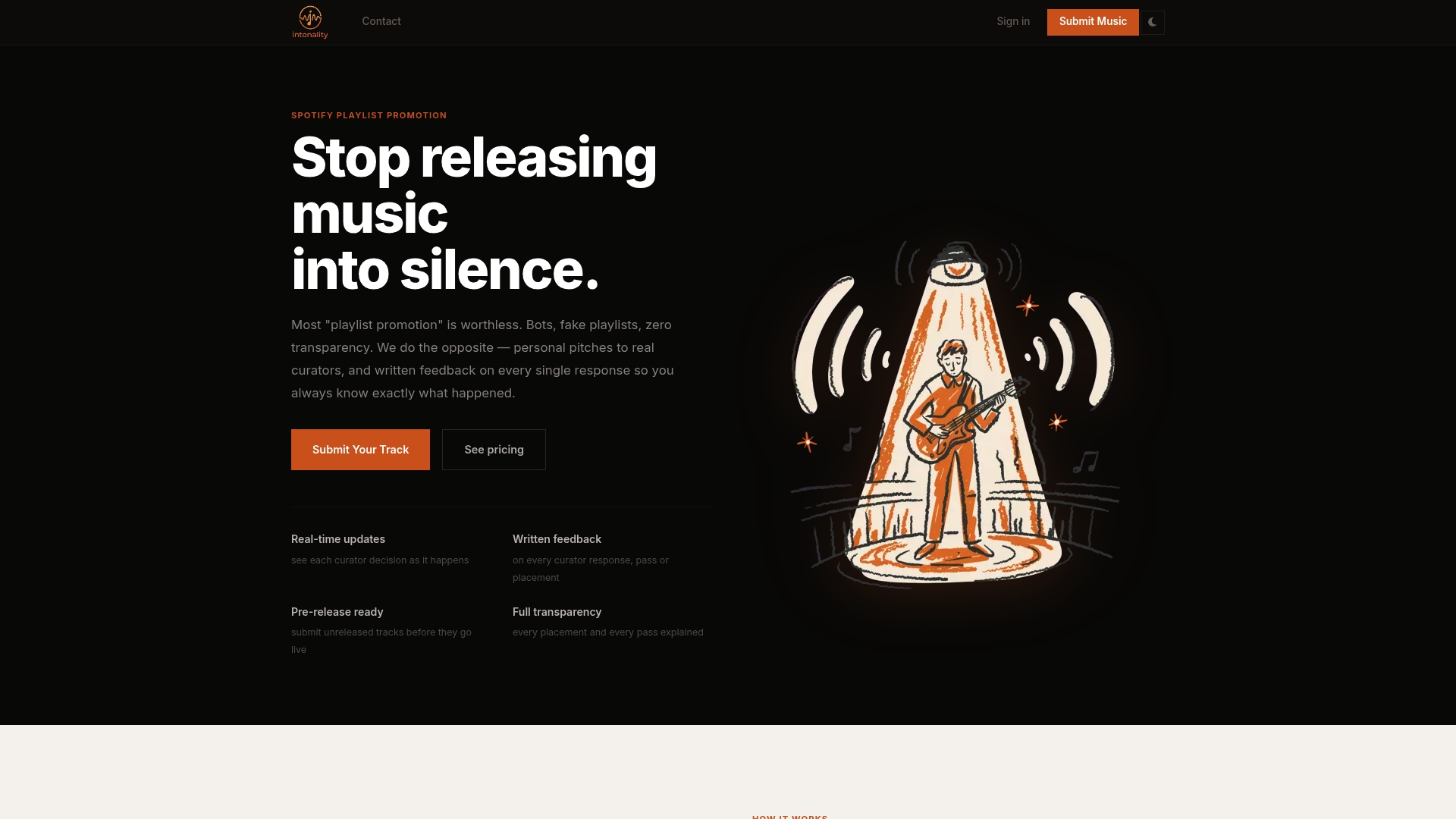
If you want to see the kind of curators involved first, browse profiles such as Music Playlists or May’s Music to check the genre fit before you commit.
When promotion is not worth it
Skip paid promotion, or delay it, if any of these apply:
- The track is not finished. A rough mix gets declined, and you pay for the lesson.
- You cannot describe your genre in two or three words. Curators cannot match what you cannot name.
- You have no release plan. Placements work better alongside a release-day push, a profile with a clear bio and a few good photos.
- You need the money back quickly. Royalties will not cover the cost soon, if ever.
- The only service available promises numbers. Wait.
A wider plan helps too. Our Spotify marketing strategy guide puts playlists next to ads, social and live shows, and our checklist on turning playlists into royalties covers what to do with the listeners once they arrive. If you want a shortlist of reputable options by type, see best Spotify playlist promotion for independent artists.
FAQ
Is paying for Spotify playlist promotion worth it?
It can be, if you pay for pitching to real curators and measure the result by saves, follows and continued listening. It is not worth it if you pay for guaranteed streams or placements, which Spotify says violate its terms. Expect to recoup little in royalties at first.
Is paid playlist promotion against Spotify’s rules?
Spotify prohibits third-party services that promise streams or placements for money. Pitching a curator who is free to decline is a different thing from buying a guaranteed result. Check that any provider does not guarantee outcomes and does not use bots.
How do I know if the listeners were real?
Open Spotify for Artists and read the Source of streams report. Look at streams per listener, saves, playlist adds and whether listening continues from your profile or from listeners’ libraries after the campaign ends. Spikes from unrelated countries or zero saves suggest low-quality traffic.
Should I try free options first?
Yes. Pitch your unreleased track through Spotify for Artists, contact curators directly and build your own playlists. Paid promotion buys speed and feedback, so it makes most sense once you have a finished track and have already used the free channels.
How many playlist placements should I expect?
No honest provider can promise a number. Intonality reports an average of 4 to 11 placements per campaign depending on the service tier, but results depend on your song and its genre fit.
Sources
- Artificial Streaming, Spotify for Artists
- Artificial streaming and paid third-party services, Spotify Support
- Source of streams, Spotify Support
- Playlisting, Spotify for Artists
- Learn how fans discover your music on Spotify, Spotify for Artists
- How playlists shape music streaming revenue and demand, UNSW Business Think
- Platforms, Promotion, and Product Discovery, NBER
- I spent $1,000 on Spotify playlist promotion in 2019, Medium
- Measure Playlist Pitching ROI, Dynamoi
- Streaming Audio Advertising: A Buyer’s Guide for 2026