

Yes, playlists generate royalties, but the amount depends on streamshare math, which royalty bucket a stream lands in, and whether your paperwork is in order. A placement on a high-follower, well-matched playlist can produce real revenue; most placements produce modest amounts. Neither happens automatically. You need correct registrations with your distributor and your PRO, verified splits, and a placement that actually reaches listeners who stick around.
TL;DR:
- Playlist streams only count toward royalty pools after reaching 1,000 streams in the past year, limiting small placements’ payouts.
- Income depends on streamshare, which is affected by playlist size, position, listener engagement, and whether streams are from Premium or ad-supported users.
- Proper registration with ISRC and ISWC codes, verified splits, and correct distributor settings are essential before promoting to ensure accurate royalty flow.
- Fake playlists, payola, or manipulated streams can cost artists money and lead to missing royalties, especially as Spotify enforces stricter anti-fraud measures.
Table of Contents
- How Playlists and Royalties Actually Connect Through Streamshare
- What Royalty Types Does a Playlist Stream Actually Generate?
- Do Playlist Placements Really Move the Needle on Streams?
- Why Your Bank Balance Doesn’t Match Your Spotify Stats
- A Prioritized Checklist for Turning Playlist Exposure Into Real Revenue
- Spotting Fake Playlists, Payola, and Streaming Fraud
- Editorial Playlists vs. Algorithmic Playlists: Different Royalty Math
- Exclusive vs. Non-Exclusive Playlist Deals: What Changes for Your Royalties
- User-Generated Playlists Add Volume, But They’re a Wildcard for Royalties
- Third-Party Curators and Aggregators: Where the Royalty Trail Can Get Murky
- Legal Ground Is Shifting Under Playlist Royalties
- The Publisher’s View: Administration Beats Optimism
- Getting Your Music in Front of Real Curators Who Actually Listen
- Sources
How Playlists and Royalties Actually Connect Through Streamshare
Spotify doesn’t pay a fixed rate per stream. It uses a streamshare model, which means your royalty depends on the percentage of total global streams your track represents in a given month and territory, not a flat cents-per-play number. Every dollar Spotify collects from Premium subscriptions and ad sales gets pooled by market, and then divided among rightsholders based on their slice of total plays that month.
Roughly two thirds of Spotify’s revenue gets paid out to rightsholders, and that pool splits by rights type: about 80% goes to recording rightsholders and 20% to publishing rightsholders. A playlist placement doesn’t change your rate. It changes your streamshare by adding volume, and volume is the only lever that moves your payout inside this model.
A few mechanics shape how much a playlist stream is actually worth:
- Premium streams pay more than ad-supported ones, because the revenue pool behind a paid subscription is larger per listener.
- Country matters because average revenue per user varies widely between markets, so a playlist popular in a high-ARPU country like Norway will out-earn one with the same stream count in a lower-ARPU market.
- Monthly totals reset the math, so the same track can earn a different rate from one month to the next depending on how much total listening happened on the platform.
Here’s a number that trips up a lot of new artists: Spotify only counts a track toward the recorded music royalty pool once it clears 1,000 streams in the prior 12 months. A track that gets 300 plays from a small playlist placement generates listening activity, but that activity may never fully register in the pool calculation used to determine payout eligibility. This is one reason tiny playlist placements can look exciting in your dashboard and still produce close to nothing in your bank account.
What Royalty Types Does a Playlist Stream Actually Generate?
A single playlist stream triggers two separate royalty types that flow through completely different pipes. Mixing them up is the single most common reason artists misunderstand their own statements.
Recording royalties go to whoever owns the sound recording, usually the artist, their label, or the party financing the master. Publishing royalties split into two further pieces: mechanical royalties (for reproducing the composition) and performance royalties (for the public performance of the underlying song), both owed to the songwriter and their publisher. A cover song, for instance, generates recording royalties for the performer but publishing royalties for the original songwriter, not the person who recorded the version on the playlist.
Getting paid on both sides requires a specific paper trail:
- ISRC codes identify your specific recording and are assigned by your distributor. Every version, remix, or edit needs its own.
- ISWC codes and composition registration identify the underlying song and route publishing royalties to you through your Performing Rights Organization, whether that’s ASCAP, BMI, SESAC in the US or a collecting society like PRS for Music elsewhere.
- Distributor payee and territory settings determine who actually receives the recording-side check, so a wrong entry here silently redirects money.
Before you chase a single playlist placement, confirm these three items are current. A great campaign on top of broken registration just produces impressive stream counts and disappointing statements.
Do Playlist Placements Really Move the Needle on Streams?
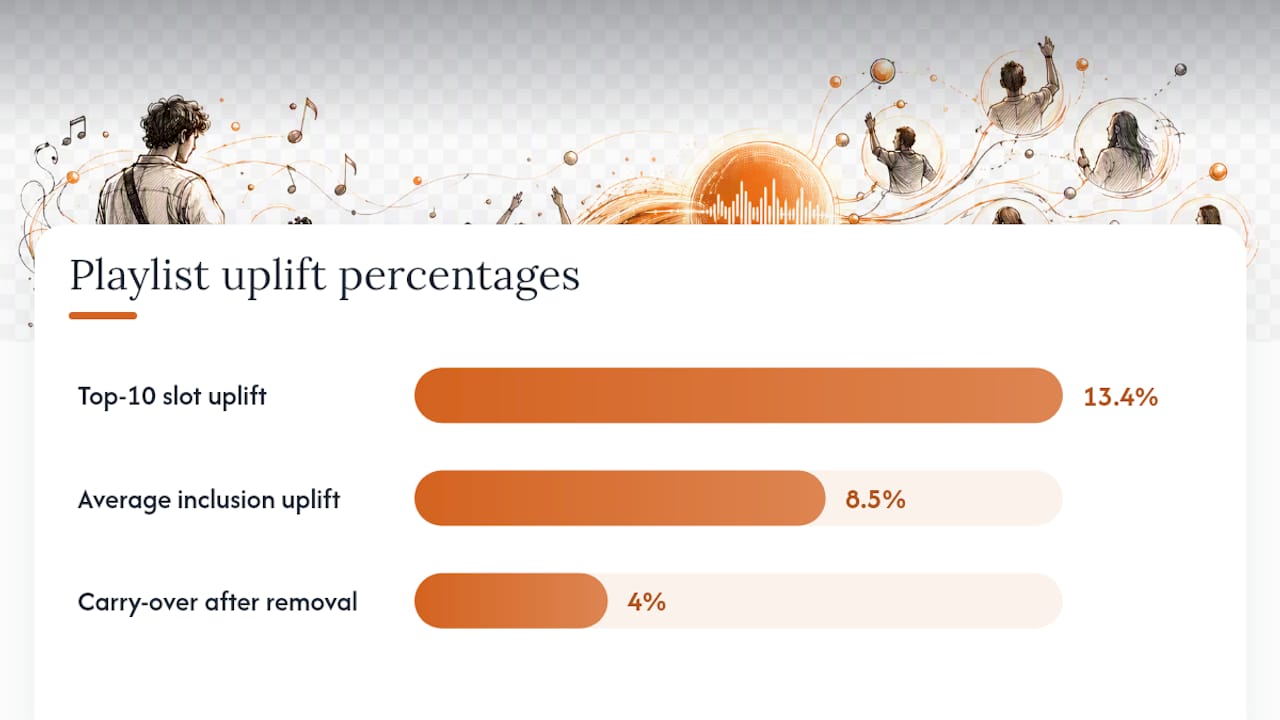
They do, but the size of the move depends heavily on which playlist you land on. A large study out of UNSW tracking playlist behavior found that inclusion lifts streams by an average of 8.5% while a track is listed, with a carry-over effect of roughly 4% even after the track gets removed. That carry-over is the number worth remembering: it means a good placement keeps paying you after it’s over, because some of the listeners it introduced you to stick around.
The gap between a strong placement and a weak one is enormous. The same research modeled 90-day revenue outcomes and found top-quintile playlists (the top 20% by follower count and engagement) generated simulated revenue around $1,997, compared to roughly $77 for bottom-quintile playlists over the same window.
| Playlist tier | Average uplift effect | 90-day revenue simulation |
|---|---|---|
| Top quintile (top 20% by followers/engagement) | Substantially higher than average | ≈ $1,997 |
| Bottom quintile | Minimal, often negligible | ≈ $77 |
| Top-10 chart position within a playlist | Uplift around 13.4% | Higher than lower-slot placements |
Pro Tip: Ask a curator or promotion service where on the playlist your track will sit, not just which playlist it’s going on. A top-10 slot on a mid-size playlist frequently outperforms a bottom-40 slot on a bigger one.
Position matters because listener attention drops off fast the further down a playlist you go. The same research found tracks placed in the top 10 slots saw uplift around 13.4%, meaningfully higher than lower positions on the same list. Fit matters too: a playlist whose regular listeners already enjoy your genre and tempo converts better into saves and follows than a mismatched placement with more raw followers. And prior exposure changes the math, since independent and smaller-label artists tend to see proportionally larger gains from a placement, because their baseline streaming numbers are lower and any lift shows up as a bigger percentage jump.
Why Your Bank Balance Doesn’t Match Your Spotify Stats
Streams don’t turn into cash on a fixed schedule you can circle on a calendar, but the general rhythm is monthly. Spotify pays rightsholders, meaning your label or distributor, roughly on a monthly basis for the prior period’s streaming activity, and that money then has to travel down a chain before it reaches you.
That chain is where most of the confusion happens:
- Distributors often hold to minimum payout thresholds, so if your account balance sits below a set amount, the money stays parked until it clears the bar.
- Recoupment eats into artist receipts if you took an advance from a label or distributor, since royalties get applied against that balance before you see a cent.
- Split agreements divide the pie before it reaches you, so a track with three co writers and a producer taking points means your dashboard total isn’t your take-home number.
- Administrative fees, whether from a distributor, publisher, or collection society, get deducted before the final transfer.
If a payout looks wrong, don’t assume Spotify made an error. Spotify itself can’t explain downstream splits between you and your label or distributor, because those terms live in contracts Spotify isn’t party to. Start your investigation with your distributor dashboard, then your original contract, then your PRO statement, in that order. Understanding the 55/45 revenue share structure that many distribution deals use is a good place to start if you’ve never actually read the fine print on your own agreement.
A Prioritized Checklist for Turning Playlist Exposure Into Real Revenue
Most artists chase placements before fixing the plumbing. Flip that order.
- Register your compositions with your PRO first. No registration means no performance royalty collection, no matter how many playlists pick up your track.
- Verify your distributor’s split settings for every collaborator before release, not after a placement drives a stream spike you’ll want to get paid on correctly.
- Confirm your ISRC and ISWC codes are attached properly. These are the identifiers that route money to the right rightsholder, and errors here are invisible until a payout comes in short.
- Target playlists with an audience that actually matches your genre and tempo, since fit drives saves and follows far more than raw follower count does.
- Track play-through rate and save rate, not just stream count, using Spotify for Artists analytics to see whether listeners are engaging or skipping.
- Push for higher positions within a playlist when you have any leverage in the conversation, since top-10 slots meaningfully outperform buried placements.
- Measure saves, follows, and geographic spread over the following weeks. These are the metrics that predict whether a placement built lasting audience or just produced a short-lived stream bump.
Here’s the budget reality nobody likes to say out loud: paid playlist pitching on playlists with 10,000 to 100,000 followers typically produces only thousands of incremental streams over a campaign window, often worth well under $30 in gross royalties at typical per-stream rates. Breaking even on royalties alone from a paid campaign usually requires well over 100,000 incremental streams, which most single placements don’t deliver. That’s not a reason to skip promotion. It’s a reason to measure success by saves and follower conversion instead of royalty payback, since those signals predict whether listeners return and generate revenue well beyond the campaign itself. A budget guide for paid pitching campaigns can help you set expectations before you spend anything.
Spotting Fake Playlists, Payola, and Streaming Fraud
Not every playlist offer is legitimate, and the fallout from a bad one goes beyond wasted money. Spotify actively detects artificial streaming and can withhold royalties or remove tracks from playlists when manipulation is flagged, meaning a shady placement can cost you money you already earned elsewhere on the same release.
Watch for these warning signs:
- A playlist promising thousands of streams for a flat fee with no curator review process.
- Follower counts that look inflated relative to actual engagement, save rates, or comment activity.
- Payola arrangements where a curator demands payment specifically for guaranteed placement rather than editorial judgment.
- Bundled “playlist packages” that don’t disclose which specific playlists your track will land on.
If you suspect fraud, screenshot everything, contact your distributor immediately, and flag the activity to your PRO if royalties were affected. Intonality’s breakdown of common playlist promotion scams covers detection and recovery steps in more depth.
Editorial Playlists vs. Algorithmic Playlists: Different Royalty Math
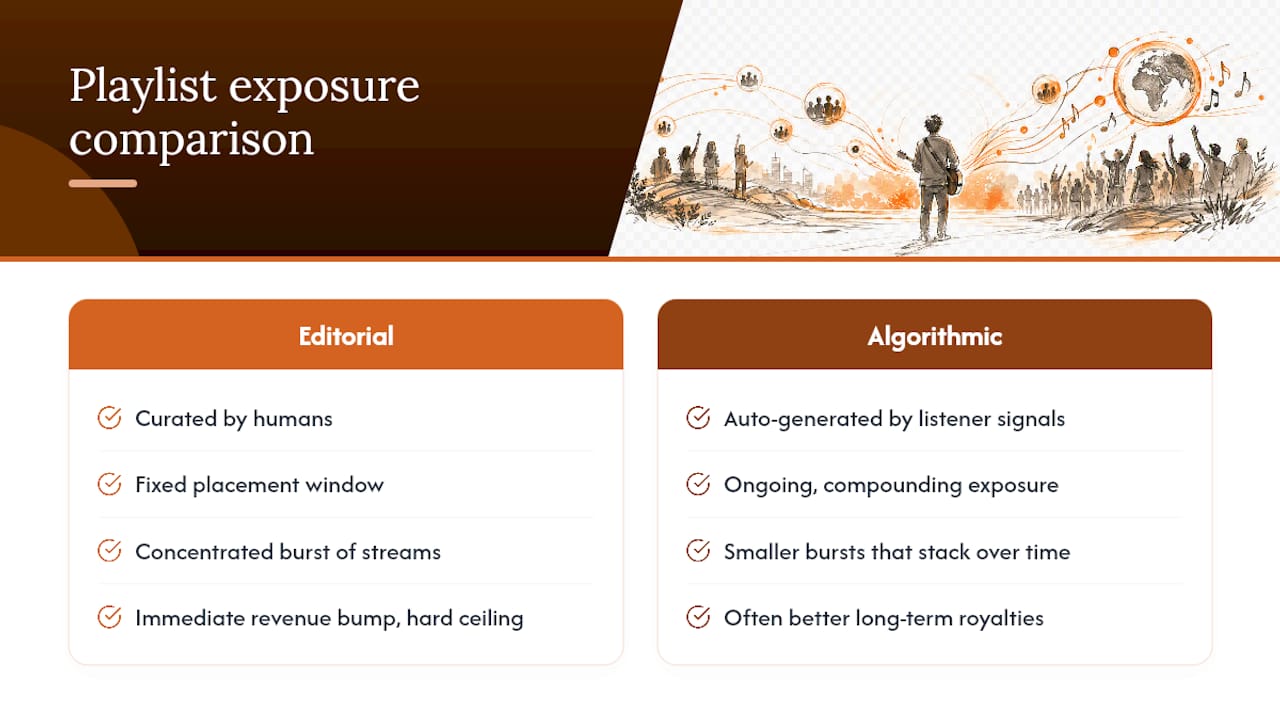
Editorial playlists, the curated ones built by Spotify’s in-house teams or third-party curators, tend to produce a concentrated burst of streams tied to a fixed placement window. You know roughly when you’re on, and you can watch the uplift happen in real time on your dashboard.
Algorithmic playlists work differently. Discover Weekly, Release Radar, and similar auto-generated lists respond to listener behavior signals like skip rate, save rate, and repeat listens rather than a curator’s one-time decision. That means algorithmic exposure can compound: a strong save rate on one algorithmic playlist increases the odds of surfacing on another, creating a snowball effect that a single editorial placement doesn’t produce on its own.
The royalty impact tracks this behavioral difference. An editorial placement generates a lump of streams concentrated in a defined window, useful for an immediate revenue bump but with a hard ceiling once the playlist refreshes and your track rotates off. Algorithmic exposure, when it takes hold, tends to generate smaller individual bursts that stack over a longer stretch of time, and it’s harder to lose entirely because it’s not tied to one curator’s ongoing goodwill.
For royalty purposes, this means algorithmic performance is often the better long-term bet, but it’s also the one you can’t pitch for directly. You earn algorithmic placement by driving the engagement signals, saves, low skip rates, playlist adds, that the algorithm rewards, which is exactly why a metric-first approach to any editorial placement pays off twice: once from the placement itself, and again from whatever algorithmic exposure it triggers afterward.
Exclusive vs. Non-Exclusive Playlist Deals: What Changes for Your Royalties
An exclusive playlist arrangement, where a curator agrees to feature your track only on their playlist for a defined period, or where a platform locks a release behind a temporary exclusivity window, doesn’t change your royalty rate. Streamshare math applies the same way regardless of exclusivity terms. What changes is your total stream volume and where those streams originate.
Exclusivity deals can concentrate attention, giving a curator or platform reason to promote your track more heavily because they have something unique to offer their audience. That can translate into a bigger uplift than a non-exclusive placement would produce, since the curator has skin in the game. The tradeoff is opportunity cost: while you’re locked into one arrangement, you’re not pursuing simultaneous placements elsewhere that might have added up to more total streams.
Non-exclusive arrangements, which describe the vast majority of independent playlist pitching, let you pursue multiple placements at once. This is usually the better approach for royalty purposes if you’re not being offered anything unusually valuable in return for exclusivity, since royalty income scales with total stream volume across all placements combined, not with how special any single one looks.
Read any exclusivity clause carefully before you sign it, especially language about duration and whether it applies to the recording, the composition, or both. A vague exclusivity term can quietly restrict your ability to pitch the same track elsewhere for longer than you intended, cutting into total streamshare during a window when you had no other placements generating volume.
User-Generated Playlists Add Volume, But They’re a Wildcard for Royalties
Curated editorial and algorithmic lists get most of the attention in royalty discussions, but user-generated playlists, the ones built by regular listeners rather than professional curators or Spotify’s algorithm, quietly account for a large share of total listening on the platform. Every stream from a user-generated playlist feeds the same royalty pool as any other stream. The mechanics don’t change.
What does change is predictability. You can’t pitch a user-generated playlist the way you pitch an editorial curator, and you generally can’t track which specific personal playlists your track has landed on unless a fan tells you directly. This makes user-generated playlist inclusion a byproduct of good release strategy rather than a direct target for a promotion campaign.
The upside is durability. A track that gets added to enough personal playlists tends to keep generating a low, steady stream of plays long after any promotional push has ended, because those playlists don’t rotate content the way editorial lists do. That slow trickle rarely produces a dramatic royalty spike, but it compounds over months and years in a way a single editorial placement can’t, since personal playlists tend to stick around in a listener’s rotation far longer than a curated list’s featured slot.
Encouraging saves and playlist adds, rather than just plays, is the most direct way to influence this outcome. A listener who adds your track to their own playlist has effectively opted into recurring royalty generation on your behalf, with no further promotional cost to you.
Third-Party Curators and Aggregators: Where the Royalty Trail Can Get Murky
Independent curators running large playlist networks, along with aggregator services that bundle access to multiple curators, sit between you and the streams your royalties depend on. They don’t hold any rights to your recording or composition, so they’re never entitled to a cut of your actual royalty payments. Any legitimate curator or aggregator makes money through submission fees or subscription access to their pitching platform, not through your royalty stream.
That distinction matters because it’s exactly where scams hide. A curator or aggregator demanding a cut of your future royalties in exchange for placement is not operating a legitimate submission model, and you should treat that request as a red flag regardless of how professional the pitch sounds.
Legitimate third-party services add value by widening your reach to curators you wouldn’t otherwise find, and by giving you feedback on why a submission was passed over. That feedback loop is worth more than it sounds, since it tells you whether a rejection was about fit, timing, or playlist capacity, information that helps you target future submissions more precisely. What these services can never do is guarantee royalty income, because royalties depend on streamshare and listener behavior after placement, both of which are outside any curator’s control once your track is live on their list.
Legal Ground Is Shifting Under Playlist Royalties
Playlist-driven royalty disputes tend to cluster around three recurring issues: artificial streaming enforcement, contested splits between collaborators, and disagreements over what counts as a qualifying stream for payout purposes. Spotify’s own enforcement against manipulated streaming has grown more aggressive, with the platform actively excluding detected artificial activity from royalty calculations and removing offending tracks from playlists entirely, a policy that puts real financial risk on any artist tempted by a stream-boosting service.
The 1,000-stream eligibility threshold for the recorded music royalty pool, introduced as a policy change, remains a point of contention among smaller artists who argue it disproportionately affects niche and emerging acts. Whether further threshold changes or legal challenges emerge around this policy is worth watching, since it directly determines whether a modest playlist placement even counts toward payout eligibility.
Split disputes between collaborators are less a matter of platform policy and more a matter of contract clarity, and they surface constantly in playlist-driven release scenarios where a track suddenly generates more attention than anyone planned for. None of this is a substitute for legal advice specific to your situation. If a dispute involves real money, a music attorney or your PRO’s member services team is the right next step, not a general guide.
The Publisher’s View: Administration Beats Optimism
Administration beats guesswork every time. Registering your compositions, verifying your splits, and confirming your ISRC and ISWC codes matter more to your actual take-home than any single placement decision, because a broken registration turns a great campaign into a great campaign that pays you nothing.
Track saves and follower conversions as your primary success metrics, not raw stream counts. A placement that converts casual listeners into followers builds an audience that keeps paying you in royalties long after the playlist forgets your track exists.
Treat playlist promotion as audience building, full stop. Royalty uplift is a welcome byproduct of a good placement, never a guaranteed return on the money you spent getting it. Artists who understand that distinction spend their promotional budget more wisely, and they’re far less likely to feel burned when a single campaign doesn’t pay for itself in royalties alone.
— Einars
Getting Your Music in Front of Real Curators Who Actually Listen
Intonality is the alternative to blind bulk-submission tools for artists who want their track heard by curators who genuinely fit the genre. Instead of automated blasts or paid placement guarantees, Intonality sends personalized pitches to vetted, genre-matched curators, and every decision comes back with written feedback so you know exactly why a submission landed or didn’t.
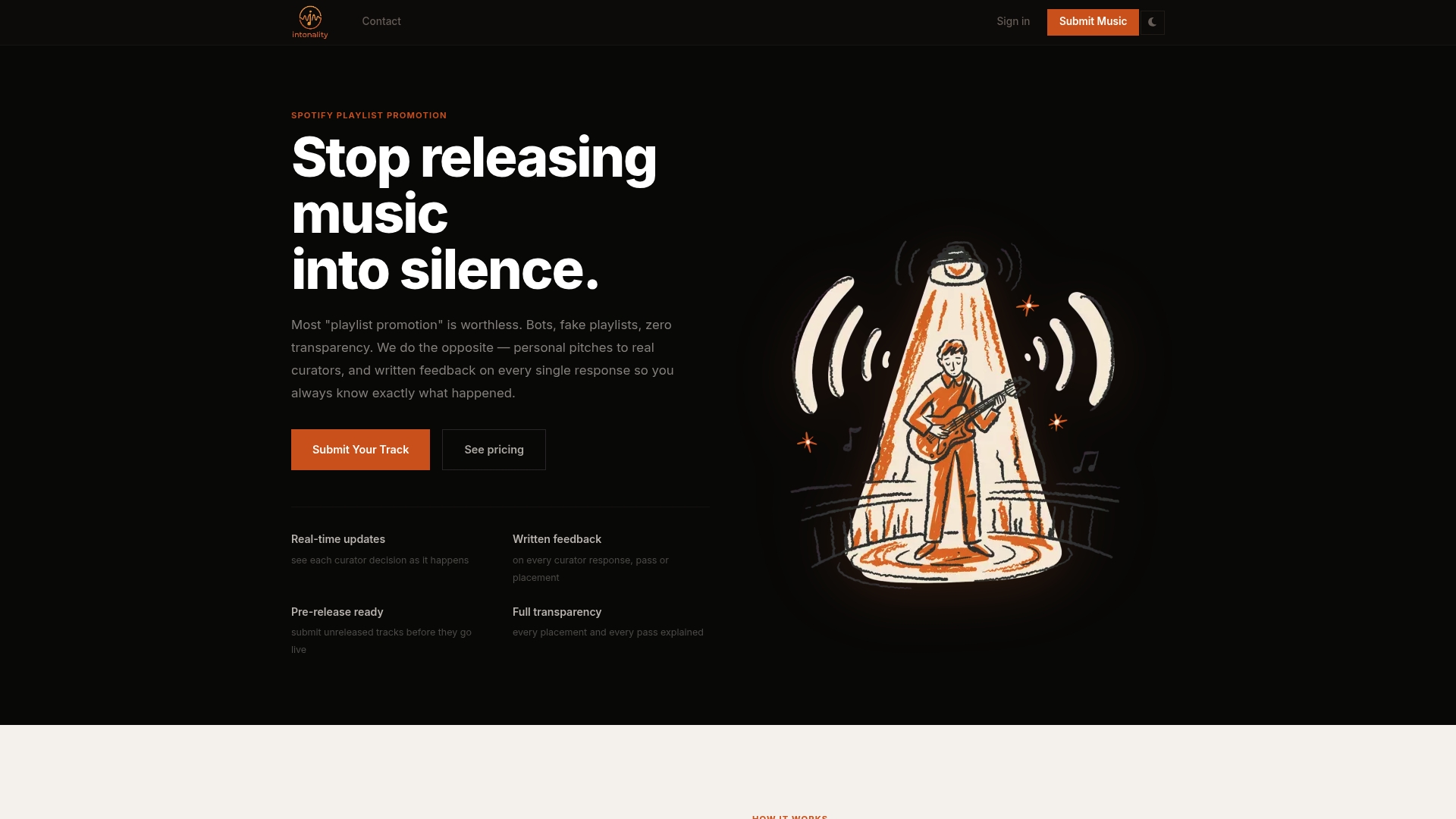
Real-time updates mean you’re not guessing whether your pitch is sitting in an inbox somewhere. Campaigns reportedly average 4 to 11 playlist placements depending on the service tier chosen, a client-reported figure that reflects tangible curator interest rather than automated adds. Given what the research shows about royalty payback from paid pitching alone, the smarter frame here is audience growth: a well-matched placement builds the saves and follower conversions that compound into future streams, with royalty income as a welcome side effect rather than the main promise.
If you’ve been relying on submission platforms that prioritize volume over fit, Intonality’s approach as a SubmitHub alternative or its positioning against Playlist Push style pitching is worth comparing directly. Check current campaign tiers and start a submission at Intonality to see which curators are actively looking for your sound right now.
Sources
- Royalties Guide – Spotify for Artists
- How playlists shape music streaming revenue and demand - UNSW BusinessThink


