
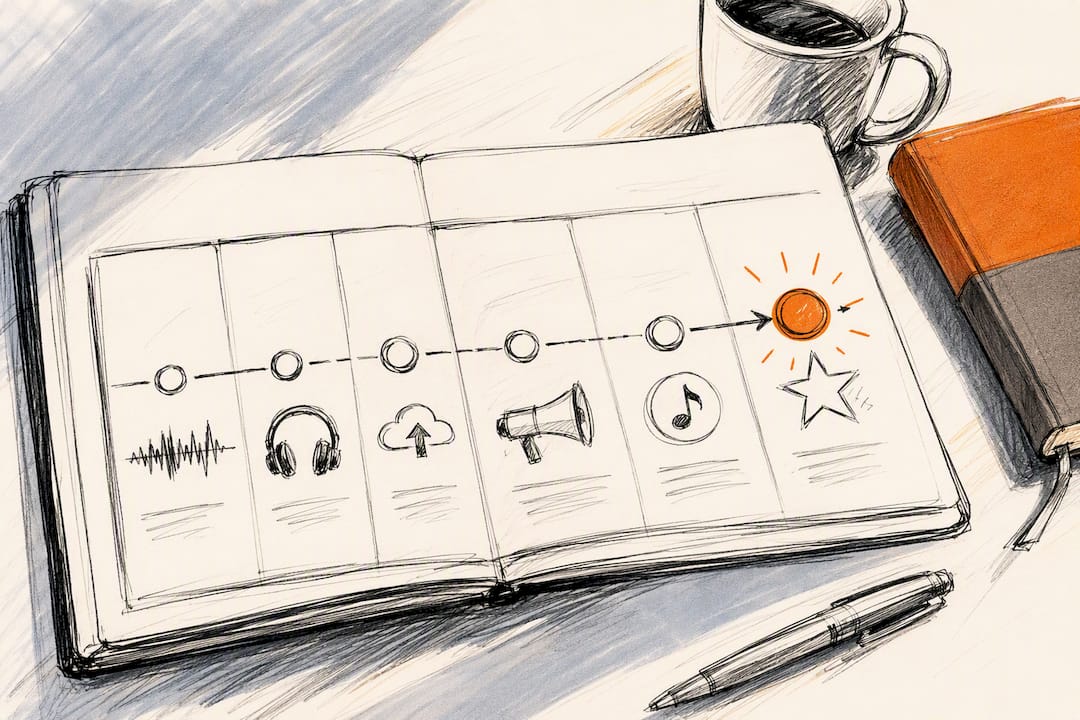
A release day plan is a date-backed checklist paired with a scripted 72-hour sprint, built by working backward from your release date. The single highest-leverage move is setting that date early and locking your assets and pitches around it, because the first three days after release decide how streaming algorithms treat your track for weeks afterward.
TL;DR:
- Planning a release at least 8 to 12 weeks ahead ensures sufficient time for promo, artwork, and distributor deadlines, especially for playlist pitching.
- Release day tasks center on execution, including final tests, coordinated social posts, and engagement, rather than creating new content.
- The first 72 hours are crucial for metrics like save-to-stream ratio and playlist adds, which predict future algorithmic support.
- Building genuine playlist placements through curator outreach during weeks 2 to 4 enhances long-term visibility compared to mass submissions.
- Maintaining momentum with daily content in the first week and a 30-day follow-up cycle significantly improves overall track performance.
Table of Contents
- What Is a Release Day Plan, and Why Start With the Date?
- How Far Ahead Should You Start Planning a Music Release?
- What Should Your Release Day Checklist Look Like Hour by Hour?
- What Metrics Actually Matter in the First 72 Hours?
- What Happens After Release Day: The 30-Day Follow-Up
- Which Technical and Visual Assets Do You Actually Need?
- Why Curator-Led Pitching Belongs in Your Timeline
- What Independent Artists Consistently Get Wrong About Launch Day
- Get Your Pre-Release Pitching Handled by Real Curators
- Sources
What Is a Release Day Plan, and Why Start With the Date?
A release day plan is the schedule that turns a finished song into a coordinated launch. Most artists get this backward. They finish a track, upload it a week later, post about it whenever they remember, and wonder why nothing happens. A real plan starts with the calendar, not the content.
You pick a release date first. Everything else, mastering deadlines, distributor uploads, curator pitches, promo assets, gets scheduled backward from that date. This is the same logic product teams use for a product rollout plan: fix the launch date, then reverse-engineer every dependency that has to happen before it. Musicians rarely think this way, but the mechanics are identical. A distributor needs lead time. A Spotify editorial pitch needs a window. Your fans need advance notice to pre-save. None of that happens if the date is an afterthought.
The term “release day plan” is really shorthand for what the industry calls a launch strategy or a product release checklist applied to music. Think of your release date as a hard deadline that every other task orbits around, the way a wedding date forces a caterer, florist, and venue to sync their timelines.
How Far Ahead Should You Start Planning a Music Release?
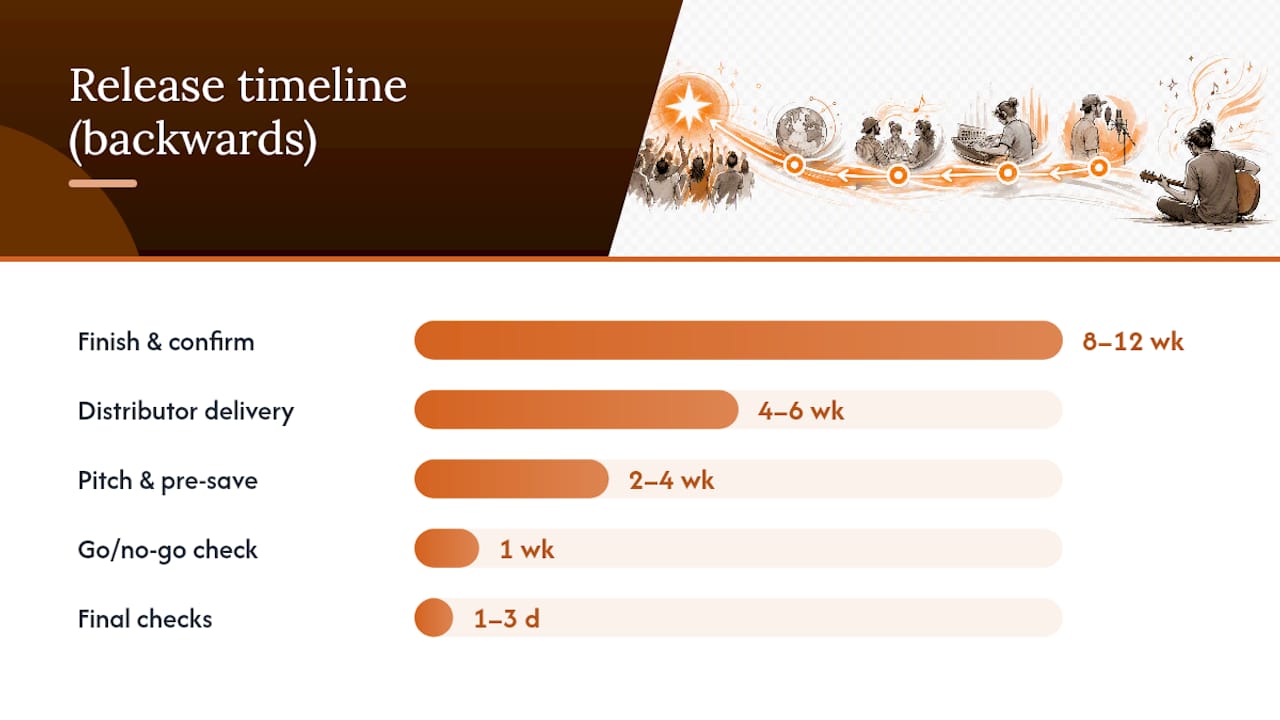
A several-week runway is recommended for a single with a real promotional push. Shorter timelines limit your options, especially for playlist pitching, which has hard windows you can’t skip.
Here’s the backward-mapped schedule that keeps you from scrambling in the final week:
- 8 to 12 weeks out: Validate the track is genuinely finished (not “almost”), set a budget for promo and any paid campaigns, and confirm your release date with your distributor.
- 6 to 4 weeks out: Finalize the master, lock the artwork at final resolution, and upload everything to your distributor. Most distributors need at least this much lead time to guarantee your street date.
- 4 to 2 weeks out: Submit your Spotify for Artists pitch and build out promotional assets, teasers, snippets, and any pre-save landing pages. Spotify recommends pitching your focus track at least two weeks before release to have a shot at editorial consideration and Release Radar placement, but earlier pitching gives your team more room to adjust if a curator asks for changes.
- 1 week out: Run a go/no-go readiness check. This is a formal moment where you confirm the master is uploaded correctly, pre-save links work, and your announcement posts are drafted. A documented go/no-go checkpoint one week before launch is standard in product launches for exactly this reason: it catches blockers while you still have time to fix them.
- 3 to 1 days out: Final verification pass. Test every smart link on both phone and desktop, confirm your announcement copy is scheduled, and draft the email or newsletter that goes out release morning.
Pro Tip: Build a shared calendar (Notion, Trello, or even a shared Google Sheet) with hard dates for each milestone above, and set reminders three days before each deadline. The artists who miss pitching windows almost always say the same thing afterward: “I thought I had more time.”
What Should Your Release Day Checklist Look Like Hour by Hour?
Release day itself isn’t when you create anything new. It’s execution of a plan you already built. Here’s how the hours actually break down.
- Night before: Test every smart link one final time, queue your social posts if your scheduler allows it, and draft the fan email so it’s ready to send with one click.
- Midnight: Check that the release is live on at least Spotify and Apple Music, and confirm the artwork, title, and featured artist credits display correctly. This single check catches most metadata errors before fans see them.
- Morning (8 to 10am local time): Post your primary announcement across every channel at once, Instagram, TikTok, X, Facebook, whatever your audience actually uses. Update your bio links to point at the smart link, not an old post.
- Before noon: Send the email announcement to your list. Email tends to convert better than social because the people who open it already chose to hear from you.
- Midday through afternoon: Switch into engagement mode. Reply to every comment, reshare fan posts, and repost anyone who tags you. This is also when a lot of artists post to Stories or go live for a short Q&A.
- Evening: Push a second wave of content, a performance clip, an acoustic snippet, anything that gives people a reason to check the song again. Check your analytics dashboard for the first read on how the day went.
This sequencing lines up closely with what release-day guides across the industry recommend: verify at midnight, announce in the morning window, and email by noon, then stay engaged through the rest of the day rather than posting once and disappearing.
Pro Tip: If your distributor shows the release as live but a fan says they can’t find it, don’t panic and don’t repost immediately. Take a screenshot, note the exact time, and contact your distributor with that evidence. Screenshots move support tickets faster than “it’s not working.”
What Metrics Actually Matter in the First 72 Hours?
The 72 hours after release function as an audition for how streaming platforms treat your track going forward. This window is widely treated as critical to a song’s early algorithmic trajectory, and the metrics you watch during it matter more than raw stream count.
| Metric | What it measures | What a healthy signal looks like |
|---|---|---|
| Save-to-stream ratio | How many listeners save the track relative to plays | Rising trend day over day, not a one-time spike |
| Skip rate | How often listeners skip before the track finishes | Lower is better; high early skips signal a weak hook |
| Completion rate | Percentage of listeners who finish the song | Steady or climbing across the first three days |
| Follower conversion | New followers gained from the release | Any meaningful uptick versus your baseline |
| Playlist adds | Listener-generated playlist placements, separate from curator pitches | Organic adds beyond your own pitching efforts |
Save-to-stream ratio deserves the most attention. Platforms weight it heavily because a save signals real intent, not a passive listen, and it’s a stronger predictor of future recommendation than total plays. Converting listeners into followers matters just as much, because follower growth compounds; every new follower is someone who sees your next release automatically.
If your numbers look strong after 48 hours, don’t sit still. Amplify what’s working, put a small paid budget behind the post that’s converting best, and target lookalike audiences of listeners already saving the track. If metrics lag, the fix usually isn’t panic, it’s targeted action: push a fresh engagement post, consider a modest paid boost aimed at your existing fan base, and follow up with any curators who added the track to ask what response it’s getting on their playlist.
What Happens After Release Day: The 30-Day Follow-Up
Momentum from release day fades fast if you don’t feed it. The first three days set the tone, but weeks two through four decide whether the song has a real shelf life.
- Days 1 to 3: Daily posting is worth the effort here. Sustained daily content in the first five days keeps the algorithm and your audience engaged past the initial announcement spike.
- Day 7: Run a short review. Pull your save-to-stream ratio, follower growth, and playlist adds, and compare them against your pre-release goals.
- Weeks 2 to 4: Rotate content themes, an acoustic version, a remix, behind-the-scenes footage from the recording session, a lyric breakdown video. Each gives fans a new reason to revisit the track.
- Day 30: Do a full debrief. What worked, what flopped, and what you’ll change for the next release.
Treat this stretch as an iteration loop rather than a single blast. Reviewing performance daily and adjusting messaging tends to outperform artists who post once, go quiet, and hope streaming numbers climb on their own.
Which Technical and Visual Assets Do You Actually Need?
A release day plan collapses fast if the technical basics aren’t locked down. Here’s the non-negotiable list:
- Final master: Confirmed sample rate and bit depth matching your distributor’s specs, no clipping, and a final listen on both studio monitors and cheap earbuds.
- Metadata: Songwriter credits, ISRCs, publishing splits, and PRO registration all filed before upload, not after. Getting this wrong delays royalty payments for months. A detailed metadata field guide walks through exactly what each field needs.
- Visual assets: Cover art at the resolution your distributor requires, plus a Canvas video loop, since Canvas measurably increases saves and shares compared to a static cover.
- Smart links: Tested on both iOS and Android, with your link-in-bio updated the moment the release goes live.
- Spotify-specific setup: Your editorial pitch submitted through Spotify for Artists, a Countdown Page enabled so pre-savers get a push notification the moment the track drops, and an Artist Pick set to highlight the release on your profile.
Why Curator-Led Pitching Belongs in Your Timeline
Automated mass submission tools blast your track to hundreds of playlists with no regard for genre fit, and most of those submissions land in inboxes nobody checks. Personalized curator pitching works differently: a real person who curates a genre-matched playlist actually listens to your track and makes a judgment call.
Intonality builds its campaigns around that distinction. Every pitch goes to a vetted, genre-matched curator, and artists get real-time updates plus written feedback on every decision, not just a placement count. Campaigns average 4 to 11 playlist placements depending on the tier, giving you a measurable outcome instead of a black box.
Written feedback from a curator who passed on your track tells you more than a placement ever could. It tells you what’s actually working with your sound and what isn’t.
Submit curator pitches during the 4 to 2 week pre-release window, the same stretch where you’d be finalizing your Spotify for Artists pitch, and follow up on placements once your release week begins to track how each playlist is performing.
What Independent Artists Consistently Get Wrong About Launch Day
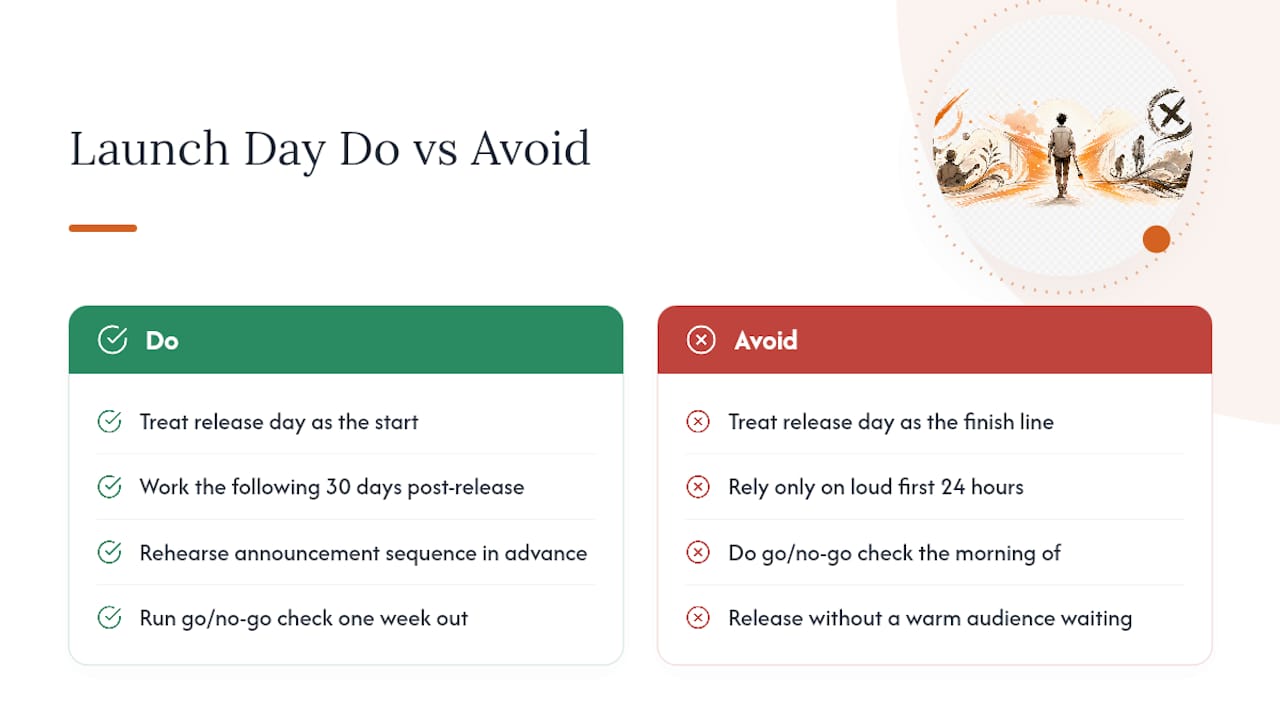
Most artists treat release day as the finish line. It’s the starting gun. The releases that actually build an audience are the ones where the artist kept working for the following 30 days, not the ones with the loudest first 24 hours.
The habit that separates artists who compound momentum from artists who don’t: rehearsing the announcement sequence in advance and running a real go/no-go check a week out, not the morning of. The other underrated move is building a qualified fan pipeline of 500 to 1,000 people before release day even starts. A release without a warm audience waiting is just a track dropped into the void, no matter how good the mastering is.
— Einars
Get Your Pre-Release Pitching Handled by Real Curators
Building a release day plan is straightforward once you have the timeline. Getting curators to actually listen is the harder part, and that’s where most DIY pitching efforts stall out. Intonality is built specifically for the 4 to 2 week pre-release window in your plan: instead of mass-submitting to playlists that never respond, your track goes to vetted, genre-matched curators who give you a real decision and written feedback either way.
Consider a campaign when you’re 3 to 4 weeks from release date and want measurable placements to fold into your promotional push, not a last-minute scramble the week your track drops. If your budget allows for it, this is the stretch where a curator campaign does the most good, right alongside your Spotify editorial pitch. Check out Intonality’s playlist promotion campaigns to see which tier fits your release, or compare it against mass-submission platforms on the SubmitHub alternative page if you’re weighing your options.
Sources
- Preparing for release day and beyond – Spotify for Artists
- What to do the week your music comes out (2026) | Tools 4 Music
- Release Day Checklist: What to Do When Your Music Goes Live | Orphiq
- 10 Things to Do on Release Day | Songkeeper


