
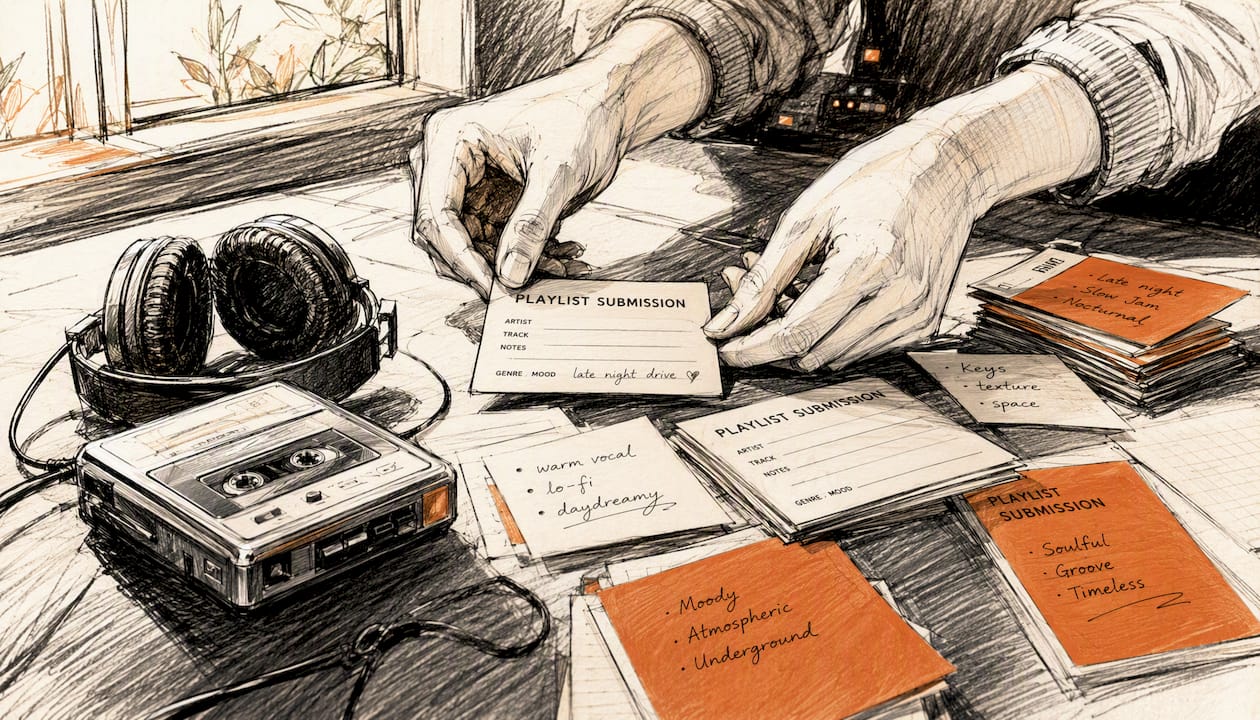
Getting on curators’ radar for playlist placement comes down to one thing: run a coordinated pre-release campaign that combines a Spotify for Artists editorial pitch, targeted outreach to independent curators, and promotion that generates real engagement before and after launch. No single tactic does the job alone. Editorial pitching without traction rarely lands, and traction without curator outreach just sits in your stats page unnoticed.
Do these three things this week if your release date is still ahead of you:
- Submit your pitch through Spotify for Artists the moment your distributor confirms delivery. Do it now, not the week of release.
- Build a list of 15 to 25 independent curators whose playlists actually match your genre and mood, not just your general vibe.
- Map out 7 to 14 days of social content, presaves, and direct-link sharing so you walk into release week with something to show curators.
Here’s the compressed version of the timeline this whole guide walks through: pitch editorial 3 to 4 weeks out, activate promotion and independent outreach during release week, then follow up with data-driven pitches 2 to 4 weeks after the track is live.
Key Takeaways
Getting on curators’ radar depends on combining early Spotify for Artists editorial pitching with targeted independent-curator outreach and promotion that produces real engagement signals.
| Point | Details |
|---|---|
| Deliver early | Submit editorial pitches 3 to 4 weeks before release; 7 days is the strict minimum. |
| Target genre fit | Research each curator’s playlist by listening before sending a pitch. |
| Open strong | Lead pitches with your best signal: traction, story, or a specific reason it fits. |
| Promote for saves | Use short-form video and presaves to build save rate and completion rate before pitching post-release. |
| Follow up once | Send a single polite follow-up 4 to 7 days after your first outreach, never more. |
| Work with Intonality | Personalized, genre-matched curator pitches with written feedback and 4 to 11 average placements per campaign. |
Table of Contents
- How to Get on Release Radar With a Pre-Release Checklist
- How Do You Pitch Spotify Editorial the Right Way?
- Where Do You Find and Pitch Independent Curators?
- What Should You Actually Write in a Curator Pitch?
- Which Promotion Tactics Actually Get Curators’ Attention?
- How Should You Structure a Full Curator Campaign?
- What Mistakes and Red Flags Should You Watch For?
- How Do You Measure Whether Your Campaign Worked?
- How Does Intonality Approach Curator Campaigns?
- Get Curator Feedback on Every Submission With Intonality
- Primary Sources and Further Reading
- Sources
How to Get on Release Radar With a Pre-Release Checklist
Most pitch rejections trace back to something that should have been finished weeks earlier: a late master, a placeholder cover, or a pitch written the morning of submission. Getting on release radar for curator consideration starts with having everything locked before you ask anyone to listen.
Here’s what needs to be done, and by when:
| Timeframe | Action |
|---|---|
| 3–4+ weeks before release | Final master delivered to distributor, artwork finalized, metadata and credits confirmed |
| 2 weeks before release | Spotify for Artists pitch written and submitted, direct track link (pre-save) ready to share |
| 7 days before release | Independent curator list finalized, first outreach emails sent, social content scheduled |
| Release day | Track live, curator outreach continues, presave links converted into share links |
Pro Tip: Finalize your artwork and metadata before you write a single pitch. Curators and editors both associate sloppy visuals with unfinished music, and a placeholder cover is one of the fastest ways to get skipped without anyone even hitting play.
How Do You Pitch Spotify Editorial the Right Way?
Submit your track through Spotify for Artists at least 7 days before release, though 3 to 4 weeks in advance gives editors real time to work your song into consideration. Editorial pitching only works pre-release. Once a track is live, that door closes for that song.
The mechanics are simple, but skipping a step costs you the pitch entirely:
- Claim and verify your Spotify for Artists profile if you haven’t already.
- Deliver the track to your distributor early enough that it appears as an “Upcoming” release in your dashboard.
- Open the pitch tool from that upcoming release and select the one song you want considered. Spotify allows a single pitch per song, so choose your strongest cut, not necessarily the one your label wants pushed.
- Fill in genre and mood tags with precision. A narrow tag like “late-night alt R&B” slots a song into curator consideration faster than a broad one like “pop”.
- Write your 500-character pitch. Cover the story, the sound, and anything that gives editors context: a co-writer, a producer credit, a tour, a milestone.
- Submit only the unreleased track. Spotify’s pitch tool rejects anything already live.
Spotify’s own guidance is direct on the fundamentals: deliver early, complete every field, and pitch only unreleased music. Editors also read for context, not just tags. Genre selection and a concise story in the pitch form give editors enough to place your song in the right conversation.
“Produced by [name], this alt R&B track blends late-night textures with a hook built for headphones. Following a 40-date support run, the artist brings a growing live following into this release.” That’s roughly 220 characters, leaving room for one more sentence of context before hitting the limit.
Where Do You Find and Pitch Independent Curators?
Independent curator outreach works both before release and after, and it’s often the more realistic path for artists without an existing Spotify footprint. Editorial slots are scarce. Independent playlists are not, and a well-matched one can move real numbers.
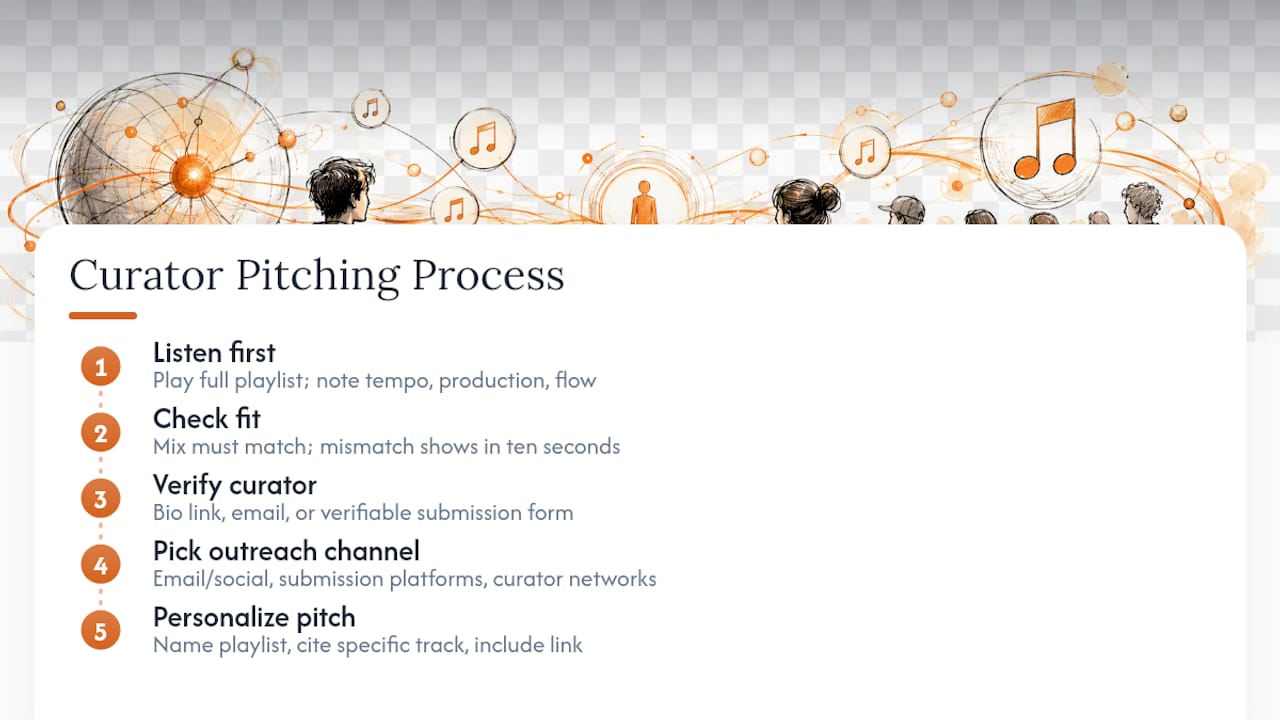
Start by listening, not searching. Play the full playlist you’re targeting, front to back if you can. Notice tempo, production polish, and how songs transition into each other. If your track’s mix sits noticeably rougher than what’s already there, that mismatch shows up in the first ten seconds and curators notice it immediately. Check whether the curator lists a real contact method: a bio link, an email, a submission form tied to a name and a social presence you can verify. Anonymous playlists with no verifiable owner are a waste of a pitch.
Outreach generally falls into three categories: direct email or social message to a curator you’ve researched, submission platforms built for artist-to-curator matching, and curator networks that connect artists with vetted playlist owners. Each has a place in a campaign, but the ones that convert best are the ones where you’ve actually done the listening first.
Hi Maria, I’ve been following Late Hours Indie for a few months and your placement of Boygenius alongside newer acts caught my ear. My new single “Amber Light” sits in that same melancholic indie-folk lane, mid-tempo with a string arrangement that I think would flow well after track 12 on your list. Here’s the direct link: [track link]. Thanks for considering it.
That message works because it names the playlist, references a specific track already on it, and gets to the link fast. A generic “check out my new song” message gets deleted in the same ten seconds it took to read it.
What Should You Actually Write in a Curator Pitch?
Open with the single strongest signal you have, whether that’s early streaming numbers, a tour date, a press mention, or a specific reason the song fits their playlist. Curators and editors both move fast. Industry guidance consistently points to leading with the most relevant signal instead of burying it in the third sentence.
Here are two templates worth adapting rather than copying word for word.
Short email or DM pitch: It’s a synth-pop track built around a driving bassline, similar in energy to what you’ve featured from [reference artist]. Would love for you to give it a listen: [link]."
500-character Spotify for Artists pitch: “Written after a year of touring small venues across the Midwest, this track blends indie rock with a pop chorus built for radio. Mixed by [engineer name], mastered at [studio]. Early listener feedback has been strong, with repeat plays showing up in our Spotify for Artists data within the first week.”
The difference between a pitch that gets read and one that gets skipped usually comes down to specificity. “Check out my new song, I think you’ll like it” says nothing. “This fits between the two tracks you added last month” says everything a curator needs in one sentence.
“Pop” tells a curator almost nothing. “Melodic techno with a four-on-the-floor build and a vocal hook at the two-minute mark” tells them exactly where your song sits and whether it belongs on their playlist.
Pro Tip: Curators often decide within the first 15 to 20 seconds of a track, so make sure whatever hook or vocal entry defines your song happens early. If your best moment doesn’t land until 45 seconds in, that’s a mix or arrangement problem worth fixing before you pitch anyone.
Which Promotion Tactics Actually Get Curators’ Attention?
Curators gravitate toward tracks already showing signs of life, even small ones. A song with a handful of playlist adds and a decent save rate reads as lower risk than one with zero footprint anywhere.
The promotional moves that tend to produce those signals:
- Short-form video clips on TikTok and Instagram Reels built around your song’s strongest 15 seconds.
- Instagram Stories with a direct swipe-up or link-sticker to the track, not just a vague “new music out now” post.
- A presave campaign that starts converting into saves and streams the moment the track unlocks.
- Activating your own release-day playlist placement and encouraging fans to add the song to their personal playlists.
- Reaching out to collaborators, co-writers, and featured artists to amplify the release on their own channels.
Even a modest 2 to 3% save rate among early listeners, paired with short-form video traction, can strengthen a follow-up pitch to a curator who passed the first time. The metrics worth tracking in Spotify for Artists are save rate, completion rate, playlist adds, and follower growth. Give algorithmic signals time to build, typically 2 to 6 weeks after release, before judging whether a promotional push worked.
Pro Tip: Build short-form content around the moment in your song that made you want to release it in the first place, not the chorus by default. A bridge, an unusual production choice, or a lyric with a sharp turn often outperforms the “obvious” hook because it feels less like an ad.
How Should You Structure a Full Curator Campaign?
Split the campaign into three phases: pre-release editorial pitching, a release-week push to independent curators, and post-release outreach backed by real performance data. Trying to compress all three into release week itself is the single most common structural mistake artists make.
- Three to four weeks before release: Submit your Spotify for Artists editorial pitch, finalize your independent curator list, and start light social teasing.
- One to two weeks before release: Send your first round of independent curator outreach, referencing your presave numbers or early buzz if you have any.
- Release week: Push promotion hard, activate playlist support from fans and collaborators, and send a second wave of curator pitches to playlists you didn’t reach earlier.
- Two to four weeks after release: Return to curators who passed or didn’t respond, this time citing real Spotify for Artists data, since independent curator outreach stays viable well after release once you have numbers to reference.
Aim for 15 to 25 well-researched curator pitches per release rather than blasting 200 generic ones. A tight, targeted list where you’ve actually listened to each playlist consistently outperforms mass submission, because curators can tell the difference between a pitch written for them and one written for anyone.
If a curator doesn’t respond, follow up exactly once, four to seven days after your first message, and keep it short: “Hi again, just following up on [song title] in case it got buried. No worries either way, and thanks for your time.” A second or third follow-up tends to do more damage to the relationship than it does good.

What Mistakes and Red Flags Should You Watch For?
The most common mistakes are submitting late, pitching the wrong genre to a curator, and sending the same generic message to fifty different playlists. Each one is avoidable, and each one gets caught immediately by anyone who reviews submissions for a living.
Watch for these red flags when evaluating a curator or a promotion service:
- Any service guaranteeing “guaranteed placement” on Spotify’s own editorial playlists. Spotify doesn’t sell editorial placement, ever.
- Curators or services offering to sell you streams or followers. This violates Spotify’s platform rules and puts your entire catalog at risk.
- Mass-submission tools that blast your track to hundreds of unverified playlists without any genre matching.
- Playlist owners who ask for payment specifically in exchange for a guaranteed add, which is closer to payola than curation.
If a service promises a guaranteed number of editorial placements, that’s not a promotion strategy. Spotify’s own editors don’t take payment for placement, and any middleman claiming otherwise is either lying or violating platform terms on your behalf.
One more thing worth flagging: be careful about where you share pre-release audio links. Public link-sharing before your official release date can create leak risk and complicate your distributor agreement, so keep pre-release files limited to verified curators and collaborators rather than open public links.
How Do You Measure Whether Your Campaign Worked?
Track save rate, completion rate, playlist adds, and follower growth. Those four numbers, all visible in Spotify for Artists, tell you more about campaign performance than stream count alone ever will.
| Metric | Where to find it | What it signals |
|---|---|---|
| Save rate | Spotify for Artists, song stats | How many listeners liked it enough to keep it; strong signal for curators |
| Completion rate | Spotify for Artists, listener behavior | Whether people skip early or listen through; low rates hurt algorithmic pickup |
| Playlist adds | Spotify for Artists, playlists tab | Direct evidence of curator and fan interest beyond your own campaign |
| Follower growth | Spotify for Artists, audience tab | Longer-term traction that curators reference when deciding on repeat placements |
Give these numbers 2 to 6 weeks to develop before drawing conclusions. If you land a placement, lean into it: share it publicly, thank the curator, and route more promotion toward that playlist’s audience. If you don’t, revisit your pitch copy, narrow your curator targets to a better genre match, and consider whether your track’s opening 15 seconds actually earns the attention you’re asking for.
How Does Intonality Approach Curator Campaigns?
Intonality builds campaigns around personalized outreach to real, genre-matched curators, not automated blasts or pay-for-placement schemes. Every submission gets a real-time update, and every curator decision, whether it’s a yes or a pass, comes back with written feedback explaining why.
That feedback loop matters more than most artists expect going in. A “no” with a reason attached (wrong tempo for the playlist, mix needs more low-end presence, great fit but no open slots this month) is worth more than a dozen silent rejections from a mass-submission tool. Depending on the campaign tier, Intonality reports an average of 4 to 11 playlist placements per campaign, with outreach targeted at playlists genuinely suited to the track’s genre and mood rather than whatever list happens to have the most followers.
A curator’s written reason for passing tells an artist more about their next release than a placement ever could, because it’s specific feedback from someone who actually listened.
What artists receive across a campaign:
- Personalized pitches sent to vetted curators matched to genre and mood, not a generic blast list.
- Real-time dashboard updates as curators respond to the submission.
- Written feedback on every single curator decision, accepted or declined.
Picture the workflow as a funnel: submission goes out to a curated list, each curator responds individually, and every response (accept, decline, feedback) feeds back into the artist’s dashboard in something close to real time.
A note on consistency over one-off pitches
Getting one placement on one release is a nice result. Building a track record with curators who remember your name and your sound is what actually compounds over multiple releases, and that only happens when artists treat outreach as an ongoing relationship instead of a single campaign they run once and abandon.
Einars has spent years covering Spotify playlist promotion and independent artist marketing, with a focus on how curator relationships and algorithmic discovery actually intersect.
Get Curator Feedback on Every Submission With Intonality
Most promotion services either hand your track to an algorithm or send it into a black box you never hear back from. Intonality does neither. Every pitch goes to a real, genre-matched curator, and every decision, yes or no, comes back with written feedback you can actually use for your next release.
That feedback loop is the part most artists say they didn’t know they needed until they had it. Instead of guessing why a playlist passed on your track, you get a specific reason tied to a specific curator, which means your next pitch is smarter than your last one. Campaigns are built around your genre and mood from the start, whether that’s dark pop, folk, or rock revival, so the curators seeing your track are ones already programming music like yours. If you’ve got a release date on the calendar, the best time to start is now: submit your track and get it in front of curators who are actually listening.
Primary Sources and Further Reading
The timing rules, editorial mechanics, and curator decision-making patterns in this guide draw on a mix of platform documentation and independent industry analysis, cross-checked for consistency before being folded into the campaign structure above.
Spotify’s own support documentation remains the authoritative source on pitch mechanics, one-pitch-per-song rules, and the 7-day minimum, while independent industry analysis fills in what happens after you hit submit, including what curators actually respond to.
- Pitching music and videos to playlist editors | Spotify Support
- Behind the playlists: your questions answered by our playlist editors | Spotify for Artists
- Spotify Playlisting Strategy 2026 | iMusician
- What Are Music Curators Actually Looking For? Insights From 100K Submissions | Hypebot
- How to pitch playlists | Symphonic (2026)
- Spotify playlist pitching strategy 2026 | Tools4Music
- How to get your music on playlists in 2026 | Magnetic Magazine
- Spotify playlist submission guide | NotNoise
Sources
- Spotify Playlisting Strategy 2026 | iMusician
- Pitching music and videos to playlist editors | Spotify Support
- What Are Music Curators Actually Looking For? Insights From 100K Submissions | Hypebot
- How to pitch playlists | Symphonic (2026)
- Spotify playlist pitching strategy 2026 | Tools4Music


