
Pitch your unreleased track through Spotify for Artists at least 7 days before release, ideally 10 to 14 days out, and send independent curators a private streaming link instead of an attachment. That single move separates artists who land placements from artists who get ignored.
- Submit through official platform tools 7+ days before release; push for 10 to 14 days when your schedule allows it.
- Use private streaming links, never MP3 attachments, when reaching out to independent curators directly.
- Line up a pre-save or Countdown Page so day-one engagement backs up your pitch.
Key Takeaways
Pre-release pitching works best when platform deadlines, private streaming links, and a coordinated pre-save campaign all move on the same timeline.
| Point | Details |
|---|---|
| Submit early | Pitch 7 to 14 days before release, with 10 to 14 days giving editors real time to consider your track. |
| Skip the attachments | Send private streaming links to independent curators; never email raw track files. |
| Pair pitching with pre-saves | Countdown Pages convert nearly 70% of pre-savers into first-week streamers, reinforcing your pitch. |
| Follow up once, then let it go | Send one follow-up after 7 to 10 days and track saves, streams, and curator feedback afterward. |
| Consider a managed option | Intonality pitches tracks to real, genre-matched curators and reports 4 to 11 placements per campaign. |
Table of Contents
- Pre Release Pitching Checklist for Independent Artists
- When Should You Submit a Pre Release Pitch?
- How Do You Write a Pitch Curators Actually Read?
- Do Pre-Saves and Countdown Pages Actually Help?
- What Should You Avoid When Sending Pre Release Material?
- How Do You Follow Up Without Being Annoying?
- How Does Intonality Support Pre Release Campaigns?
- What I’ve Learned Running Pre-Save Campaigns
- Ready to Pitch Your Next Release?
- Frequently Asked Questions About Pre Release Pitching
- Sources
Pre Release Pitching Checklist for Independent Artists
Treat pre-release pitching as a sequence, not a single email. Miss a step and the whole campaign loses momentum.
- Confirm your distributor’s delivery deadline and upload final assets (art, metadata, ISRC) with buffer room.
- Build private, password-protected streaming links for any curator you plan to contact outside official platform tools.
- Complete your Spotify for Artists pitch and Apple Music Connect submission inside their recommended windows.
- Write a short, specific outreach note and set up your pre-save Countdown Page.
- Schedule a follow-up date and block time on release day to check analytics.
Pro Tip: Build your pitch list backward from release day. Working forward almost always eats into your submission window before you notice it’s gone.
Soundcharts’ breakdown of playlist pitching makes a point worth repeating: pitching early and being specific about your track’s metadata does more for placement odds than a polished bio ever will.
When Should You Submit a Pre Release Pitch?
Spotify and Apple Music both publish hard numbers, and ignoring them is the fastest way to miss editorial consideration entirely.
- Spotify: submit at least 7 days before release to qualify for Release Radar. Spotify for Artists recommends 2 weeks out for editorial playlist consideration.
- Apple Music: Apple Music Connect recommends pitching at least 10 days before release for full editorial review, with 7 days as the final cutoff for late additions.
- Independent curators: most want 2 to 4 weeks. They’re often programming playlists in batches, not reacting to same-week submissions.
A 7-day pitch might get you Release Radar. It rarely gets you in front of an actual editor with time to actually listen, weigh the track against everything else in their queue, and place it with intention. The extra week or two is the difference between a pitch that gets skimmed and one that gets heard.
How Do You Write a Pitch Curators Actually Read?
A curator scanning fifty submissions a day isn’t reading your life story. They’re scanning for fit, fast.
- Line one: state exactly why this track fits their playlist. Not your career, the fit.
- Lines two and three: one or two supporting details. A notable collaborator, a placement history, a specific production choice that matters to the sound.
- Final line: a brief note on your release plan. Ads running, press lined up, a pre-save campaign already active.
Every pitch needs clean metadata: genre, mood, lead instrument or featured artist, and location if it’s relevant to a regional playlist. Spotify’s own pitching documentation notes editors search submissions by these fields, so vague genre tags cost you visibility before a human even opens the pitch.
Use the official Spotify for Artists and Apple Music forms first. For independent curators found through blogs, Instagram, or curator databases, send a private streaming link directly, never a file attachment. Intonality’s guide on nailing a Spotify editorial pitch walks through the exact fields editors weigh most.
Example structure: “Dream pop track with a shoegaze chorus, perfect for [playlist name]'s late-night rotation. Co-produced by [name], out [date], with a coordinated pre-save and $500 in ad spend behind it.” Short, specific, done.
Do Pre-Saves and Countdown Pages Actually Help?
Yes, and the number backs it up: Spotify reports that nearly 70% of listeners who pre-save an album through a Countdown Page stream it in the first week. That’s the exact signal editors and algorithms both respond to on release day.
- Run your pre-save campaign 2 to 6 weeks before release, longer if your fanbase or ad budget is small.
- Map organic posts, paid ads, and email sends to hit peaks in the final week before release, not evenly across the whole runway.
- Use the pre-save as a contact-capture tool. Emails collected now become your release-day activation list.
Intonality’s Spotify marketing strategy guide covers how to build that calendar so pitching, pre-saves, and paid promotion land in the same week instead of competing for attention.
What Should You Avoid When Sending Pre Release Material?
A few mistakes can undo weeks of prep work, so check these before you hit send.
- Never send track files as attachments. Use private streaming links or upload directly through the platform’s pitch tool.
- Confirm you fully control the recording and publishing rights before pitching anyone, including friends running playlists.
- Skip any service promising guaranteed placements or bundled streams. Spotify is explicit that editorial spots can’t be bought.
- Keep a simple log of who you contacted, when, and what they said back.
How Do You Follow Up Without Being Annoying?
Send one polite follow-up 7 to 10 days after your initial pitch if you haven’t heard back. If the release date has passed and the track is still relevant, one final note is fine. After that, move on.
Track these numbers after release: pre-saves, day-one streams, your save-to-stream ratio, playlist adds, and any written feedback curators gave you. Spotify for Artists’ dashboard shows most of this directly, and if you ran a Countdown Page, its own analytics fill in the pre-save conversion piece. Intonality’s guide to following up with curators has message templates that get replies without sounding pushy.
How Does Intonality Support Pre Release Campaigns?
Intonality pitches your track to real, genre-matched curators, not bots and not pay-for-play playlists stuffed with fake streams.
- Every submission goes to a vetted human curator, and every decision comes back with written feedback, not silence.
- You get real-time updates as your campaign runs, so you’re never guessing where things stand.
- Campaigns average 4 to 11 playlist placements depending on the service tier you choose.
What I’ve Learned Running Pre-Save Campaigns
Pre-save totals look great on a dashboard, but they mean nothing if fans forget to actually stream on release day. Chase follow-through, not just sign-ups.
Ready to Pitch Your Next Release?
Cold-emailing curators one by one, hoping for a reply, is a slow way to build a release campaign. Intonality gives you a faster path: personalized pitches sent to real, genre-matched curators on your behalf, with written feedback on every decision instead of silence.
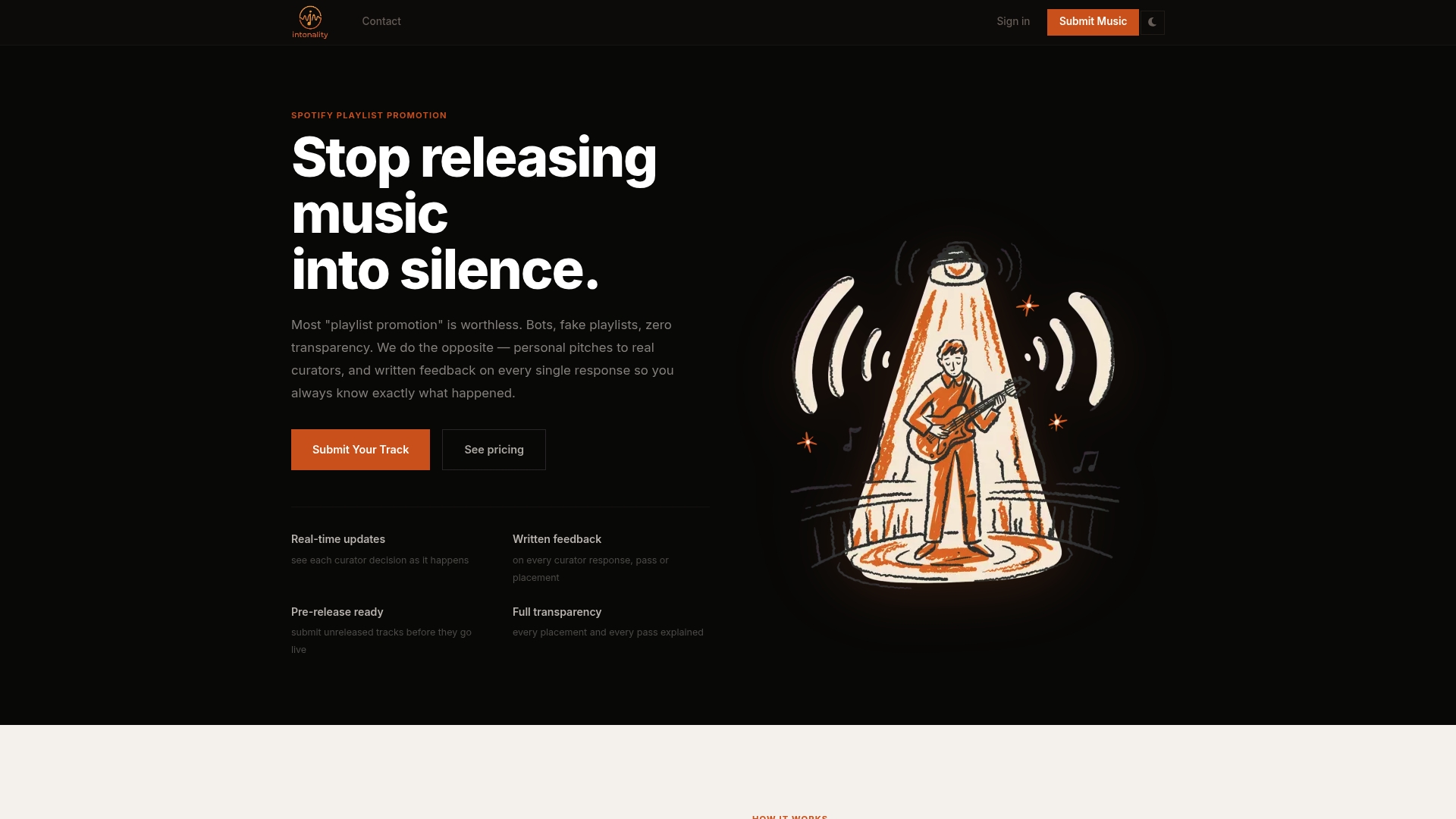
When you submit a track, you’re not dropping it into a queue and hoping. You get real-time updates as curators respond, a dashboard tracking where your campaign stands, and typically 4 to 11 playlist placements by the time the campaign wraps, depending on your tier. If you’d rather compare this approach to automated submission tools first, see how Intonality differs from services that lean on fake playlists and bot streams. Ready to start? Submit your track and get your campaign moving before your next release date.
Frequently Asked Questions About Pre Release Pitching
How early should I start pre release pitching? Aim for 10 to 14 days before release. Spotify’s 7-day minimum only covers Release Radar eligibility, not full editorial consideration.
Can I pitch the same track to Spotify and Apple Music at once? Yes. Submit through Spotify for Artists and Apple Music Connect separately, respecting each platform’s own deadline.
Does pitching guarantee a playlist placement? No. Spotify states plainly that pitching improves your odds but never guarantees a spot, since editors choose tracks manually.
What’s the biggest mistake artists make when pitching curators? Sending file attachments instead of private streaming links, and skipping genre or mood metadata that editors use to search pitches.
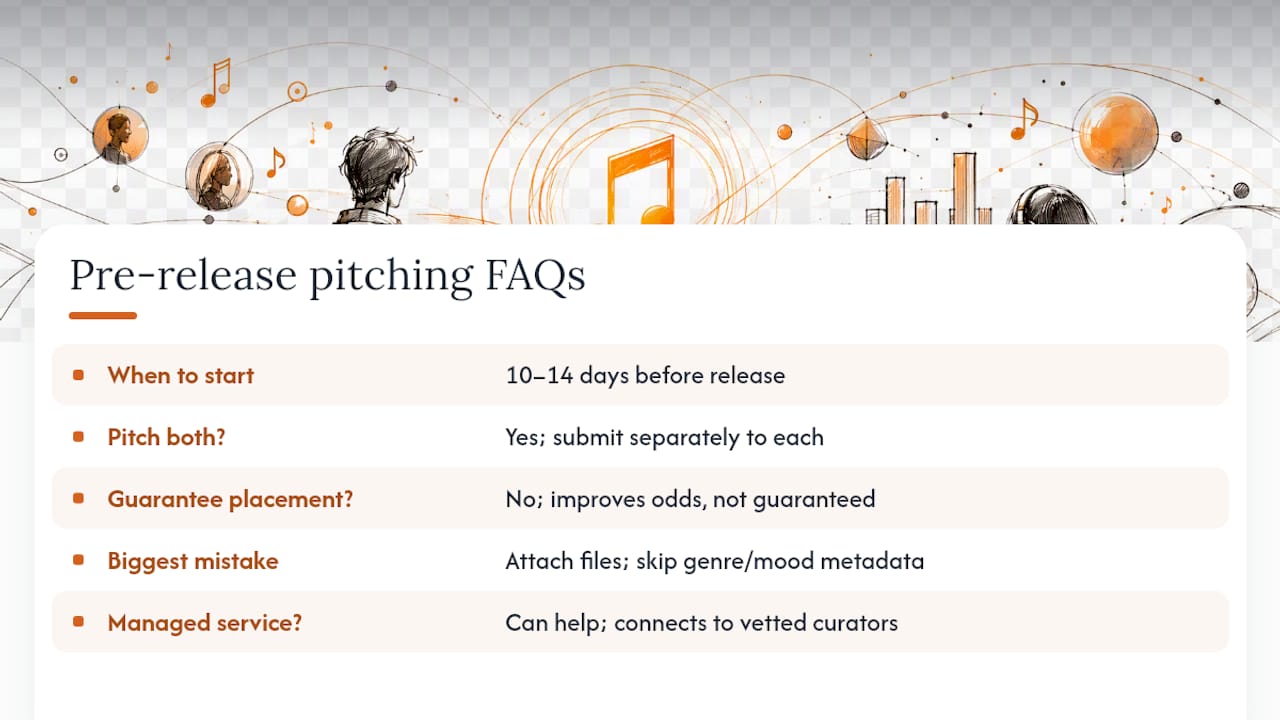
Is a managed pitching service worth it for a first release? It can be, especially if you lack curator relationships. Services like Intonality connect you directly with vetted, genre-matched curators and return written feedback either way.
Sources
- Behind the playlists: your questions answered by our playlist editors — Spotify for Artists
- Countdown Pages — Spotify for Artists
- Apple Music pitching support — Apple Music Connect
- Pitching music and videos to playlist editors — Spotify Support


