

Friday is the industry default, but it’s not automatically the best day to release for your goals. The right release day depends on three variables: whether you’re chasing chart eligibility, whether you’ve hit your editorial pitch windows, and how much promotional runway you actually have. Here’s the short version:
- Chart and editorial goals: Friday gives you a full Friday–Thursday tracking week and aligns with every major editorial playlist refresh cycle.
- Independent artists with direct audience access: Tuesday or Wednesday typically means less competing noise, better curator bandwidth, and a natural run-up into weekend listening.
- Coordinated social or TikTok pushes: Thursday puts you one day ahead of the weekend scroll without the full Friday release-day chaos.
None of these is universally correct. Academic research on optimal release timing in adjacent entertainment industries confirms what experienced artists already sense: the best timing depends on product characteristics and market conditions, not a single rule. The rest of this guide walks through the mechanics, trade-offs, and a checklist you can use to pick your date with confidence.
Key Takeaways
Friday maximizes chart eligibility and editorial alignment, but Tuesday or Wednesday typically delivers better curator attention and less competition for independent artists without full campaign infrastructure.
| Point | Details |
|---|---|
| Match day to your goal | Friday for chart and editorial goals; Tuesday or Wednesday for most independent releases without label support. |
| Hit pitch deadlines first | Spotify editorial requires 7+ days lead time; Apple Music needs 10–14 days. Miss these and editorial is off the table. |
| Submit to your distributor early | Submit at least 14 days before release to avoid metadata errors and broken delivery. |
| Stay available post-release | Block the 72 hours after release for active engagement; this window sets your algorithmic trajectory. |
| Intonality for playlist reach | Intonality’s pre-release curator pitching aligns with your distributor deadlines and delivers written feedback on every placement decision. |
Table of Contents
- Why did Friday become the global release day?
- Why Friday can work against independent artists
- When does Tuesday, Wednesday, or Thursday make more sense?
- What are the exact deadlines you need to hit?
- How do you actually choose your release day?
- How do you test which release day actually works for you?
- What does the research actually say about mid-week releases?
- Intonality fits your release timeline before the window closes
- What most artists get wrong about release day timing
- Sources
Why did Friday become the global release day?
The short answer is the IFPI. In 2015, the International Federation of the Phonographic Industry coordinated a global shift to Friday as the universal new-music day, replacing the fragmented Tuesday (US), Monday (UK), and Friday (Australia) system that had existed for decades. The goal was to reduce piracy from markets where music dropped earlier, and it worked well enough that Friday has been the default ever since.
What Friday actually unlocks for you:
- A full chart tracking week. Billboard and most national charts measure Friday through Thursday. A Friday release gets the maximum seven days counted in its first tracking period, which matters if chart position is a campaign goal.
- Editorial playlist alignment. Spotify, Apple Music, and Amazon Music all refresh their major editorial playlists on or around Friday. Releasing on Friday means your track is eligible for the current cycle rather than waiting a week.
- Release Radar inclusion. Spotify’s Release Radar pulls tracks released within the prior 28 days from followed artists and delivers them every Friday. A Friday release hits listeners the same day it drops.
- Synchronized press and playlist calendars. Music journalists, bloggers, and playlist curators organize their coverage around Friday. Your publicist, your playlist pitches, and your press hits can all land on the same day.
A Friday release maximizes chart eligibility and gives the largest possible first-week window for chart-driven campaigns, but it requires coordinated promotion across multiple partners. That coordination cost is real, and for many independent artists it’s where things go wrong.
Stat worth knowing: Spotify’s Release Radar refreshes every Friday and draws from the prior 28 days of releases, meaning a track released on a Tuesday is still eligible for that week’s Radar if it falls within the window.
Why Friday can work against independent artists
The same mechanics that make Friday powerful for major labels make it punishing for smaller releases. Every major, mid-major, and well-funded independent drops on Friday. That’s not a coincidence; it’s the system working as designed for the biggest players.
Here’s what that means in practice:
- Curator inbox saturation. Playlist curators who accept submissions through tools like SubmitHub see their highest submission volume on Fridays and in the days immediately before. Smaller projects get buried under the volume.
- Algorithmic noise. Spotify’s editorial and algorithmic systems are processing hundreds of new releases simultaneously on Friday. A track without significant early engagement signals can get lost before it gains any traction.
- Social media competition. Major-label campaigns spend heavily on Friday social pushes. Your organic posts compete with paid campaigns from artists with much larger budgets.
- Operational risk. Friday releases require hitting distributor deadlines and editorial pitch windows earlier in the week. Miss a metadata detail or submit a day late, and you either delay the release or lose your editorial consideration window entirely.
Pro Tip: If you’re releasing independently without a publicist or label support, ask yourself honestly: do you have the bandwidth to run a coordinated Friday campaign? If the answer is no, a Tuesday or Wednesday release with a focused push to your own audience will almost always outperform a poorly executed Friday drop.
The crowding problem is particularly acute for artists under 10,000 monthly listeners. At that scale, the editorial playlist system is largely inaccessible anyway, and the Release Radar advantage (which requires followers) is limited. For those artists, the Friday standard is largely a convention they’ve inherited from a system built for someone else.
When does Tuesday, Wednesday, or Thursday make more sense?
Mid-week releases aren’t a consolation prize. For the right campaign type, they’re the smarter choice. RouteNote recommends Tuesday specifically for artists who control most of their audience communication and want a clear run into the weekend with less noise.
Breaking down each option:
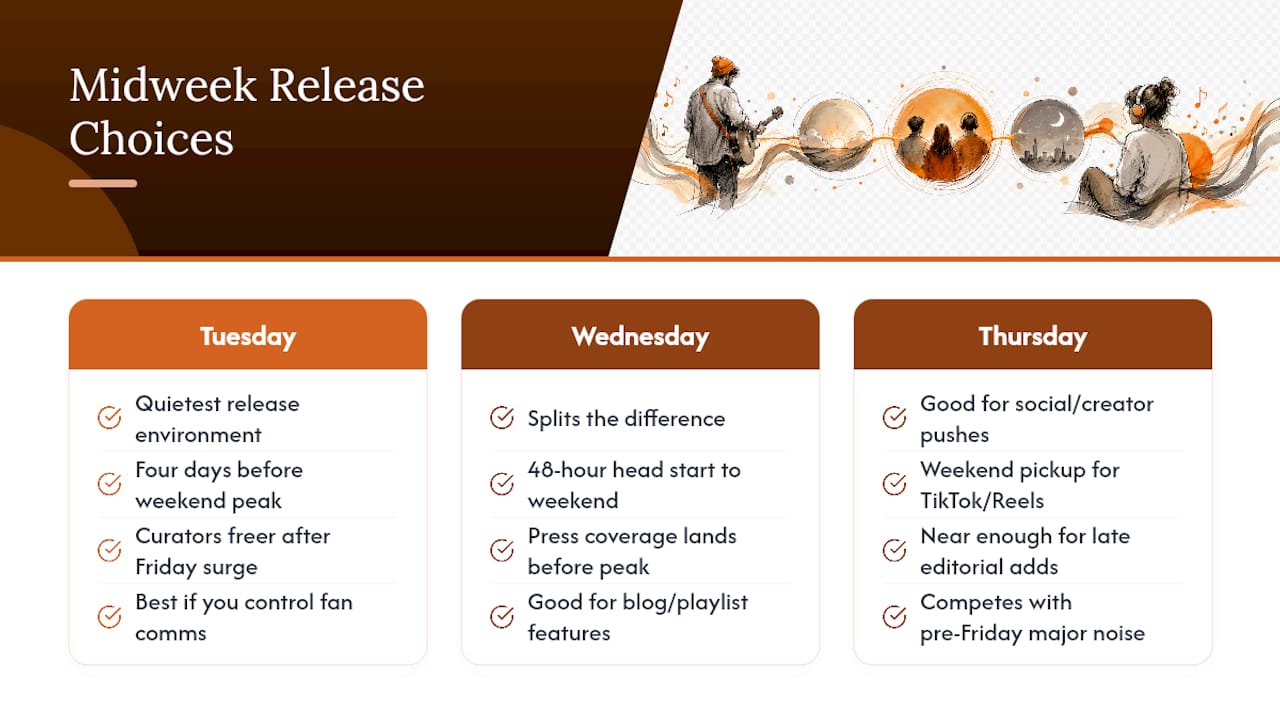
Tuesday gives you the quietest release environment of the week. Curators have processed Friday’s surge and have more mental bandwidth. You get four full days before the weekend listening peak, which means your track has time to accumulate saves and playlist adds before the heaviest streaming hours arrive. LANDR’s distribution data shows Tuesday can nearly match Friday streaming levels for certain independent-artist cohorts, which is a meaningful finding.
Wednesday splits the difference. You’re still well clear of Friday noise, you get a 48-hour head start into the weekend, and press coverage published Wednesday or Thursday lands right before peak listening. If you have a music blog or playlist feature lined up, Wednesday is often the cleanest fit.
Thursday makes sense when your primary push is social or creator-driven. A Thursday drop gives TikTok creators and Instagram Reels users the weekend to pick up the audio. You’re also close enough to the Friday editorial cycle that any late-breaking playlist consideration can still land. The trade-off is that you’re competing with pre-release Friday campaign noise from major artists.
For Bandcamp-first or direct-to-fan strategies, platform-specific rhythms matter too. Bandcamp’s “New and Notable” updates follow their own schedule, so if direct sales are your primary revenue driver, check Bandcamp’s current feature cadence before defaulting to any DSP-driven logic.
What are the exact deadlines you need to hit?
This is where most independent releases fail. The release day decision is meaningless if you miss the technical windows that make it work.
- Distributor submission (DistroKid, TuneCore, CD Baby, etc.): Submit your final, mastered audio and complete metadata at least 7 days before release. The safe window is 2+ weeks. Most distributors recommend 7–14 days minimum, and submitting early gives you time to catch metadata errors before they cause a broken release.
- Spotify editorial pitch: Spotify for Artists requires your pitch to be submitted at least 7 days before release. Pitching 2–3 weeks out gives editors more time to consider your track. Miss this window and editorial consideration is off the table entirely for that release.
- Apple Music and Amazon Music: Apple Music pitches typically require 10–14 days of lead time. Amazon Music’s editorial team has similar windows. If you’re targeting these platforms’ editorial features, your release date needs to be set at least three weeks out.
- Pre-save campaign: Set up your pre-save link as soon as your distributor confirms the release date. Ideally, you’re promoting the pre-save for 2–4 weeks before release. Tools like Spotify for Artists’ pre-save feature or third-party options through your distributor handle this.
- Social media scheduling: Lock your content calendar 1–2 weeks before release. Schedule your announcement posts, cover art reveals, and release-day content in advance so you’re not scrambling.
- Creator and playlist seeding: If you’re working with TikTok creators or independent playlist curators through platforms like SubmitHub, send outreach 1–2 weeks before release so they have time to prepare content.
Pro Tip: Block the 72 hours after your release in your calendar as active campaign time. Respond to playlist curator feedback, engage with every comment and share, and monitor your Spotify for Artists dashboard in real time. The first 72 hours set the algorithmic trajectory for the next 30 days.
How do you actually choose your release day?
Work through this checklist before you set a date. It takes 15 minutes and prevents the most common mistakes.
- Define your primary goal. Is this release about chart position, editorial playlist placement, building your streaming catalog, or driving direct sales? Chart and editorial goals point toward Friday. Everything else is open.
- Check your editorial pitch windows. Count back from your target release date. Do you have 7+ days for Spotify and 10–14 days for Apple Music? If not, push the date back or accept that editorial is off the table.
- Audit your promotional bandwidth. Do you have a publicist, a PR plan, and coordinated social assets ready? If you’re running everything yourself, a Tuesday or Wednesday release with a focused push will outperform a chaotic Friday drop.
- Check competing releases. Search your genre on Spotify and look at what’s scheduled for your target week. If a major artist in your genre is dropping the same Friday, consider shifting a week or going mid-week.
- Map your audience’s listening habits. If most of your fans are in a single time zone, schedule your release for 12:00 AM in that zone. If your audience is global, midnight ET (the Spotify default) covers the largest early-listening window.
- Coordinate with collaborators and touring. If you’re playing a show the week of release, align the date so the show amplifies the release rather than competing with it. Check gig and event planning tools to coordinate release timing with live dates.
- Set your release calendar. Work backward from your release day and fill in: distributor submission date, Spotify editorial pitch date, Apple Music pitch date, pre-save launch date, press outreach date, social asset scheduling date, and creator seeding date.
| Milestone | Lead time before release |
|---|---|
| Distributor submission | 14+ days (safe), 7 days (minimum) |
| Spotify editorial pitch | 7 days (minimum), 14–20 days (recommended) |
| Apple Music / Amazon pitch | 10–14 days |
| Pre-save campaign launch | 14–28 days |
| Press outreach | 7–14 days |
| Social assets scheduled | 7 days |
| Creator / curator seeding | 7–14 days |
How do you test which release day actually works for you?
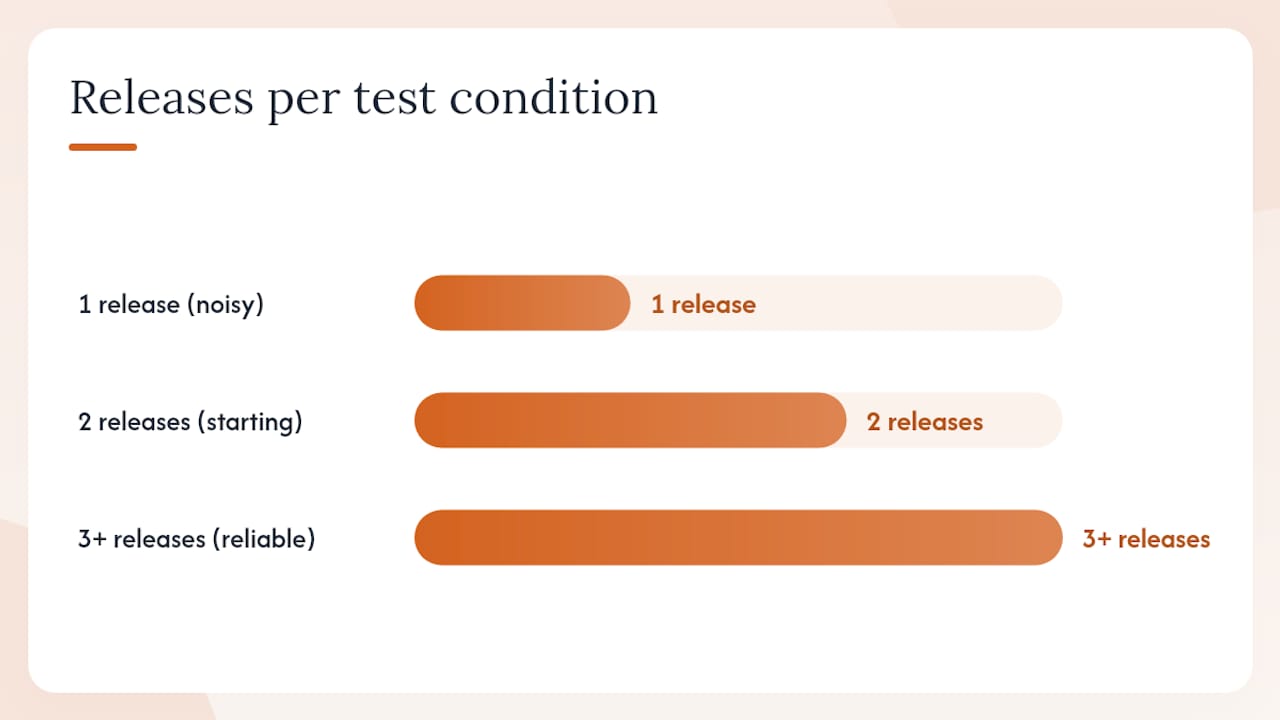
One release tells you almost nothing. The variables are too noisy: the season, what else dropped that week, how much you promoted, whether a playlist picked it up by chance. Reliable data requires a structured experiment across multiple releases.
Here’s a minimal framework:
- Set your control variables. Use the same promotional playbook for each test release: same ad spend (or zero), same number of SubmitHub pitches, same social post cadence. The only variable that changes is the release day.
- Run at least three releases per day you’re testing. Two Friday releases and two Tuesday releases give you a starting signal. Three or more per condition gives you something closer to reliable.
- Track these metrics for each release, measured at day 7 and day 30:
- First-week streams
- Saves and follows generated
- Playlist adds (editorial and independent)
- Listener retention (streams at day 30 vs. day 7)
- Control for seasonality. Don’t compare a summer release to a January release and call it a day-of-week finding. Keep your test releases within the same quarter when possible.
- Use Spotify for Artists analytics to pull the data. The Spotify for Artists analytics dashboard breaks down streams, saves, and playlist adds by time period, giving you the raw numbers for each experiment leg.
- Wait 30 days before drawing conclusions. First-week numbers are useful but incomplete. A Tuesday release that builds slowly through algorithmic recommendations can outperform a Friday release by day 30 even if it starts lower.
Testing release-day impact requires controlling for promotion spend and seasonality. A single release is too noisy to draw conclusions from; use multiple releases with the same promotional playbook to get results you can actually act on.
What does the research actually say about mid-week releases?
The evidence for Tuesday and Wednesday isn’t just anecdotal. LANDR’s distribution data found Tuesday was a surprising outlier: in some independent-artist cohorts, Tuesday streaming levels nearly matched Friday. That’s a meaningful finding because it suggests the Friday advantage is partly structural (chart tracking, editorial alignment) and partly psychological (artists and fans both expect Friday), not purely algorithmic.
The curator bandwidth argument is equally grounded. Independent artists who release mid-week face fewer simultaneous submissions, which means curators on platforms like SubmitHub have more time to actually listen. That attention gap is real and measurable in acceptance rates.
| Factor | Friday | Tuesday/Wednesday |
|---|---|---|
| Release-day competition | Very high | Low |
| Editorial playlist alignment | Full alignment | Partial (algorithmic still active) |
| Curator bandwidth | Lowest of the week | Higher mid-week |
| Chart tracking week | Full 7-day window | Shorter or none |
| Weekend streaming run-up | Immediate | 3–4 days |
Where this insight does NOT apply: if you have a label, a publicist, and a coordinated campaign with press, sync, and playlist partners all timed to Friday, breaking from that coordination costs more than the mid-week noise advantage gains. The same logic applies to any release targeting chart position. Friday is still the correct choice for those campaigns.
For everyone else, the practical rule of thumb is this: if you can’t run a fully coordinated Friday campaign, Tuesday or Wednesday will likely serve you better. The academic literature on release timing in entertainment markets supports exactly this kind of context-sensitive decision-making over any universal rule.
Intonality fits your release timeline before the window closes
Most artists figure out their release day too late to do anything about it. By the time the distributor submission is in and the Spotify editorial pitch is filed, there’s no room left to coordinate playlist pitching with the same precision.
Intonality’s pre-release campaign structure is built around the exact deadlines in this guide. You submit your track before release, and Intonality pitches it to vetted, genre-matched curators with personalized outreach, not automated blasts. Every curator decision comes back with written feedback, so you know what’s landing and what isn’t in real time. Campaigns average 4 to 11 playlist placements depending on tier, and the dashboard shows you exactly where your track sits at every stage.
Whether you’re dropping on a Tuesday to maximize curator attention or on a Friday for a chart push, the timing of your playlist pitching campaign matters as much as the release day itself. Start a campaign at Intonality before your editorial pitch window closes and give your release the curator reach it needs from day one.
What most artists get wrong about release day timing
The conventional wisdom says “release on Friday.” Most guides stop there. What they miss is that Friday is a system designed by and for major labels, and independent artists who follow it without the infrastructure to back it up are essentially volunteering to compete in the noisiest possible environment with the fewest possible resources.
The mid-week insight from LANDR isn’t a loophole or a hack. It’s a reflection of a simple reality: curator attention is finite, and Friday is when it’s most stretched. A Tuesday release from an artist with 2,000 followers and a focused email list will almost always get more genuine playlist consideration than the same release dropped on a Friday alongside 40,000 other tracks.
What I see in real campaigns is that artists obsess over the release day and underinvest in the two things that actually determine outcomes: metadata quality and post-release availability. A broken ISRC code or a missing songwriter credit can delay a release by days. And an artist who goes dark after dropping a track misses the 72-hour window where curator responses, algorithmic signals, and fan engagement compound on each other.
Pick your day based on your goals and your bandwidth. Then stay available, stay responsive, and treat the week after release as seriously as the release itself.
Sources
- What is the Best Day to Release Music? | LANDR Blog
- How to Choose a Release Date for Your Music (2026) | Tools 4 Music Blog | Tools 4 Music 2026
- When to Release Music: Timing Strategy Guide | AndR. Learning Center
- Should You Release Music on Tuesday Instead of Friday? - RouteNote - Radar
- Determining the optimal release time of movies: A study of movie and market characteristics


