
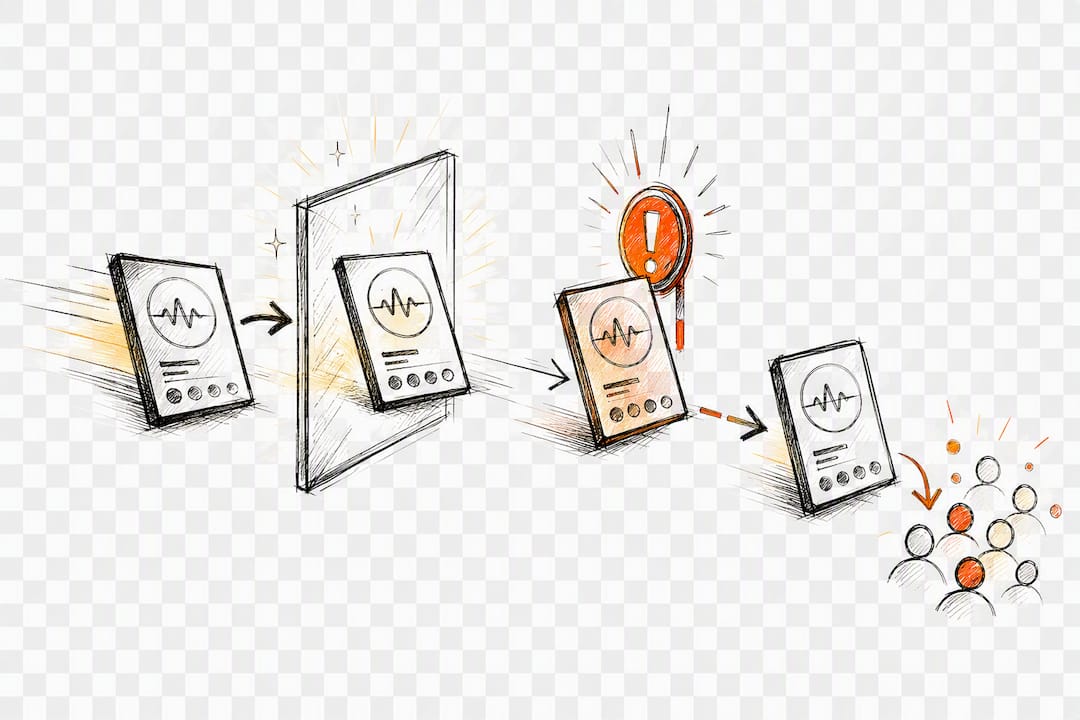
The fastest safe route to a real placement is checking two things before you send a single message: does the curator’s lane actually match your sound, and can you verify a real person or brand behind the account through the Spotify for Artists “source of streams” data after any placement. Skip the follower count. Check lane coherence, curator identity, and submission method first, then confirm results after the fact rather than trusting promises made before.
TL;DR:
- Verify that the curator’s playlist matches your genre, mood, and era, and confirm it has recent updates within the last two months.
- Ensure the curator provides clear contact methods, real social presence outside Spotify, and maintains lane coherence with recognizable artists.
- Avoid curators who guarantee placements, ask for payment upfront, or have suspiciously low engagement and incomplete or altered descriptions.
- Check whether streams from placements are accompanied by saves, follows, and downstream playlist activity within 72 hours to confirm genuine listener interest.
- Rely on personalized, transparent outreach efforts like those from services that use manual curator vetting, feedback, and proof of placement results.
Table of Contents
- What Are Spotify Playlist Curators, Exactly?
- How to Find Playlist Curators Without Guessing
- What to Include in a Curator Pitch
- Did the Placement Actually Work?
- Publisher Perspective: Relationships Beat Automation
- Let Intonality Run Your Curator Outreach
- Sources
What Are Spotify Playlist Curators, Exactly?
When artists talk about vetting playlist curators, they almost always mean listener-created playlists, not Spotify’s own editorial lists or the personalized algorithmic playlists like Discover Weekly. That distinction matters because independent curators require outreach or submissions, while Spotify’s own editorial team and its algorithm can’t be pitched directly at all. If a service promises to get you on Discover Weekly through a submission, that’s already a sign something is off.
Independent curators build playlists around a specific mood, genre, or scene, and their value depends entirely on whether real people follow and listen to what they curate, as explained in detail by folk clarinet music examples and styles. Some are hobbyists running a single niche playlist. Others operate small networks across a dozen playlists and treat curation like a part-time job. Vetting them means figuring out which kind of curator you’re dealing with before you invest time or money.
Fast vetting checklist you can run in 5 to 10 minutes
Before you reach out to anyone, run through a quick pass on the playlist itself. Open the tracklist and ask whether the songs actually belong together. A playlist claiming to be “chill indie folk” that’s stacked with unrelated trap beats has either been hijacked, bought in bulk, or was never curated with intention.
- Lane coherence: do the tracks share a genre, mood, or era, or does the list feel randomly assembled?
- Curator identity: does the description name a person, brand, or account with a consistent presence, or is it anonymous?
- Submission method: is there a visible email, form link, or social handle, or does the bio just say “DM for promo”?
- Update frequency: has the playlist changed in the last 30 to 60 days, or has it been frozen for a year?
Once the quick pass clears, dig one layer deeper. Look at the roster: are there recognizable independent artists alongside bigger names, or is it filled entirely with unknown tracks that look bought in bulk? Check whether the curator has any presence outside Spotify (Instagram, a website, a newsletter) since a real curator tends to leave a trail. A playlist with 50,000 followers but almost no engagement activity, and a curator with zero social footprint anywhere, is a mismatch worth flagging.
Red flags deserve extra weight. Any curator who guarantees a placement, guarantees stream counts, or asks for payment before listening to your track is stepping into artificial streaming territory, which Spotify treats as a policy violation. Disposable-looking accounts and playlists that suddenly swap their entire genre overnight are also common signs of a resold or hijacked list.
Pro Tip: Screenshot the playlist description and submission instructions before you pitch. Curators edit or delete these details often, and having your own record protects you if a dispute comes up later.
How to Find Playlist Curators Without Guessing
Most independent musicians overcomplicate discovery. The playlist itself usually tells you most of what you need to know, if you read it carefully.
- Check the “appears on” section of artists similar to you. If a track from an artist in your lane shows up on a playlist you’ve never heard of, that playlist is worth investigating.
- Read the full playlist description, not just the title. Independent curators often list a submission URL, an email address, or a social handle directly in the description, and capturing that exact method matters more than guessing at a generic contact form.
- Visit the curator’s own page or website. A page like Uncrumpled Playlists spells out its lane, its update cadence, and who it’s curating for, which is exactly the kind of transparency a legitimate curator offers.
- Follow social bios back to Spotify. Curators who post their playlist link on Instagram or TikTok are usually running a real, visible operation rather than a throwaway account.
Beyond manual searching, three categories of tools can speed up discovery, though each one only gets you partway there:
- Discovery engines surface playlists by genre or mood, but you still have to verify curator identity yourself; the tool finds candidates, it doesn’t vet them.
- Roster analyzers show you what other artists appear on a given playlist, which helps you spot lane coherence at a glance.
- Outreach helpers manage your contact list and follow-up timing, but they don’t replace reading a curator’s actual submission instructions.
None of these tool categories should be treated as a shortcut around the checklist. They narrow your list of candidates. You still do the vetting.
Once you’ve found a handful of legitimate candidates, log them somewhere you’ll actually use again: playlist name, genre lane, contact method, last update date, follower count, and two or three notable tracks already on the roster. That last field matters more than it sounds. It tells you at a glance whether your track would sit comfortably next to what’s already there, or stick out.
What to Include in a Curator Pitch
Curators reading dozens of submissions a week don’t want a biography. They want enough information to make a fast, confident decision. A minimal, effective pitch pack includes:
- One primary listening link, Spotify preferred over other platforms
- Release date and timezone, if the track hasn’t dropped yet
- Clean metadata: correct title, artist name, and genre tags
- Two or three RIYL (sounds like) comparisons the curator will actually recognize
- One sentence of context: why this track fits this specific playlist
That’s the whole pack. Resist the urge to add a press kit, a bio paragraph, or a link to five other platforms. Outreach research on contacting playlists consistently shows that shorter, specific pitches get read faster and more often than long ones.
Send a single message per platform rather than a generic email that reads as batch outreach. Follow up once, politely, after a week or two of silence. If a curator responds with feedback, even a rejection, that’s a sign you found someone real. A repeat non-response after two attempts means it’s time to move to the next prospect rather than push harder.
Pro Tip: Never offer to pay a curator for a guaranteed add. That single request converts a normal pitch into a payola risk, and it’s the fastest way to end up on a playlist that gets pulled or flagged later.
Avoid attaching large files, making claims about your streaming numbers you can’t back up, or promising a curator anything in return for a placement. A pitch built on honesty about your music, not leverage, is what earns a long-term relationship.
Did the Placement Actually Work?
A placement only matters if it produces real listeners, and the only reliable way to check that is inside Spotify for Artists. The “source of streams” tool breaks down exactly which playlist sent you streams, and pairing that with saves and follows tells you whether people who heard your track actually cared.
Healthy signals look like this: streams from the playlist accompanied by a meaningful share of saves, a bump in your artist follower count, and spillover into algorithmic placements like radio stations built off your track. That spillover is the real payoff. A curator placement that gets your song into someone’s personal library or triggers Spotify’s own algorithm to test it elsewhere has done its job well beyond the original playlist slot.
Suspicious signals look different: a sudden spike in raw stream count with almost no saves, no follows, and no downstream algorithmic pickup. That pattern often points to artificial streaming rather than genuine listener interest, a practice Spotify actively polices and can penalize distributors and artists for.
- Check saves and follows within the first 48 to 72 hours after a placement goes live.
- Compare the stream-to-save ratio against your other playlist placements to catch outliers.
- If something looks off, contact the curator directly and ask for clarification before assuming the worst.
- If a placement clearly used bot traffic, report it through your distributor and consider requesting removal to protect your account standing.
Guides on avoiding fake playlists on Spotify walk through more of these patterns if you want a deeper look at what artificial streaming tends to look like from the inside.
Publisher Perspective: Relationships Beat Automation
The checklist above is exactly what Intonality runs internally, and the reason is simple: automation can find you a thousand playlists, but it can’t tell you which fifty of them actually fit your sound. Every pitch Intonality sends goes to a real curator matched by genre, and every decision, yes or no, comes back with written feedback instead of silence.
That feedback loop is the part most services skip, and it’s the part that actually teaches you something about your own music. Campaigns run this way land an average of 4 to 11 playlist placements, depending on the tier, not because the pitch volume is higher but because the fit is tighter. A curator who adds your track because it genuinely fits their lane keeps it there. That’s the difference between a placement that produces a real listener base and one that produces a stream spike nobody remembers by next month.
— Einars
Let Intonality Run Your Curator Outreach
Running the checklist above on your own works, but it takes hours you might not have between finishing tracks and everything else an independent release demands. Intonality exists for exactly that gap: real curators, matched to your genre by hand, contacted with a personalized pitch instead of a mass blast.
Every campaign comes with real-time updates and written feedback on each curator’s decision, so you’re not left guessing why a track got passed over. That level of transparency is rare in this space, where most services either hide behind vague reporting or lean on playlists with follower counts that don’t hold up to scrutiny. Intonality’s tiers report an average of 4 to 11 placements per campaign, and the roster spans lanes from ambient to rock revival to metal, so genre fit is the starting point, not an afterthought.
If you want placements that come with proof instead of promises, submit your track and see which curators are actually a fit for what you’ve made.
Sources
For further reading on curator vetting and outreach, the Dynamoi playlist pitching guide covers curator types and pitch structure in depth. Uncrumpled Playlists is a working example of a transparent independent curator page, and this pet relaxation playlist shows how a well-defined lane reads in practice. Hypebot’s contact primer rounds out the outreach etiquette side.
- Playlist pitching — Spotify playlist curators (Dynamoi)
- About Uncrumpled Playlists — Independent Spotify Curator
- How to find and contact the right playlists (Hypebot)


