
Paying for playlist placement isn’t illegal by itself, but hiding that payment can be. Federal law under 47 U.S.C. §317 and §508 forces broadcasters to disclose paid airplay, backed by real penalties for silence. Streaming playlists sit outside that statute almost entirely, which is exactly why undisclosed curator payments create a legal gray zone instead of a clear violation, and why state regulators and platform terms have started filling the gap.
TL;DR:
- Federal broadcast laws require disclosure of paid airplay and reporting of payments to station personnel, but these rules do not apply to streaming platforms.
- Streaming playlist deals often fall into a legal gray area since they involve platforms not regulated as broadcasters under existing US laws.
- State authorities, such as Texas, are investigating undisclosed incentives in streaming promotion under consumer protection statutes, independent of federal payola laws.
- Spotify’s terms prohibit manipulative streaming practices, allowing platform action like removing tracks or suspending accounts regardless of legal violations.
- Verifiable, transparent collaborations with curated playlist services are the safest and least risky method for artists to gain placements without breaching undisclosed pay-for-play rules.
Table of Contents
- Playlist Payola Legal Rules: What Federal Broadcast Law Requires
- Why Streaming Playlist Deals Don’t Fit the Same Legal Box
- State Regulators Are Stepping Into the Federal Gap
- What Spotify’s Terms of Service Actually Prohibit
- Red Flags, Documentation, and When to Call a Lawyer
- What a Transparent Curator Process Actually Looks Like
- The Music Modernization Act and Playlist Promotion
- How US Payola Law Compares to International Rules
- What Artists Should Actually Prioritize Right Now
- Get Verified Playlist Placements Without the Payola Risk
- Primary Sources Worth Bookmarking
- Sources
Playlist Payola Legal Rules: What Federal Broadcast Law Requires
Congress built the original payola framework for radio, not for Spotify or Apple Music, and the distinction matters more than most artists realize. 47 U.S.C. §317 requires that any broadcast content paid for by someone other than the station be announced as sponsored, at the time it airs. A station that plays a song because a label wrote a check has to tell listeners that happened. The rule isn’t about the payment. It’s about the silence.
47 U.S.C. §508 goes further and targets the individuals involved. Station employees, program directors, or anyone connected with a broadcast who accepts money or anything of value for airplay must report that arrangement to the station in advance. Fail to disclose, and you’re looking at fines, and in serious cases, imprisonment.
The FCC’s sponsorship identification guidance spells out how this plays out in practice, and the underlying regulations, 47 C.F.R. §73.1212 and §73.4180, operationalize the statute for licensed stations. A recent FCC Enforcement Advisory also flagged covert manipulation of airplay tied to artist participation in promotions, making clear that licensees carry an ongoing duty of reasonable diligence, not just a one-time disclosure checkbox.
What actually triggers liability:
- Accepting payment for airplay without reporting it to the station beforehand
- A station broadcasting sponsored content without an on-air disclosure
- Concealing the financial relationship between a label, promoter, or artist and a decision-maker at the station
- Repeated or willful violations, which the FCC treats more harshly than isolated lapses
Enforcement typically starts with a complaint or an FCC investigation, moves through fines that can scale with severity, and in egregious cases, involves referral for criminal prosecution. None of this, notably, was written with streaming in mind.
Why Streaming Playlist Deals Don’t Fit the Same Legal Box
Here’s the jurisdictional reality that trips up a lot of artists and even some managers: the Communications Act regulates broadcasters holding an FCC license. Spotify, Apple Music, and independent playlist curators are not broadcast licensees. They don’t transmit over public airwaves, so the statutory language in §317 and §508 simply doesn’t reach them. That’s not a loophole someone engineered. It’s a gap Congress never closed because streaming didn’t exist when the law was written.
A 2022 Duke Law analysis on the “commerce of music streaming” makes this point directly: pay-for-play arrangements on streaming platforms are largely unregulated at the federal level. The paper doesn’t argue this is automatically good or bad. It lays out real tension. Paid placement can help unknown artists get discovered who’d otherwise never crack an editorial playlist. It can also mislead listeners into thinking a recommendation is organic when money changed hands, which is the exact harm disclosure law was built to prevent in the first place.
The legal analysis shifts depending on who gets paid:
- Paying the platform directly for algorithmic or featured placement usually falls under commercial advertising rules, not payola law
- Paying an independent third-party curator to add your track to their playlist sits in murkier territory, since curators aren’t broadcasters and often aren’t bound by any disclosure statute
- Paying an influencer or “playlister” to promote a track as though it’s a genuine recommendation edges toward deceptive advertising, especially if the FTC’s endorsement disclosure principles apply
That third category is where most real risk lives.
State Regulators Are Stepping Into the Federal Gap
Where federal broadcast law stops, state consumer protection statutes pick up, and that shift is already happening. As of May 2026, the Texas Attorney General launched formal investigations into major streaming platforms, including Spotify, using Civil Investigative Demands to probe whether undisclosed incentives shape playlist placements and recommendations.
The legal theory here isn’t payola law at all. It’s deceptive trade practices, the idea that presenting a paid placement as an organic recommendation misleads consumers, which is a well-established basis for state action regardless of whether federal broadcast statutes apply.
That distinction changes the risk calculus for artists and curators:
- Civil Investigative Demands can compel platforms and third parties to hand over internal records, contracts, and communications
- State attorneys general don’t need a federal violation to act. Deceptive practices statutes exist independently in most states
- Outcomes can include settlements, injunctions, or civil penalties, even when no criminal broadcast law was ever triggered
An artist who never touches a radio station can still get pulled into a records request if their curator relationship becomes part of a broader state probe.
What Spotify’s Terms of Service Actually Prohibit
Even without a single applicable government statute, Spotify and other platforms enforce their own rules, and those rules carry teeth. Spotify’s terms explicitly prohibit manipulated streaming metrics, fake plays, and deceptive promotional schemes, regardless of whether any law technically applies.
Platforms don’t need a court case to act. They can:
- Remove tracks or entire artist profiles flagged for manipulated streams
- Withhold royalty payments tied to suspicious streaming activity
- Suspend or terminate an artist’s account, cutting off distribution entirely
- Flag the artist or label to distributors, who may also enforce their own anti-fraud clauses
The mechanism here is contractual, not statutory, but the consequences are just as real, sometimes worse for a working artist than a regulatory fine, since a pulled catalog kills momentum overnight. If you’ve paid for playlist promotion, review the platform’s terms of service before you sign anything with a curator or promoter, keep every invoice and campaign agreement, and know the appeal process before you need it. Spotify’s own reporting tools let you flag suspicious activity on your own catalog, which is worth doing proactively if you suspect a service used bots rather than real curator interest.
Red Flags, Documentation, and When to Call a Lawyer
Most legal exposure in playlist promotion traces back to a handful of recognizable warning signs. Learn them, and you avoid the vast majority of trouble before it starts.
Watch for these red flags:
- Requests for account access or login credentials — a legitimate curator never needs to log into your Spotify for Artists account
- Guarantees of a specific stream count or “instant viral” results — real curator decisions can’t be promised in advance
- “Paper add” schemes, where a service claims placement on a playlist that barely exists or has no real listener base
- Any arrangement involving undisclosed payments to station personnel if the promotion touches traditional radio at all
- Pressure to skip a written agreement or avoid putting campaign terms in writing
Build a documentation habit around every campaign, not just the ones that feel risky:
- Keep a written agreement for every paid promotion, specifying deliverables and cost
- Save receipts and invoices tied to each campaign
- Screenshot or archive any disclosure copy a curator or platform provides
- Date-stamp your campaign records so you can reconstruct a timeline if a platform or regulator asks
- Verify curator credentials, playlist follower counts, and engagement history before paying anyone
Cross-check what curators tell you against Spotify for Artists analytics, track where your referral traffic actually originates, and keep every email thread. If a platform flags your account or a regulator’s request lands in your inbox, pause the campaign immediately and talk to an entertainment lawyer before responding to anything in writing.
Pro Tip: Ask any curator or promotion service for a written breakdown of playlist names, follower counts, and expected placement timelines before you pay. A service that won’t put specifics in writing is telling you something.
What a Transparent Curator Process Actually Looks Like
The compliance steps above only work if the promotion service behind them operates the same way. Intonality builds its process around personalized pitches sent to vetted, genre-matched curators, not automated blasts or fabricated playlists. Every submission generates real-time updates and written feedback from the curator who made the decision, so artists see exactly why a track landed or didn’t.
Campaigns typically result in 4 to 11 playlist placements depending on the service tier, and every placement is traceable to a real curator, not a black box. That structure maps directly onto the documentation habits worth building anyway: written records, verifiable decisions, and a paper trail that holds up if a platform or regulator ever asks questions.
The Music Modernization Act and Playlist Promotion
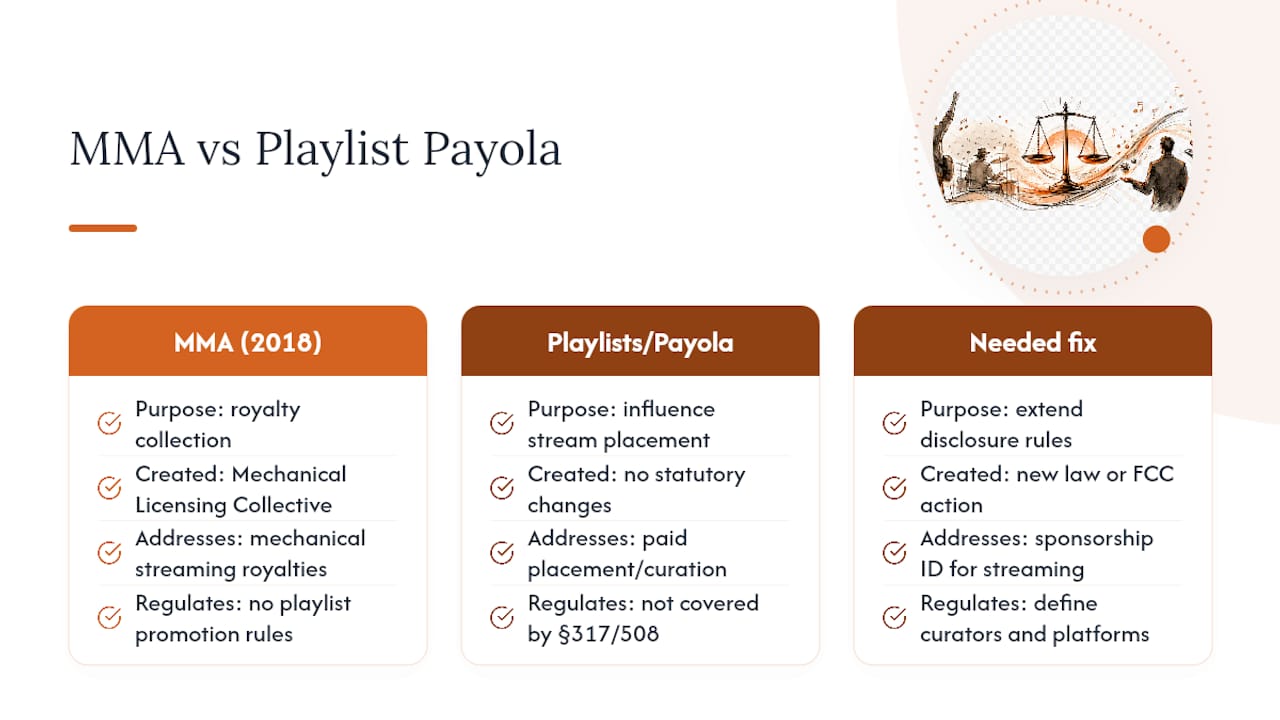
The Music Modernization Act, signed into law in 2018, reshaped how streaming royalties get collected and paid out through the creation of the Mechanical Licensing Collective. It solved a real problem: songwriters weren’t getting paid accurately because mechanical licensing for streaming had no efficient central system.
What it didn’t touch is playlist promotion or payola. The Act addresses royalty administration, not disclosure obligations around paid placement. Nothing in the law creates a streaming equivalent of §317 or §508, and nothing in it regulates how curators or platforms decide what gets featured.
That’s worth stating plainly because artists sometimes assume any major music legislation must have modernized payola rules along with everything else. It hasn’t. Congress addressed the money artists are owed for streams that already happened. It never addressed the money changing hands to influence which streams happen in the first place. Until Congress or the FCC extends sponsorship identification requirements to internet-based platforms, and there’s no indication that’s imminent, streaming payola will keep operating in the same regulatory gap the Duke Law analysis identified. Any future legislative fix would most likely need to define streaming curators and platforms as covered entities explicitly, since the current statutory language simply doesn’t reach them.
How US Payola Law Compares to International Rules
Other countries handle broadcast payment disclosure with varying degrees of strictness, and the comparison is useful mostly for what it reveals about how unusual the US streaming gap actually is. The United Kingdom’s Ofcom enforces sponsorship and disclosure rules for licensed broadcasters that function similarly to the FCC’s framework, requiring clear identification when airtime is paid for.
The European Union doesn’t have a single unified payola statute, but member states generally fold broadcast sponsorship disclosure into broader consumer protection and advertising transparency law, which tends to apply more readily to digital platforms than the US framework does. That’s a meaningful structural difference. Because EU consumer protection law is built to cover deceptive commercial practices broadly, rather than targeting broadcast licensees specifically the way US law does, it has an easier time reaching streaming-era promotion without needing new legislation.
The US system, by contrast, ties disclosure obligations to broadcast licensing status. That worked fine when radio was the only game in town. It leaves streaming largely uncovered now, and closing that gap would require either new federal legislation or an expansive reinterpretation of existing consumer protection statutes, the same tool Texas is currently testing against major platforms.
What Artists Should Actually Prioritize Right Now
Chase documented, verifiable placements over anything promising an instant spike, and insist on full disclosure in every paid promotional relationship you enter. The absence of a clean federal streaming statute doesn’t mean the absence of risk. Platform bans and state investigations move faster than Congress ever will.
Opaque services that guarantee numbers and won’t explain their methods are the ones most likely to trigger a Spotify enforcement action or land in a state’s document request. Balance paid promotion with genuine editorial pitching. The artists who weather scrutiny best are the ones who can prove, in writing, exactly what they paid for and why.
— Einars
Get Verified Playlist Placements Without the Payola Risk
Intonality is the alternative to opaque pay-for-play services and DIY curator outreach. Instead of guessing which playlists are real or hoping a payment buys genuine listeners, you get personalized pitches sent to vetted, genre-matched curators, with written feedback and real-time updates on every decision.
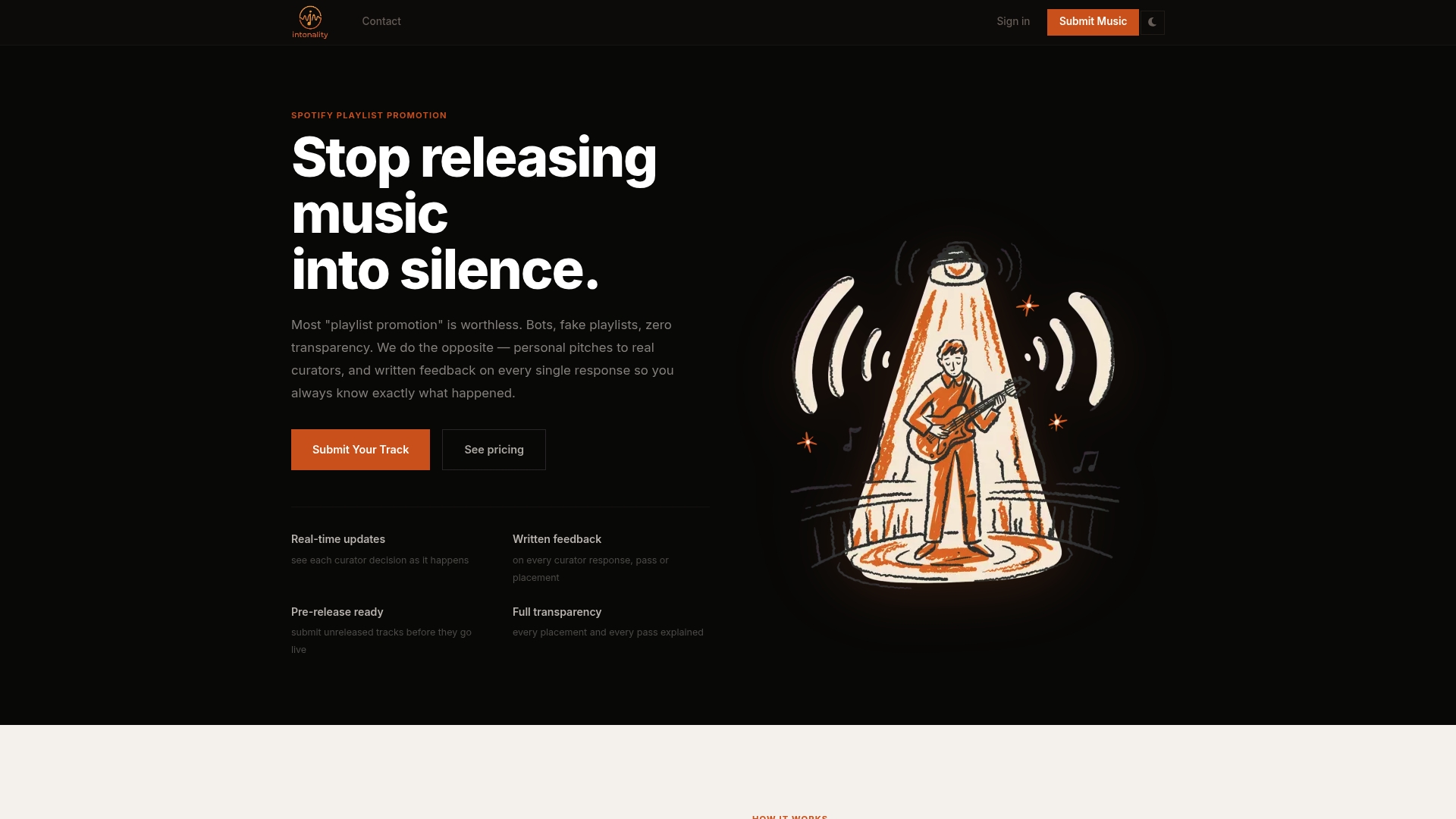
Every campaign comes with a dashboard tracking placements as they happen, so you have documented proof of exactly where your track landed and why, the same paper trail this article recommends building for any paid promotion. Campaigns average 4 to 11 placements depending on your tier, and every curator relationship is traceable, never a black box you’re trusting blindly.
If you’re ready to start a campaign built on transparency instead of guesswork, submit your track and see which curators respond.
Primary Sources Worth Bookmarking
For the statutes themselves, read 47 U.S.C. §317 and §508 directly. The FCC’s payola guidance explains enforcement in plain terms, the Texas AG’s release shows state action in motion, and the Duke Law paper remains the sharpest academic take on streaming’s regulatory gap.
Sources
- Payola and Sponsorship Identification | Federal Communications Commission
- 47 USC 317: Announcement of payment for broadcast
- 47 U.S. Code § 508 - Disclosure of payments to individuals connected with broadcasts | LII
- Pay-to-Playlist: The Commerce of Music Streaming
- Attorney General of Texas — investigative release on streaming platforms


