
For independent artists, Intonality is the strongest pick for Spotify playlist promotion. It sends personalized pitches to vetted, genre-matched curators, gives you written feedback on every decision, and updates your dashboard in real time. That combination of transparency and measurable reporting is rare in this space.
Here is a quick shortlist if you need to decide fast:
- Intonality — Best for artists who want curator-led placements with full reporting and genre-matched targeting. Claims 4–11 placements per campaign depending on tier.
- SubmitHub / Groover (pay-per-submission marketplaces) — Best for DIY artists on a tight budget who want direct curator feedback and broad exposure across many genres.
- Playlist Push — Best for artists with a mid-range budget seeking a managed campaign with a wider curator network.
- SoundCampaign — Best for artists who want a self-serve, data-driven approach with campaign analytics.
- Groover — Best for artists who want European and US curator reach with guaranteed feedback on every submission.
One thing worth knowing upfront: Spotify’s editorial curators and algorithms prioritize engagement signals like saves, profile follows, and repeat listens. Raw stream counts mean far less than how listeners behave after they hear your track. A good promotion service should be driving those signals, not just adding your song to a playlist with 50,000 ghost followers.
Table of Contents
- What are the best Spotify playlist promotion services?
- How do the top Spotify promotion services actually work?
- How do you choose the right Spotify playlist promotion service?
- What does real campaign testing actually look like?
- Why Intonality is the recommended pick
- Is Spotify playlist promotion legal and ethical?
- Key Takeaways
- The gap between what playlist promotion promises and what actually matters
- Intonality gives you curator-led promotion with full transparency
- Authoritative resources for Spotify playlist promotion
What are the best Spotify playlist promotion services?
The table below covers Intonality alongside the three broad service categories that dominate the market. Specific named services are profiled in the section that follows.

| Service | Best For | Pricing (ballpark) | Avg. Placements / Outcomes | Curator Transparency | Turnaround | Reporting / Dashboard | Guarantee / Refund |
|---|---|---|---|---|---|---|---|
| Intonality | Independent artists wanting genre-matched, curator-verified placements with written feedback | Not publicly listed (tiered packages) | 4–11 placements per campaign (claimed) | High: vetted curators, genre-matched, per-curator written feedback | Varies by tier | Real-time dashboard with per-curator notes | Not publicly listed |
| Pay-per-submission marketplaces (SubmitHub, Groover) | DIY artists on low-to-moderate budgets wanting broad curator exposure | $0.50–$3+ per submission credit | Variable; depends on curator acceptance rate | Medium: curator profiles visible, quality varies widely | 7 days typical | Feedback per submission (accept/reject + note) | Credits refunded if curator doesn’t respond |
| Curator-network agencies (Playlist Push, Moonstrive Media, etc.) | Artists wanting hands-off managed campaigns | $150–$600+ per campaign | Variable; agencies claim targeted placements | Medium–Low: some show curator samples, others do not | 2–4 weeks | Campaign summary reports; depth varies by agency | Partial refunds or re-runs offered by some |
| Label-affiliated promotion services | Artists with label relationships or catalog-focused campaigns | Custom / not publicly listed | Varies; label access can open different playlists | Low–Medium: label priorities may not align with indie goals | Custom | Varies | Varies |
Intonality stands out in the transparency column. Most curator-network agencies give you a summary report after the fact. Intonality’s dashboard shows you what each curator said, in writing, as decisions come in.
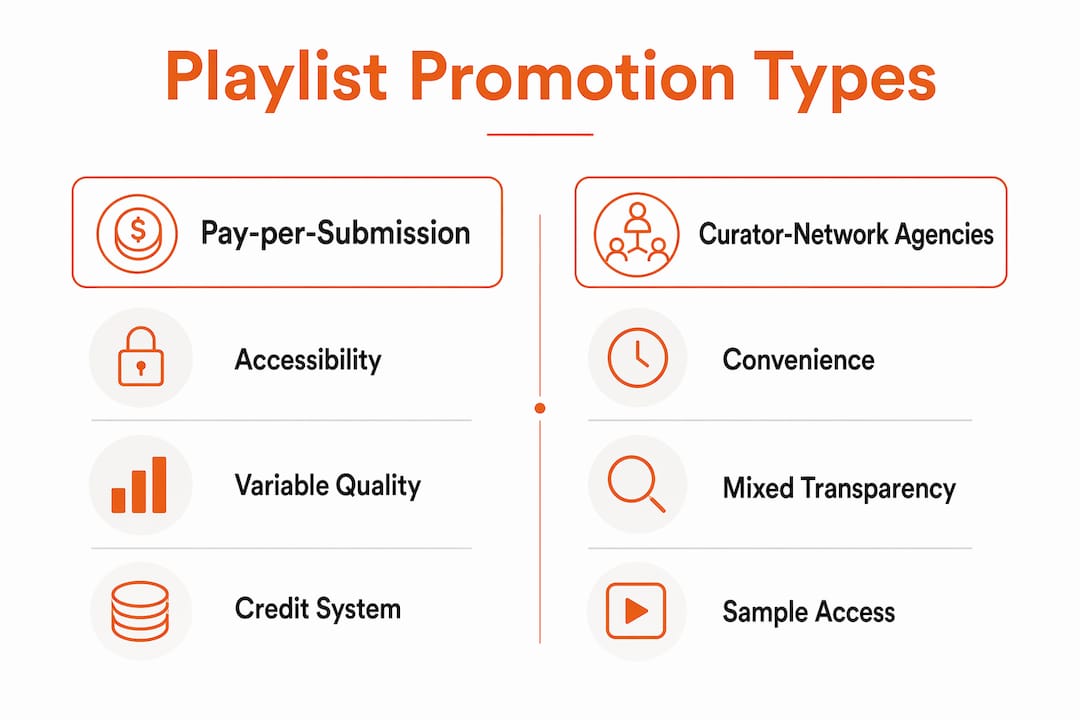
Pay-per-submission marketplaces are the most accessible entry point. The tradeoff is quality control: curator standards vary significantly, and a high submission volume does not guarantee high-quality placements.
Curator-network agencies offer convenience but transparency is inconsistent. Some show you real curator samples before you buy; others keep their networks opaque. Always ask for samples.
Label-affiliated services make sense if you already have a label relationship. For most independent artists, they are not the right fit.
How do the top Spotify promotion services actually work?
Intonality
Intonality operates as a curator-led marketplace. When you submit a track, the team sends personalized pitches to curators who are pre-vetted and matched to your genre. Every curator who reviews your track leaves written feedback, which appears in your dashboard alongside real-time status updates. The claimed average is 4–11 playlist placements per campaign, depending on the tier you choose. Pre-release submission is supported, which matters because submitting 3–4 weeks before release gives editors and curators the most time to consider your track. Intonality’s genre-specific playlists span indie, folk, dark pop, and more, so the matching is based on actual playlist content rather than broad genre tags.

Pro Tip: Before purchasing any campaign, browse Intonality’s genre playlists directly. The indie playlist and folk music playlist show you exactly the kind of curators and audiences your track would reach.
Pay-per-submission marketplaces
SubmitHub and Groover are the two dominant platforms in this category. Both operate on a credit system: you pay per submission, choose curators from a filterable directory, and receive feedback within a set window. SubmitHub charges roughly $0.50–$3 per submission depending on whether you use standard or premium credits. Groover operates on a similar model with a stronger European curator base but solid US coverage too. The key advantage is direct feedback: you learn why a curator passed, which is genuinely useful for refining your pitch. The risk is curator quality variance. Some curators on these platforms run playlists with real, engaged audiences; others do not. Filtering by follower count, engagement indicators, and genre specificity before submitting is worth the extra time.
Curator-network agencies
This category includes services like Playlist Push, Two Story Media, Moonstrive Media, Daimoon Media, Members Media, Spin Promo, and Omari MC. The model is managed: you pay for a campaign, the agency pitches your track to their curator network, and you receive a report. Pricing typically runs $150–$600+ per campaign. The quality gap between agencies in this category is wide. Playlist Push has a well-known curator network and a longer track record. Smaller agencies like Moonstrive Media and Daimoon Media serve niche genres and may offer more targeted placements for the right artist. Omari MC is known in the hip-hop and R&B space. Two Story Media and Indie Music Academy both publish educational content alongside their promotion services, which adds some credibility. YouGrow and YouGrow Promo focus on organic growth strategies combined with playlist pitching.
What separates the better agencies from the rest is whether they can show you real curator samples before you commit. If an agency cannot or will not do that, treat it as a red flag.
Label-affiliated promotion services
These services leverage existing label relationships to access playlists that independent artists typically cannot reach through standard pitching. The tradeoff is alignment: a label-affiliated service may prioritize its own catalog over your track, and pricing is rarely transparent. For most independent artists releasing on their own or through a distributor, this category is not the right starting point.
On campaign metrics: The numbers that matter are saves per stream, completion rate, playlist adds, and profile follows. A track with a save rate above 15% is considered strong by most curator standards. Vendor dashboards that only show stream counts are hiding the signal that actually matters.
How do you choose the right Spotify playlist promotion service?
Selection criteria
Before you spend anything, run through this checklist:
- Genre matching: Does the service match your track to playlists where your genre actually fits, or does it blast to a generic list?
- Curator verification: Can you see real curator profiles, playlist URLs, and follower counts before you buy?
- Reporting granularity: Does the report show per-placement metrics (saves, streams, follows) or just a list of playlist names?
- Refund or guarantee policy: What happens if placements underperform or curators do not respond?
- Campaign sample size: How many curators does a typical campaign reach? More is not always better if targeting is weak.
- Expected engagement metrics: Does the service define what a successful placement looks like in terms of saves or completion rates?
Realistic campaign timeline
- 4 weeks before release: Submit your track. Spotify requires a minimum 7-day lead time for editorial pitching, but 3–4 weeks gives curators and editors the most runway.
- Release week: Monitor your Spotify for Artists dashboard. Watch for saves, playlist adds, and follower spikes.
- Weeks 2–4: Placements from curator-network campaigns typically land here. Track completion rates and repeat listens.
- Days 30–60: Algorithmic playlists like Discover Weekly and Release Radar begin to respond to the engagement signals your placements generated.
- Day 90: Assess the full picture. Did follower growth translate to Release Radar reach? Did saves-per-stream hold above 15%?
Red flags to watch for
- Guaranteed stream counts with no mention of curator identity or playlist URLs
- Playlists that are private or have no public follower count
- Reseller networks that cannot name their curators
- Reports that only show stream totals with no engagement breakdown
- No refund or re-run policy of any kind
Questions to ask any provider before you buy:
- “Can you share live examples of playlists in my genre from recent campaigns?”
- “What raw metrics do you report: saves, completion rate, follower lifts?”
- “What is your refund or re-run policy if placements underperform?”
- “How do you verify that your curators are active and have real audiences?”
What does real campaign testing actually look like?
Testing a playlist promotion service properly requires more than running one campaign and checking stream counts. A valid test design uses a consistent release (same artist, similar track quality, similar genre), equal campaign windows, and a defined set of metrics measured at the same intervals.
The five metrics that matter most are:
-
Saves per stream: The clearest signal of genuine listener interest. Spotify’s own guidance confirms that high save rates improve algorithmic playlist performance.
-
Completion rate: What percentage of listeners hear the track to the end? A low completion rate suggests poor audience fit, regardless of how many playlists you landed on.
-
Playlist adds: How many listeners added your track to their own playlists after hearing it?
-
Profile follows: Did listeners care enough to follow your artist profile? This directly affects Release Radar reach for your next release.
-
Repeat listens: Are people coming back? Repeat listens are a strong quality signal for Spotify’s editorial team.
“The most effective promotion strategies trigger Spotify’s quality signals — saves, completion, repeats — rather than chasing raw stream counts. Combining paid promotion tools with curator outreach typically produces higher new-active-listener conversion than either tactic alone.” — Spotify for Artists
A note on vendor dashboards: most services show you what they want you to see. A dashboard that displays only stream counts and playlist names is not giving you the data you need. Before trusting a vendor’s report, cross-check the playlist URLs in Spotify for Artists to confirm the placements are real and the follower counts match what was promised.
Sample size matters too. A single campaign is not a test. Artists who submit consistently and build relationships with curators over multiple releases perform better over time. Treat your first campaign as a baseline, not a verdict.
Why Intonality is the recommended pick
Full disclosure: this article is published by Intonality. That said, the recommendation is grounded in what independent artists actually need from a promotion service, and the reasoning holds up against the alternatives.
Intonality’s core differentiator is the combination of personalized curator pitching and per-curator written feedback. Most services in this space either give you a bulk submission with no feedback (curator-network agencies) or charge per submission for curator feedback without managing the campaign for you (pay-per-submission marketplaces). Intonality sits between those two models: managed pitching with the transparency of a marketplace.
The claimed average of playlist placements per campaign varies by tier and service. Lower-tier campaigns reach fewer curators; higher-tier campaigns expand the network while maintaining genre-matching. Every placement comes with written curator notes explaining why the track was accepted or passed, which is information you can use to improve your next submission.
The dashboard updates in real time. You do not wait for a summary email two weeks after your campaign closes. You can see which curators have reviewed your track, what they said, and which playlists you have been added to as it happens.
Pre-release submission is supported, which aligns with the best-practice window of 3–4 weeks before release. Getting your track in front of curators before it goes live gives them time to add it to their playlists on release day, which concentrates the engagement signals Spotify’s algorithm responds to.
Pro Tip: Check Intonality’s dark pop playlist before submitting if you make pop-adjacent music. Seeing the actual playlist content tells you more about curator taste than any service description.
Is Spotify playlist promotion legal and ethical?
Paying a service to pitch your music to independent playlist curators is legal and does not violate Spotify’s terms of service, provided the placements are on real playlists with genuine audiences. The distinction Spotify draws is between legitimate promotion and artificial manipulation.
What Spotify explicitly prohibits is the use of bots, fake accounts, or third-party services that artificially inflate stream counts, follower numbers, or save rates. Services that guarantee a specific number of streams without disclosing curator identity or playlist URLs are almost always operating in this gray zone or beyond it. Spotify’s detection systems flag abnormal streaming patterns, and tracks found to have inflated metrics can be removed from playlists or have their royalties withheld.
The ethical line is clearer than the legal one. Paying a curator to add your track to a playlist they do not actually listen to, or paying for placements on playlists with purchased followers, is misleading to listeners and to Spotify’s algorithm. It wastes your money and can damage your artist profile’s credibility with real curators down the line.
Legitimate promotion means paying for access and pitching, not for guaranteed outcomes. A service that says “we will pitch your track to 50 real curators and you will receive written feedback” is selling a service. A service that says “we guarantee 10,000 streams” is selling something else entirely.
Cross-platform promotion through station branding and radio can complement playlist pitching without any of these risks, since it builds audience awareness outside Spotify’s ecosystem entirely.
Key Takeaways
Legitimate Spotify playlist promotion drives saves, follows, and repeat listens — the engagement signals that feed Spotify’s algorithm and build long-term artist visibility.
| Point | Details |
|---|---|
| Prioritize engagement over streams | Saves per stream, completion rate, and profile follows matter more to Spotify’s algorithm than raw stream counts. |
| Submit 3–4 weeks before release | Submitting early gives curators and Spotify editors the most time to consider your track before it goes live. |
| Verify curator transparency before buying | Ask any service for real playlist URLs and curator samples; refuse to pay for campaigns with no curator identity disclosure. |
| Release Radar grows with your followers | Every new follower means your next release lands automatically in their Release Radar, compounding the value of each campaign. |
| Intonality for transparent, curator-led campaigns | Intonality’s per-curator written feedback and real-time dashboard make it the strongest pick for independent artists who want to see exactly what their campaign is doing. |
The gap between what playlist promotion promises and what actually matters
Most artists approach playlist promotion with the wrong goal. They want streams. Spotify’s algorithm wants something different: it wants to know whether listeners who heard your track for the first time chose to save it, replay it, or follow you. Those three behaviors are the ones that trigger Discover Weekly and Release Radar placements, which are worth more than any independent playlist placement you will ever buy.
The practical implication is that a campaign landing you on five playlists with highly engaged, genre-matched audiences will outperform a campaign landing you on twenty playlists with inflated follower counts and passive listeners. Every time. The services that understand this build their curator networks around engagement quality. The ones that do not sell you stream counts.
There is also a compounding effect that most artists underestimate. Playlist pitching should not be a one-shot strategy. Artists who submit consistently across multiple releases, build relationships with curators, and treat each campaign as a data point rather than a verdict tend to see their algorithmic reach grow release over release. The first campaign sets a baseline. The third or fourth campaign, with refined genre targeting and a track that has already demonstrated save-rate performance, is where the real momentum starts.
One more thing worth saying plainly: editorial pitching through Spotify for Artists is free, and acceptance rates for independent artists without prior editorial placements are under 1%. Paid curator promotion does not replace editorial pitching. It builds the engagement signals that make editorial consideration more likely next time.
Intonality gives you curator-led promotion with full transparency
Most playlist promotion services make you wait for a summary report. Intonality shows you the campaign as it happens: which curators reviewed your track, what they said, and which playlists you have been added to, all in a live dashboard. Personalized pitches go to vetted, genre-matched curators, and every decision comes with written feedback you can actually use.
If you are preparing a release and want curator-led promotion with real reporting, submit your track and ask to see curator samples before you commit. Browse the Intonality service page to compare campaign tiers and see what a real campaign report looks like. Pre-release submissions are supported, so the earlier you start, the better your placement window.
Authoritative resources for Spotify playlist promotion
These are the primary sources worth bookmarking before you run a campaign:
- Spotify for Artists: Pitching Music to Playlist Editors — The official rules for editorial pitching: eligibility, lead times, and what the pitch form covers. Read this before submitting anything to Spotify’s editorial team.
- Spotify for Artists: Promoting Music on Spotify — Overview of all first-party promotion tools including Marquee, Showcase, and Spotify Ads Manager. Use this to understand what paid tools Spotify itself offers alongside curator pitching.
- Spotify Campaign Kit — Spotify’s own suite of campaign tools. Combining Campaign Kit with curator outreach produces higher new-active-listener conversion than either tactic alone, according to Spotify.
- Spotify for Artists: Playlisting Guidance — Explains how editorial and algorithmic playlists work and which engagement signals matter most. Use this to understand what a successful placement actually looks like in your dashboard.
- Spotify Promotion and Playlists Hub — The full support category for promotion tools, playlist types, and campaign setup. Useful for troubleshooting and understanding how different playlist types interact with your release.
How to use these for verification: When a promotion service claims their placements drive algorithmic growth, check their reported metrics against what Spotify’s own documentation says matters. If a vendor’s dashboard does not show saves, completion rates, or follower lifts, you are not getting the data Spotify itself uses to evaluate your track.