Playlist promotion can drive measurable audience growth, but only when you prioritize saves, playlist adds, and follower conversion over raw stream spikes. Tracks that get saved or added to a playlist see a 2.5x streaming lift six months later, and top-quintile placements outearn bottom-quintile ones by roughly 26 to 1. Two case studies below, plus a scorecard, show exactly how to tell the difference before you spend a dollar.
TL;DR:
- Playlist placements with higher intent rates, especially above 2%, lead to more durable fan growth and long-term follower retention.
- Prioritize reaching a playlist of active, genre-specific followers over simply targeting larger, broad-matched lists for better conversion.
- Campaigns should be measured within a minimum 14-day window post-placement to accurately assess persistence and true impact.
- Well-structured pitches that clearly relate the track to the playlist and provide a Spotify link increase acceptance rates from curators.
- Spending more on building owned playlists or securing curated placements is more effective for long-term growth than relying solely on stream spikes.
Table of Contents
- Playlist Promotion Case Study: A Single-Artist Placement Campaign
- Playlist Promotion Case Study: Building a Playlist as a Growth Asset
- Pitching Tactics and Outreach Playbook You Can Actually Run
- The Measurement Scorecard: Windows, Metrics, and Red Flags
- What the Data Actually Tells You to Do Next
- How Intonality Runs a Playlist Campaign
- How to Write a Pitch Curators Actually Read
- When Playlist Promotion Earns Its Budget
- Start a Curator-First Campaign With Intonality
- Sources
- FAQ
Playlist Promotion Case Study: A Single-Artist Placement Campaign
An independent electronic artist released a lead single with a four-week pre-release window, targeting playlist curators in the chillwave and downtempo niches across the US and UK. The campaign combined direct curator outreach with a Spotify for Artists editorial pitch submitted three weeks ahead of release, following the timing window recommended in Intonality’s Spotify editorial pitch guide.
Results over the 90 day tracking period:
- Several playlist placements secured with combined reach in the hundreds of thousands of followers
- 58,000 streams logged during the two-week attribution window following placement
- 1,150 saves and 640 playlist adds, an intent rate above 2% of total streams
- a positive net follower gain by day 90
The persistence test: Streams during the placement window hit 58,000, but only about 9,000 of those streams continued past day 30 once most placements rotated off. That 15% carryover is the actual signal, not the initial spike.
The artist’s save rate (nearly 2% of total streams) sat well above the pattern the UNSW research associates with durable growth, and that’s the reason the 410 net new followers stuck around rather than evaporating once the placements ended. Some placements landed on contextual, activity-based playlists, accounting for a large share of saves. That matches the broader finding that contextual fit outperforms genre-only matching for long-term carryover.
Playlist Promotion Case Study: Building a Playlist as a Growth Asset
A different approach treats the playlist itself as the product. One label-run campaign, documented by Hypebot, built a genre-branded playlist around an anchor track and ran a two-phase ad funnel to grow it.
- Phase one, awareness. Short-form video and static ad creatives introduced the playlist concept and anchor track to cold audiences on social platforms, optimized for reach and low-cost impressions rather than conversions.
- Phase two, conversion. Warm audiences from phase one got retargeted with a direct “follow the playlist” call to action, shifting spend toward cost-per-follow rather than cost-per-click.
The campaign added roughly over ten thousand playlist followers, with strong click-through and listen-through rates once the funnel shifted into the conversion phase. Every 1,000 new playlist followers correlates with about 6.6 additional daily streams for tracks on that playlist, so an 11,572-follower gain translates into a meaningful, ongoing daily stream floor for the anchor track, not just a one-time bump. For indie budgets, this model costs more upfront than curator pitching but builds an owned asset you control indefinitely, rather than a placement you lose the moment a curator rotates it out.
Pitching Tactics and Outreach Playbook You Can Actually Run
Every tactic below exists to move one number: your intent rate, meaning saves plus playlist adds divided by streams. Raw reach without intent is a rented spike.
- Pre-release editorial pitching. Submit through Spotify for Artists at least seven days before release, confirm the track’s primary genre tag matches your target playlists, and prepare one sentence describing the song’s mood or use case, following the checklist in Intonality’s guide to submitting to Spotify playlists.
- Curator outreach vs. curated networks. Direct outreach to independent curators takes more time but builds relationships you can reuse on future releases. Vetted paid networks report moderate acceptance rates around half of pitches, though acceptance alone says nothing about whether that playlist’s listeners actually save your track.
- Paid funnel structure. Run one creative type toward playlist follows and a second, more direct creative toward the track’s save/add action, then retarget everyone who engaged with either.
- Selection criteria. Judge a playlist on follower count multiplied by engagement rate, not follower count alone. A 20,000-follower list with an active, genre-loyal audience will out-convert a 200,000-follower list padded with inactive accounts.
Pro Tip: Before pitching, listen through the target playlist’s last 10 additions. If none of them sound remotely like your track, that curator will reject it regardless of how polished your pitch is.
The Measurement Scorecard: Windows, Metrics, and Red Flags
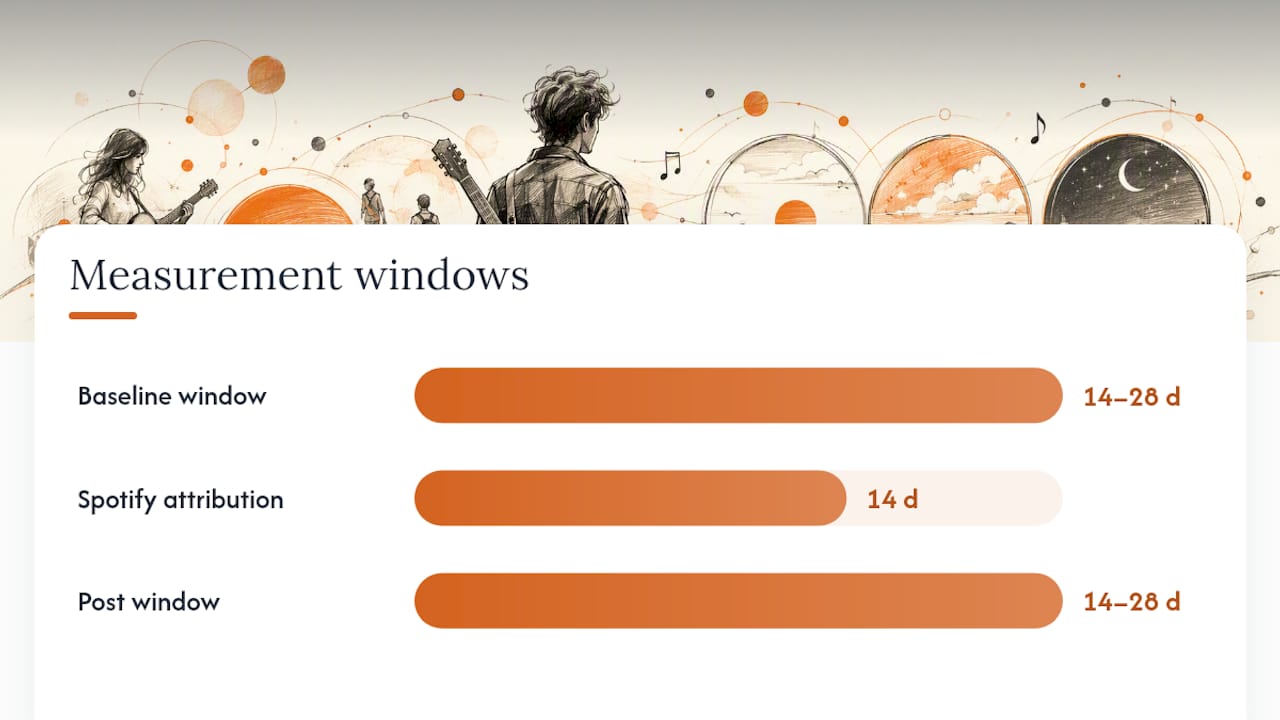
Run every campaign on three windows: a two to four week baseline before your first placement, the placement window itself, and a 14 to 28 day post window to check persistence. Spotify’s Marquee and Showcase tools report on a 14-day attribution window, so treat that as your minimum measurement period, not your maximum.
Track these five fields for every placement:
- Converted listeners and conversion rate (new listeners who streamed after exposure)
- Intent rate: saves plus playlist adds relative to streams
- Active streams per listener
- Net follower delta at day 14, day 30, and day 60
- Estimated revenue using per-stream benchmarks, cross-checked against the 6.6 streams per 1,000 followers rule of thumb
| Field | What to log | Red flag |
|---|---|---|
| Placement date | Date track was added | None expected |
| Playlist followers | Follower count at time of add | Implausibly round numbers |
| Streams (window) | Total streams during placement | Spike with near-zero saves |
| Saves + adds | Combined intent actions | Ratio under 1% of streams |
| Geo distribution | Top 3 listener countries | Mismatch with your fan base |
| Streams (day 30) | Streams 30 days post-removal | Near-total collapse to zero |
Intonality’s guide on spotting playlist promotion scams covers the warning signs in more detail.
What the Data Actually Tells You to Do Next
Saves, playlist adds, and follower conversion predict durable growth far better than the stream count during a placement window. Both case studies confirm it: the campaign with the higher intent rate kept more of its audience after the placements ended.
- Chase top-quintile, contextually-fitted playlists over broad genre lists when you have a choice
- Budget playlist pitching as a fan-acquisition expense, not a royalty-recovery play
- Run small pilot campaigns first, log every placement on one scorecard, then scale whichever tactic produced the highest intent rate
| Priority | Metric | Target |
|---|---|---|
| 1 | Intent rate (saves + adds / streams) | Above 2% |
| 2 | Day 30 stream persistence | Above 15% of peak |
| 3 | Net follower delta | Positive by day 60 |
How Intonality Runs a Playlist Campaign
Intonality pitches tracks directly to real, genre-matched curators rather than relying on automated submission tools, and every curator decision comes back with written feedback so you know why a track landed or didn’t.
- Campaigns average 4 to 11 playlist placements depending on the service tier selected
- Real-time dashboard updates let you track placement status without waiting for a final report
- Campaign data exports as CSV, mapping directly onto the scorecard fields above: placement date, playlist size, and performance detail
That export format matters more than it sounds. Most artists lose their own campaign history because it lives in scattered emails and screenshots instead of one file they can compare release over release.
How to Write a Pitch Curators Actually Read
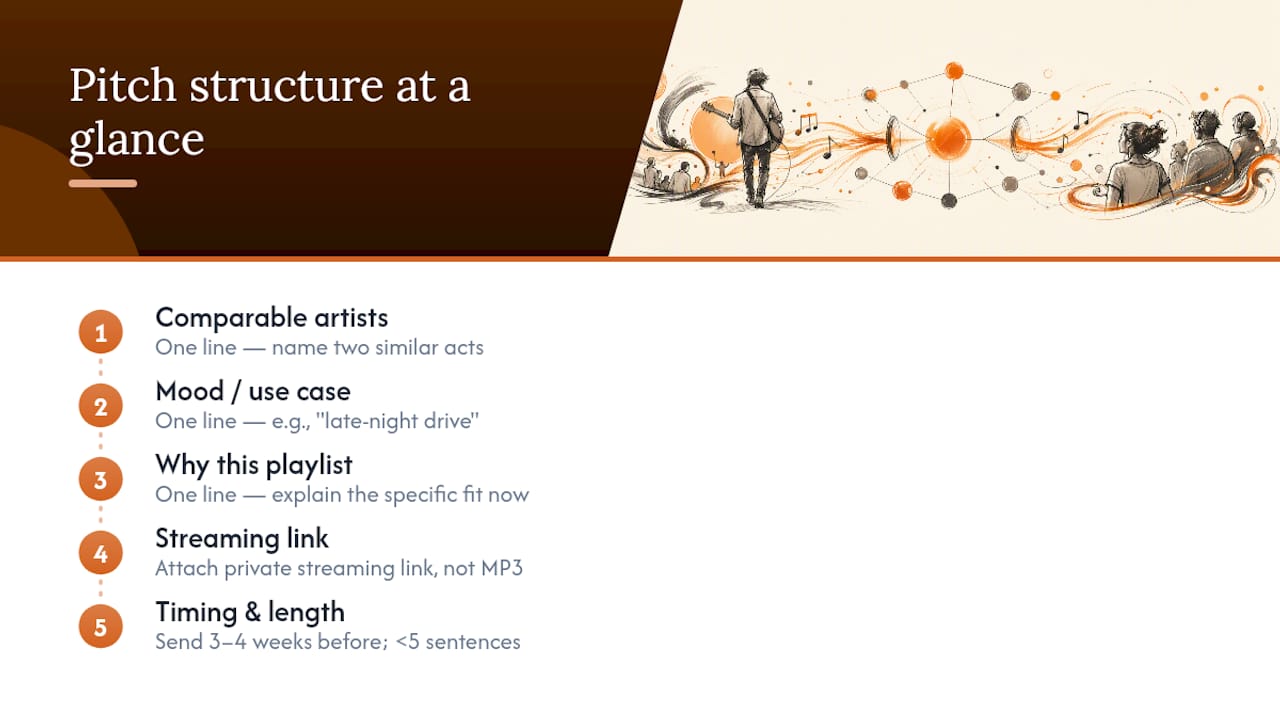
Curators reject far more tracks than they accept, and most rejections come down to a pitch that gives them nothing to work with. A pitch that says “please add my song” gets deleted. A pitch that answers three questions in one paragraph gets read to the end: what does this sound like, who is it for, and why does it fit this specific playlist right now.
Structure the message like this: one line naming two comparable artists, one line describing the mood or use case (“late-night drive,” “focus work,” “workout warmup”), and one line explaining why you picked this exact playlist rather than any other. Attach a private streaming link, not an mp3, so the curator can listen inside Spotify without downloading anything.
A working template looks like this:
“Hi [name], I’ve been following [playlist name] for its mix of [specific reference]. My new single ‘[track title]’ pulls from [two comparable artists] and fits the [mood/use case] feel your list leans into. Here’s the pre-release link: [URL]. Releasing [date] — would love your take.”
Keep it under five sentences. Curators scan dozens of these a day, and a long backstory about your creative process reads as a wall of text they’ll skip. Timing matters as much as wording: pitches sent three to four weeks before release give editorial curators enough lead time to consider the track for launch-day playlists, while a pitch sent after release has already missed most editorial windows.
If you’re using generative tools anywhere in your production chain, keep that separate from your pitch. Curators can tell when a track description was written by a tool like AmmarAI’s music generator rather than an artist who actually made the song, and that disconnect kills trust faster than a genre mismatch.
When Playlist Promotion Earns Its Budget
Playlist promotion earns its budget on priority releases, anchor tracks you want algorithmic momentum behind, or when testing a new market. The mistake I see constantly: judging a campaign by royalties alone instead of checking day-30 persistence. Run the scorecard, not just the stream count.
— Einars
Start a Curator-First Campaign With Intonality
Intonality pitches your track directly to real, genre-matched curators and sends written feedback on every decision, so you’re never guessing why a submission was passed over. It suits independent artists who want managed placements without handing their release to an automated queue or a network of anonymous playlist owners.
Every campaign reports through a dashboard built around the same fields covered in the scorecard above: placements, follower reach, saves, and adds, all exportable as CSV. If you’re planning a priority release and want placements measured the way this article recommends, start a campaign on the Intonality playlist promotion page and check available service tiers before your next release date.
Sources
- How playlists shape music streaming revenue and demand - UNSW BusinessThink
- Marquee + Showcase reporting guide (Spotify reporting)
- Playlist placement ROI: 6.6 daily streams per 1,000 followers (Dynamoi)
- How to promote a playlist: A Case Study — Hypebot
FAQ
How Long Should a Playlist Promotion Campaign Run?
Plan for a four-week pre-release pitching window, a two-week active placement window matching Spotify’s attribution standard, and a 14 to 28 day post window to check whether streams and followers persist.
Should I Expect Playlist Promotion to Pay for Itself in Royalties?
No. A 28-day placement on a mid-size playlist typically generates a few thousand streams, which rarely covers campaign costs on royalties alone; the real return is fan acquisition and algorithmic discovery, not direct payout.
How Does Intonality’s Approach Differ From Automated Pitching Tools?
Intonality sends personalized pitches to real, genre-matched curators and provides written feedback on every decision, averaging 4 to 11 placements per campaign depending on tier, instead of relying on automated bulk submissions.
What’s a Warning Sign of a Fake or Low-Quality Playlist Placement?
Watch for a large stream spike with almost no saves or adds, implausible listener geography, or streams that collapse sharply after the placement ends.