
Personalized playlist pitching means sending a short, specific message to a playlist curator explaining why your song fits their exact playlist, rather than blasting the same generic note to hundreds of contacts. The single best next step: write one tight pitch per playlist, submit it through Spotify for Artists and a handful of genre-matched independent curators, and treat every response as data. It won’t guarantee a placement, but consistent, well-targeted pitches beat mass submissions almost every time.
TL;DR:
- Focus on targeted, well-crafted pitches to playlists with a clear fit rather than simply chasing larger follower counts or generic outreach.
- Submit your track at least 7 days before release through Spotify for Artists and space out interactions with curators to avoid spam.
- Choose playlists with consistent updates, similar artists, and engaged followers, avoiding those with suspicious activity or no recent changes.
- Keep pitch messages short, specific, and based on concrete attributes like genre, mood, tempo, and comparable artists to increase acceptance chances.
- Treat playlist pitching as an ongoing process, incorporating curator feedback to refine your approach and build relationships over multiple releases.
Table of Contents
- What is personalized playlist pitching and why does it matter?
- When should you pitch a song to playlists?
- How do you choose the right playlists and curators?
- How do you write a personalized playlist pitch?
- Where do you submit pitches, and how should you follow up?
- What results should you actually expect?
- How do you run a 4-week personalized pitching campaign?
- Why pitching should be a habit, not a campaign
- Get personalized pitches sent for you
- Where to verify this guidance
- Sources
What is personalized playlist pitching and why does it matter?
Two channels exist, and they work differently. Spotify’s own editorial pitch, submitted through Spotify for Artists, puts your unreleased track in front of Spotify’s internal playlist editors. Independent curator outreach means contacting real people who run genre or mood playlists outside Spotify’s editorial team, whether through email, social media, or curator platforms.
Both matter more than most artists assume. In 2024, 74% of artists added to an editorial playlist had fewer than 100,000 monthly listeners, which means editorial consideration isn’t reserved for artists who already have an audience.
Fit beats follower count. A 3,000-follower playlist that plays your exact subgenre to engaged listeners will do more for you than a 50,000-follower playlist stuffed with mismatched tracks nobody finishes. Chase mood and genre alignment first. Chase size second, if at all.
When should you pitch a song to playlists?
Timing determines whether your song is even eligible for editorial consideration, so treat these as rules, not suggestions.
- Submit to Spotify for Artists at least 7 days before release — Spotify’s own guidance sets this as the minimum window for editorial playlist eligibility.
- Start preparing 2 to 4 weeks out so you have time to gather art, credits, and a clean pitch instead of rushing the night before.
- Pitch independent curators in three waves: pre-release, release week, and again 1 to 4 weeks after, since some curators only update monthly.
- Space out your outreach rather than pitching the same curator repeatedly in a short window. Spammy cadence gets you ignored or blocked, and it undermines the relationship you’re trying to build for your next release.
How do you choose the right playlists and curators?
Start with fit, not size. Listen to the playlist’s most recent additions and check whether your track would sound natural next to them. If the playlist mixes six genres with no clear identity, skip it.
Real curators leave a trail. Look for:
- A working social account or website tied to the playlist name, not just a Spotify profile
- Consistent update history, ideally weekly or biweekly
- Similar artists already featured, especially ones close to your career stage
- A follower count that roughly matches engagement (comments, shares, streams per track)
Watch for red flags too: tracklists that never change, suspiciously round follower numbers, or curators who guarantee placement in exchange for payment with no editorial process behind it. Genuine curators reject tracks. That’s a feature of a real system, not a bug.
Pro Tip: Before pitching, play the playlist’s last five additions back to back. If you can’t tell which one is “yours,” you’ve found a genuine match.

How do you write a personalized playlist pitch?
Curators skim. A short, specific pitch that names the playlist and two or three concrete fit attributes consistently outperforms long, generic ones. Use this formula:
- Name the playlist directly in your opener.
- State genre and mood in one clause.
- Add one or two concrete attributes (tempo, instrumentation, a comparable artist already on the playlist).
- Close with your streaming link and release date.
Keep it under roughly 200 characters for in-app pitch fields, or three short sentences for email. Skip your life story. Skip “I think you’ll love this.” Curators want facts they can act on, not flattery.
Two examples worth adapting:
- Chill indie: “For [Playlist Name]: a slow-burn indie folk track, 78 BPM, fingerpicked guitar and close-mic vocals, in the vein of early Bon Iver. Out March 20. [link]”
- Energetic dance: “For [Playlist Name]: 124 BPM tropical house with a vocal hook built for a festival set. Fits alongside your recent [artist name] additions. Out this Friday. [link]”
Both examples do the same job: name the playlist, prove fit fast, and get out of the way.
Where do you submit pitches, and how should you follow up?
For editorial consideration, Spotify for Artists is the only official channel, and filling in every field (genre tags, mood, cultural context, instrumentation) gives editors more to match against.
For independent curators, your options are broader:
- Curator platforms that verify real people and require written feedback on every decision
- Direct email, which works well when you already have a contact
- Instagram or Twitter DMs, reserved for curators who explicitly invite that channel
Follow up once, and only once, 10 to 14 days after your initial pitch. A short note like “Following up on [track name], just checking if it landed in your inbox” is enough. Anything more frequent reads as pressure, not persistence. Keep a simple log (a spreadsheet works fine) of who you pitched, when, and what they said, so your next follow-up draws on real history instead of guesswork.
What results should you actually expect?
Track five things: placements, stream uplift, saves, follower quality, and listener retention past the first 30 seconds. Placements alone tell you little if nobody finishes the song.
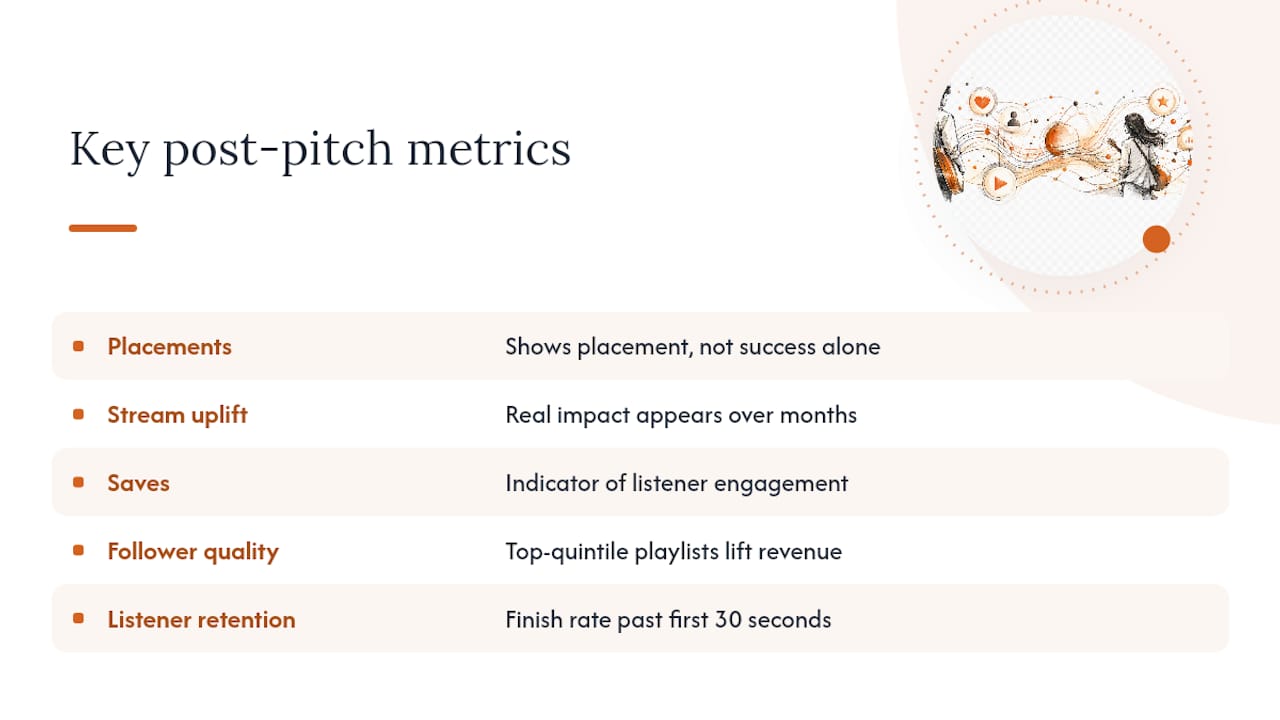
Timelines run longer than most artists expect. Editorial decisions often land within the pitch window, but independent curator responses can take two to six weeks, and the real impact shows up over months, not days.
Playlist quality matters enormously here. Top-quintile playlists generate materially higher revenue and stream increases compared to bottom-quintile playlists, which show little to no uplift. A handful of well-matched, active playlists will outperform dozens of dead ones. Use Spotify for Artists analytics to confirm a placement actually drove streams rather than just appearing in your pitch history.
How do you run a 4-week personalized pitching campaign?
Treat pitching as a repeatable process, not a one-time scramble before release day.
- Week 1, audit: Research 15 to 20 genuinely matched playlists and note each curator’s update pattern and recent additions.
- Week 2, craft: Write a distinct pitch for each playlist using the formula above, referencing something specific from that playlist’s recent tracklist.
- Week 3, submit: Send pitches through Spotify for Artists and your chosen independent channels, staggered rather than all at once.
- Week 4, follow up and log: Send respectful follow-ups where appropriate, record every response, and note which fit-language got the best reaction.
Curator feedback should directly reshape your next pitch: if three curators mention your track feels “too polished for lo-fi,” adjust how you describe production quality next time. A broader release strategy that pairs pitching with owned playlists you build and maintain yourself gives you a compounding asset alongside each campaign. Treat this as a monthly habit, not a release-week sprint, since artists who pitch consistently tend to build curator relationships that pay off over multiple releases.
Why pitching should be a habit, not a campaign
Most artists treat pitching like a launch event: one big push, then silence until the next single. That’s backwards. The artists who actually build a curator network are the ones who pitch quietly every month, learn from every rejection note, and refine their fit language instead of their follow-up frequency. Prioritize honest genre matching over reach, and log everything. Curator feedback is the closest thing indie music has to a free consulting session.
— Einars
Get personalized pitches sent for you
Building curator relationships from scratch takes months most artists don’t have between releases. Intonality runs the entire personalized playlist pitching process for you: real, genre-matched curators, a written response on every decision, and a live dashboard so you’re never guessing what happened to your submission.
A typical campaign delivers between 4 and 11 playlist placements depending on the tier you choose, and every rejection comes back with actual curator feedback you can use on your next release, not silence. That feedback loop is the part most pitching methods skip entirely: you learn what’s working before you spend another month guessing. If you have a release coming up, submit your track and get matched with curators who actually listen to what you make.
Where to verify this guidance
Confirm editorial pitch rules directly through Spotify for Artists, and see the underlying playlist economics in the UNSW Business Think analysis. For pitch wording specifics, Intonality’s editorial pitch guide covers the details step by step.
Sources
- How to Meet Your Music Goals with Campaign Kit – Spotify for Artists
- Music streaming economics: playlist marketing strategy (UNSW Business Think)
- Safe ways to promote music on Spotify without killing your algorithm — Illustrate Magazine


