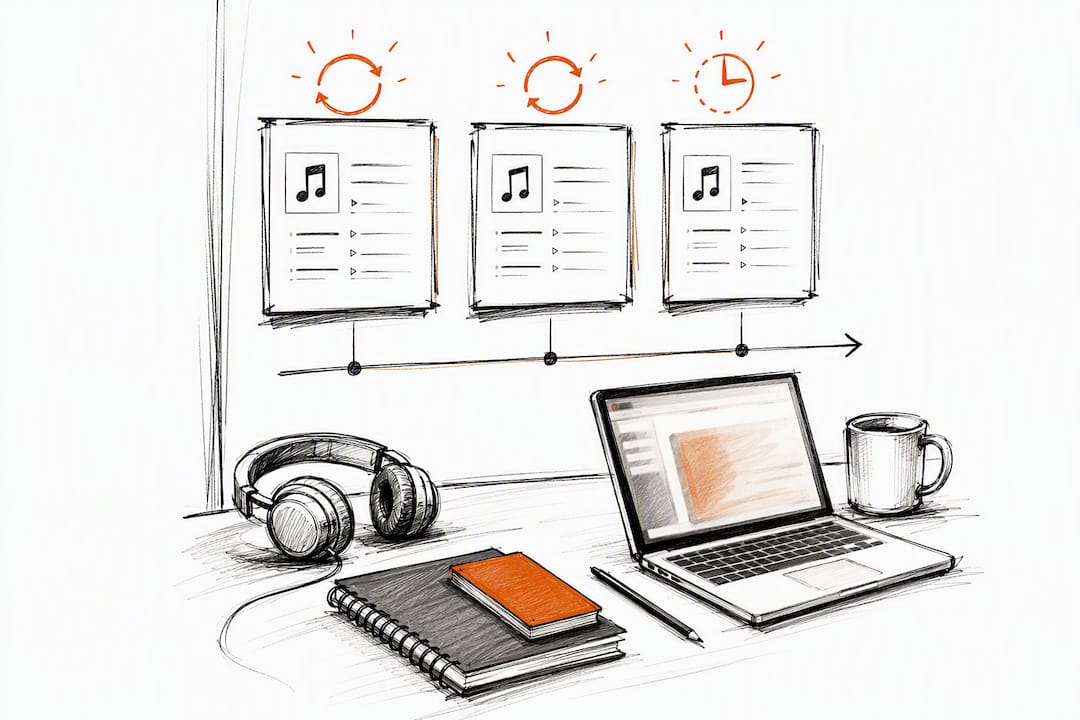
Spotify’s own pitch field caps out at roughly 500 characters, so anything you write there should land closer to 350–500 characters of tight, factual copy. For third-party curators and email pitches, aim for 50 to 90 words, or a short email with three or four bullets and a sharp subject line. Structure it the same way every time: one-sentence hook, genre and mood, “for fans of” comparisons, the timestamp of your best hook, and one stat or a direct ask.
TL;DR:
- Focus on keeping Spotify’s pitch within 350–500 characters, emphasizing genre, mood, and momentum proof without flowery language.
- Curator email pitches should stay between 50–90 words and include a clear hook, playlist fit, best hook timestamp, and a private stream link.
- Sending pitches at least 7 days before release to Spotify and 7–14 days in advance to independent curators maximizes respect for their review process.
- Prioritize specific, checkable details like the hook timestamp and FFO comparisons over overall length for better success.
- Personalization and precise targeting to actual, genre-matched curators outperform generic mass emailing and improve placement chances.
Table of Contents
- What Counts as Playlist Submission Guidelines: Spotify vs. Third-Party Curators
- Playlist Length Recommendations by Channel
- Pitch Structure: What Fits Into a Tight Word Count
- Music Pitch Best Practices for Timing
- Effective Playlist Presentation: Templates You Can Adapt
- What Curators Actually Look For (and What Kills Your Chances)
- Why Intonality’s Curator Model Backs These Length Rules
- The Real Problem Isn’t Length. It’s Precision.
- Get Curator-Matched Pitching Instead of Guessing at Word Counts
- Sources
- FAQ
What Counts as Playlist Submission Guidelines: Spotify vs. Third-Party Curators
Spotify and independent curators operate under completely different rules, and mixing them up is one of the fastest ways to waste a pitch. Spotify’s editorial team gives you a free-text field inside Spotify for Artists that maxes out at roughly 500 characters, and their guidance leans toward factual, data-driven descriptions rather than flowery bios. Editors are reading hundreds of these a day. They want genre, mood, instrumentation, and any press or tour context that proves the record has momentum, not your life story.
Third-party platforms, curator inboxes, and directories play by looser but still specific rules:
- Spotify’s pitch form: genre and sub-genre, mood tags, instrumental or vocal features, and any concrete press or tour notes.
- Curator email pitches: a subject line, a one-sentence hook, playlist fit, and a private streaming link.
- Submission platforms and directories: structured fields similar to Spotify’s, often with an added note field for context, following the same who, what, why, and what’s next format recommended by Playlist Atlas.
Cramming curator-email content into the Spotify field, or vice versa, is a common mistake. Each channel has its own character limit and its own reader expectations, and treating them the same wastes the space you do have.
Playlist Length Recommendations by Channel
Here’s how the numbers actually break down once you separate the channels:
- Spotify editorial pitch: 350–500 characters. Stay factual. Genre, mood, one comparison artist, and a hook timestamp is plenty.
- Curator email: 50–90 words. Some curator guides push this even tighter, recommending 90 words or roughly 500 characters for a fast read.
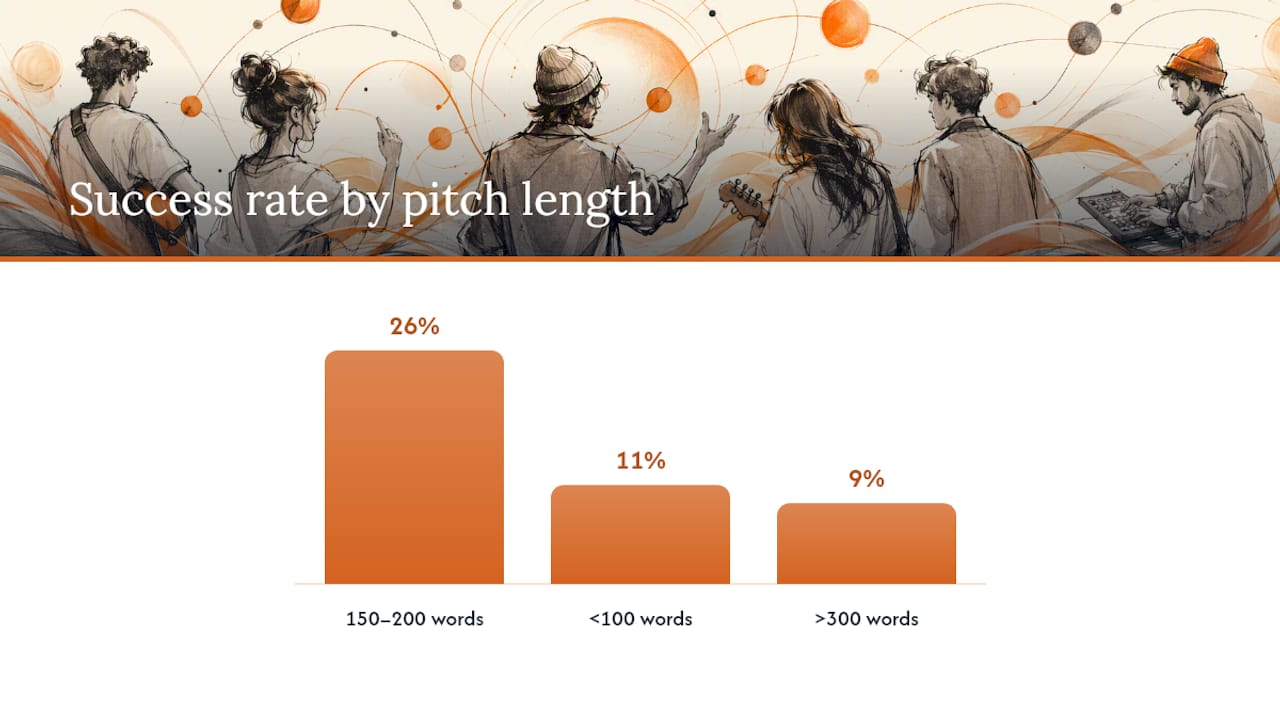
- Editorial outreach with more context: 150–200 words. One analysis of over 800 successful pitches found submissions in this range hit a 26% success rate, while pitches under 100 words dropped to 11%, and anything past 300 words fell to 9%.
- Subject line: 6–8 words. Lead with the song title and a genre tag, not “New Single Out Now.”
That third number surprises a lot of artists who assume shorter always wins. It doesn’t. A pitch that’s too clipped often skips the context a curator needs to place the song correctly, while a bloated one buries the hook. The sweet spot for a slightly longer editorial email sits closer to 150–200 words than to 50.
Here’s the reformulation in practice. A 500-character Spotify pitch reading “Indie folk track blending fingerpicked guitar with layered harmonies, for fans of Phoebe Bridgers and Big Thief. Hook drops at 0:48 with a key change into the chorus. Track has 40K pre-saves and a feature on a regional radio program” compresses into a curator email as: subject line “Fingerpicked Indie Folk, FFO Phoebe Bridgers,” one sentence of fit, and the hook timestamp with a link attached.
Pitch Structure: What Fits Into a Tight Word Count
Every effective pitch, regardless of channel, carries the same five components. The trick is compressing them without losing the signal a curator actually uses to judge fit.
- One-sentence hook: ten words or fewer describing the song’s core feeling or sound. “A slow-burn breakup anthem with a gang-vocal chorus” does more work than three adjectives strung together.
- Genre and mood: use the curator’s own vocabulary. If their playlist is labeled “Bedroom Pop Nights,” don’t call your track “alternative.” Sub-genre precision reads as professionalism.
- FFO (for fans of): one or two comparable artists, chosen because they explain the sound, not because they’re popular. A vague FFO wastes the most valuable line in the pitch.
- Hook timestamp: cite the exact second the best musical moment happens (“hook at 0:31”). Curators use this to judge fit quickly without listening to the whole track first.
- One stat or ask: pre-save counts, a playlist add elsewhere, or a direct, specific request like “would love a spot on your Sunday Chill rotation.”
Career history, discography rundowns, and long artist bios don’t belong in the pitch itself. Save links to your press kit or full metadata for a separate line at the end, and keep any private streaming link short and clearly labeled.
Pro Tip: Write your hook sentence last. Draft the whole pitch first, then go back and cut it down to the one sentence that best captures what makes the song worth adding.
Music Pitch Best Practices for Timing
Length and timing work together. A perfectly written pitch sent too late doesn’t get read, no matter how tight the copy is.
- Upload to your distributor 3–4 weeks before release. This is what makes the Spotify pitch field appear in the first place.
- Submit to Spotify at least 7 days before release, which is the minimum Spotify itself recommends so editors can weigh the track for Release Radar and genre playlists.
- Pitch independent curators 7–14 days ahead. Some want more lead time, and a few will still consider tracks on release day, so check individual curator preferences when you can find them.
- Run a pre-send checklist: correct metadata, a working private preview link, pre-saves live, pitch copy finalized, subject line written, and no dead attachments.
- If you miss the window, don’t skip the pitch. Send a shorter, honest follow-up after release, noting early streaming numbers instead of pre-release momentum.
Effective Playlist Presentation: Templates You Can Adapt
A Spotify pitch built around 480 characters might read: “Dream-pop single layering reverb-heavy guitar over a driving 4-on-the-floor beat, for fans of Beach House and Alvvays. Hook lands at 1:02 with a full-band drop. Track has 12K pre-saves and a placement on a regional college radio show.” Every phrase maps to a field: sound description, FFO, timestamp, and a momentum stat, all inside the limit.
For an ultra-short curator email, keep it to a subject line and a single sentence:
- Subject: “Dream-Pop Track, FFO Beach House, Out March 6”
- Body: “Hey [Curator Name], sending over [Song Title], a dream-pop track with a hook at 1:02 that I think fits [Playlist Name] well. Private link here: [URL].”
When you have a little more room to work with, a three-bullet email performs well too:
- Why it fits their specific playlist, named directly.
- One metric: pre-saves, prior playlist adds, or streaming numbers if the track is already out.
- The hook timestamp and a private link.
Adjust tone by genre. A hip-hop curator responds to different language than a lo-fi or acoustic playlist curator, so swap FFO comparisons and mood words to match how the curator describes their own list.
What Curators Actually Look For (and What Kills Your Chances)
Editorial fit and playlist energy matter more than any single metric you can attach to a pitch. Curators track pacing and skip rates across their whole playlist, and a track that disrupts that flow gets passed over even with strong streaming numbers behind it. Playlists tend to run around 50 tracks at a consistent length, so a submission that clashes with the set’s rhythm is a harder sell than a pitch with a modest follower count but a perfect sonic match.
The mistakes that sink most pitches are avoidable. Vague genre labels (“alternative,” “indie,” “chill”) tell a curator nothing useful. Subject lines that read like spam get deleted before the body is read. Career-history paragraphs push the actual hook out of view. Missing timestamps force the curator to hunt for the best part of the song themselves, and broken or public-only links (instead of a private, pre-release stream) are an instant pass for editorial consideration.
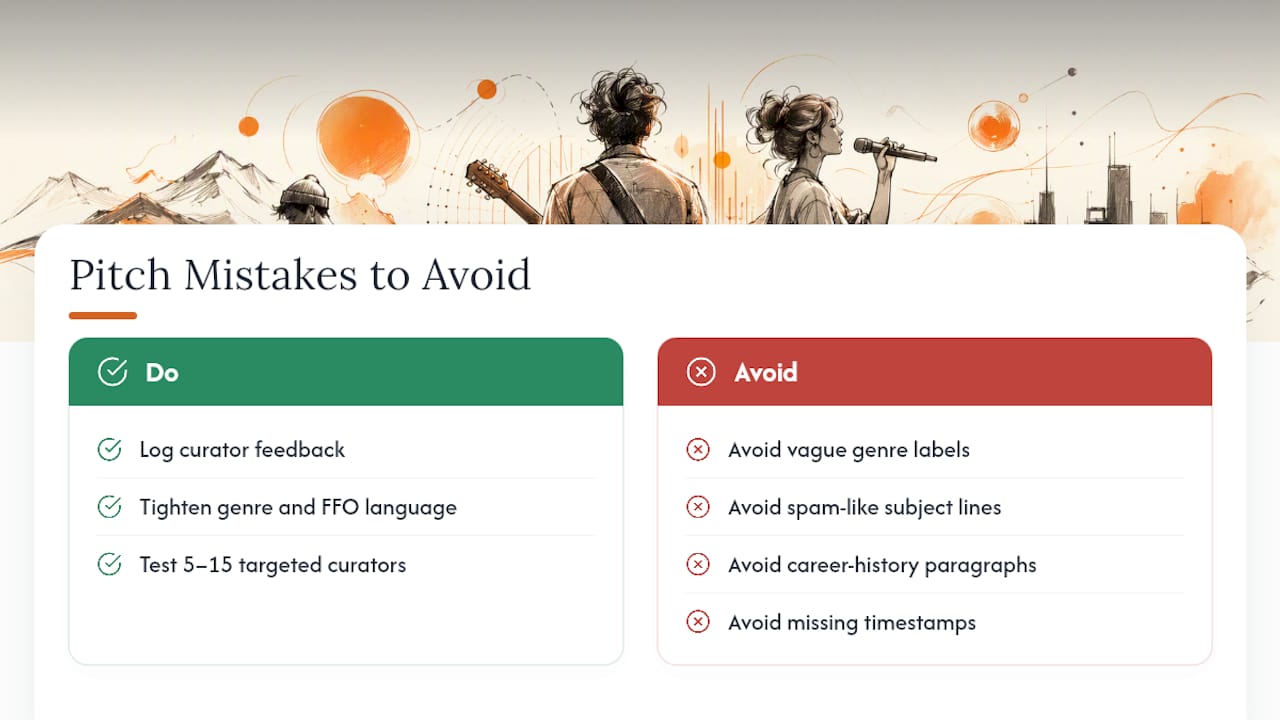
After a rejection, log the feedback if you get any, tighten your genre and FFO language, and test small batches of five to fifteen highly targeted curators with slightly different wording before scaling whatever gets responses.
Why Intonality’s Curator Model Backs These Length Rules
Intonality builds each campaign around personalized pitches sent to vetted, genre-matched curators, not automated blasts. That structure gives a direct read on which pitch language actually lands, because every curator decision comes back with real-time updates and written feedback instead of silence.
That feedback loop is what turns generic length guidance into something sharper. When a curator passes and explains why, the note usually points to exactly the kind of issue this article covers: a vague genre tag, a missing timestamp, or a hook buried too deep into a pitch. Some promotion services report an average of several playlist placements per campaign depending on the tier, reflecting how a well-matched, well-timed pitch can outperform generic mass emails.
The Real Problem Isn’t Length. It’s Precision.
Most advice on this topic treats pitch length like a magic number, as if hitting exactly 487 characters guarantees a curator’s attention. It doesn’t. The Wiseband data on 150–200 word pitches performing best isn’t proof that longer wins. It’s proof that vague, padded pitches under 100 words and rambling ones over 300 words both fail for the same reason: they don’t give a curator enough specific, checkable information to make a fast decision.
What the conventional advice gets wrong is treating Spotify’s form and a curator’s inbox as the same problem with different word counts. They’re not. Spotify wants proof and precision in under 500 characters. A curator wants to feel like you actually listened to their playlist before writing to them. That distinction, not the character count itself, is what separates a pitch that gets read from one that gets skipped.
If there’s one thing to prioritize before worrying about exact word counts, it’s the FFO line and the hook timestamp. Get those two elements specific and accurate, and the rest of the pitch can be short without feeling thin.
— Einars
Get Curator-Matched Pitching Instead of Guessing at Word Counts
Writing a tight pitch is only half the job. The other half is knowing which curators actually fit your sound, and that’s where most independent artists lose time firing off the same generic email to hundreds of playlists that were never a match to begin with. Intonality skips that guesswork by sending personalized, genre-matched pitches to real curators on your behalf, then reporting back what each one said.
Every campaign comes with real-time updates and written feedback on every curator decision, so you learn what’s working instead of wondering why a pitch went nowhere. Some promotion services report an average of several placements per campaign, though no service can promise guaranteed placement since that decision always lies with the curator. If you want your next release pitched with precision instead of a mass email, check Intonality’s Spotify playlist promotion campaigns and see which tier fits your release timeline.
Sources
Spotify’s own pitching guidance covers the 500-character limit and submission timing directly from the source. The Wiseband analysis of 800-plus pitches backs the word-count success rates cited above. Playlist pacing and sizing guidance comes from DJ Will Gill’s breakdown, and practical curator-facing structure is drawn from Playlist Atlas.
- Pitching music and videos to Spotify playlist editors - Spotify
- How to Get on Spotify Editorial Playlists: Analysis of 800+ Successful Pitches (Wiseband Data) - Wiseband
- Submit music to Spotify playlists | Playlist Atlas
FAQ
What is the perfect length for a playlist pitch?
Spotify’s pitch field allows roughly 500 characters, so aim for 350–500 characters of factual copy there, and 50–90 words for curator emails, with 150–200 words performing best in one analysis of editorial pitches.
What is the Spotify 1,000 rule?
There’s no official Spotify rule by that name in Spotify’s own guidance. If you’ve seen it referenced, it’s not a documented editorial standard, so don’t build your submission strategy around it.
Is 50,000 minutes on Spotify a lot?
There’s no fixed streaming-minute threshold that guarantees playlist consideration. Curators and editors weigh sound fit, mood, and momentum stats like pre-saves far more heavily than any single minutes-listened milestone.
Is it worth pitching to Spotify playlists?
Yes, when the pitch is targeted and timed correctly. Submitting at least seven days before release through Spotify for Artists, and pitching independent curators seven to fourteen days ahead, gives editors and curators real time to consider the track before it drops.