
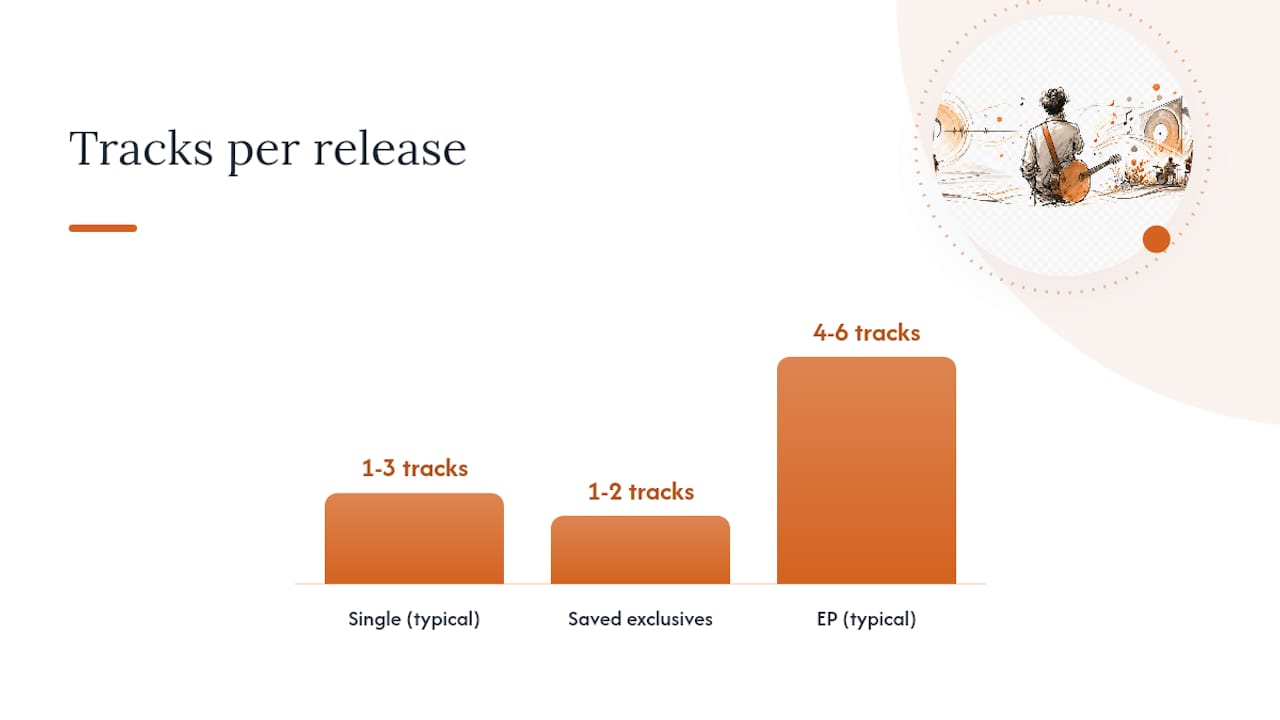
A single is 1–3 tracks with a total runtime under 30 minutes. An EP is 4–6 tracks, also typically under 30 minutes. If you have one strong track ready and want to build streaming momentum fast, release a single. If you have 4–6 cohesive songs and a story to tell, an EP gives you a proper project to pitch to press and curators.
Quick decision checklist:
- Release a single if you have 1–3 tracks, a limited budget, or you’re still building your audience.
- Release an EP if you have 4–6 finished songs, a cohesive theme, and a press or touring goal.
- When in doubt, single first. You can always bundle strong singles into an EP later using a waterfall strategy.
Key Takeaways
Choosing between a single and an EP comes down to track count, runtime, budget, and what you need the release to accomplish at your current career stage.
| Point | Details |
|---|---|
| Standard thresholds | 1–3 tracks under 30 min = single; 4–6 tracks under 30 min = EP; 7+ tracks or 30+ min = album. |
| Platform auto-labeling | Stores like Apple Music insert “- Single” or “- EP” automatically, so your distributor settings must match your intent. |
| Singles for early growth | Frequent singles every 6–8 weeks build algorithmic momentum faster than infrequent EP releases. |
| Waterfall strategy | Release 2–3 singles first, then bundle them with 1–2 exclusives into an EP to maximize pitching and streaming data. |
| Intonality for pitching | Intonality pitches your single or EP to real, genre-matched Spotify curators with written feedback and real-time placement tracking. |
Table of Contents
- How stores and distributors classify singles vs EPs at upload
- Concrete thresholds and edge cases: 3 songs, 7 songs, long tracks
- Marketing, press, touring, and budget tradeoffs
- Tactical release plans: the waterfall strategy and campaign timing
- What to set in your distributor and why metadata matters
- How playlist pitching works differently for singles vs EPs
- A short checklist to choose single or EP for your next release
- Sources
How stores and distributors classify singles vs EPs at upload
The single vs EP distinction is not just artistic. It’s a technical classification that affects how your release appears on Spotify, Apple Music, and every other storefront. Get it wrong, and your EP shows up labeled as a single, or your release gets flagged during distribution.
According to CD Baby’s Help Center, digital stores commonly classify a release as a single when it has three or fewer tracks and a total runtime under 30 minutes. Four to six tracks under 30 minutes typically gets tagged as an EP. Seven or more tracks, or anything over 30 minutes, is treated as an album. Stores may insert “- Single” or “- EP” automatically into the release title based on these rules, which is why your metadata needs to match your intent before you upload.
TuneCore’s guidance echoes this: a single is 1–3 tracks under 30 minutes, and stores may display releases as singles or EPs automatically depending on what you submit.
What to do at upload:
- Select the correct release type in your distributor’s upload form (Single, EP, or Album).
- If your distributor auto-labels, check the preview before submission to confirm the storefront title looks right.
- A 3-track release you call an EP in your marketing will still appear as a single on Apple Music. That’s not a problem artistically, but know it going in.
Concrete thresholds and edge cases: 3 songs, 7 songs, long tracks
Most artists hit a gray area at some point. Here’s how to handle the common edge cases.
The standard rules
- 1–2 tracks, under 30 minutes: Unambiguously a single on every major platform.
- 3 tracks, under 30 minutes: Still classified as a single by most stores, including Apple Music and Spotify via distributors like TuneCore and CD Baby.
- 4–6 tracks, under 30 minutes: This is the EP zone. Most platforms will tag it accordingly.
- 7+ tracks or 30+ minutes: Album territory, regardless of how you label it in your marketing.
Edge cases worth knowing
3 songs you want to call an EP. You can market it as an EP, but stores will likely display it as a single. If the cohesive-project framing matters for your press pitch, consider adding a fourth track.
7 songs you want to keep as an EP. Most platforms will classify this as an album. If you’re not ready for the album label, trim to six tracks or keep the seventh as a bonus available only on your website or Bandcamp.
One long track over 10 minutes. TuneCore notes that a single long track can alter classification in some cases. A 12-minute ambient piece released alone is still a single by track count, but check your distributor’s specific rules before uploading.
B-sides and bonus tracks. A single with a B-side (2 tracks total) stays a single. Two B-sides (3 tracks total) still qualifies as a single on most platforms.
Key threshold to remember: The 30-minute runtime rule is the hidden trip wire. You can have 5 tracks and still get classified as an album if the total runtime crosses 30 minutes.
Marketing, press, touring, and budget tradeoffs
Choosing between a single and an EP is really a question of what you need the release to do. Tools4Music puts it plainly: the streaming era favors frequent singles for algorithmic traction, while EPs provide a mid-length project to showcase range. Both are true, and neither cancels the other out.
| Dimension | Single | EP |
|---|---|---|
| Track count | 1–3 | 4–6 |
| Runtime | Under 30 min | Under 30 min |
| Best marketing use | Discovery, algorithm, testing | Press, touring, storytelling |
| Store display | “- Single” auto-label | “- EP” auto-label |
| Campaign cadence | Approximately every 1 to 2 months | Less frequently, once per cycle |
| Budget required | Low | Moderate (more mixing, artwork, assets) |
| Playlist pitching | Focused, one-track pitch | Multi-track pitch or lead-track pitch |
When a single wins: You’re early in your career, you want to test which songs resonate before committing to a full project, or your budget is tight. Singles are cheaper to produce, faster to turn around, and easier to pitch because curators evaluate one track at a time. Streaming algorithms also reward consistent activity, and frequent single releases keep you in rotation far longer than one EP every few months.
When an EP wins: You have a cohesive batch of songs that tell a story, you’re preparing for a tour and need physical or digital merch to sell, or you’re pitching to music blogs and press outlets that want a proper project to review. An EP gives journalists something to write about beyond a single track. It also signals a level of artistic commitment that a standalone single doesn’t always convey.
Career stage guidance:
- First 1–2 releases: Single every time. Build the audience before you build the project.
- Growing audience, 500–5,000 monthly listeners: Singles with a waterfall plan leading to an EP.
- Preparing for an album or tour: EP as a pre-album statement or touring support release.
Ditto Music’s guide recommends aligning format choice to budget and goals, and specifically advises saving 1–2 exclusive tracks for the EP rather than releasing everything as singles first, so listeners have a reason to stream the full project.
Tactical release plans: the waterfall strategy and campaign timing
The waterfall strategy is the most practical release model for independent artists on a budget. Release 2–3 singles over several months, then compile those tracks plus 1–2 new exclusives into an EP. Each single builds streaming history and playlist traction. By the time the EP drops, you have data to strengthen your pitch and an audience primed to listen.
Here’s a sample waterfall timeline you can adapt:
- Week 1: Finalize all tracks for the eventual EP. Decide which 2–3 will be singles and which 1–2 stay exclusive to the EP.
- Weeks 3–4: Submit Lead Single A to Spotify’s editorial pitch tool (at least 7 days before release). Prepare press assets: one-sheet, streaming-quality audio, cover art.
- Week 6: Release Lead Single A. Begin curator outreach for playlist placement. Post social assets.
- Weeks 8–10: Submit Lead Single B to editorial pitch. Refresh press pitch with updated streaming numbers from Single A.
- Week 12: Release Lead Single B. Pitch to blogs and playlist curators using Single A’s performance as social proof.
- Weeks 14–16: Announce the EP. Submit the EP’s lead track to editorial pitch. Send advance copies to press.
- Week 18: EP release. Activate full campaign: press, playlists, email list, social.
Awards for Creators’ release checklist recommends a cadence of roughly every 6–8 weeks for singles, which maps cleanly onto this timeline.
Pro Tip: Pitch each single to Spotify’s editorial tool individually before the EP drops. Editorial placements on singles build your artist profile data, and that data makes your EP pitch stronger when you submit it.
What to set in your distributor and why metadata matters
Metadata errors are one of the most common reasons releases get misclassified or rejected. Wrong release type, missing ISRCs, or incorrect track durations can cause a release to display incorrectly on storefronts or get flagged during delivery. CD Baby’s documentation explicitly warns that metadata errors can lead to misclassification or rejection.
Fields that matter most:
- Release type: Single, EP, or Album. This is the field that triggers auto-labeling on Apple Music and other stores.
- UPC (Universal Product Code): One per release. Your distributor typically generates this, but verify it’s assigned before submission.
- ISRC (International Standard Recording Code): One per track. Required for royalty tracking and charting. Never reuse an ISRC from a previous version of the same song.
- Track durations: Must match the actual audio file. Even a few seconds off can cause issues with some distributors.
- Explicit tag: Mark tracks accurately. An unmarked explicit track can be removed from certain playlists or filtered from family-safe listening modes.
- Contributor credits: List all featured artists, producers, and songwriters. Missing credits affect publishing royalties and can complicate sync licensing later.
Pre-upload checklist:
- [ ] Release type matches track count and runtime
- [ ] UPC assigned and recorded
- [ ] ISRC assigned to every track
- [ ] Track durations verified against audio files
- [ ] Explicit tags set correctly
- [ ] All contributor credits entered
- [ ] Release date set at least 7 days out (14–21 days for editorial pitch eligibility)
Pro Tip: Keep a spreadsheet with every ISRC, UPC, and release date for every track you’ve ever distributed. When you compile singles into an EP, you’ll reuse the same ISRCs for the previously released tracks, and having them on hand saves time and prevents errors.
How playlist pitching works differently for singles vs EPs
Singles are easier to pitch. Full stop. A curator receives one track, one story, one mood. Your pitch is focused, and the curator’s decision is simple. With an EP, you’re asking a curator to evaluate a project, which takes more time and requires a clearer narrative.
That said, EPs can be pitched effectively when you lead with one standout track and use the project context to strengthen the story. “This is the lead single from my debut EP, a five-track collection of late-night R&B recorded in a home studio in Atlanta” gives a curator more to connect with than a bare track submission.
Here’s what to prepare for any curator pitch, single or EP:
- A streaming-ready track: Live on Spotify or submitted via your distributor’s pre-release link. Curators need to hear it on the platform, not via a SoundCloud or WeTransfer link.
- A 30–60 word pitch: Who you are, what the track sounds like, and why it fits the playlist. No longer. Curators read dozens of pitches a day.
- Genre and mood tags: Be specific. “Indie pop” is too broad. “Dreamy indie pop with 80s synth textures” tells a curator exactly where the track fits.
- Artist bio: Two to three sentences. Focus on what makes you distinct, not your influences list.
- Prior playlist history: If you’ve been placed before, mention it. It’s social proof that curators respond to.
- Cover art: High-resolution, platform-compliant (3000x3000 pixels minimum). Curators notice when artwork looks unprofessional.
For a deeper walkthrough of the submission process, this guide to submitting to Spotify playlists covers the full preparation sequence.
Pro Tip: Pitch each single individually before bundling tracks into an EP. Singles that already have playlist placements carry streaming data into the EP campaign, and curators are more likely to feature a track they can see is already resonating.
A short checklist to choose single or EP for your next release
Work through these questions before you set a release date:
- [ ] How many finished tracks do you have? 1–3 = single. 4–6 = EP candidate. 7+ = consider an album or trim to 6.
- [ ] Is your total runtime under 30 minutes? If yes, you’re in single or EP territory. Over 30 minutes, stores will classify it as an album regardless of track count.
- [ ] Do you have a press goal? If you’re pitching to blogs, magazines, or radio, an EP gives journalists more to write about.
- [ ] Are you preparing for a tour? An EP is easier to merchandise and gives fans a physical or digital product to buy at shows.
- [ ] What’s your budget? Singles cost less to produce, promote, and distribute. If budget is tight, single first.
- [ ] How big is your current audience? Under 1,000 monthly listeners, singles build the audience faster. Over 5,000, an EP starts to make strategic sense.
- [ ] Do the songs share a theme or narrative? If yes, an EP lets that story land. If the tracks are unrelated, singles give each one its own moment.
- [ ] Are you ready to run a full campaign? An EP requires more assets, more lead time, and more coordination. If you can’t commit to a 6–8 week campaign, release a single now and plan the EP properly.
Once you’ve made the decision, the next steps are the same regardless of format: set a release date at least 3–4 weeks out, build your asset list (cover art, social clips, press one-sheet), choose your distributor settings carefully, and submit to Spotify’s editorial pitch tool as early as possible. Treat every release as a campaign with a start date, a peak week, and a follow-up plan. That framing, more than the single vs EP choice itself, is what separates artists who build momentum from those who release into silence.
The case for singles first, always
Most independent artists release EPs too early. The instinct makes sense: you’ve got five songs you’re proud of, and an EP feels like a statement. But a statement needs an audience to land. Without consistent streaming history and playlist traction, an EP launch is just five songs released at once with no algorithmic runway.
The artists who build the most durable early momentum tend to follow the same pattern: singles first, EP when the audience is ready. Each single is a test. Each placement is data. By the time the EP drops, you know which songs connect, which curators respond to your sound, and which playlists your listeners actually use. That’s not a compromise. That’s how you make a release count.
Get your release in front of real Spotify curators
Once your single or EP is ready to pitch, the difference between a release that gets heard and one that doesn’t often comes down to who’s listening. Intonality pitches your track directly to vetted, genre-matched Spotify playlist curators with personalized submissions, not automated blasts. Every curator decision comes with written feedback, and you can track placements in real time through your campaign dashboard.
Campaigns typically deliver 4–11 playlist placements depending on the tier, and you can submit before your release date so placements are live on launch day. Paid promotion works best when it’s paired with a clear release plan, the kind this article walks you through. When you’re ready, submit your track and put your release in front of curators who are actively looking for new music in your genre.
Sources
These are the primary sources behind the platform rules and strategic guidance in this article:
- How do music stores define a Single, EP, Album, or a Various Artists release? – CD Baby Help Center
- What is the difference between a Single, an EP, and an Album? – TuneCore
- Albums vs EPs vs Singles: A Guide to Releasing Music in 2026 | Ditto Music
- Single vs EP vs Album: What Should You Release in 2026? | Tools 4 Music Blog
- Music Release Checklist for Independent Artists in 2026 — Awards For Creators


