

For most independent artists, the right approach is to pitch through Spotify for Artists first, then supplement that with a vetted managed submission route for broader curator reach. Start your editorial pitch at least a week before release, then use a service that publishes real curator feedback. Never pay for a guaranteed placement, since that practice violates Spotify’s policies and can trigger artificial streaming flags.
TL;DR:
- Spotify for Artists accepts one song per release once it appears as Upcoming; submit at least seven days early for Release Radar consideration.
- Prioritize genre and mood fit over follower counts, because mismatched listeners may skip quickly and weaken recommendation signals rather than help the track.
- Before paying a submission service, verify named or profiled curators, sample written feedback, transparent placement reporting, and a clearly stated refund policy.
- Avoid services that guarantee placements or streams; document suspicious playlist URLs and dates, report activity to Spotify, and notify your distributor.
Table of Contents
- Choosing the right playlist submission route for your release
- How to pitch an unreleased track through Spotify for Artists
- Tactics that actually move the needle on placement
- Spotting scam services and reporting suspicious activity
- Why a vetted managed campaign can fill the gaps DIY pitching leaves
- Playlist submissions are one piece of a longer game
- Explore managed campaign options with Intonality
- FAQ
- Sources
Choosing the right playlist submission route for your release
Independent musicians generally have four ways to get a track in front of playlist curators: the free Spotify for Artists pitch tool, curated submission platforms, managed outreach campaigns, and direct emails to independent curators. Each one serves a different purpose, and mixing them without a plan wastes both time and money.
Spotify for Artists is the only path to Spotify’s own editorial playlists, and it costs nothing beyond the time it takes to fill out the pitch form. Curated submission platforms and managed campaigns reach independent curators who run playlists outside Spotify’s editorial team, often with far more responsiveness and transparency about outcomes. Direct outreach to curators you already know or follow can work too, but it scales poorly once you’re releasing more than a few tracks a year.
What these platforms commonly promise:
- Access to a pool of genre-matched, manually screened curators
- Written feedback explaining why a curator passed or added your track
- Transparent reporting on where your track actually landed
- A refund or credit when the campaign underdelivers
What none of them can promise is a guaranteed spot on a Spotify editorial playlist. That decision sits entirely with Spotify’s internal editorial team, and Berklee Online’s guide to Spotify playlists confirms the free pitch tool inside Spotify for Artists is the only legitimate route to those placements.
Match the route to your goal. If you’re chasing algorithmic exposure through Release Radar, the official pitch matters most. If you want broader independent curator reach and feedback you can act on, a managed campaign fills that gap.
How to pitch an unreleased track through Spotify for Artists
Submitting your own pitch is free, but the timing has to be right.
- Deliver your release through your distributor early enough that it shows as “Upcoming” in Spotify for Artists, since the pitch window only opens once that status appears, according to Berklee Online.
- Log in at artists.spotify.com, go to Music, then Upcoming, and select the track you want to pitch.
- Fill out the pitch form with genre, mood, instrumentation, and a short marketing plan, then submit. You can only pitch one song at a time per release, per Spotify Support.
- Submit at least 7 days before release. This doesn’t guarantee placement, but it does qualify the track for Release Radar consideration and can make it eligible for pinning to This Is playlists.
Music video pitches run through a separate workflow with their own eligibility rules and timing, so treat audio and video as two distinct submissions rather than one combined pitch. Our step-by-step pitching guide walks through the form field by field if you want a reference while you fill it out.
Tactics that actually move the needle on placement
Submitting more pitches isn’t the same as submitting better ones. A handful of tactical choices separate tracks that land placements from tracks that get ignored or, worse, added to playlists where they get skipped fast.
- Match curators by genre and mood rather than chasing follower counts; a smaller playlist with the right audience outperforms a huge one with the wrong one.
- Keep metadata clean and complete, including accurate ISRC and UPC codes, finished artwork, and correct songwriter and producer credits.
- Write pitch copy that leads with one specific hook, followed by two supporting points about context, press, or playlist fit, rather than a vague artist bio.
- Prioritize high-fit curators first and track who responds before moving down your list, instead of blasting the same message to everyone at once.
- Target playlists whose listeners already favor your style, since that lowers skip rate and favors saves and completions over raw play counts.
Pro Tip: Send a shorter, sharper pitch to five well-matched curators before you send a generic one to fifty random playlists.
Skip rate deserves special attention. When a track lands on a playlist whose audience doesn’t match its sound, listeners skip quickly, and that signal can hurt your standing in Spotify’s recommendation system more than simply not being featured at all. Our guide to cutting early skips breaks down how to read your skip data after a campaign and adjust your targeting for the next release. Genre-matching isn’t a nice-to-have here. It’s the difference between a placement that builds momentum and one that quietly works against you.
Spotting scam services and reporting suspicious activity
A few warning signs show up again and again with services that aren’t worth your money.
- Watch for guaranteed placements, opaque curator lists with no names attached, sudden unexplained spikes in plays, or demands for payment to “remove” your track from a playlist you never asked to join.
- Remember that paid services claiming guaranteed streams or placements may violate Spotify’s terms outright, according to Spotify’s own policy on artificial streaming, so steer clear of anyone making that promise.
- If you suspect artificial streaming on your track, document the playlist URL and the dates you noticed unusual activity, report it through Spotify’s official reporting flow, and notify your distributor so they can assist on the royalty side.
- Before paying for any platform, check whether curators are named or profiled, whether written feedback samples are shown, and whether the refund policy is actually spelled out. Our breakdown of fake streams and how to report them covers the documentation process in more detail.
Why a vetted managed campaign can fill the gaps DIY pitching leaves
Spotify for Artists covers editorial pitching, but it doesn’t touch the much larger world of independently run genre and mood playlists. That’s where a managed campaign earns its keep.
We built our approach around personalized pitches to curators we’ve manually screened and genre-matched to your track, rather than blasting submissions to an unverified list. Every curator decision, whether it’s an add or a pass, comes back with written feedback and a real-time update, so you’re not left guessing why a pitch didn’t land. Placement results are reported transparently rather than summarized after the fact. Depending on the service tier, campaigns may result in multiple playlist placements, with outcomes varying based on factors like genre fit, track quality, and timing.
DIY pitching makes sense when you have time and a short list of curators you already know. A managed campaign makes more sense when you want broader reach, written feedback you can learn from, and reporting you don’t have to chase down yourself.

Playlist submissions are one piece of a longer game

Playlists put your track in front of engaged listeners, but they shouldn’t be the whole plan; complement your efforts with direct fan-building and effective social media tactics for event promotion. Build direct relationships through a mailing list, shows, and consistent social presence alongside any submission campaign.
Chase relevance over vanity numbers. Saves, follows, and completion rates tell you more than a raw play count ever will. In release week, pitch early, line up some social proof, and keep an eye on completion and skip rates rather than obsessing over total streams.
— Einars
Explore managed campaign options with Intonality
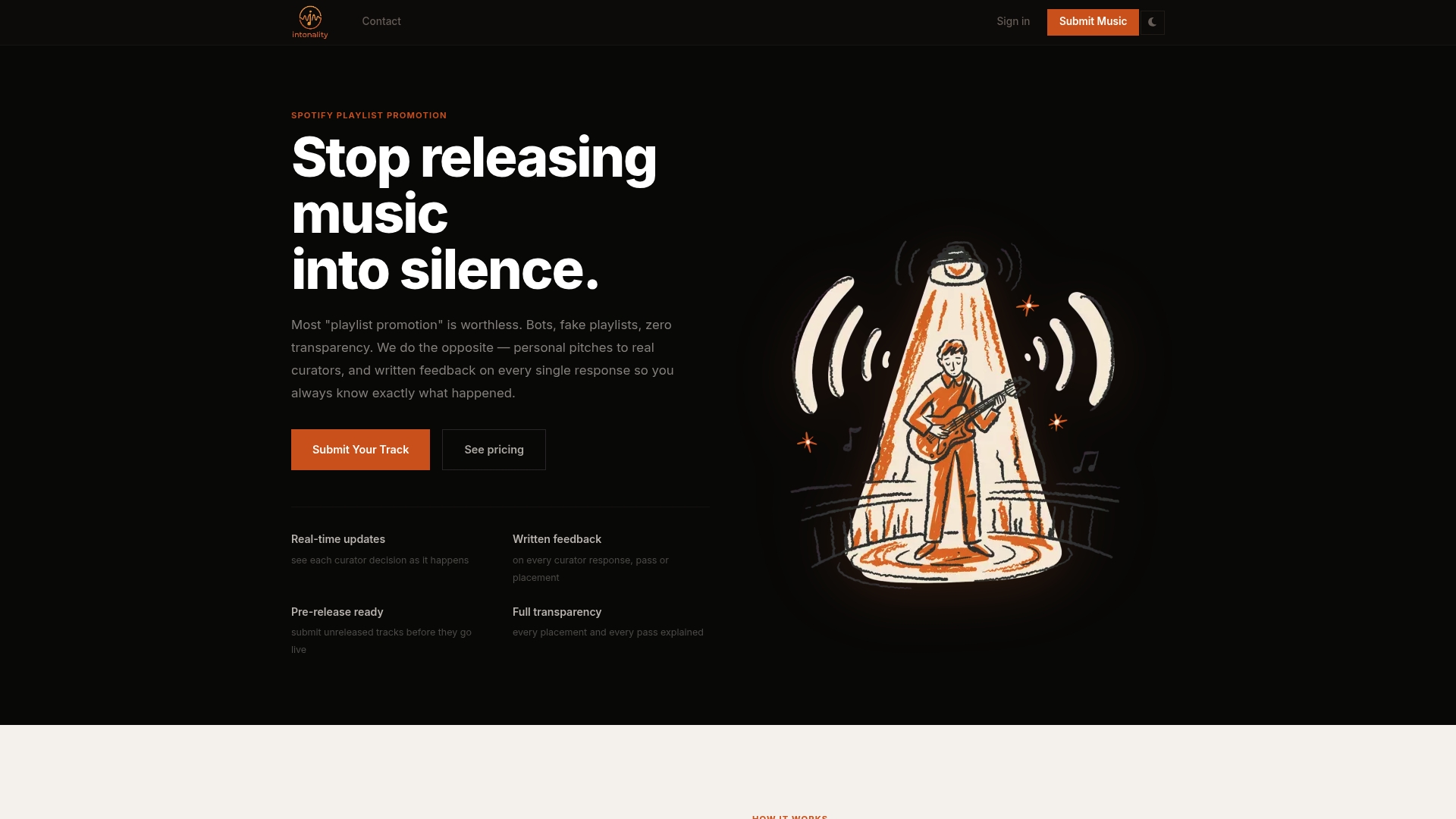
If you’d rather spend your release week promoting the song instead of chasing down forty curators by hand, a managed campaign handles that outreach for you while keeping every decision visible. We offer four tiers, Starter, Standard, Pro, and Max, each built around the same core promise: manually screened, genre-matched curators and written feedback on every placement or pass.
- Starter and Standard suit artists testing a managed campaign for the first time or working with a tighter release budget.
- Pro and Max fit artists who want broader curator reach and more detailed reporting across a bigger release push.
- Every tier includes real-time updates so you can see responses as they come in rather than waiting for a final report.
Pricing for each tier is available on our campaign page, where you can also browse public campaigns with real curator feedback before you commit to one.
FAQ
What is the fastest legitimate way to get on a Spotify playlist?
The fastest legitimate route is pitching through Spotify for Artists at least 7 days before release, which makes your track eligible for Release Radar and editorial consideration, according to Spotify Support. Pitching doesn’t guarantee a placement, but it’s the only way to reach Spotify’s own editorial playlists.
Can I pay for a guaranteed playlist placement?
No legitimate service can guarantee a placement on Spotify’s editorial playlists, and Spotify’s policy treats paid guarantees as a violation that risks your account. Any service making that promise is a red flag worth avoiding.
How do I know if a playlist curator service is trustworthy?
Check whether the service names or profiles its curators, shows real written feedback from past decisions, and publishes a clear refund policy. Services that keep their curator lists opaque or dodge questions about reporting are the ones to be cautious with.
What should I do if I think my track has fake streams?
Document the playlist URL and the dates you noticed unusual play activity, then report it through Spotify’s official channel and notify your distributor. Distributors can assist with royalty-side issues and help flag the account for investigation.
How many playlist placements should I expect from a managed campaign?
Results vary by service and tier; the number of placements per campaign depends on factors like service tier, genre fit, track quality, and release timing. Genre fit, track quality, and release timing all affect how an individual campaign performs.
Sources
- How to get your music on Spotify playlists — Berklee Online
- Pitching music and videos to Spotify playlist editors — Spotify Support (US)


