

Independent artists can trigger Spotify’s Discover Weekly, and the path runs through listener behavior, not luck or spending. The algorithm responds to saves, playlist adds, and repeat listens far more than raw stream counts, which means your first move isn’t advertising. It’s engineering the actions real listeners take in the first few days after release.
Three things matter before anything else. First, make sure the track itself earns a replay: a weak intro or a slow build kills your shot before the algorithm even notices you. Second, run a save-focused push on release day, because saves in week one carry outsized weight in how Discover Weekly gets triggered. Third, convert every bit of social attention (TikTok views, Instagram shares, email opens) into an actual Spotify action: a save, a follow, a playlist add.
- Optimize the track’s first 15 to 30 seconds so casual listeners don’t skip before the hook lands.
- Launch a coordinated save push within the first 24 to 48 hours of release, targeting your most engaged fans first.
- Turn social traffic into Spotify signals immediately, using direct links and a clear, single call to action.
Pro Tip: Skip the temptation to buy streams. Fraudulent streaming has become enough of a problem that Forbes recently reported on Spotify facing scrutiny over billions of suspected bot streams tied to major releases. Fake plays don’t generate saves, and saves are what the algorithm actually reads.
Key Takeaways
Discover Weekly placement follows real listener behavior: save rate, completion rate, and playlist adds in the first week matter more than total streams ever will.
| Point | Details |
|---|---|
| Prioritize saves over streams | Save rate is the strongest early signal; ask fans to save the track within the first 24 to 48 hours. |
| Optimize the first 30 seconds | A weak hook causes early skips that hurt completion rate before the algorithm can register interest. |
| Seed niche playlists first | Genre-matched, smaller playlists build taste-cluster overlap more effectively than broad, low-engagement ones. |
| Expect a 3 week window | Discover Weekly tests tracks in phases, expanding distribution only after early cohorts respond well. |
| Use curator-led promotion | Intonality pairs genre-matched curator pitches with written feedback, averaging 4 to 11 playlist placements per campaign. |
Table of Contents
- How Discover Weekly Actually Works
- Which Metrics Actually Matter in Spotify for Artists
- The First 72 Hours: Your Release Week Playbook
- Picking the Right Track and Producing It to Survive the Skip Button
- Turning Social Attention Into Real Spotify Signals
- Where to Seed Your Track First: Playlists That Actually Help
- Metadata, Delivery Timing, and the Editorial Pitch Checklist
- Measuring Results and Cutting Through the Myths
- A Curator-Led Campaign, Start to Finish
- Chasing Placements vs. Building an Audience
- Let Real Curators Do the Heavy Lifting
- Frequently Asked Questions
- Sources
How Discover Weekly Actually Works
Discover Weekly runs on collaborative filtering layered with content analysis. Collaborative filtering looks at what people with similar listening habits already stream, save, and skip, then finds overlap between your track and their taste profile. Content analysis adds a second layer: audio features like tempo and energy, plus metadata and natural language processing on your genre tags, help the system decide which taste clusters your song even belongs in.
Raw stream count barely factors into either process. What matters is what listeners do after they hit play. A save signals strong intent. A playlist add signals the listener trusts the track enough to return to it. A full listen through to completion signals the track holds attention, while a skip in the first ten seconds signals the opposite.
- Saves and playlist adds carry more algorithmic weight than plays alone.
- Completion rate tells Spotify whether the track earns the listener’s full attention.
- Taste-cluster overlap decides whether your song reaches the right new listeners, not just more listeners.
Spotify refreshes Discover Weekly every Monday, and it tests new tracks conservatively. Independent analysis suggests the platform seeds a track into small listener cohorts first, then expands distribution only if early engagement holds up — a phased rollout rather than an all-or-nothing gamble.
Which Metrics Actually Matter in Spotify for Artists
Your Spotify for Artists dashboard hides the real signal behind a handful of numbers most artists check once and ignore. Here’s what to actually watch:
- Save rate: the percentage of listeners who save the track relative to total streams. This is the single strongest predictor of algorithmic pickup.
- Completion rate: how many listeners make it to the end without skipping.
- Replay rate: how often the same listener comes back to the song within days.
- Playlist adds: saves to personal or third-party playlists, not just the library.
- Follower growth tied to the release: new followers gained specifically after this track dropped.
- Listener overlap: how much your audience already resembles listeners of similar artists.
Save rate is the metric to obsess over early. A data-driven guide on artist growth tactics notes that save-focused strategies outperform stream-volume strategies when it comes to actual playlist pickup, and vendor benchmarks commonly cite save rates in the low single digits as a rough threshold for early testing, though that number shifts by genre and audience size.
Pro Tip: Treat save rate as your leading KPI in week one, and completion rate as your leading KPI from week two onward. Early on, you’re proving intent. Later, you’re proving staying power.
The First 72 Hours: Your Release Week Playbook
Everything before release day is setup. Everything in the first 72 hours is execution.
Pre-release (7 to 14 days out):
- Deliver your track to your distributor with enough lead time (most recommend at least 5 to 7 days) to be eligible for playlist consideration and editorial pitching.
- Submit your Spotify for Artists pitch with complete metadata, mood tags, and a short, specific note about the track’s sound and story.
- Launch a pre-save campaign so fans commit to saving the track before it’s even live. Pre-saves prime day-one signals, and guides for independent artists treat this as one of the most reliable ways to front-load engagement.
Day 0 to day 3:
- Push your most engaged fans (email list, close followers, superfans) to save the track within the first six hours of release.
- Direct every social post, story, and bio link straight to the Spotify track page. Remove any extra clicks between attention and action.
- If you’re running paid promotion, weight your ad spend toward premium-market listeners, since accounts with richer listening history and taste data tend to carry more algorithmic weight than free-tier or new accounts.
- Ask fans explicitly to add the track to a personal playlist, not just save it to their library. Playlist adds are a stronger signal.
Week one follow-up:
- Check your save rate and completion rate daily rather than waiting for a weekly report.
- If saves stall within the first few days, pivot promotion toward your warmest audience segments instead of broadening spend.
- Keep pushing new listeners toward the track through week two. The algorithm’s testing window often runs longer than artists expect.
Picking the Right Track and Producing It to Survive the Skip Button
Not every song in your catalog deserves to be your Discover Weekly bet. Pick the track with the clearest hook, the most obvious genre identity, and the strongest replay potential, because ambiguity confuses both listeners and the taste-matching system.
- Choose a track with a hook that lands inside the first 15 to 30 seconds. Slow builds cost you skips before the algorithm has data to work with.
- Confirm your genre and mood are unambiguous. A song that blurs three genres makes it harder for collaborative filtering to place you in the right taste cluster.
- Trim dead air, long intros, or unnecessary instrumental stretches that give listeners a reason to bail early.
- Master for consistent loudness so the track doesn’t feel jarring next to whatever played before it in a listener’s queue.
Pro Tip: Before a full release, A/B test two versions (say, a full intro versus a trimmed one) with a small email or Discord audience. Ask which one they’d keep listening to. Small-sample feedback like this catches skip-triggers you can’t hear yourself after 40 listens in the studio.
Turning Social Attention Into Real Spotify Signals
Attention on TikTok or Instagram means nothing to Discover Weekly unless it becomes a save, a follow, or a playlist add on Spotify. Ranked by reliability, here’s what actually converts:
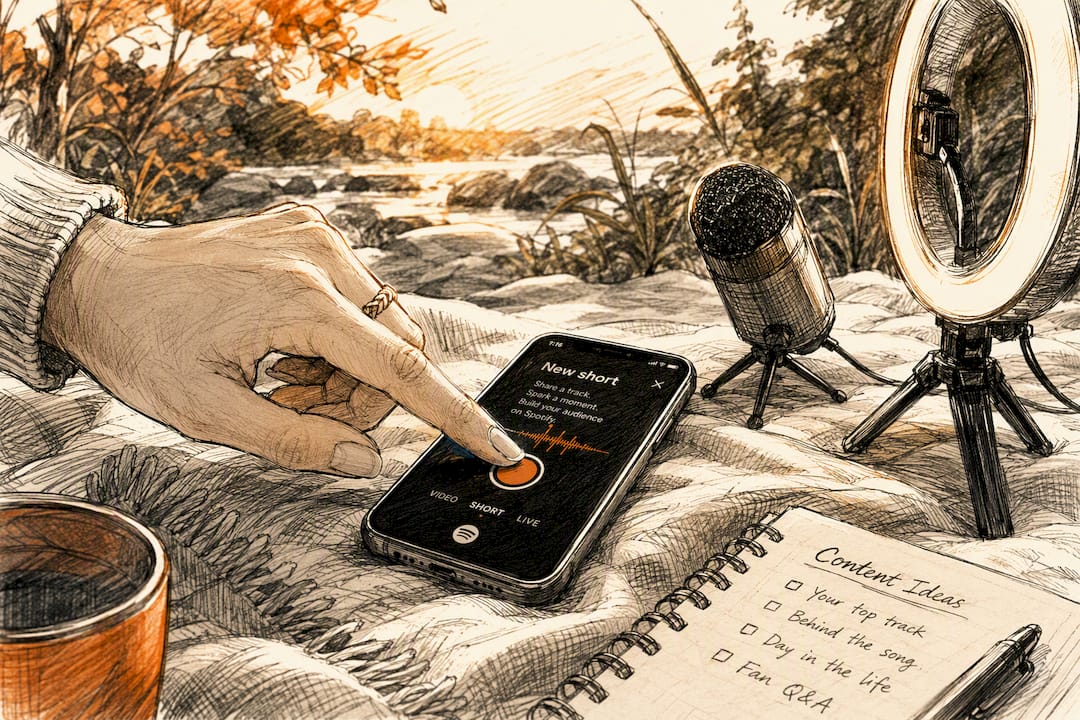
- Social-to-Spotify funnels: a direct link from your highest-performing short-form video straight to the Spotify track page, with a caption that tells viewers exactly what to do next.
- Email list conversion: your list converts at a far higher rate than cold social traffic because these listeners already trust you.
- Targeted ads in premium markets: paid reach works best when aimed at accounts with established listening history rather than broad, low-intent audiences.
- Niche playlist seeding: getting added to smaller, genre-specific playlists builds the taste-cluster data Spotify needs to recommend you elsewhere.
- Organic cross-posts from other artists or fans: slower to build but often the highest-trust signal you can get.
For each channel, minimize the number of steps between attention and action:
- Never send traffic to a general profile page when you can link directly to the track.
- Give one specific ask per post: “Save this” works better than “check out my new music.”
- Strip your Linktree or bio link down to a single, obvious call to action during release week.
Pro Tip: Use direct, specific language. “Save it now” or “add it before it disappears from your feed” outperforms vague CTAs like “check it out.” Friction kills saves, so cut every extra tap between the post and the save button.
If you’re building out a short-form strategy from scratch, platform-specific growth tactics can help you figure out which content format actually drives click-throughs before you spend on ads.
Where to Seed Your Track First: Playlists That Actually Help
Not all playlist placements move you closer to Discover Weekly, and some can actively hurt you. A track dropped into a broad, million-follower playlist with low genre alignment often produces a flood of passive streams with weak completion and near-zero saves, which tells the algorithm your song doesn’t hold attention.
- Editorial playlists: curated by Spotify’s own team, these carry strong discovery value but are competitive and require a clean, complete pitch.
- Large public playlists: high stream volume, but often low engagement per listener unless the genre match is precise.
- Niche user-curated playlists: smaller audiences, but usually stronger taste-cluster alignment, which is exactly what feeds Discover Weekly’s matching.
- Personal playlists: the strongest signal of all, since a listener adding your song to their own playlist tells Spotify this is a keeper, not a passive listen.
When pitching curators, include a short, specific note about genre, mood, and comparable artists. Vague pitches get ignored. Genre-matched pitches get placements that actually convert.
Pro Tip: A placement on a tightly genre-matched playlist with 2,000 followers often does more for your Discover Weekly odds than a placement on a generic 500,000-follower playlist. Engagement density beats raw reach here.
Metadata, Delivery Timing, and the Editorial Pitch Checklist
Spotify’s classification system leans on your metadata as much as your audio. Sloppy tags mean the algorithm misfiles your track into the wrong taste cluster before a single listener even hears it.
- Confirm your genre and mood tags are specific rather than generic. “Indie” alone tells the system almost nothing.
- Double-check songwriter and producer credits are accurate; incorrect credits can quietly break your connection to related artists.
- Submit high-resolution, on-brand artwork that matches the tone of the track, since visual signals influence playlist curator decisions too.
Delivery timing matters just as much:
- Deliver to your distributor at least 5 to 7 days before release to leave room for editorial review.
- Submit your Spotify for Artists pitch as soon as the track is uploaded, never at the last minute.
- Confirm your release date lands on a day that gives you a full week before the next Discover Weekly refresh, so your early engagement data has time to register.
Measuring Results and Cutting Through the Myths
Set a weekly check-in on your Spotify for Artists dashboard rather than obsessing daily. Track save rate, completion rate, and playlist adds against your baseline from your last two releases, since your own history is the most honest benchmark you have.
A few myths deserve to die. Raw stream count alone does not trigger Discover Weekly. Buying streams does not help, and given ongoing scrutiny over fraudulent streaming activity, it can actively damage your credibility with the platform. There’s no fixed follower count you need before the algorithm will consider you.
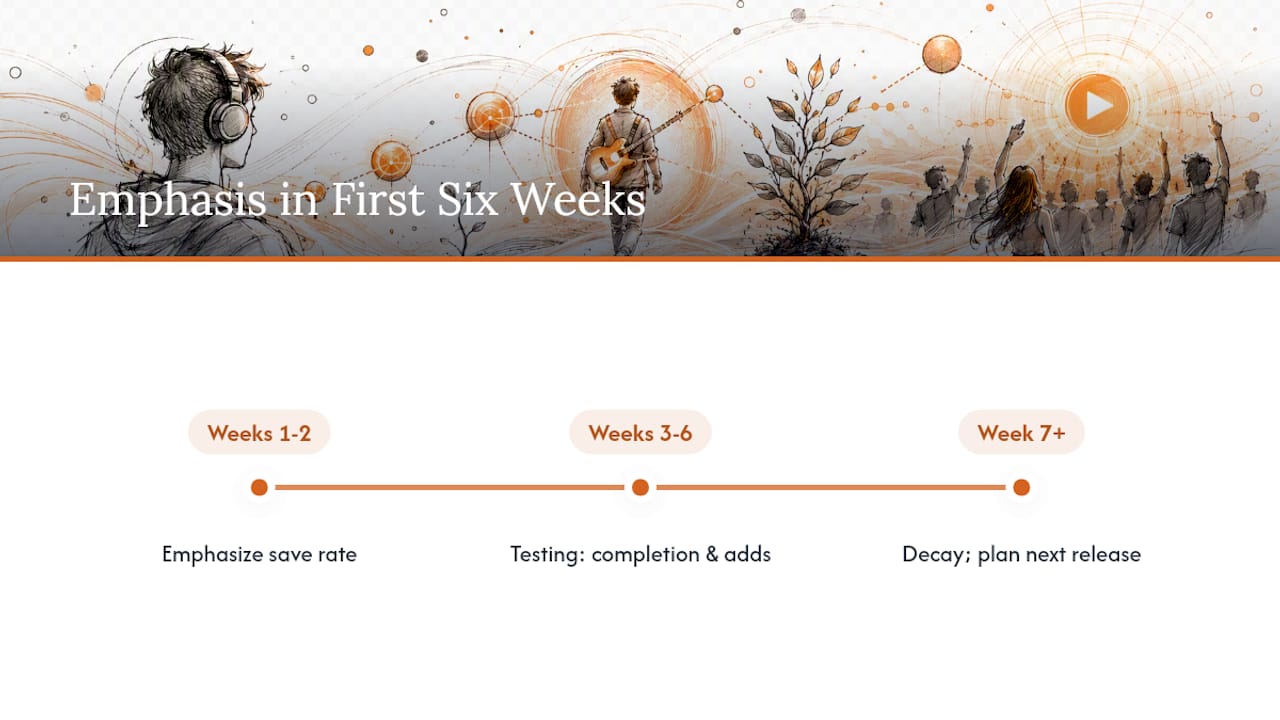
Independent analysis of pickup patterns suggests the typical testing window runs roughly weeks three through six after release, with expansion happening only if early cohorts respond well. Placements naturally decay after several weeks, which is normal, not a failure. The fix isn’t panic. It’s your next release, timed to renew the signal.
A Curator-Led Campaign, Start to Finish
One useful way to see these signals in action is through a curator outreach campaign rather than a passive submission into the void. Intonality builds campaigns around genre-matched pitches sent to real, vetted curators, and campaigns average 4 to 11 playlist placements depending on the service tier chosen.
Each placement comes with written feedback from the curator, whether accepted or passed on, so artists can see exactly why a track landed or didn’t. That feedback loop, combined with real-time dashboard updates, gives artists something rare in playlist promotion: a clear read on whether their track is generating the kind of engaged, niche-aligned listens that feed algorithmic discovery, rather than a black box of stream counts.
Results vary by genre, release quality, and market, and no campaign guarantees a Discover Weekly placement. What it can guarantee is exposure to curators who are actually listening.
Chasing Placements vs. Building an Audience
Discover Weekly placement is a byproduct of good listener behavior, not a goal you can hack directly. Chase it too hard on a single release, and you burn energy that would compound better across a full year of consistent output.
The smarter sequence: build catalog depth first, push hard for algorithmic pickup on your strongest single, then let the next release ride the following you’ve already built. Alternate between audience-building releases and placement-focused pushes, and don’t panic if one track misses its window. The next one inherits everything the last one taught you.
Let Real Curators Do the Heavy Lifting
Intonality gets your track in front of real, genre-matched curators instead of leaving your Discover Weekly odds to algorithm guesswork alone. Every campaign pairs a personalized pitch with a curator who actually listens to your genre, not a bot farm or a pay-to-play playlist mill, so the listens you generate look and behave like the organic signals Spotify’s system rewards.
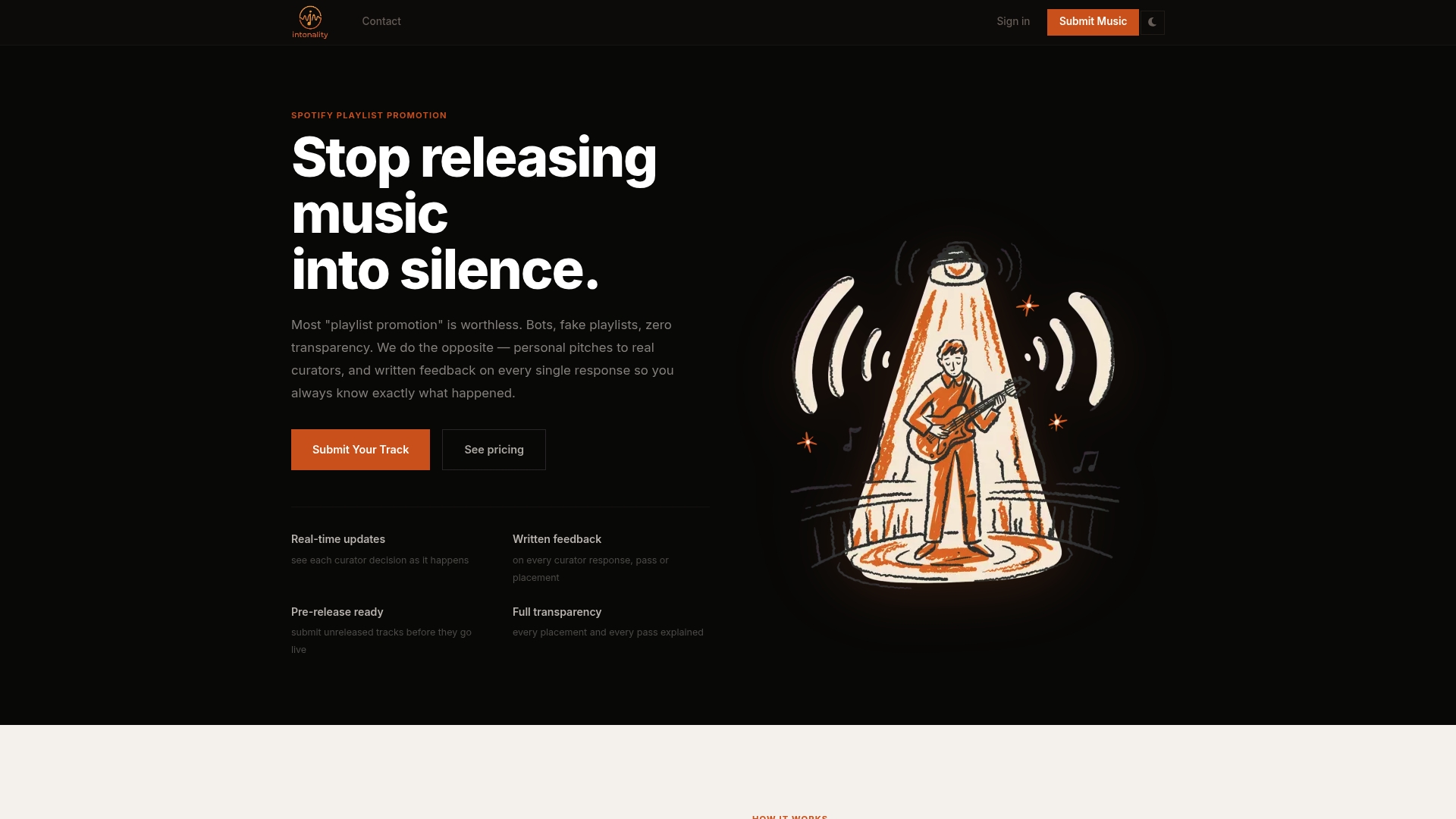
Every decision comes back with written feedback, whether a curator adds your track or passes, so you’re not left guessing why a pitch worked or didn’t. That transparency, paired with real-time dashboard updates, means you can adjust your next pitch instead of waiting weeks in the dark. Campaigns average 4 to 11 placements depending on the tier, giving you both reach and the kind of niche-aligned engagement that feeds algorithmic discovery downstream. If you’re comparing options against a pitch marketplace or a campaign-style service, the difference comes down to who’s actually listening on the other end. Ready to see what genre-matched curators think of your track? Submit your song and start your campaign today.
Frequently Asked Questions
How long does it take to get on Discover Weekly after a release? Independent analysis points to a testing window of several weeks after release, with wider distribution only following if early saves and completion rates hold up during that period.
Does Release Radar work the same way as Discover Weekly? No. Release Radar mainly surfaces new music to your existing followers, while Discover Weekly uses collaborative filtering to introduce your track to entirely new listeners with similar taste profiles.
Can buying streams get me on Discover Weekly? No, and it can backfire. Fraudulent or purchased streams don’t generate real saves or completions, and platform scrutiny over bot streaming makes this a genuine credibility risk.
What save rate should I aim for as an independent artist? There’s no universal number, since thresholds shift by genre and audience size, but vendor benchmarks cite save rates in the low single digits as a directional target during early testing. Treat your own release history as the more reliable comparison point.
Do I need a large playlist placement to get noticed by the algorithm? Not necessarily. A smaller, genre-matched playlist with engaged listeners often produces stronger taste-cluster signals than a large, low-engagement placement, which can help your Discover Weekly odds more.
Sources
- Spotify accused of ignoring billions of fraudulent Drake streams — Forbes
- How to Get on Spotify Discover Weekly in 2026: A Data-Driven Guide — Music24
- Discover Weekly Placement: How to Trigger Spotify’s Monday Algorithmic Playlist — intellijend
- Spotify metrics that trigger Discover Weekly — ANDR Music


