

Most paid Spotify playlist-promotion campaigns in the U.S. land somewhere between 4 and 11 placements per campaign, depending on the service tier and how well the track fits the curators being pitched. Entry-level campaigns typically produce 1–4 placements; mid-tier campaigns average 4–11; premium campaigns can push past 10, sometimes significantly. The biggest source of variance is not budget alone. Genre fit, curator vetting quality, and the total number of curators pitched all move the needle more than spending an extra hundred dollars.
One number worth watching from day one: save rate. Raw placement count tells you how many curators said yes. Save rate tells you whether listeners actually want to hear the track again, which is what triggers Spotify’s algorithmic surfaces.
Key Takeaways
Paid Spotify playlist campaigns typically deliver 4–11 curator placements per campaign, but save rate, not placement count, is the metric that predicts algorithmic growth.
| Point | Details |
|---|---|
| Realistic placement range | Entry campaigns yield 1–4 placements; mid-tier 4–11; premium 10 or more, depending on genre fit and curator vetting. |
| Save rate is the real signal | Target 10–30% saves from playlist listeners in week one; below 5% means reassess targeting or creative. |
| Verify curator quality | Ask for written feedback and engagement data per placement, not just follower counts. |
| Placements trigger algorithms | Royalties rarely cover campaign cost; the real ROI is Discover Weekly and Radio exposure from save signals. |
| Intonality benchmark | Intonality’s vetted campaigns average 4–11 placements with real-time updates and written curator feedback on every decision. |
Table of Contents
- What “average playlist placements” actually means in this guide
- Realistic placement ranges by campaign tier
- What actually changes your placement count
- What to measure besides placement count
- When placements appear and what reporting should look like
- How to spot fake playlists and vendor red flags
- Questions to ask before you buy a campaign
- How Intonality approaches placements and what to expect
- An honest note on reporting and transparency
- Intonality: vetted curator campaigns with real reporting
- Sources
What “average playlist placements” actually means in this guide
A playlist placement counts as one distinct Spotify playlist that adds your submitted track during a paid campaign. That is the metric this guide uses throughout.
Three types of placements exist, and they are not interchangeable:
- Curator placements: A real, independent curator adds your track to their playlist. This is what paid campaigns target and what this guide benchmarks.
- Editorial placements: Spotify’s own editorial team adds your track to an official playlist (Fresh Finds, New Music Friday, etc.) through the Campaign Kit pitching tool. These are not purchased; they are applied for through Spotify for Artists before release.
- Algorithmic surfaces: Radio, Discover Weekly, Release Radar. These are triggered by engagement signals, not pitched directly.
What counts in this guide’s placement numbers: curator adds during the campaign window, including pre-release placements and follow-on adds where a curator keeps the track after the initial window. What does not count: personal user playlists, editorial adds, or algorithmic appearances. Playlist follower count is tracked as a reach multiplier, not as a placement itself.
Realistic placement ranges by campaign tier
Independent curator pitching typically costs $20–$60 per submission, with full campaigns running $300–$2,500. A documented $250 campaign produced placements with roughly six curators and approximately 1,200–1,500 first-week plays, illustrating the modest direct-royalty return at entry level.
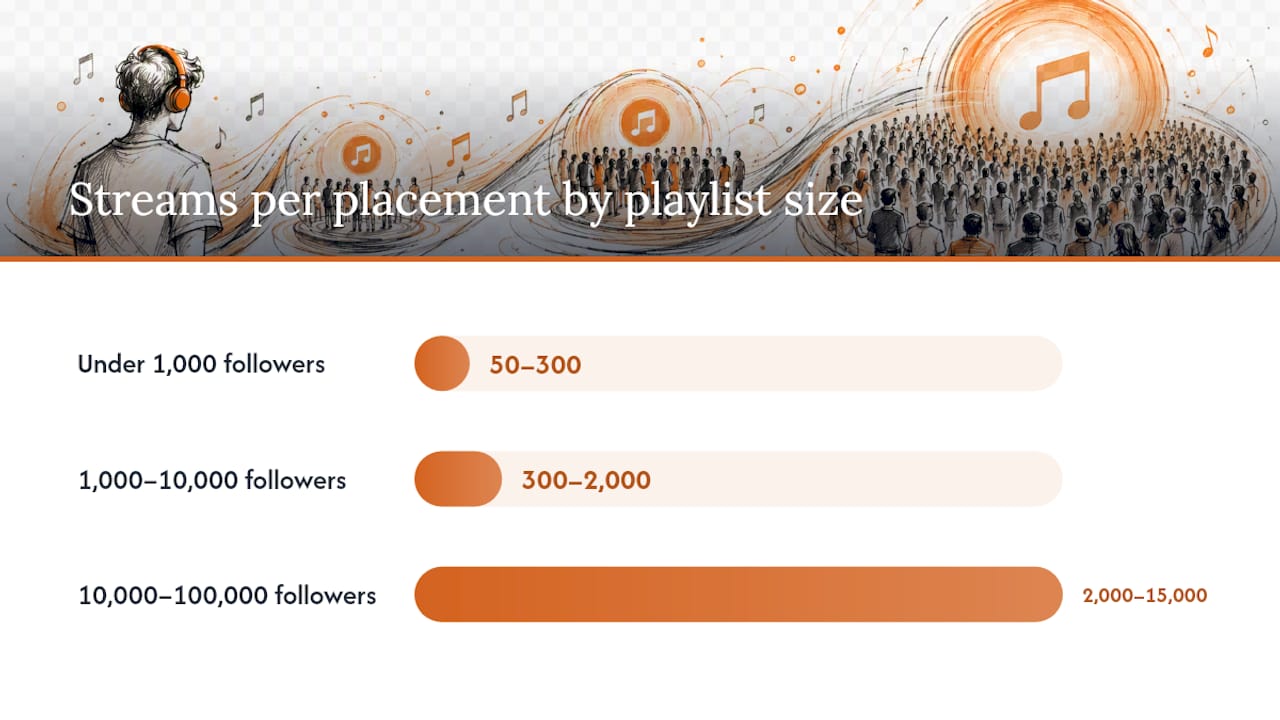
Stream math matters here. Research derived from NBER benchmarks puts daily streams at roughly 6.6 per 1,000 playlist followers. A placement on a 10,000-follower playlist yields around 66 daily streams, which at Spotify’s per-stream rate means most campaigns do not break even on royalties alone. The real value is algorithmic. Placements that generate saves push tracks into Discover Weekly and Radio.
Per-placement stream estimates by playlist size, based on documented campaign data:
- Under 1,000 followers: 50–300 streams
- 1,000–10,000 followers: 300–2,000 streams
- 10,000–100,000 followers: 2,000–15,000 streams
What actually changes your placement count
Genre fit is the single highest-leverage variable. A track pitched to 50 loosely matched curators will underperform a track pitched to 20–30 well-matched ones. Here are the ten factors that move placement counts most:
- Genre fit: Tighter match = higher curator acceptance rate.
- Curator vetting quality: Verified, active curators respond and decide; unverified ones ghost.
- Release timing: Pitching 2–4 weeks before release gives curators time to add tracks before the algorithm’s first-week window.
- Pitch quality: A personalized pitch with context (mood, influences, story) outperforms a generic one.
- Pre-save and fan engagement: Existing momentum signals credibility to curators.
- Campaign volume: More curators pitched means more chances, but only if they are matched.
- Curator response rate: Some genres have more active curator communities than others.
- Exclusivity requests: Some curators want first-add rights, which can slow multi-placement timelines.
- Track maturity: Tracks with prior streaming history convert better than cold releases.
- Metadata and labeling: Correct genre tags, mood tags, and BPM help curators self-select.
Pro Tip: When choosing between a service that pitches 100 curators broadly and one that pitches 30 with verified genre matching, pick the 30. Acceptance rates on well-matched pitches routinely outperform mass-submission volume.
What to measure besides placement count
Placements are the entry point. What happens after a track lands on a playlist determines whether the campaign actually works.
Priority metrics to track in the first 7–14 days:
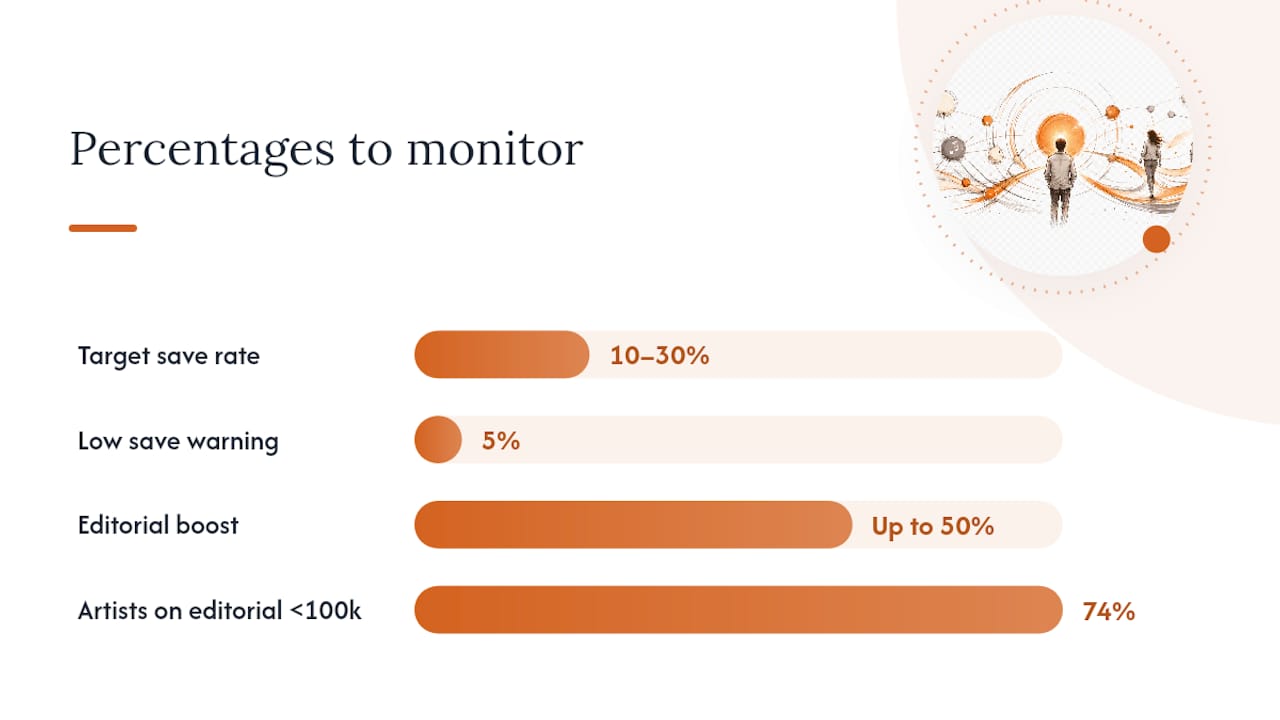
- Save rate: The percentage of listeners who save the track. Practitioners target 10–30% from warm audiences in week one as a planning benchmark. Below 5% on a placed track is a signal to reassess targeting or creative.
- Playlist adds: Distinct from saves; shows how many listeners added the track to their own playlists.
- Completion rate: What percentage of listeners hear the track through. Low completion suggests a hook or mix problem.
- Repeat listens: A strong indicator of genuine interest and a known algorithmic trigger.
- New followers gained: Measures audience conversion, not just passive listening.
- Algorithmic surface appearances: Check Spotify for Artists for Discover Weekly, Radio, and Release Radar activity in weeks 2–4.
That volume of saves, combined with completion data, is often enough to push a track into Discover Weekly for a meaningful listener segment. Use Spotify for Artists analytics to verify these numbers against each placement.
Spotify’s editorial playlist features can boost first-week engagement by up to 50%, and 74% of artists added to editorial playlists had fewer than 100,000 monthly listeners. Running a Campaign Kit editorial pitch in parallel with a paid curator campaign is worth doing for every release.
When placements appear and what reporting should look like
| Phase | Typical timing | What to expect |
|---|---|---|
| Outreach window | Days 1–7 | Vendor pitches curators; no placements yet |
| First decisions | Days 5–14 | Early curator responses; first placements appear |
| Peak placement window | Days 7–21 | Most placements confirmed and active |
| Reporting cadence | Weekly minimum | Placement dates, curator names, follower counts, saves/streams |
Good reporting from a vendor includes: curator name and playlist link, follower count at time of placement, placement date, and an engagement snapshot (saves and streams) at 7 days. Written feedback on every curator decision, including rejections, is a mark of a legitimate service. Using Campaign Kit tools alongside paid outreach can amplify reach further, since Discovery Mode is active in 90+ markets.
Acceptable delays: curator response times vary by genre and season. Expect the bulk of decisions within 14 days. If a vendor cannot show any placements or curator responses by day 10, ask for a status update with specifics.
How to spot fake playlists and vendor red flags
Not every placement is worth having. Watch for these:
- Guaranteed large follower placements: No legitimate vendor can guarantee a specific follower count. Curators decide independently.
- No curator names or feedback: If a vendor cannot name the curators or provide written feedback, the placements are likely fabricated or bot-driven.
- Anonymous bulk uploads: Vendors who accept a link and return a placement list with no process transparency are a risk.
- Sudden play spikes with no saves: 10,000 plays and 12 saves is a bot fingerprint, not an audience.
- Link-only submissions: Legitimate curators listen to tracks in context; link-only bulk uploads skip that step.
- Follower count without engagement data: A playlist with 50,000 followers and 200 monthly listeners is worthless for algorithmic purposes.
Defensive steps: request written curator feedback on every decision, ask for follower counts and recent engagement metrics (not just follower numbers), and insist on a real-time dashboard or update cadence. The fake streams guide from Intonality covers account-risk implications in detail.
Questions to ask before you buy a campaign
Copy these into your next vendor conversation:
- How do you vet your curators, and how often is that list updated?
- How many curators will be pitched for my genre specifically?
- What is the typical placement count for a campaign at this budget?
- Do you provide written curator feedback on every decision, including rejections?
- What follower counts and engagement metrics do you report per placement?
- What is your refund or cancellation policy if placements fall below the stated range?
- Can I see a sample report from a recent campaign (anonymized metrics are fine)?
- Do you recommend or support running Spotify Campaign Kit editorial pitching in parallel?
- What is the expected timeline from submission to first placement?
- Can you share recent campaign examples showing placements, saves, and streams?
How Intonality approaches placements and what to expect
Intonality’s stated benchmark is 4–11 playlist placements per campaign, tied to service tier and genre match. Those numbers assume vetted, genre-matched curators, a personalized pitch per submission, and a standard 14–21 day campaign window.
Artists who run mid-tier campaigns with strong genre alignment consistently land in the 6–9 placement range, with curator-reported saves averaging well above the 10% threshold that signals algorithmic readiness. The placements that matter most are not always the biggest playlists. A 3,000-follower playlist in exactly the right subgenre often outperforms a 30,000-follower general playlist on save rate and repeat listens.
Intonality tracks saves, playlist adds, and repeat listens alongside raw placement count. Those signals, not the placement number alone, determine whether a campaign is working and whether a mid-campaign pivot is needed. Real-time updates and written curator feedback on every decision are standard, not optional. For artists who want to see how genre matching works in practice, the folk and rock playlist pages show the kind of curated context placements land in.
An honest note on reporting and transparency
At Intonality, written curator feedback is not a bonus feature. It is the only way to know whether a rejection was about genre fit, timing, or track quality, and that distinction changes what you do next. If a curator says the track is too slow for their playlist’s current rotation, that is a pivot signal. If five curators say the same thing, it is a production note.
Placement-linked follower counts let us advise on mid-campaign adjustments. If early placements are landing on smaller playlists than projected, we can shift outreach toward better-matched curators before the campaign window closes. That kind of real-time adjustment is only possible when the reporting is honest and specific.
[Einars’s credentials and client testimonials to be inserted here by the editorial team.]
Intonality: vetted curator campaigns with real reporting
Paid playlist promotion works best when you know exactly what you are getting. Intonality pitches your track to vetted, genre-matched curators with a personalized submission for each one, then delivers real-time updates and written feedback on every curator decision, including the rejections.
The typical campaign delivers 4–11 placements depending on tier, with saves and engagement data tracked alongside each placement so you can see what is actually moving. For artists comparing options, the Spotify playlist promotion page covers campaign tiers in full. If you are weighing per-submission services, the PlaylistPush alternative page breaks down how Intonality’s model compares. Pick your tier and submit your track.
Sources
- Release guide: promotional engagement and best practices | Spotify for Artists
- Spotify Playlist Placement: What It Costs | DJ Will Gill


