

Curator feedback is the written or one-line response a Spotify playlist owner gives after reviewing a submitted track, ranging from a flat accept/decline to detailed critique of the mix, hook, or genre fit. Paid review platforms let you pay for a curator’s attention, not a placement. Spotify’s own developer terms prohibit exchanging money for guaranteed playlist spots. Your immediate move: tighten your metadata, nail your pitch, and treat any feedback you get as data, not a verdict on your music.
TL;DR:
- Ensure your metadata is accurate and consistent across all platforms before submitting to minimize filtering out your track early.
- Focus on crafting a compelling first 30 seconds that clearly establishes mood, as Spotify playlist editors prioritize hook quality in opening tracks.
- Recognize that written curator feedback provides actionable insights on genre fit, mix issues, or placement suggestions, unlike simple accept or decline responses.
- Avoid platforms promising guaranteed playlist placements, as Spotify’s terms prohibit monetary exchanges for direct exposure or guaranteed spots.
- Build relationships with verified, active curators via official channels by providing a concise pitch and key metadata, and steer clear of red flags like untraceable promises or asking for untracked payments.
Table of Contents
- How Paid Curator Review Platforms Actually Work
- What Does Curator Feedback From Spotify Actually Say?
- How Curators Decide What Makes the Cut
- How to Find and Contact Legitimate Curators
- How to Become a Curator and Get Paid for Reviews
- Turning Feedback Into Your Next Move
- What Running Curator Campaigns Has Taught Us
- Get Your Track in Front of Curators Who Actually Listen
- Sources
How Paid Curator Review Platforms Actually Work
Most paid review services follow a consistent pattern. You submit a track and a link, pay a review fee, and a matched curator listens and responds within a set window. What happens next depends entirely on the platform’s honesty about what it’s selling.
Legitimate services are careful with their language because Spotify’s rules leave no room for ambiguity. The Spotify Developer Terms bar using the platform’s tools or API to promise exposure or placement in exchange for payment. That’s why credible review platforms frame the transaction as “pay for a curator’s time and written opinion,” never “pay to get on the playlist.” A Spotify community thread makes the point sharply: even hinting that placement is an option, rather than a possible outcome of genuine editorial fit, can put a platform on the wrong side of the rules.
Curator qualification varies by platform, but a few gates show up repeatedly:
- A minimum real follower count on the playlist, often cited around 1,000 or more.
- Verification that the playlist is active, meaning it’s been updated recently and isn’t a bot-inflated shell.
- Some kind of identity or ownership check tying the curator to the playlist they claim to run.
Before paying anyone, read the refund policy closely. Do you get money back if the curator declines? Is there an appeal process if you think the review was rushed or generic? Vague answers to either question are a warning sign.
What Does Curator Feedback From Spotify Actually Say?
Feedback splits into two broad categories, and knowing which one you’re getting changes how you should react to it. A bare accept or decline tells you almost nothing actionable. Written critique, even three or four sentences, gives you something to work with.
Common phrases show up often enough that you can start decoding them like shorthand:
- “Not quite the vibe for this list” usually means genre or mood mismatch, not quality.
- “Intro didn’t grab me” points to your hook, specifically the first 30 to 45 seconds.
- “Vocals felt buried” is a mix note, often fixable without a full remaster.
- “Would fit better on a discovery slot than an opener” tells you exactly where the curator sees your track sitting, which matters for how you pitch other playlists.
That last one is worth sitting with. Curators who bother to specify placement within the playlist, opener versus deep-cut, are giving you a genuinely useful signal about how your track reads emotionally, and you can use it to retarget similarly structured playlists elsewhere.
If a curator leaves the door open, a short, professional follow-up is fair game as part of your sound-design workflow. Something like: “Thanks for the note on the intro. Would a re-edit with a tighter first 20 seconds be worth resubmitting?” works. What doesn’t work is arguing with the assessment or asking why a decline happened when the curator gave a clear reason already.
Pro Tip: Save every piece of written feedback in one document, even the one-liners. Patterns across five or six responses tell you more about your track’s actual weak point than any single note ever will.
How Curators Decide What Makes the Cut
Curators weigh a mix of gut instinct and cold numbers, and pretending it’s all one or the other misreads how Spotify’s own editorial teams operate. An interview with a Spotify editor lays out the core editorial logic: playlist intention matters first. A curator building a “focus” playlist is evaluating something completely different from one running a “new rock” discovery list, even if your track would technically fit both on paper.
Opening tracks get outsized scrutiny. Spotify’s editors describe the first song on a playlist as setting the emotional tone for everything after it, which means your hook has to work in isolation, not just in the context of your full release.
Data plays a real role too. Curators, especially ones running larger playlists, watch listener behavior: save rates, skip timing, and completion percentage all feed back into whether a track stays on a list after its first week. Spotify’s engineering team has described this as an “algotorial” model, where human editorial choices build the initial pool and algorithms handle personalized ordering afterward, according to a Spotify engineering post. Human judgment still opens the door. The data decides how long you stay.
Before you submit anywhere, run through a short checklist:
- Does your opening 30 seconds establish a clear mood without needing the rest of the song for context?
- Have you listened to five tracks currently on the target playlist back to back with yours in the mix?
- Does your genre tag match what the playlist actually plays, not just what you’d like it to play?
- Is your metadata (BPM, mood, genre) consistent across your distributor and your pitch?
Skipping that fourth step is more common than it should be, and it’s an easy way to get filtered out before a human ever hits play.
How to Find and Contact Legitimate Curators
Start with the official channel. Spotify for Artists includes an editorial pitch tool that lets you submit unreleased tracks directly to Spotify’s own editorial team, no third party involved. It’s free, and it’s the only route with zero ambiguity about compliance.
Beyond that, independent curators run public playlists with contact info in their profile bio or description, and third-party discovery tools can help you filter by genre and follower count. When evaluating any tool or platform, check a few things before trusting it with your money or your masters:
- Does it show any verification that playlists are actively curated by a real person, not scraped or bot-managed?
- Are the playlists listed recently updated, with tracks added in the last few weeks?
- Does contact information match a real, findable curator profile rather than a generic inbox?
If you’re reaching out cold, keep it tight. A subject line naming the genre and mood, one sentence describing the track’s fit for that specific playlist, and a link to a streaming preview with your key metadata attached (BPM, key, release date) is enough. Curators skim; you have about ten seconds to earn the click. For the actual field-by-field breakdown of what to include, a metadata guide for playlist submissions covers the details worth getting right before you hit send.
Watch for red flags: anyone promising a specific number of playlist adds, refusing to share which playlists they work with, or asking for payment through untraceable methods. “Guaranteed placement” is not a phrase a compliant platform can honestly use.
How to Become a Curator and Get Paid for Reviews
Playlist owners looking to monetize their taste face gatekeeping that’s inconsistent across platforms but follows a rough pattern. Most review services want proof your playlist is real before they’ll route paid submissions your way.
Typical requirements include a follower minimum, often over a thousand, along with some evidence the playlist gets regular engagement rather than sitting untouched for months. Payout eligibility can also depend on your country, since some platforms route payments through services with limited regional support.
Pay structures vary by platform, but a few models are common:
- Flat per-review fee, often small individually but scalable if you review in volume.
- Tiered payouts based on playlist size or genre demand.
- Revenue share models tied to how many submissions you process in a given period.
The ethical line matters here as much as the money. Reviewing honestly, meaning you actually listen and give real feedback rather than rubber-stamping every submission, protects your credibility and keeps you compliant with Spotify’s terms. Disclosing to artists that a fee covers your time and attention, not a placement guarantee, keeps expectations aligned on both sides.
Pro Tip: If you’re setting up as a paid reviewer, write your review policy before you take your first submission. Artists respect clear boundaries far more than vague promises.
Turning Feedback Into Your Next Move
Getting feedback is only half the job. What you do with it determines whether the next pitch lands better than the last one.
- Triage the note. Sort feedback into categories: metadata fixes, mix issues, arrangement changes, or pure taste mismatch. Only the first three are actionable.
- Fix before you re-pitch. A curator who said your vocals felt buried isn’t going to hear a different track if you resubmit unchanged.
- Reference the prior note briefly. “Made the adjustment you mentioned on the intro” is enough context. Don’t over-explain or push back on the original call.
- Track everything. A simple spreadsheet with track version, date submitted, curator response, and outcome turns scattered feedback into a pattern you can actually learn from.
- Feed it forward. If three separate curators flag the same hook problem, that’s not a one-off cost. It’s a signal for your next release’s Spotify pitching strategy too.
What Running Curator Campaigns Has Taught Us
Genre-matching sounds obvious until you see how often artists skip it. Intonality routes every pitch to curators whose playlists actually fit the track, then requires written feedback on every decision, accept or decline, so artists get something to act on either way.
Campaign patterns are consistent: placements typically land in the single digits to low double digits per campaign, and the higher end almost always correlates with tracks that had clean metadata and a strong opening hook before the first pitch went out. The lesson holds regardless of platform. Curators reward preparation, not persistence. Fix the hook and the tags before you spend money chasing more submissions.
— Einars
Get Your Track in Front of Curators Who Actually Listen
Intonality skips the volume-blast approach entirely: every submission goes to genre-matched curators as a personalized pitch, not a mass email blast hoping something sticks. 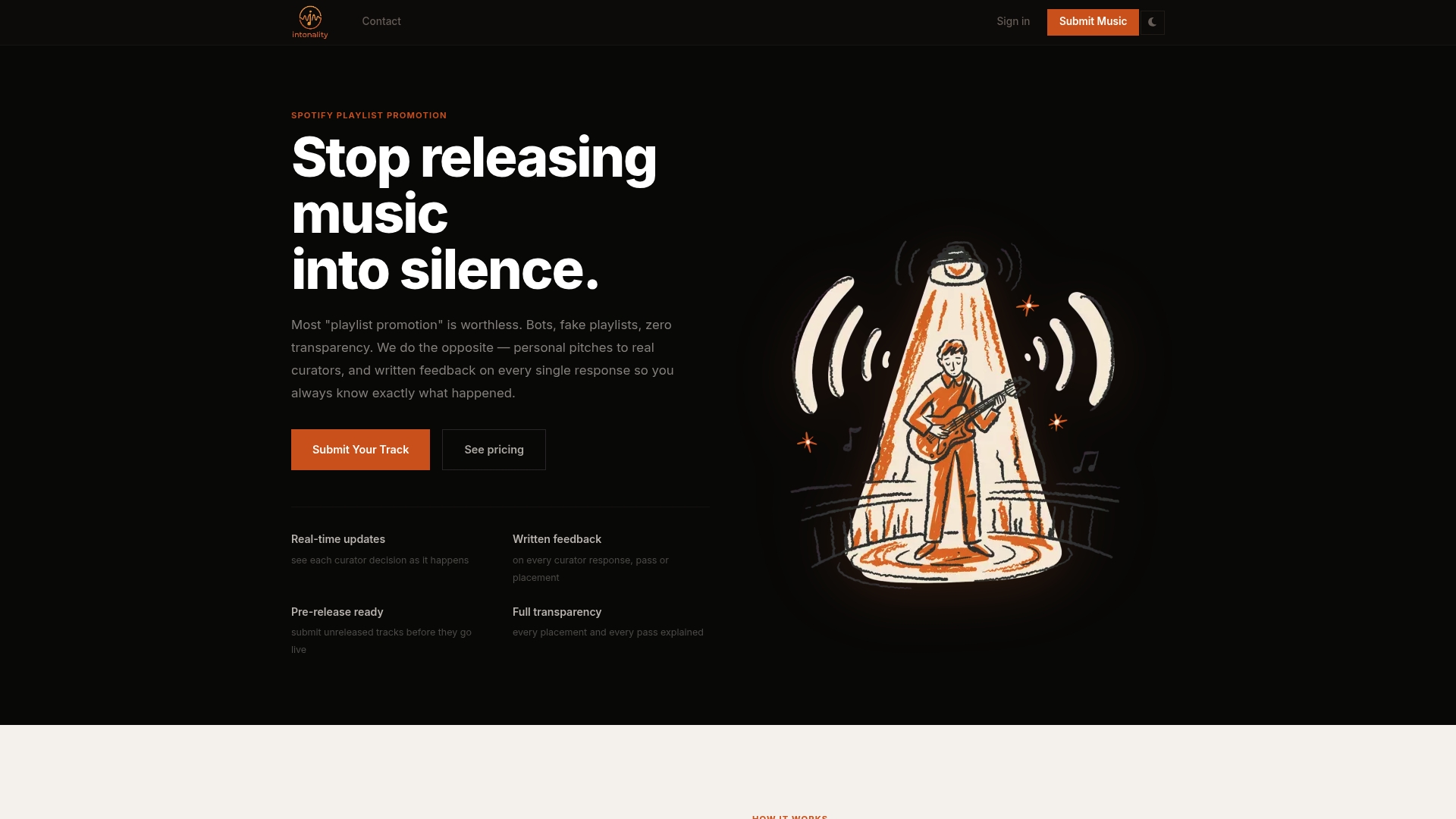
You get real-time updates as decisions come in and written feedback on every single response, accept or decline, so a “not for this list” note actually tells you something useful instead of leaving you guessing. Campaigns typically result in several placements, with genre fit and track readiness influencing results. If you want to see what a genre-specific placement path looks like, the Rock Revival playlist page shows how targeting works for one specific sound.
Start a campaign on the Intonality homepage and get your next release in front of curators who are actually going to listen to it.
Sources
- Spotify Developer Terms
- Spotify editor shares top 3 tips for crafting a perfect playlist
- Humans + machines: a look behind Spotify’s ‘algotorial’ playlists
- Clarification on Spotify Terms for Curator Review Platforms (Spotify Community)


