
There’s no Spotify rule dictating song length, but for most pop and indie playlist submissions, aim for a runtime roughly between two minutes and forty-five seconds to three and a half minutes, with the hook landing early, inside the first several seconds. That range hits the sweet spot between editorial expectations and streaming mechanics. Genre and campaign goals can shift the target, so treat this as a starting point to test, not a rule to force.
TL;DR:
- Most successful tracks now aim for a length between two minutes and forty-five seconds and three and a half minutes to match streaming and playlist trends.
- The average charting song length has steadily declined to around three minutes over the past decade, reflecting social platform and algorithm incentives.
- Length alone is less important than strong structure, with early hooks, brief intros, and energy consistency being key to higher engagement and replay rates.
- Shortening a song is effective only if the core musical and lyrical elements remain intact; editing should focus on the hook and energy flow rather than just duration.
- Testing track performance through key metrics like completion, skip, and save rates helps determine if a song is ready for playlist pitching, regardless of its raw length.
Table of Contents
- What Do the Data and Spotify’s Own Guidance Say About Ideal Track Length?
- What Runtime Range Should You Target by Genre and Goal?
- Which Structural Fixes Matter More Than Trimming Seconds?
- How Do You Test Whether Your Track Is Ready to Pitch?
- How Does Track Length Factor Into Playlist Pitching Strategy?
- How Has the Ideal Track Length Changed Over the Decades?
- How Does Track Length Affect Listener Psychology and Engagement?
- Does Track Length Influence Radio Airplay and Chart Performance?
- Do Ideal Track Lengths Differ by Audience Demographics?
- How Does Ideal Track Length Compare Between Physical Media and Streaming?
- What Technical Limits Actually Constrain Track Length Today?
- What We See in Campaigns: Recurring Fixes and Realistic Expectations
- Get Genre-Matched Curator Feedback on Your Track’s Readiness
- Sources
What Do the Data and Spotify’s Own Guidance Say About Ideal Track Length?
Spotify has never published a minimum or maximum runtime for playlist consideration. The platform’s own editors have said directly that they care about track quality and playlist fit over strict duration, which means a rigid formula doesn’t exist on their end. What exists instead is a pattern in the data that smart artists use as a benchmark.
A large-scale analysis of currently streamable tracks found the average song length settling just over three minutes for tracks released in 2020, continuing a multi-decade decline from the 4-minute-plus averages common in earlier eras. Separate reporting built on Chartmetric data found that charting Spotify songs now average around three minutes, a shift tied directly to how social platforms and playlist algorithms reward hook-first songwriting.
The 30-second rule changes the incentive structure. Spotify only counts a play as a stream once a listener passes the 30-second mark. That single mechanic explains a lot of the shortening trend: a song that gets skipped at 20 seconds earns nothing, while a tight, hook-forward track that clears 30 seconds and gets replayed can rack up multiple counted streams in less total listening time.
Here’s what the trend data actually shows:
- Songs released in the 2020s average a bit over three minutes, down from decade averages well above four minutes in earlier eras
- Charting tracks specifically skew even shorter, often near the 3:00 mark
- The decline has been steady rather than sudden, tracking the rise of streaming and short-form social discovery
None of this means write a 2:30 song and expect a placement. It means the market has shifted, and pretending otherwise puts your track at a structural disadvantage before an editor even presses play.
What Runtime Range Should You Target by Genre and Goal?
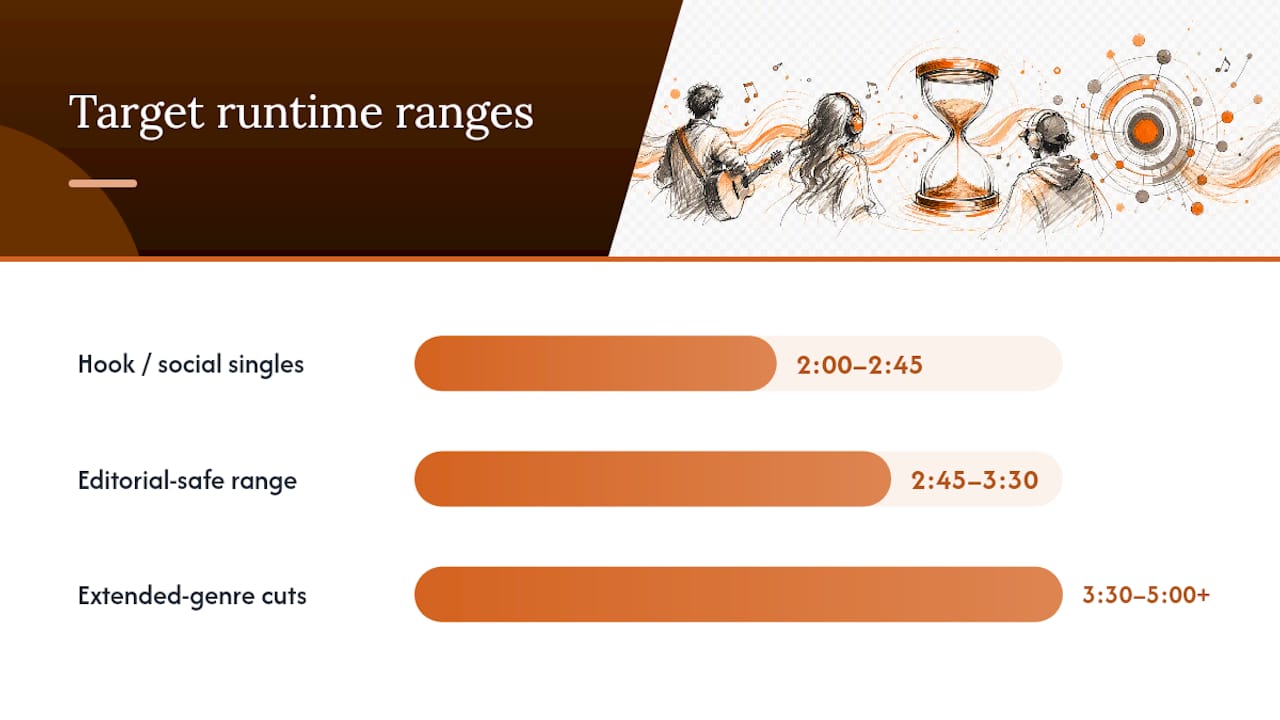
The 2:45 to 3:30 window works as a default for pop, indie, and mainstream playlist submissions because it matches both editorial expectations and algorithmic playlist behavior. That’s not a random number. It’s roughly where the current streaming average sits, with enough room to develop a hook, a verse, and a second chorus without dragging.
That said, the right length depends heavily on what you’re trying to accomplish and where the song lives musically:
- 2:00 to 2:45: works well for hook-driven singles, social-first releases, or tracks meant to loop cleanly on short-form video
- 2:45 to 3:30: the safest range for editorial and algorithmic playlist submissions across pop, indie, hip-hop, and most mainstream genres
- 3:30 to 5:00+: acceptable, sometimes expected, for progressive rock, jazz, post-rock, ambient, and other genres where extended development is part of the genre’s identity
- Album versions vs. playlist edits: a 5-minute album cut can coexist with a trimmed 3:15 edit built specifically for playlist pitching
The decision rule that matters more than any number: only shorten a track if the core hook and every meaningful lyrical or musical milestone survives the cut. A trimmed intro that loses none of the song’s identity is a win. A chopped bridge that guts the emotional payoff is a mistake dressed up as optimization.
Pro Tip: If you’re genuinely unsure whether your song needs a shorter edit, make one anyway and keep both versions ready. Curators reviewing pitches for editorial and algorithmic playlists sometimes respond better to a tighter cut, and having it prepared costs you nothing.
Which Structural Fixes Matter More Than Trimming Seconds?
Shaving 20 seconds off your runtime does almost nothing if the first 15 seconds don’t earn a listener’s attention. Structure, not raw duration, is what actually moves completion rates and skip rates.
- Land the hook within 10 to 15 seconds. Most skips happen before listeners ever reach the song’s central hook, so if your melodic or lyrical payoff is buried at 25 or 30 seconds in, you’re losing people who would have stayed.
- Cut intros longer than 8 to 15 seconds. A slow fade-in or extended instrumental open might feel artistically justified, but it’s frequently the single biggest skip trigger on a first listen.
- Protect the energy curve. Avoid a major dip in intensity right before your second hook or chorus. Listeners who make it that far are primed to stay, and a lull there is where you lose them anyway.
- Trim outros to roughly 10 to 15 seconds when it doesn’t damage the musical resolution. Shorter outros improve streams-per-hour on autoplay chains, which can help algorithmic momentum even if it won’t sway an editorial decision on its own.
Pro Tip: Trimming an intro to hit the hook inside 10 to 15 seconds usually produces a bigger completion-rate lift than cutting 20 to 30 seconds off the total runtime. Fix the front of the song before you touch anything else.
How Do You Test Whether Your Track Is Ready to Pitch?
Before submitting anywhere, pull your Spotify for Artists numbers and look at four specific data points: skip rate in the first 15 and first 30 seconds, overall completion rate, save rate, and listens from non-followers.
Rough targets worth aiming for before you pitch:
- Completion rate above roughly 70%, though this varies by genre and track length
- First-30-second skip rate under about 15%
- A save rate that suggests people want to hear the track again, not just tolerate it once
- A meaningful share of listens coming from outside your existing follower base
If your numbers fall short, don’t guess at fixes. Distribute a private link to a small beta-listener group, upload staged versions to test an edited cut against the full version, and compare skip points directly. Cheap, fast tests beat assumptions every time.
How Does Track Length Factor Into Playlist Pitching Strategy?
Editors weigh fit and completion far more heavily than duration when reviewing a playlist pitch. That means the decision isn’t “make it shorter,” it’s “pitch the version that performs best.”
- If your album cut runs long but a trimmed edit preserves the hook and energy, pitch the edit for playlist consideration.
- If your full version already completes well, don’t manufacture a shorter cut just to chase a number.
- Shorter tracks can lift replay-based metrics and streams-per-hour, but that’s a supplement to strong songwriting, not a substitute for it.
- Remember Spotify’s guidance to deliver your pitch at least seven days before release and submit the exact version you want editors to hear.
How Has the Ideal Track Length Changed Over the Decades?
Song length has been shrinking for most of the last hundred years, and the reasons have almost always been technical or commercial rather than artistic. Early 20th-century recordings were constrained by 78 rpm shellac discs, which physically capped a side at roughly three minutes. That constraint effectively invented the “radio-length single” before radio even existed as a mass medium.
The arrival of the 45 rpm single in the 1950s kept that roughly three-minute ceiling in place, and AM radio programmers reinforced it by favoring shorter songs that let them fit more spins and ads into an hour. The 1960s and 1970s saw FM radio and album-oriented rock loosen that constraint, giving rise to six, eight, even twenty-minute album tracks that never would have gotten airplay as singles.
CDs in the 1980s and 1990s removed the physical runtime pressure almost entirely, and average song lengths crept upward again through the era of maximalist pop and extended rock arrangements.
Streaming reversed the trend hard. Crawlora’s decade-by-decade dataset built from Billboard’s Year-End Hot 100 shows average durations sliding back down toward the 3:15 to 3:20 range in the 2020s, essentially returning to the same runtime the shellac disc forced on artists a century earlier. The mechanism changed. The outcome landed in nearly the same place.
How Does Track Length Affect Listener Psychology and Engagement?
Attention doesn’t decay evenly across a song. It spikes hardest in the opening seconds, when a listener is unconsciously deciding whether to stay or swipe away, and that decision window has compressed as streaming and short-form video have trained ears to expect payoff fast.
A song that opens with eight bars of atmospheric build asks for patience most casual playlist listeners no longer extend by default. That’s not a moral failing on the listener’s part. It’s a learned behavior shaped by an environment where the next song, video, or notification is one tap away.
Length also interacts with memory and repeat-listen behavior. A track that resolves before it overstays its welcome tends to get replayed more; one that drags past its emotional peak often gets finished once and never revisited, even if the listener didn’t actively dislike it. That distinction shows up directly in save rates and repeat streams, which is exactly why completion and replay data matter more than raw duration when you’re evaluating whether a song is actually working.
Shorter doesn’t automatically mean better engagement, though. A rushed song that cuts a hook short before it lands can feel unsatisfying in a different way, leaving a listener with nothing to remember the track by. The psychological target isn’t brevity. It’s pacing that matches how long the song’s ideas actually take to pay off.
Does Track Length Influence Radio Airplay and Chart Performance?
Terrestrial radio still runs on constraints streaming doesn’t have. Programmers build hourly clocks around a fixed number of minutes for music, ads, and talk breaks, and a three-minute song fits that math more cleanly than a five-minute one. That’s a big part of why radio edits exist at all: labels routinely trim album cuts down to a leaner runtime specifically for airplay, independent of whatever length the artist originally intended.
Chart methodology adds another layer. Billboard’s Hot 100 blends sales, radio airplay, and streaming data, which means a song’s chart position is influenced by how well it performs across formats with different length preferences. A track that’s too long for radio rotation but performs well on streaming can still chart, just through a different mix of inputs than a radio-friendly single would.
The practical takeaway for an independent artist pitching Spotify playlists specifically: radio’s runtime pressure is largely irrelevant to your playlist strategy, but it’s worth knowing it still shapes what “normal” length looks like across the broader industry. If you ever pursue radio or sync opportunities alongside streaming, expect to prepare a separate, tighter edit for that channel.
Do Ideal Track Lengths Differ by Audience Demographics?
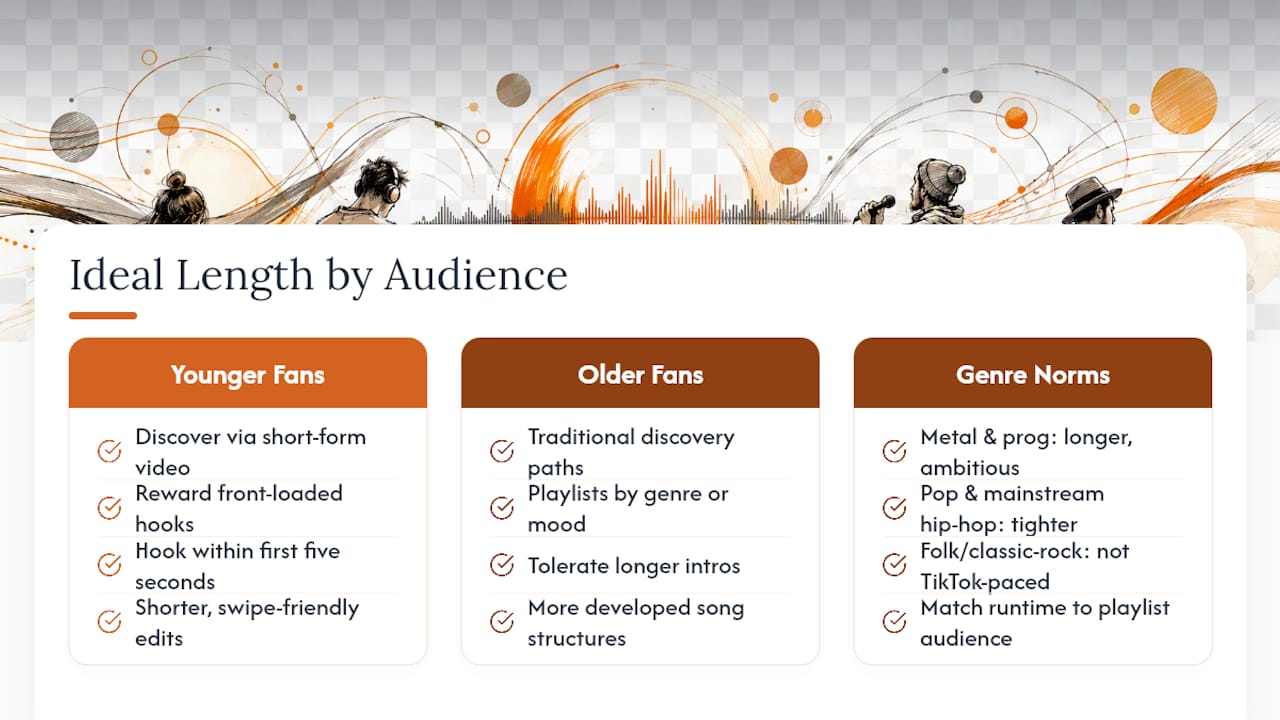
Listener age and platform behavior both shift what “ideal” looks like in practice. Younger audiences who discover music primarily through short-form video and algorithmic feeds tend to reward tracks that front-load their hook aggressively, sometimes within the first five seconds, because that’s the exact window a video clip or Spotify preview uses to earn a swipe-through.
Older listeners and audiences coming from more traditional discovery paths, playlists built around genre or mood rather than virality, tend to tolerate longer intros and more developed song structures. A folk or classic-rock playlist audience isn’t measuring your song against TikTok pacing.
Genre-specific communities carry their own norms regardless of age. Metal and prog audiences expect longer, more structurally ambitious tracks and would view a stripped-down 2:30 cut as a mismatch with the genre’s identity. Pop and mainstream hip-hop audiences, by contrast, have been conditioned toward tighter, hook-dense songwriting by the same streaming incentives driving the broader shortening trend.
This is exactly why Intonality’s genre-matching approach to curator pitches matters more than a one-size-fits-all length rule. A track’s ideal runtime only makes sense in the context of the specific audience and playlist ecosystem it’s being pitched into.
How Does Ideal Track Length Compare Between Physical Media and Streaming?
Vinyl and CD eras built length expectations around hard physical limits, not artistic taste. A standard 12-inch vinyl side typically holds around 20 to 22 minutes of audio before sound quality starts degrading from tighter groove spacing, which forced album sequencing decisions that had nothing to do with which songs “felt” right together.
CDs relaxed that pressure to roughly 74 to 80 minutes total, and albums grew accordingly through the 1990s, sometimes stuffed with extra tracks simply because the format allowed it. Neither format imposed a per-song limit the way the old 78 and 45 rpm singles did, but album sequencing on both still nudged artists toward songs that fit a coherent runtime across a side or disc.
Streaming removed physical constraints entirely and replaced them with attention-based ones. There’s no side to fill and no groove-quality tradeoff to manage, but there’s a skip button one thumb-tap away and an algorithm quietly tracking whether you held a listener past 30 seconds. The result is a format with more theoretical freedom than vinyl or CD ever offered, paired with tighter behavioral pressure than either format ever had to contend with. That combination is exactly why the “optimal” streaming length has drifted shorter even as the technical ceiling on length has effectively disappeared.
What Technical Limits Actually Constrain Track Length Today?
Physical formats had hard technical ceilings. A vinyl side maxes out around 20 to 22 minutes of usable audio, and cramming more onto it means shrinking the groove spacing, which directly degrades sound quality and bass response. That’s a real engineering tradeoff, not a stylistic guideline.
Streaming platforms have no comparable audio-quality ceiling, but they do enforce upload limits. Spotify’s distribution system through most aggregators caps individual track uploads, generally allowing very long files, though extremely long ambient or experimental pieces occasionally bump into aggregator-specific limits rather than a single universal Spotify rule. Practically speaking, almost no commercial release comes close to any platform’s technical maximum.
The real modern constraint isn’t technical at all. It’s behavioral, enforced by the 30-second stream-counting threshold and by skip-driven algorithmic weighting rather than by any file-size or duration ceiling. A song can technically run 40 minutes on Spotify with no rejection at upload. Whether anyone finishes listening to it, and whether an editor considers it for a playlist built around 3-minute pop songs, is an entirely separate question the technical limits never touch.
What We See in Campaigns: Recurring Fixes and Realistic Expectations
Across campaigns, the same fixes come up again and again: trim a bloated intro, tighten a sagging middle section, and occasionally build a playlist-specific edit when the album version just doesn’t serve pitching. Real-time curator feedback tends to surface these issues fast, often flagging a slow hook or an energy dip an artist never noticed in their own mix.
Placements vary campaign to campaign, and no length adjustment guarantees a yes. Genre-matching and a genuinely well-pitched track do more work than shaving off 15 seconds ever will.
— Einars
Get Genre-Matched Curator Feedback on Your Track’s Readiness
Trimming your intro and tightening your hook only gets you so far without knowing whether real curators actually respond to the result. Intonality pitches your track directly to vetted, genre-matched curators instead of running it through automated playlist bots or pay-to-play networks, so the feedback you get reflects what an actual human listener thinks about your structure, your hook placement, and your fit for their playlist.
Every campaign includes real-time updates and written feedback on every curator decision, whether it’s a placement or a pass, so you learn exactly what’s working and what isn’t. Campaigns average between 4 and 11 playlist placements depending on the tier you choose, giving you a concrete read on how your track edit is actually performing in front of the people who decide what makes a playlist. If you’ve got a track ready, submit your song and find out how it lands with curators who genuinely work in your genre.
Sources
- Behind the playlists — your questions answered by our playlist editors — Spotify for Artists
- Mean song duration of currently streamable songs by year of release — Statista
- Songs are getting shorter and the surprising truth behind it — Hypebot
- Song length optimizer — Tools4Music


