
Most playlist rejection reasons boil down to five fixable problems: poor fit with the playlist’s sound, weak production, a slow intro, sloppy metadata, and a vague pitch. None of these require more followers or a label deal to solve. The fastest move: pull up two or three tracks currently on your target playlist and compare your first 15 seconds, mix, and vibe against theirs before you submit anything else.
TL;DR:
- Ensuring a track matches the playlist’s sound and vibe is critical, as even a slight mismatch can lead to rejection, regardless of production quality.
- Packaging errors, such as inconsistent artist names or low-resolution artwork, are common causes of automatic rejection and are easy to fix before submission.
- Writing a specific, concise pitch that references similar artists and playlist use cases increases the chance of catching a curator’s interest and improves placement success.
- Submitting at least three to six weeks before release and avoiding competition-heavy weeks greatly enhances chances of editorial playlist inclusion.
- Curators decide within the first 15 to 20 seconds based on fit and vibe, making early critical; proper comparison to similar tracks helps identify if your song meets their expectations.
Table of Contents
- What Are the Most Common Playlist Rejection Reasons?
- Technical Checklist: Metadata, Artwork, and Assets Curators Expect
- How Do You Write a Pitch Curators Actually Read?
- When Should You Pitch to Avoid Editorial Rejection?
- How Curators Actually Screen a Track in Real Time
- How to Read a Rejection and Decide What to Fix Next
- Why Curator Feedback Speeds Up Every Fix on This List
- Author perspective: practical heuristics from campaign experience
- Get Curator Feedback Instead of Guessing at Rejections
- Sources
What Are the Most Common Playlist Rejection Reasons?
Curators reject far more tracks than they accept, and the reasons cluster around a small set of recurring problems. Understanding which one applies to your submission is the difference between fixing it in an afternoon and wondering forever why nothing lands.
Fit and vibe mismatch tops the list. A curator running a chill indie-folk playlist isn’t going to add your synth-pop banger no matter how well it’s produced. Before pitching, listen to the last 10 to 15 tracks added to a playlist and ask whether your song would sit comfortably in that sequence. If it sounds like an outlier, it probably is one. This is what industry insiders call playlist “room,” the sonic and emotional space a curator has carved out, and violating it is one of the fastest ways to get passed over.
Production, mix, and mastering issues come next. Curators listen on the same speakers and headphones they use for professional playlists, so a track that’s quieter, muddier, or harsher than its neighbors stands out immediately, and not in a good way. Common red flags include vocals buried under instrumentation, muddy low end from unbalanced bass and kick frequencies, and masters that clip or distort at streaming loudness levels. The fix is rarely complicated: run an A/B comparison against a professionally mastered reference track in the same genre and match perceived loudness before you submit anywhere.
A weak intro or hook kills otherwise solid tracks. Curators typically decide within the first 15 to 20 seconds whether a song earns a full listen. If your best hook doesn’t arrive until the second verse, restructure the arrangement, or at minimum, trim the intro. A slow fade-in or a 20-second ambient buildup might work artistically, but it reads as dead air to someone screening 200 submissions in an evening.
Genre and subgenre tagging errors confuse curators trying to slot your track correctly. “Pop” is too broad to be useful; “bedroom pop” or “dream pop” tells a curator exactly where you belong. Cross-genre tracks need extra context in the pitch itself, because metadata alone can’t capture a song that blends hip-hop drums with folk instrumentation.
Packaging errors cause instant rejection before a curator even hits play. This includes:
- Mismatched artist names across Spotify, Apple Music, and your pitch form
- Missing or incorrect ISRC codes
- Release dates that don’t match what’s live on the platform
- Low-resolution or text-heavy artwork that gets auto-flagged
Platform-specific filters can auto-reject submissions with these errors before a human ever reviews them, which means a technically perfect song can lose purely on paperwork.
Pitch text mistakes round out the list. Vague descriptions like “this track slaps” or “perfect for any playlist” tell curators nothing. Overblown claims about streaming numbers or comparisons to major artists without justification tend to get ignored outright, since editors respond better to specific, grounded pitches than to hype.
Pro Tip: Before writing your pitch, name three reference artists whose fans would genuinely enjoy your track. If you can’t think of three, your fit problem is bigger than your pitch problem.
Technical Checklist: Metadata, Artwork, and Assets Curators Expect
Packaging problems are the easiest rejection cause to eliminate entirely, because they don’t depend on subjective taste. Run through this before every submission:
- Metadata consistency. Your artist name, track title, and featured artist credits must match exactly across Spotify for Artists, your distributor, and your pitch form. A stray middle initial or inconsistent capitalization can trigger a mismatch flag.
- ISRC and release date accuracy. Confirm your ISRC code is correctly attached and that your listed release date matches what’s scheduled to go live. Discrepancies here are a common, invisible cause of automatic rejection.
- Artwork specs. Use a square image at least 3000x3000 pixels, avoid excessive text or explicit imagery, and stick to standard color profiles. Oversized text or cluttered designs often fail legibility checks at thumbnail size.
- Mastering and loudness. Your track should sit within a comparable loudness range to what’s already on your target playlists. A track mastered quietly at negative teens LUFS while everything around it sits hotter will sound weak by comparison, even if the mix itself is clean.
- Supporting assets. Have a Spotify Canvas ready, a short bio (two to three sentences), a list of reference artists, and links to any video or visual content. Curators researching a submission often check these before deciding.
Roughly one editorial review window exists per release cycle on major platforms, so technical rejections here waste your only shot at that cycle’s consideration.
Some checklist-style resources recommend pitching at least 21 days before release for certain distributors, giving editorial teams time to review before the track goes live, while Spotify’s own guidance emphasizes submitting before your release date regardless of exact lead time. A metadata field-by-field guide can help you catch errors before they cost you an entire cycle.
How Do You Write a Pitch Curators Actually Read?
A strong pitch does one job: give a curator enough context to place your track quickly without guessing. That means specificity over enthusiasm, every time.
Include exactly three things in one to two sentences: reference artists your track sounds like, the listening context it fits (driving, studying, late-night, workout), and one standout moment, whether that’s a bridge, a vocal run, or a production choice worth flagging. If you have genuine, verifiable metrics, like a strong save rate from an earlier release, mention them briefly. If you don’t, leave metrics out entirely.
What to avoid:
- Vague superlatives (“this is fire,” “perfect for every playlist”)
- Inflated or unverifiable numbers
- Pitch descriptions longer than three or four sentences
- Comparisons to massive artists with no sonic justification
Editors consistently favor pitches that name specific reference artists and listening contexts over ones that lean on adjectives. A working framework looks like this: “For fans of [Artist A] and [Artist B], this track brings a driving bassline and a hook that lands at the 0:45 mark, built for late-night drive playlists.” That’s one sentence, three concrete data points, and zero fluff.
Naming your target playlists directly, when the platform allows it, also helps. A curator who sees you’ve clearly researched their playlist rather than mass-blasted every submission form on the internet is more likely to give the track a fair listen. Tools like genre targeting guides can help sharpen exactly how to describe that fit.
When Should You Pitch to Avoid Editorial Rejection?
Timing mistakes sink otherwise strong tracks constantly, mostly because artists treat pitching as a last-minute task instead of a scheduling one.
Submit at least seven days before release as an absolute minimum, but three to six weeks ahead is the safer window for genuine editorial consideration, since Spotify’s editorial process happens before a track goes live, not after. Pitching after release date usually means you’ve missed that window entirely.
Release timing matters beyond your own pitch. Dropping a single during a week stacked with major-label releases means competing for the same limited editorial attention against artists with entire promo teams. Smaller release weeks, even if they feel less exciting, often mean less competition for the same curator eyes.
Smaller playlists also tend to offer better odds than chasing a handful of massive flagship lists, and building a base of smaller placements often outperforms one big swing for artists without an existing audience.
A simple scheduling checklist:
- Lock your release date at least six weeks out
- Submit to Spotify editorial as soon as the pitch window opens
- Target five to ten smaller, genre-matched playlists alongside any editorial pitch
- Avoid release weeks with major competing drops in your genre when possible
How Curators Actually Screen a Track in Real Time
Curators aren’t sitting down to give your song a fair, patient listen from start to finish. Most are working through dozens or hundreds of submissions in a sitting, and they’ve trained themselves to make fast calls.
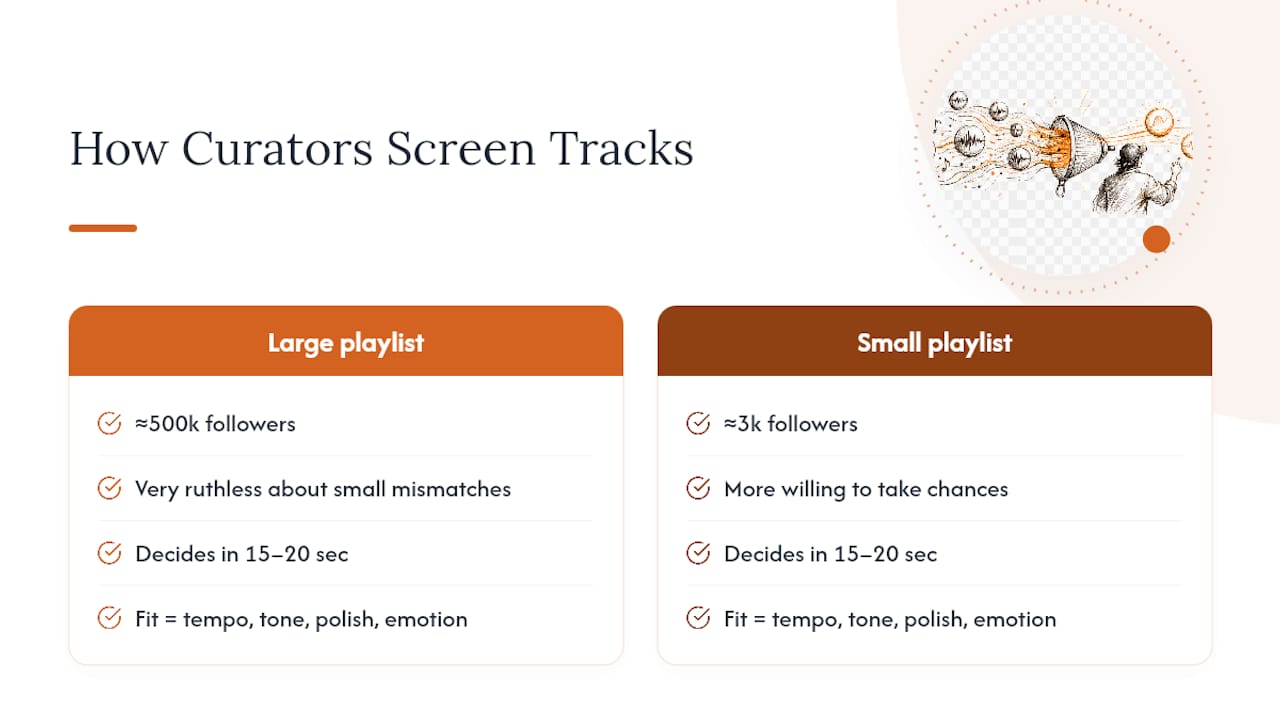
A curator running multiple playlists develops an instinct for the exact energy and production level their audience expects. That instinct kicks in within the first 15 to 20 seconds of any submission, and it’s usually the difference between a yes and a no.
That instinct is what “room” really means. It’s not just genre. It’s tempo, production polish, vocal tone, and emotional register all matching what already lives on the playlist. A technically great track that’s slightly too aggressive, too polished, or too raw for a given playlist’s established feel gets passed over for fit, not quality.
Curator workload directly shapes pickiness. A playlist with 500,000 followers gets pitched constantly, so its curator can afford to be ruthless about even small mismatches. A playlist with 3,000 followers in a tight niche often has more room to take a chance on something slightly different, because the volume of competing submissions is lower.
Follower counts and monthly listeners help, but they rarely override a fit problem. Curators want their playlists to feel cohesive and improve the listening experience for their actual audience, not to look impressive by number alone.
Pro Tip: Listen to your track back to back with the two most popular songs on your target playlist, using the same speakers you’d use for critical listening. If your track feels louder, quieter, or tonally off within the first 20 seconds, that’s your answer before a curator even gives one.
How to Read a Rejection and Decide What to Fix Next
Not all rejections mean the same thing, and reading them correctly saves you from either giving up too early or resubmitting the same flawed track repeatedly.
Explicit written feedback (a curator telling you the track didn’t fit the playlist’s energy, for instance) is specific and actionable. Silent “not selected” outcomes, common on many editorial platforms, usually mean the track simply didn’t clear the fit or quality bar in a fast screening pass, without deeper explanation.
Check these signals after any placement or rejection:
- Save rate. A low save rate relative to plays suggests a fit or quality issue even if you did get added somewhere.
- Repeat listens and retention. Listeners dropping off in the first 30 seconds points straight back to your intro or hook.
- Playlist adds over time. A trickle of small adds after rejection from bigger lists often means the track works, just not for the playlists you tried first.
- Pattern across submissions. Three or more rejections citing similar reasons signal a structural problem worth remixing, not just retargeting.
If the pattern points to production or arrangement, remaster or rework before resubmitting anywhere. If the song performs but keeps missing fit, redirect it toward better-matched playlists instead of changing the track itself.
Why Curator Feedback Speeds Up Every Fix on This List
Every fix above depends on knowing which specific reason caused a rejection, and most submission tools never tell you. Intonality pitches your track directly to real, genre-matched curators and returns written feedback on every single decision, so you learn whether a rejection came down to fit, production, or timing instead of guessing.
That real-time visibility turns a silent “not selected” into an actual diagnosis you can act on before your next release. Campaigns average four to 11 playlist placements depending on the tier chosen, giving artists a concrete outcome to weigh against a self-managed pitch strategy. This tends to fit best once you’ve run the free fixes above and want faster, better-informed iteration on the next release.
Author perspective: practical heuristics from campaign experience
Three checks catch most problems before submission: play your track against a genre-matched sample from the target playlist, time exactly how long it takes your hook to land (anything past 15 seconds needs trimming), and cross-check your metadata fields twice, not once.
The pattern that shows up again and again in campaign feedback: artists who tighten just their intro and fix one metadata error see placement rates improve noticeably on the very next submission round, without touching anything else about the song. Small, targeted fixes usually beat a full remix.
— Einars
Get Curator Feedback Instead of Guessing at Rejections
Every fix in this article gets faster with real feedback attached to it. Intonality pitches your track to vetted, genre-matched curators and sends back written notes on every decision, so instead of a silent rejection, you get a specific reason and a next step.
That’s the core difference from automated submission tools or pay-for-placement schemes: real curators listening, real reasons when a track doesn’t fit, and real-time updates as decisions come in. Campaigns typically land four to 11 playlist placements depending on the tier, giving you outcomes you can actually evaluate rather than a black box. If you’ve run through the fit, packaging, and pitch fixes above and want curator-level insight on what’s still missing, start a campaign with Intonality and see which playlists genuinely fit your sound.
Sources
- What Are Music Curators Actually Looking For? Insights From 100K Submissions
- Pitching music and videos to playlist editors — Spotify support
- Why Your Track Is Not Getting Playlisted: Spotify and Yandex Music Pitching Checklist 2026
- Playlist Pitching: What Editors Really Look At - Camille Jamet


