Expect a reply within a few days from most active curators. About half of all responses land within the first day, the bulk arrive within a week, and after several weeks the odds of hearing anything new drop close to zero. Anything beyond that window is almost always silence, not a delayed yes.
TL;DR:
- Most curator responses arrive within a week, with 91% landing in the first seven days, but response time varies greatly depending on their workload and sector.
- Response windows differ from a few hours to several months, with paid platforms like SubmitHub promising responses within 72 hours, while institutions may take up to three months.
- Response speed depends on factors such as staffing levels, submission quality, platform rules, and technical issues, with slow replies often caused by high volume or irrelevant links.
- Following up after three to seven days is effective for playlist pitches, while institutional or museum inquiries warrant waiting two weeks or more before additional contact.
- Personalized outreach significantly improves reply rates, and campaigns with curator relationships tend to achieve more placements than bulk, cold pitches.
Table of Contents
- What Counts as a Normal Curator Response Time?
- Curator Feedback Benchmarks: What the Data Actually Shows
- How Platforms and Institutions Set Their Own Response Windows
- Why Some Curators Reply Faster Than Others
- When Should You Follow Up With a Curator?
- Tactics That Actually Shorten Curator Response Time
- How Managed Campaigns Change the Waiting Game
- What Musicians Get Wrong About Curator Silence
- A Faster, Clearer Path to Playlist Placements
- Sources
What Counts as a Normal Curator Response Time?
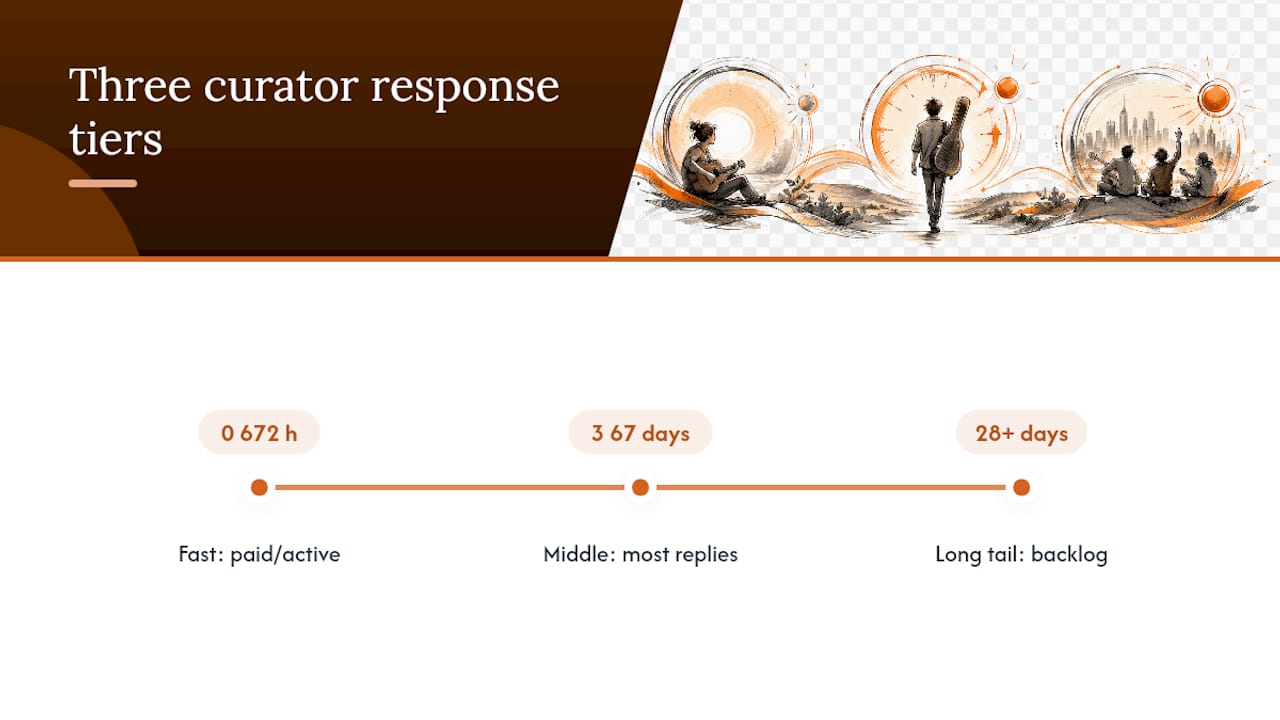
Curator response time breaks into three rough tiers, and knowing which one you’re in tells you whether to relax or start troubleshooting your pitch.
The fast tier covers the first 72 hours. This is where paid playlist curators, active Spotify curators, and busy PR-style outreach recipients tend to reply if they’re going to reply quickly at all. The middle tier runs from three days to a week, which is where most legitimate responses eventually show up even when the curator didn’t answer immediately. The long tail stretches to 28 days and beyond, and that’s mostly backlog territory, whether it’s a curator drowning in submissions or an institution working through a stack of enquiries with no dedicated intake team.
Sector matters here. A Spotify playlist curator running a side hustle between a day job and a few hundred weekly submissions moves at a different pace than a museum curatorial department fielding research requests, and both move differently from an editorial curator working off a documented review process. The 28-day mark shows up again and again across outreach research as the point past which curatorial feedback time stops meaningfully improving, so it’s a fair line to draw for your own planning.
Curator Feedback Benchmarks: What the Data Actually Shows
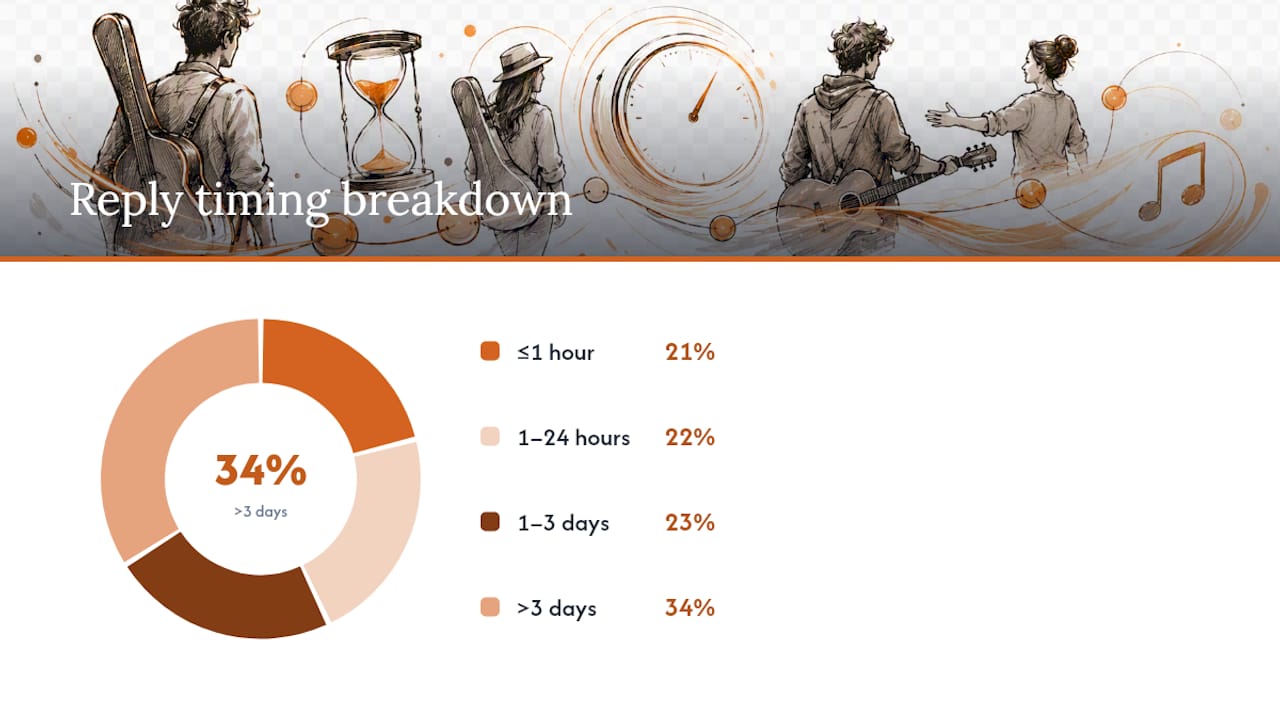
Outreach research gives a much clearer picture than gut feeling ever could. Janney AI’s analysis of over 5,200 outreach conversations breaks the timing down like this:
- About 21% of replies land within the first hour
- Another 22% arrive between 1 and 24 hours
- 23% show up within 1 to 3 days
- The remaining 34% take more than 3 days
- Roughly 91% of all replies arrive within 7 days total
That last figure is the one worth remembering. If a week has passed with nothing, you’re already outside where most responders fall, and you’re waiting on the long tail rather than the norm.
1stcollab’s analysis of 100,000 creator outreaches tells a similar story from a different angle: about 47% of responses happen within 24 hours, and response rates plateau around the 28-day mark. Past that point, additional waiting rarely produces new replies. 1stcollab also found that anything above a 30% overall response rate counts as a strong campaign, which is a useful gut check if you’re comparing your own submission batch against a benchmark.
Broader outreach data backs the pattern for context. BuzzStream’s study of email outreach replies found that in some categories, like link-building and PR outreach, 57% of replies come within 6 hours, with average response times under 13 hours. Not every curator moves that fast, but it shows how much variance exists between outreach types, and it explains why comparing your playlist pitch response time to a journalist’s inbox turnaround is not a fair comparison.
How Platforms and Institutions Set Their Own Response Windows
Some organizations don’t leave response time to chance. They write it down.
SubmitHub updated its policy so curators now have 72 hours to respond to a submission, up from the previous 48 hour window. The platform also requires higher-priced curators to maintain a consistent average listening time of 90 seconds per track, tying the response window to an actual engagement floor rather than a rubber-stamp reply.
Museums operate on a completely different clock. York Museums Trust tells enquirers it aims to provide full curatorial service within three months, while acknowledging simpler requests faster when staffing allows. That’s not a typo. Curatorial backlog in museum settings is a known, disclosed reality, not a service failure.
Between those extremes sit institutional customer service standards like the ones the Royal College of Surgeons of England publishes for museum enquiries: acknowledge written enquiries within 3 working days, answer within three days where practicable, and use out-of-office messages to manage expectations when staff are unavailable. Academic and editorial curators often run on internal standard operating procedures with their own service level targets, which is why a query to a university archive can behave nothing like a pitch to a Spotify playlist owner.
Why Some Curators Reply Faster Than Others
Response time isn’t random. A handful of concrete factors decide where you land in that 24-hour-to-28-day range.
- Staffing and timing: a solo curator managing submissions around a day job will always be slower than a team with dedicated review hours, and holiday periods stretch every timeline.
- Submission volume: curators receiving hundreds of pitches a week triage in batches, so your track might sit in a queue for days before anyone opens it.
- Fit and quality: a submission that clearly matches the curator’s genre and playlist mood gets reviewed faster because there’s less second-guessing involved.
- Paid vs. free lanes: paid submission platforms often carry contractual response windows, like SubmitHub’s 72-hour rule, while free or cold-pitch submissions have no such obligation.
- Technical friction: broken streaming links, missing press assets, or a submission that requires extra research from the curator all add delay before feedback can even start.
Pro Tip: If a week passes with silence, check your own submission first. A dead link or missing bio is a more common cause of “no response” than curator indifference.
When Should You Follow Up With a Curator?
Silence doesn’t always mean rejection, but it does have a shelf life. Here’s a workable cadence:
- Days 3 to 7: send your first follow-up for playlist or creator outreach. This lines up with where the bulk of legitimate replies already land.
- Days 7 to 14: appropriate window for institutional, editorial, or academic curatorial queries, which move slower by design.
- Day 28: treat this as your practical cutoff. Response rates plateau here across outreach research, so a fresh follow-up rarely changes the outcome.
Keep the follow-up short, restate why the track or request fits their work, and don’t repeat your entire original pitch. Also learn to read the reply types you get: an automated rejection, a bare acknowledgement, detailed written feedback, and an actual placement are four very different outcomes, and only the last two mean your submission actually got a real review. Our own guide to following up with curators walks through message templates if you want the exact wording.
Tactics That Actually Shorten Curator Response Time
You can’t force a reply, but you can stack the odds. Personalized outreach performs dramatically better than generic templates. Janney AI’s benchmark data puts personalized outreach at 25 to 40% reply rates, compared to just 5 to 10% for copy-paste pitches.
- Lead with why the track fits this curator’s specific playlist, not a generic pitch line
- Attach one-click, working assets: a streaming link, a cued timestamp, and a short preview if the platform allows it
- Follow any platform-specific rules on listening time or paid credit lanes so your submission isn’t auto-deprioritized
- Send from a real inbox, not a mass-mail address
- Keep a simple log of which curators reply fast, and prioritize pitching them again on future releases
Pro Tip: Reference your track title and submission date in any follow-up subject line. Curators managing hundreds of pitches a week rely on that detail to find your original message instead of ignoring a vague “checking in” email.
How Managed Campaigns Change the Waiting Game
Intonality runs campaigns on personalized pitches to genre-matched curators, not blast submissions, which is a large part of why response certainty improves. Every campaign includes real-time status updates and written feedback on every curator decision, so an artist knows whether a submission was declined, still under review, or placed, rather than guessing after a week of silence.
Campaigns typically achieve multiple playlist placements depending on the service tier, leveraging curator relationships and targeted pitching rather than bulk submissions. Organized feedback capture means the uncertainty that usually defines curator response time gets replaced with an actual paper trail.
What Musicians Get Wrong About Curator Silence
Most advice on this topic treats every non-response as a rejection, and that’s a mistake. The Janney AI and 1stcollab benchmarks both show a large chunk of legitimate replies arriving after the first few days, sometimes closer to the two week mark for slower-moving curators. Writing someone off at day 4 throws away a decent share of future placements that were never actually dead, just delayed by volume or timing.
The bigger error is treating every submission channel the same way. A cold pitch to a curator’s public inbox behaves nothing like a paid platform lane with a contractual 72-hour SLA, and a museum enquiry behaves nothing like either one. If you’re not adjusting your patience to the channel, you’re either following up too aggressively on institutional requests or giving up too early on playlist pitches that were always going to take a full week.
What actually matters is matching your follow-up cadence to the data instead of your anxiety level. Three to seven days for playlist and creator outreach, seven to fourteen for anything institutional, twenty eight as your hard stop. That’s not guesswork. It’s the pattern the research keeps showing.
— Einars
A Faster, Clearer Path to Playlist Placements
Cold-pitching curators one by one and guessing at response windows is a slow way to build playlist momentum. Intonality gives artists a faster, clearer path: personalized pitches sent to real, genre-matched curators, with written feedback on every single decision so you’re never left wondering if your submission is stuck or simply declined.
Instead of tracking down curator emails and hoping for a reply within your self-imposed follow-up window, you get real-time campaign updates and a dashboard showing exactly where each pitch stands. Campaigns typically land between 4 and 11 placements depending on the tier you choose, backed by actual curator relationships rather than mass submissions into a black hole. If you’d rather skip the guesswork around curator response time altogether, start a campaign with Intonality and see written feedback on your own submissions instead of silence.
Sources
- Influencer Reply Rate Benchmarks 2026: Real Data From 5,200+ Outreach Conversations | Janney AI
- Creator response rates (1stcollab)
- York Museums Trust - Curatorial Enquiries
- Museums customer service standards (Royal College of Surgeons of England)