

If you need embeddable pre-saves with full branding control, the right category is an embed-first smart-link platform that lets you own fan contact data. If you’re running paid Meta or TikTok ads, prioritize a tool with server-side Conversions API (CAPI) and event_id deduplication — ad optimization breaks without it. For label-scale routing across multiple DSPs with granular analytics, look at platforms built for catalog management rather than single-release pages.
Three things separate a strong Feature.fm alternative from a mediocre one:
- Fan data ownership: You need CSV export of email and SMS subscribers, not platform-hosted contacts you can’t take with you.
- Conversion-tracking accuracy: Server-side CAPI with event_id deduplication prevents double-counting and keeps Meta’s algorithm optimizing on real signals.
- Custom branding: White-labeled domains and embeddable widgets matter for artists building a brand, not just a link.
Pro Tip: Before you migrate, run a quick test: create a free-tier page on your shortlisted tool, embed it on your site, and try to export a dummy subscriber. If either step fails or hits a paywall, that’s your answer.
Table of Contents
- How the top Feature.fm alternatives compare at a glance
- Why artists and labels look beyond Feature.fm
- Short profiles of the top replacements
- How to choose the right platform for your release
- Setting up and measuring your campaign after launch
- The real trade-off between all-in-one platforms and specialized tracking tools
- Key Takeaways
- What most artists get wrong about pre-save tools
- Playlist pitching pairs naturally with pre-save campaigns
- Useful sources and tool pages to visit next
How the top Feature.fm alternatives compare at a glance
| Platform | Best for | Free plan | Pre-save (Spotify/Apple/Deezer) | Embeddable widgets | Custom domain | Email/SMS capture + export | CAPI / ad tracking | Label scale |
|---|---|---|---|---|---|---|---|---|
| Sonikit | Embed-first pre-saves + SMS | Yes (limited links) | Yes / Yes / Yes | Yes | Yes (paid) | Email + SMS, exportable | Verify plan | Moderate |
| ToneDen | Ad-focused campaigns | Free tier available | Yes / Yes / Verify | Limited | Yes | Email capture | Strong (verify CAPI tier) | Good |
| Linkfire | Label-scale routing + analytics | No free tier | Yes / Yes / Yes | Limited | Yes | Email (verify SMS) | Strong | Excellent |
| Hypeddit | Pre-saves + fan gating | Free tier | Yes / Yes / Verify | Limited | Paid plan | Email, exportable | Basic | Moderate |
| Show.co | Fan engagement + email | Free tier | Yes / Yes / Verify | Yes | Paid plan | Email + SMS | Verify | Moderate |
| Tunelinx | Budget smart links | Free tier | Yes / Verify / Verify | Limited | Verify | Email (verify export) | Basic | Limited |
| Artlink | All-in-one for independents | Yes (3 smart links) | Yes / Verify / Verify | Verify | Verify | Email capture | Verify | Limited |
| CopyThisTune | Fan-data-first independents | Verify | Yes / Verify / Verify | Verify | Verify | Email, owned contacts | Verify | Limited |
Key signals from this table:
- Linkfire is the clearest choice for labels managing large catalogs across multiple DSPs.
- Sonikit stands out for independents who want embeddable pre-saves and built-in SMS in one place.
- Any cell marked “Verify” means the vendor’s public documentation is unclear on that tier — confirm before paying.
Why artists and labels look beyond Feature.fm
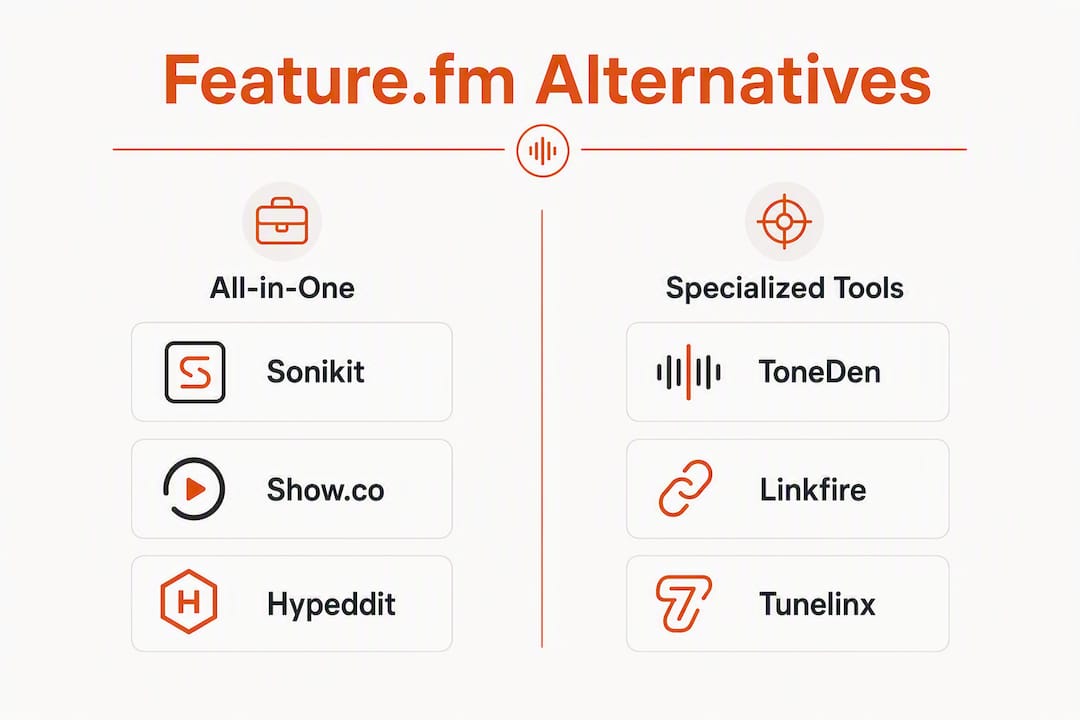
Feature.fm built a strong reputation for pre-saves and smart links, and its CAPI documentation does reference Conversions API integration. But which plan actually includes it isn’t always obvious from the public pricing page, and that ambiguity alone pushes serious ad buyers to look elsewhere.
The most common pain points that drive a switch:
- Branding limits on lower tiers: Free and entry-level plans often show Feature.fm branding on your landing pages, which undermines an artist’s station branding guide and visual identity.
- No embeddable pre-save widget: Feature.fm’s pre-save pages are hosted, not embeddable. If you want a pre-save module living directly on your own website, you’ll need a different tool.
- Platform-controlled fan data: When your subscriber list lives inside a platform you don’t control, you’re one pricing change away from losing access to contacts you earned.
- SMS messaging absent: Built-in SMS capture and broadcast is missing from most Feature.fm tiers, which matters if you want to reach fans off-platform.
- CAPI tier ambiguity: Ad buyers running Meta campaigns need confirmed server-side event delivery. Unclear plan documentation forces a support ticket before you can trust your tracking setup.
Each of these affects campaign outcomes in a concrete way. Platform branding on your pre-save page reduces trust and click-through rate. Missing embeds mean you can’t capture fans who arrive via your own site. Locked fan data means your list disappears if you switch tools. And broken CAPI means Meta optimizes on incomplete signals, raising your cost per conversion.
Artists and labels increasingly prioritize tools that give them direct ownership of fan contacts through email and SMS, because owned lists provide resilience against streaming-algorithm changes that no DSP can guarantee.
Short profiles of the top replacements
Sonikit
Best for: Independent artists who want embeddable pre-saves, SMS messaging, and full branding control in one tool.

Sonikit lists embeddable pre-saves, SMS messaging, email capture, and fully customizable landing pages as its core differentiators versus Feature.fm. The embed-first approach is the real draw: you can drop a pre-save widget directly onto your artist website rather than sending fans to a hosted page.
Pros: Embeddable pre-save widgets; built-in SMS capture and broadcast; exportable fan contacts. Cons: Free plan limits links; CAPI depth should be verified for paid ad campaigns. Who should shortlist it: Any independent artist running a release campaign from their own website who wants to keep fan contacts.
ToneDen
Best for: Artists and marketers running paid social campaigns who need strong ad integrations.
ToneDen has long been known for its Facebook and Instagram ad tools built specifically for music promotion. Its smart links and pre-save pages connect cleanly to ad platforms, and it offers a free tier to test the workflow. CAPI support exists — verify which plan tier activates it before committing to a paid campaign.
Pros: Strong ad-platform integrations; clean pre-save flow; free tier available. Cons: Embeddable widget support is limited; SMS capture is not a core feature. Who should shortlist it: Artists spending real ad budget on Meta who want their smart link and ad account in the same workflow.
Linkfire
Best for: Labels and distributors managing large catalogs across multiple DSPs.
Linkfire is the enterprise-grade option here. It handles routing across Spotify, Apple Music, Deezer, and dozens of other platforms with analytics granular enough to satisfy a label’s marketing team. No free tier, but the analytics and routing depth justify the cost at scale.
Pros: Best-in-class DSP routing; granular analytics; strong custom domain support. Cons: No free plan; overkill for a single-release independent artist. Who should shortlist it: Labels, distributors, and managers handling multiple artists or catalog releases.
Hypeddit
Best for: Independents who want pre-saves paired with fan-gating (download gates, follow gates).
Hypeddit built its reputation on the “fan gate” mechanic: fans unlock a download or exclusive content by following on Spotify or submitting their email. Pre-save support is solid. The free tier is genuinely usable, though custom domains sit behind a paid plan.
Pros: Fan-gating mechanics; free tier with pre-saves; email capture exportable. Cons: Interface feels dated; CAPI tracking is basic compared to ad-focused tools. Who should shortlist it: Independents building a Spotify following who want to trade content for follows and emails.
Show.co
Best for: Artists who want fan engagement tools including email and SMS alongside smart links.
Show.co combines smart links with fan engagement features like email capture, SMS, and contest/sweepstakes mechanics. Pre-save support covers Spotify and Apple Music. The free tier exists but limits branding; custom domains require a paid plan.
Pros: Email and SMS in one place; engagement mechanics beyond just links; pre-save support. Cons: CAPI integration should be verified; paid plan required for white-labeling. Who should shortlist it: Artists focused on building an owned audience rather than pure ad conversion.
Tunelinx
Best for: Budget-conscious artists who need basic smart links and pre-saves without complexity.
Tunelinx sits at the simpler end of the spectrum. It covers the fundamentals: smart links, pre-save pages, and basic analytics. Pricing is accessible, and the setup time is minimal. It won’t satisfy a label’s analytics team or an ad buyer who needs CAPI, but for an independent artist releasing their first few projects, it removes friction.
Pros: Low cost; fast setup; covers core smart-link and pre-save needs. Cons: Limited analytics; CAPI and SMS support should be verified; not built for label scale. Who should shortlist it: Early-career independents who need a working pre-save page quickly without a steep learning curve.
Pro Tip: Artlink offers a free plan with one artist bio page and three smart links — useful for testing the all-in-one workflow before committing to a paid tier. CopyThisTune takes a similar approach but emphasizes converting links into email signups and campaign assets, which suits artists whose primary goal is building an owned contact list.
How to choose the right platform for your release
The right tool depends on two things: where your traffic comes from and what you want to do with fans after they click.
- Confirm pre-save embed support first. If you have an artist website, an embeddable widget is worth more than a hosted page. Test it on mobile before launch.
- Check fan data export before you sign up. Request a CSV export of a test subscriber list during your free trial. If the platform won’t let you export contacts, your list is theirs, not yours.
- Verify CAPI if you’re running paid ads. Ask the vendor directly: does your plan include server-side Conversions API with event_id deduplication? Then test it with a small ad spend and a controlled creative before scaling.
- Check SMS capture separately from email. Many platforms offer email capture on lower tiers but gate SMS behind higher plans. If SMS is part of your strategy, confirm it’s included before committing.
- Evaluate custom domain support. Platform branding on your pre-save page signals to fans that you’re using a third-party tool. A custom domain keeps the experience on-brand.
- Look at analytics granularity. Basic click counts are table stakes. What you want: per-DSP conversion data, referral source breakdown, and ideally post-save streaming lift.
- Ask about customer support. Live chat during a campaign launch matters. Check whether your plan tier includes it or routes you to a help doc.
Red flags during a trial: no data export option, CAPI documentation that’s vague or missing, heavy platform branding you can’t remove, and core features locked behind the next pricing tier.
Pro Tip: Match tool choice to your ad budget. Spending under $200/month on ads? An all-in-one tool with basic tracking is fine. Spending more? Prioritize confirmed CAPI with event_id dedup — the difference in Meta’s optimization quality is significant.
Setting up and measuring your campaign after launch
Once you’ve chosen a platform, the technical setup determines whether your data is trustworthy.
Technical checklist:
- Confirm the pre-save flow end-to-end on both desktop and mobile before going live.
- Verify that your pixel fires on the confirmation page and that the server-side event fires within the same session.
- Check event_id threading: the browser pixel and server call should share the same event_id to prevent duplicate conversions in Meta Events Manager.
- Test DSP redirect routing — confirm Spotify, Apple Music, and Deezer links all resolve correctly.
- If using an embeddable widget, test it on your actual site at mobile viewport widths.
KPIs to track:
| Metric | What it tells you | Target signal |
|---|---|---|
| Pre-save conversion rate | % of page visitors who pre-save | Higher = stronger fan intent |
| Click-through rate (smart link) | % of link clicks that reach a DSP | Low CTR = friction in the flow |
| Email/SMS opt-in rate | % of visitors who submit contact info | Measures owned-audience growth |
| Cost per pre-save (paid ads) | Ad spend divided by pre-saves | Benchmark against past campaigns |
| Post-release streaming lift | Streams in week 1 vs. baseline | Validates pre-save campaign impact |
| Playlist adds (post-release) | Curator and algorithmic adds | Signals editorial traction |
Spotify’s Campaign Kit provides first-party listener data that complements third-party smart-link analytics. Use it alongside your platform’s dashboard rather than treating it as a replacement — Campaign Kit won’t give you fan email addresses or ad conversion data.
Common troubleshooting: Low pre-save conversions usually point to a friction issue in the flow (too many steps, mobile layout problems) or weak ad targeting. Ad optimization problems almost always trace back to tracking mismatch — specifically, server-side events not firing or firing without event_id deduplication.
The real trade-off between all-in-one platforms and specialized tracking tools
The core tension in choosing a smart-link platform is this: all-in-one tools give you pre-save embeds, landing pages, and messaging in a single dashboard, but they often sacrifice the ad-tracking precision that paid campaigns require. Specialized tools built for CAPI accuracy — like VLVTN, which ships server-side CAPI with event_id deduplication at $4.99/month — may lack the embeddable pre-save experience that drives owned-fan growth. Neither approach is universally better. The right call depends on your campaign’s primary objective.
The practical rule:
- Running paid Meta or TikTok ads? Prioritize confirmed server-side CAPI with event_id deduplication. Without it, Meta undercounts conversions and optimizes toward the wrong audience.
- Building an owned fan list from organic and web traffic? Prioritize embeddable pre-save widgets, CSV export, and separate SMS consent capture. These three features together give you a portable, compliant fan database.
- Doing both? You may need two tools: one for ad-side tracking accuracy, one for the embeddable fan-capture experience. That’s not a failure — it’s a deliberate stack.
Spotify’s Campaign Kit sits outside this trade-off entirely. It’s a first-party platform tool, not a smart-link replacement, and it doesn’t give you fan email addresses or cross-platform conversion data.
Key Takeaways
The single most important decision when choosing a Feature.fm alternative is whether your primary goal is ad conversion accuracy or owned fan-list growth, because the best tool for each objective is different.
| Point | Details |
|---|---|
| Match tool to campaign goal | Ad-focused campaigns need confirmed server-side CAPI; fan-list campaigns need embeddable widgets and CSV export. |
| Test data export before committing | Export a sample subscriber list during your free trial — if the platform blocks it, your contacts aren’t yours. |
| Verify CAPI with real ad spend | Run a small test campaign and check event_id threading in Meta Events Manager before scaling budget. |
| Watch for red flags | No data export, vague CAPI docs, and heavy platform branding on lower tiers are the three most common deal-breakers. |
| Intonality for amplification | After your pre-save campaign, submit your track to Intonality for personalized Spotify playlist pitching to genre-matched curators. |
What most artists get wrong about pre-save tools
The conventional wisdom says: pick the platform with the most features. That’s usually the wrong frame. More features means more complexity, and complexity during a release week is a liability.
The smarter question is: what breaks if this tool fails? For an artist running paid ads, the answer is CAPI. A broken server-side event means Meta optimizes on incomplete data for the entire campaign window, and you can’t recover those wasted impressions. For an artist building an owned audience, the answer is data portability. If you can’t export your list, you’re building on someone else’s land.
The tools that get this right are the ones that are honest about their trade-offs. A $4.99/month CAPI-focused tool won’t give you the polished embeddable pre-save experience of a premium all-in-one platform. A beautifully branded embed-first tool may not satisfy a performance marketer’s tracking requirements. Knowing which failure mode matters more to you is the actual decision.
One thing worth noting for artists pairing smart links with broader promotion: Spotify for Artists analytics can validate whether your pre-save campaign translated into real streaming lift post-release. That data, combined with playlist placement data, gives you a clearer picture of what actually moved the needle.
Playlist pitching pairs naturally with pre-save campaigns
Smart links and pre-saves drive fans to your release. Playlist pitching drives curators to it. The two tactics work on different timelines — pre-saves build momentum before release day, while playlist placements extend reach in the weeks after.
Intonality focuses specifically on Spotify playlist promotion through personalized pitches to vetted, genre-matched curators. It’s not a smart-link tool — it’s the amplification step that follows one. After your pre-save campaign converts fans, Intonality pitches your track to real curators who are actively looking for music in your genre, with written feedback on every decision and real-time campaign updates. Campaigns deliver an average of 4–11 playlist placements depending on the tier. To pair your next release with curator outreach, start a playlist promotion campaign at Intonality.
Useful sources and tool pages to visit next
These are the primary sources used in this article. Each link goes directly to the platform page or research post referenced.
- Spotify Campaign Kit — First-party Spotify marketing tools; use alongside smart-link platforms, not as a replacement.
- Intonality Blog — Articles on Spotify marketing strategy, promotion services, and campaign measurement for independent artists.


