

Playlist promotion with curator feedback is worth the cost for independent artists when the campaign delivers three verifiable things: real playlist placements, measurable saves and adds, and a bump in listeners who come back for more. Written feedback from actual curators turns a single campaign into a learning tool you can use for the next release. The rest of this guide shows you how to confirm those results yourself and what questions to ask before you pay anyone.
TL;DR:
- Campaign success depends on verifiable playlist placements, genuine follower engagement, and actual listener retention beyond simple play counts.
- Written curator feedback, whether a track is accepted or declined, provides actionable insights to improve future releases and pitch effectiveness.
- Ensure the provider offers transparent reporting, including detailed playlist names, timestamps, and written responses from curators, before committing.
- Avoid providers that guarantee placements, promise artificial stream boosts, or lack proof of curator vetting and detailed feedback.
- Verify placements yourself in Spotify for Artists and ask for sample responses to confirm the provider’s transparency and legitimacy.
Table of Contents
- What a feedback-driven playlist promotion campaign actually delivers
- How a campaign runs: step-by-step timeline and artist responsibilities
- How to read and verify campaign results in Spotify for Artists
- How to evaluate services that promise feedback
- Publisher proof points and a short case summary
- Pricing expectations and what a fair deliverable set looks like
- Getting started checklist: prepare, submit, monitor, and iterate
- What independent artists get wrong about playlist feedback
- Why Intonality is a direct option for feedback-driven promotion
- Sources
- FAQ
What a feedback-driven playlist promotion campaign actually delivers
A campaign built around curator feedback should provide you with more than a placement count. You’re paying for a documented process, and that process has specific, checkable parts.
- Pitch copy written for your track, plus the list of curators it was sent to
- A written response from each curator: accepted or declined, with a reason
- A placement list naming the actual playlists and their follower counts
- A final report with Spotify for Artists screenshots showing streams, saves, and playlist adds
The written feedback matters more than most artists expect going in. A decline that says “mix needs more low-end clarity” or “not a fit for our chill-pop audience this round” tells you something you can act on immediately, whether that’s a remix pass or a sharper pitch for the next single. Vague replies, or no replies at all, tell you the curator relationship probably isn’t real.
It’s also worth separating passive reach from active signals. Follower counts on a playlist are passive. What actually proves a placement worked is what happens after someone hears your song: did they save it, add it to their own library, or stick around for the next track. Those behaviors, not raw play counts, are what Spotify’s own guidance on audience segments points to as the signal that predicts long-term fan growth.
How a campaign runs: step-by-step timeline and artist responsibilities
A legitimate feedback-driven campaign follows a predictable sequence. If a provider skips steps or rushes the timeline, that’s worth noticing.
- Submission: you provide a final mastered WAV or MP3, complete metadata, a one-sentence pitch, and the genres you’re targeting.
- Curator outreach: the service pitches vetted curators matched to your genre, then waits on responses, typically somewhere between one and six weeks depending on how many curators are contacted and how quickly they reply.
- Reporting and follow-up: you receive placements as they happen, written notes on declines, and a final package tying everything back to your Spotify for Artists dashboard.
During the outreach window, expect incremental updates rather than silence followed by one big reveal at the end. A curator accepting your track mid-campaign should show up as a real-time note, not a line buried in a spreadsheet three weeks later. The final deliverable package should let you match every claimed placement to a playlist name, a follower count, and a date, because that’s what you’ll need in the next section to verify the numbers actually hold up.
How to read and verify campaign results in Spotify for Artists
The dashboard is where a campaign’s claims get tested. Spotify’s audience segmentation guidance treats listener conversion, meaning saves, playlist adds, and repeat streams, as the metric that matters for building a durable audience, far more than a one-time stream spike.
A handful of checks will tell you whether a campaign produced real engagement:
- Saves and playlist adds relative to total streams: a healthy campaign shows a meaningful share of listeners saving the track, not near zero
- Session length and whether listeners stay for the full track or drop off in seconds
- Regional consistency that matches where your existing audience actually lives
- A genuine follower increase on your artist profile, not just a stream spike that disappears
A common sign of manipulation is a stream spike paired with unusually short sessions and near-zero saves, which Spotify’s policy on artificial streaming flags as a pattern tied to bot activity. Spotify states plainly that artificial streaming is prohibited and that confirmed manipulation can trigger penalties up to account suspension and track removal.
Before you accept a provider’s report, match every playlist name they claim against your own “Top playlists” tab in Spotify for Artists, and ask for raw placement timestamps or a distributor report. If a claimed playlist never shows up in your own data, that’s a direct contradiction worth raising immediately.
How to evaluate services that promise feedback
Not every provider that promises curator feedback delivers it consistently. A short framework keeps you from relying on gut feeling alone.
Look for these in any provider’s pitch or contract:
- A described curator vetting process, not just a claim of “handpicked curators”
- Full transparency on both placements and declines, ideally with written notes on each
- A refund or remediation policy if placements fall short of what was promised
- Reporting that includes real screenshots or raw data, not summary numbers with no source
Red flags are just as telling. Guaranteed placements, promises of algorithmic boosts, reporting that stays vague no matter how many times you ask for detail, and unusually low prices paired with big follower claims should all make you pause. So should a provider that never produces a single written note from a curator across an entire campaign.
Pro Tip: Ask a provider directly for a sample curator response from a past campaign before you pay. A legitimate service will have one ready; a vague answer is itself the answer.
A few direct questions separate the providers worth trusting from the ones to avoid. Ask how curators are selected and whether that process is genre-specific. Ask what happens if your track gets fewer placements than expected. An acceptable answer names a concrete vetting method and a specific remediation step, such as a partial refund or additional curator outreach; a vague “we’ll make it right” with no specifics is a reason to walk away. Resources like this guide to common playlist promotion scams and how to spot fake playlists walk through more of these patterns in detail.
Publisher proof points and a short case summary

A legitimate approach to playlist promotion centers on personalized pitches sent to real, genre-matched curators rather than automated blasts or fabricated playlists. Every curator decision, accepted or declined, comes with real-time updates and written feedback. Some services state an average number of playlist placements per campaign depending on the service tier, but such figures may lack independent verification.
In a typical case pattern, a written decline citing weak arrangement in the song’s midsection led an artist to rework that section before resubmitting a later track, which then drew stronger curator interest and more saves relative to total streams on the next campaign. That kind of iteration, not the placement count alone, is where curator feedback earns its value.
Feedback that names a specific problem, not just a yes or no, is what turns one campaign into a better second release.
Pricing expectations and what a fair deliverable set looks like
Pricing for feedback-driven playlist promotion typically scales with how many curators get pitched and how detailed the reporting is, rather than with any promise of a specific stream count. Intonality’s own tiers, Starter, Standard, Pro, and Max, are priced on request rather than published outright, so confirm current pricing directly on the Intonality plans page before committing.
Regardless of budget, a few deliverables should be non-negotiable:
- A written response from every curator contacted, not just the ones who said yes
- A placement list with actual playlist names, not a vague “several playlists” summary
- A final report tied to Spotify for Artists data you can check yourself
If you’re working with a limited budget, running one smaller campaign and applying the feedback before your next release often produces better long-term results than spending everything on a single large push. A budget guide to playlist promotion costs breaks down how tiers typically compare.
Getting started checklist: prepare, submit, monitor, and iterate
Running a first campaign well comes down to preparation and follow-through as much as picking the right provider.
- Before submitting: finalize your master, complete your metadata, write a one-sentence pitch, and confirm your target genres.
- During the campaign: read every curator note as it arrives, ask for clarification on anything vague, and log placement timestamps as they’re reported.
- After the campaign: cross-check every claimed placement against Spotify for Artists, apply the feedback to your mix or your next pitch, and decide whether a follow-up campaign makes sense for your next release.
A practical guide to playlist pitching covers similar prep steps if you want a second perspective before you submit.
What independent artists get wrong about playlist feedback
Most artists chase placement counts and treat the number as the whole result. The real value is in the written notes, because a decline with a specific reason is more useful for your next release than an accept with no explanation at all. Verify every claim in your own dashboard before you judge a campaign a success.
— Einars
Why Intonality is a direct option for feedback-driven promotion
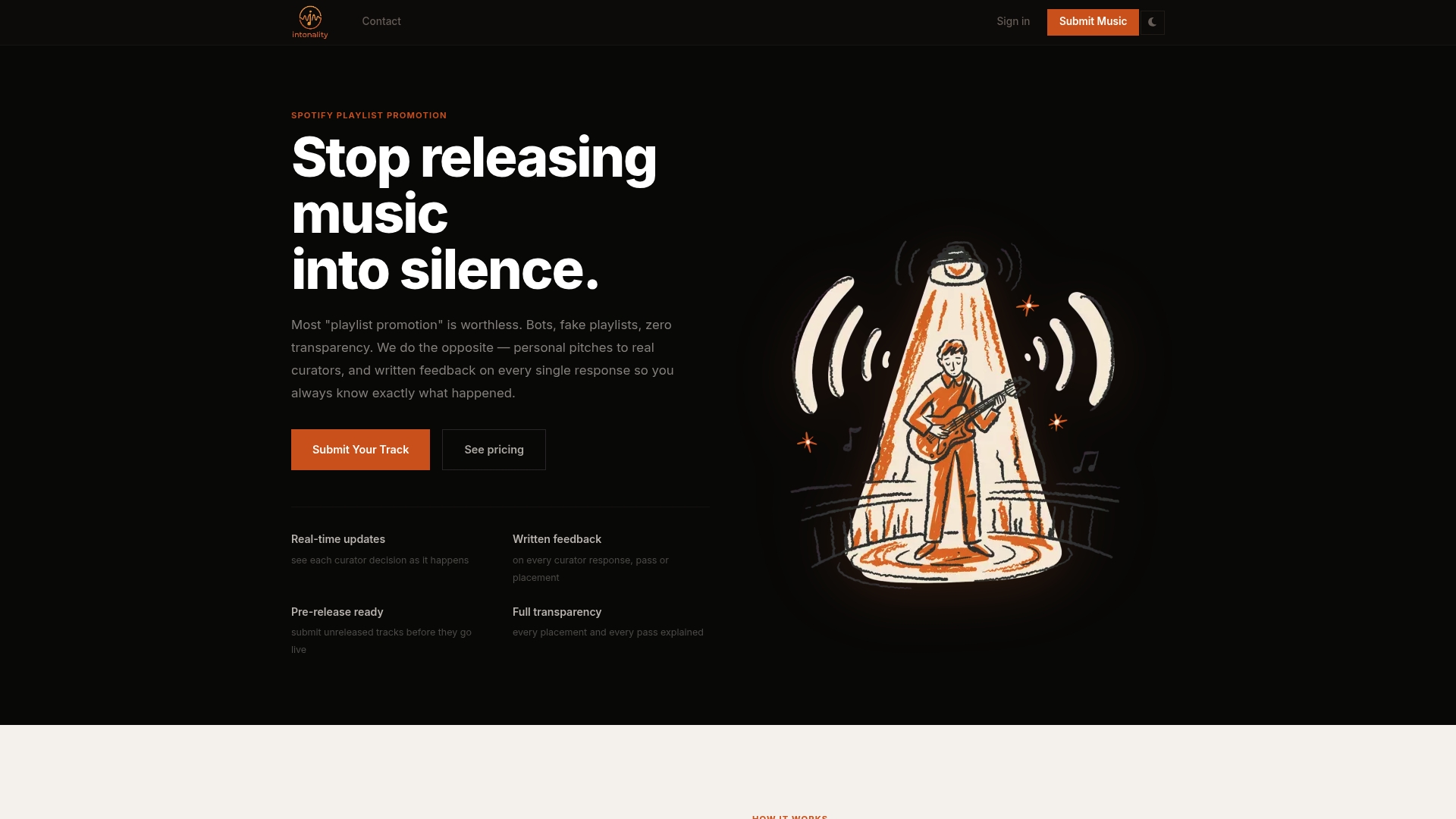
Some services build their offerings around personalized pitches to real, genre-matched curators, with real-time updates and written feedback on every curator decision, accepted or declined. Campaign tiers may scale the number of curator pitches and the depth of reporting provided.
- Review current tiers and request pricing on the Intonality plans page
- See a vetted curator profile, including genre focus, on the amplaylists curator page
- If you’re comparing managed campaigns against self-serve submission tools, see how the approach differs on the SubmitHub alternative page
Before paying any provider, including this one, ask for a sample curator response and confirm you’ll be able to verify placements in your own Spotify for Artists dashboard once the campaign runs.
FAQ
Which playlist promotion works best?
The most reliable approach pairs genre-matched curator pitching with transparent, written feedback on every decision, since that combination lets you verify results instead of taking placement claims on faith. Campaigns that convert listeners into savers and repeat streamers, a signal Spotify’s audience segmentation guidance ties to long-term growth, tend to outperform those chasing raw stream counts.
How many streams does it take to make $10,000?
Streaming payouts vary by platform, distributor, and listener location, so there’s no single stream count that applies universally. A more useful approach is tracking your own per-stream rate in your distributor’s reporting and projecting from there rather than relying on a general industry figure.
Can I get paid for reviewing songs?
Some platforms and curator networks do pay for track reviews or playlist curation work, though terms and rates differ widely by platform and aren’t standardized industry-wide. Check each platform’s own payment terms directly rather than assuming a flat rate.
How many Spotify streams do you need to make $1,000?
This depends on your specific per-stream rate, which varies by distributor and listener geography, so there’s no fixed number that holds across every artist. Your distributor’s royalty statement is the most accurate way to calculate what you’d need.
Is playlist promotion with curator feedback legitimate?
It can be, provided the service shows vetted curator sourcing, written responses to every submission, and placements you can independently confirm in Spotify for Artists. Spotify itself warns that services guaranteeing streams or placements for a fee are frequently scams, so transparency and verifiability are what separate a legitimate provider from a risky one, as outlined in Spotify’s artificial streaming policy.


