

Authentic playlist placements are curator, editorial, or algorithmic adds that reflect genuine listener behavior rather than bots or pay-for-play tricks. The most reliable route to them combines correct use of Spotify for Artists pitching with genre-matched curator outreach, careful vetting, and tracking real listener signals. Artists who want help without the guesswork often turn to a transparent, curator-driven service like Intonality rather than gambling on guaranteed-placement offers.
TL;DR:
- Authentic playlist placements are based on genuine listener engagement and are not guaranteed by pay-for-play schemes that violate Spotify’s policies.
- Successful pitching involves timely, specific submissions via Spotify for Artists, emphasizing quality over quantity and building curator relationships directly.
- Vetting curators requires checking actual engagement metrics and avoiding any offers that ask for login information or guarantee placements, which are illegal.
- Managed campaign services like Intonality handle research, outreach, and reporting, saving artists time and focusing on real, track-specific relationships.
- The best strategy prioritizes genre fit and curator trust over volume, as real relationships lead to lasting listener growth and follower conversion.
Table of Contents
- What “authentic” playlist placements actually mean
- How to use Spotify for Artists pitching the right way
- Community and curator outreach: real channels to pursue
- Vetting curators and spotting red flags
- Crafting a pitch and the assets curators want
- Measuring placement impact and next steps
- How Intonality runs authentic curator campaigns
- Why chasing guarantees is the wrong instinct
- Intonality: a managed option for artists short on time
- Authoritative resources to confirm policy and learn more
- Sources
- FAQ
What “authentic” playlist placements actually mean
Editorial playlists are curated by Spotify’s own team, algorithmic playlists like Discover Weekly respond to listening patterns, and independent curator playlists are built by individuals or communities around a genre or mood. All three differ fundamentally from paid schemes promising guaranteed adds or streams.
Spotify’s policy on third-party services that guarantee streams prohibits paying for guaranteed placement, and violations can lead to withheld royalties, content removal, or account suspension.
- Editorial and algorithmic placements grow from real engagement, not purchase.
- Curator-driven placements depend on genre and mood fit, not price paid.
- Guaranteed-placement offers violate platform terms and put revenue at risk.
Spotify actively polices artificial streaming, running daily cleaning processes that can strip royalties or remove flagged content. Authentic, context-matched placements tend to hold listeners longer because the fit between song and audience was real from the start.
How to use Spotify for Artists pitching the right way
Pitching through Spotify for Artists remains the only sanctioned path to editorial consideration and Release Radar eligibility, but it works only if you use it correctly.
- Submit unreleased tracks at least 7 days before release, since Spotify requires this window for Release Radar and editorial eligibility.
- Understand that pitching never guarantees a placement: editors can choose a different track from your release or skip it entirely.
- Fill every pitch field with specifics: describe the mood, name comparable artists, and explain why the song fits particular editorial playlists rather than playlists in general.
- Keep the pitch text tight. Editors read many submissions a day, and a rambling description gets skipped.
Pro Tip: Write your pitch like a one-line elevator description a stranger could repeat back to you, not a biography.
Our step-by-step submission guide walks through each field in more detail if you want a template to start from.
Community and curator outreach: real channels to pursue
Editorial pitching covers only one lane. Independent curators, many running playlists with genuine engaged followings, offer a parallel and often faster route to authentic exposure.
- Indie curator platforms and direct submit pages let you pitch specific playlists rather than a general pool.
- Music communities on Reddit, Discord, and genre forums often have curators actively looking for new tracks.
- Fan-curated playlists built around an activity or mood tend to retain listeners better than broad genre lists, since the context match improves retention.
- Direct, personalized outreach to a curator you have researched outperforms mass submission every time.
Research the curator’s recent adds before reaching out, personalize the note to the playlist’s actual theme, and send one polite follow-up if you hear nothing back. Building a relationship over several releases, rather than a single ask, is what turns one placement into a recurring one.
Vetting curators and spotting red flags
Not every curator claiming influence delivers real listeners, and separating the genuine from the fake takes a few concrete checks.
- Look for engaged follower behavior: comments, shares, and playlist growth that tracks with actual engagement rather than sudden spikes.
- Check for cross-platform presence and transparency about how the playlist is run and who curates it.
- Treat any guarantee of placement or streams as a hard no, since Spotify explicitly warns that such services violate its terms.
- Be wary of instant bulk adds, requests for your account login credentials, or a visible history of removed tracks.
Pro Tip: If a curator asks for your Spotify login instead of a link to send, stop the conversation there.
If you spot artificial streaming or a suspicious offer, document the message and report it through Spotify’s official channels rather than engaging further. Our curator vetting checklist covers this in more depth if you want a fuller walkthrough.
Crafting a pitch and the assets curators want
A strong pitch is short, specific, and ready before you send the first message.
- A working streaming link that actually plays, tested beforehand.
- A timestamp pointing to the strongest 30 to 60 seconds of the track.
- A one-line pitch describing genre, mood, and why it fits this particular playlist.
- A short artist bio and two or three comparable artists.
- Recent press mentions or social proof, if you have them.
If the track is unreleased, pitch at least 7 days ahead through Spotify for Artists to stay eligible for Release Radar. For a track that is already out or arriving late, lead with social proof and recent numbers instead, since the editorial window has closed. Personal touches matter. Mentioning a specific track already on the playlist and explaining the thematic overlap shows a curator you did the work rather than mass-blasting a form letter.
Pro Tip: Keep a one-page press kit ready with your bio, photos, and links so you never scramble when a curator asks for more. A strong artist photo makes that kit look finished rather than thrown together.
Our editorial pitch guide breaks down wording examples for each field.
Measuring placement impact and next steps
A placement only matters if it changes listener behavior, and Spotify for Artists gives you the numbers to check that.
- Saves and playlist follower growth show whether new listeners actually liked what they heard.
- Listener retention and geographic spread reveal whether the placement reached people who stick around.
- Follower conversion, meaning listeners who go on to follow your artist profile, is the clearest sign of a lasting gain.
Placement quality varies widely. Context-based and top-tier playlists tend to produce measurably stronger uplift than low-engagement, genre-only lists. After a placement lands, thank the curator, cross-promote the playlist on your own social channels, and retarget engaged listeners with a follow-up release or email so the gain outlasts the single spike.
How Intonality runs authentic curator campaigns
Intonality pitches tracks directly to real, vetted music curators rather than relying on automated systems or fake plays, and the company states it avoids guaranteed-placement and bot-driven schemes entirely. Every campaign includes real-time updates and written feedback from each curator decision, so artists see exactly why a track was accepted or passed over rather than guessing.
Intonality reports an average number of playlist placements per campaign that varies depending on the tier chosen, with results linked to genre-matching and curator relationships rather than volume submission. That transparency, including published outcomes for both placements and declines, is the core of how the service positions itself against mass-submission platforms. Our placement expectations breakdown covers how those numbers are calculated.

Why chasing guarantees is the wrong instinct
The biggest mistake independent artists make is treating playlist placement like an ad buy: pay a fee, expect a fixed result. That mindset is exactly what guaranteed-placement schemes exploit, and it is also why so many artists get burned by services promising numbers no legitimate curator can promise.

The conventional advice to “submit to as many playlists as possible” is largely wrong. Volume without genre fit produces streams that vanish the moment the playlist cycles, while a handful of context-matched placements, the kind built on real curator relationships, tend to hold listeners and convert them into followers.
If you take one thing from this guide, prioritize fit and relationships over reach. A curator who plays your track because it genuinely matches their playlist will keep coming back for future releases. A service promising a guaranteed number will not.
— Einars
Intonality: a managed option for artists short on time
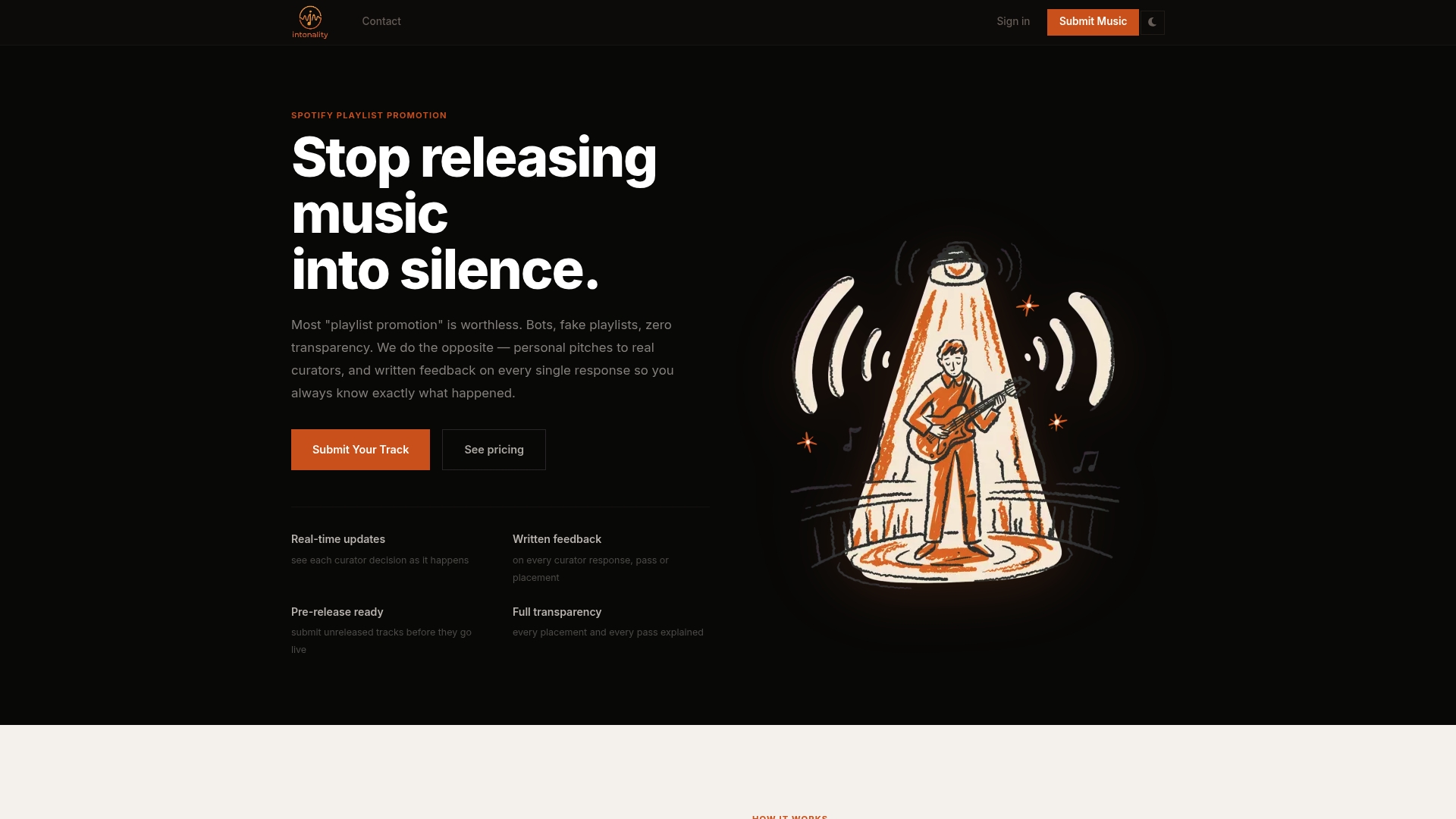
Independent artists often lack the hours it takes to research curators, personalize outreach, and follow up without burning bridges. That gap is where a managed campaign earns its cost: Intonality builds the curator list, sends the personalized pitch, and reports every accept and decline in writing so you know exactly where your track landed.
- Artists who want time back from manual outreach benefit most from a managed campaign.
- DIY outreach costs time and requires you to vet every curator yourself.
- Managed campaigns add relationship-building and transparent reporting you would otherwise build from scratch.
Campaigns run across multiple tiers with varying scopes, and current pricing details are available on the Intonality campaign page. You can also browse an example curator profile, like amplaylists, to see what a transparent curator relationship looks like before you commit, or read our ethical campaign breakdown for the full six-week structure.
Authoritative resources to confirm policy and learn more
Before submitting anywhere, read Spotify’s own guidance on pitching to playlist editors and its policy on services that guarantee streams. Spotify’s Loud & Clear takeaways show how Fresh Finds placements translate into measurable artist growth over time.
Sources
- Artificial streaming and paid 3rd-party services that guarantee streams - Spotify
- Takeaways - Loud and Clear (Spotify)
- Music streaming economics and playlist marketing strategy - Business Think UNSW
FAQ
How many plays on Spotify to make $1,000?
Spotify pays rights holders, not artists directly, and the Loud & Clear FAQ recommends checking your distributor or label statement for the actual rate applied to your account. There is no single stream count that applies to every artist, since royalty rates vary by agreement and market.
How many streams to make $10,000?
The same distributor-dependent math applies here as with smaller amounts, so there is no universal stream figure that guarantees a set payout. Check your own distributor reporting, since Spotify itself directs artists to those statements rather than publishing a fixed per-stream rate.
Where is the best place to make a playlist?
Spotify’s own playlist creation tools inside the app are the standard starting point for building a public or collaborative playlist. Independent curators typically build theirs the same way, then grow an audience through community outreach and cross-promotion.
What is the 1,000 rule on Spotify?
There is no official “1,000 rule” published by Spotify, and the phrase is not a recognized industry standard. If you have seen it referenced, treat it as informal shorthand rather than a documented platform policy, and rely on Spotify’s own pitching guidance instead.
Does Intonality guarantee playlist placements?
No. Intonality pitches tracks to real, vetted curators and reports an average of 4 to 11 placements per campaign depending on tier, but outcomes depend on genre fit and curator judgment rather than a guarantee.


