

Spotify’s Campaign Kit reporting got a meaningful upgrade: Discovery Mode now surfaces a Campaign Lift metric that uses machine learning to separate campaign-driven stream growth from your organic baseline, calculated over a 14-day attribution window. That single change makes it possible to measure real ROI on a playlist campaign instead of guessing whether a stream spike was you or the algorithm. Here’s what changed, what it means, and what to do about it this month:
- Campaign Lift is now live in Discovery Mode reports, isolating incremental streams from organic growth using a 14-day attribution window.
- Historical lift comparisons use a 28-day pre/post window, so you can see long-term audience growth, not just a release-week spike.
- Audience growth metrics (new listeners, returning listeners, saves, playlist adds, intent rate) are now part of the expanded Discovery Mode dashboard.
- Third-party pre-save tokens now expire every six months, which means “set-and-forget” pre-save lists are gone. Build your email and SMS list now.
- Immediate action: run a 14–28 day Discovery Mode test on one or two tracks, read Campaign Lift first, and optimize toward saves and playlist adds rather than raw stream counts.
Key Takeaways
Spotify’s Campaign Lift metric, combined with genre-matched curator outreach and a disciplined 14-to-28-day measurement window, gives independent artists the clearest picture of playlist campaign ROI they’ve ever had.
| Point | Details |
|---|---|
| Campaign Lift is your primary ROI signal | It uses a 14-day attribution window to separate campaign-driven streams from organic baseline growth. |
| Saves and playlist adds outrank raw streams | These engagement signals feed algorithmic playlists like Discover Weekly weeks after your campaign ends. |
| Submit editorial pitches 3–4 weeks early | The hard minimum is 7 days before release; earlier submissions give editors more time to consider your track. |
| Vet curators before you pay | Check update frequency, follower growth curves, curator identity, and whether written feedback is included. |
| Intonality sequences curator outreach with Spotify tools | Genre-matched placements establish a baseline so Discovery Mode and Marquee can measure incremental lift cleanly. |
Table of Contents
- What are the biggest playlist campaign updates right now?
- How does each Campaign Kit tool work, and when should you use it?
- How do you measure campaign impact with the new reporting tools?
- What are realistic outcomes for editorial, independent, and algorithmic placements?
- A concise campaign playbook you can run this month
- What are the submission windows and typical campaign costs?
- What tactics actually build lasting algorithmic reach?
- How do you vet playlist curators and spot the red flags?
- How does Intonality run playlist campaigns and what makes it different?
- When would I spend money vs. do it myself?
- Ready to run a vetted playlist campaign with Intonality?
- Sources
What are the biggest playlist campaign updates right now?
The most significant shift is in how Spotify lets you measure what a campaign actually did. Discovery Mode’s expanded reports now include campaign stream lift, listener lift, historical lift against the 28 days before your first Discovery Mode campaign, audience growth, and long-term engagement signals like saves, playlist adds, and intent rate. Spotify is explicit that these figures are estimates built on machine-learning comparisons, not exact predictions. That caveat matters: treat them as directional signals, not accounting.
Campaign Lift is the headline number. It compares your stream growth during a campaign against a modeled organic baseline, then attributes the difference to the campaign. The 14-day attribution window means streams that happen within two weeks of a listener’s first exposure get counted.
Historical lift adds a longer lens. It compares your current performance against the 28 days before you ever ran a Discovery Mode campaign, which is useful for catalog tracks where you want to see whether a reactivation effort actually moved the needle over time.
Campaign Kit also reported sample performance lifts from display campaigns including significant increases in saves, playlist adds, and follows in the first month for certain examples, reflecting typical positive trends rather than exact figures. Those are Spotify’s own illustrative figures, not guaranteed outcomes, but they show what the tool is designed to move.
The other update that affects your retention strategy: Spotify now requires fans to reauthorize third-party app permissions every six months. Pre-save lists built through third-party tools will go stale unless fans re-opt in. The practical fix is to capture email and SMS at the same time as a pre-save, so you have a direct line when tokens expire. Fan engagement platforms built for independent artists can help you manage that owned-channel infrastructure alongside your Spotify campaigns.
| Metric | Attribution Window | What It Shows |
|---|---|---|
| Campaign Lift | 14 days post-exposure | Incremental streams vs. organic baseline |
| Historical stream/listener lift | 28 days before first campaign | Long-run audience growth from Discovery Mode |
| Saves / playlist adds / intent rate | Campaign duration | Engagement quality and conversion signals |
| Audience growth | Campaign duration | New vs. returning listeners |
Pro Tip: When Campaign Lift and raw stream counts tell different stories, trust Campaign Lift. A big stream spike with low Campaign Lift usually means organic activity or an external playlist placement drove the numbers, not your paid campaign. Optimize toward the tracks where Campaign Lift is high and saves are climbing together.
How does each Campaign Kit tool work, and when should you use it?
Campaign Kit bundles three distinct tools. Knowing which one to reach for first saves money and produces cleaner data.
Spotify for Artists playlist pitching
This is the free editorial pitch you submit directly through Spotify for Artists before a release. The goal is an editorial playlist placement, which carries the highest upside of any Spotify tool: a single placement on a major editorial list can deliver tens of thousands of streams and a lasting algorithmic signal. The catch is acceptance. Industry estimates indicate a very low acceptance rate for independent artists without prior editorial history, reflecting the high selectivity of editorial playlist placement., and the timing is strict. Submit 3–4 weeks before your release date; the hard floor is 7 days before release. Miss that window and the pitch is ineligible.
For your pitch copy, focus on the song’s mood, instrumentation, and the specific playlist context where it fits. Spotify’s editors are matching tracks to listener experiences, not evaluating your career arc. A detailed guide on crafting your Spotify editorial pitch can help you write copy that actually gets read.
Discovery Mode
Discovery Mode lets you flag eligible tracks for potential inclusion in Spotify’s personalized listening sessions, including Radio and Autoplay. You accept a lower per-stream royalty rate in exchange for increased exposure to listeners who haven’t heard you yet. It works best for back-catalog tracks where you want to reactivate interest, or for a new release after the editorial pitch window has closed and you want sustained algorithmic reach.
The tradeoff is real: you earn less per stream. But the audience-growth data you get back, especially the new listener and returning listener split, is genuinely useful for deciding which tracks deserve further investment.
Marquee and Showcase (display campaigns)
Marquee is a full-screen recommendation that appears when a recent listener opens Spotify shortly after your release. Showcase places a sponsored card in the Home feed. Both are paid display formats, and both are designed to drive a specific action: saving a track, adding it to a playlist, or following your artist profile.
Discovery Mode and display campaigns are available in multiple markets and regions, though exact numbers vary by service updates. If you’re a US-based artist, both are accessible. Display campaigns tend to work best once you have an audience that already knows your name. Running Marquee cold, before any editorial or Discovery Mode exposure, often produces lower intent rates because the listener has no prior context.
How to sequence them
The most effective order is: editorial pitch first (free, highest upside), then Discovery Mode to sustain reach after release week, then display campaigns once engagement signals confirm the audience is responding. Here’s what that looks like in practice:
- Emerging indie act (under 5K monthly listeners): Submit editorial pitch, run a 14-day Discovery Mode test on your lead single, read Campaign Lift and saves before spending on display.
- Mid-level artist (10K–50K monthly listeners): Pitch editorial, activate Discovery Mode on two tracks simultaneously, run a short Marquee campaign targeting recent listeners who haven’t saved yet.
- Catalog boost (existing followers, older releases): Skip editorial (ineligible for older tracks), run Discovery Mode on your top three catalog tracks, use historical lift to identify which one is gaining new listeners, then run Showcase on that track.
How do you measure campaign impact with the new reporting tools?
The new metrics give you more to work with, but only if you know which number to read first. Here’s the priority order and what each metric actually tells you.
Start with Campaign Lift. It’s the only metric that attempts to isolate what your campaign did versus what would have happened anyway. A positive Campaign Lift on a track means the campaign drove incremental streams. A flat or negative Campaign Lift on a track with rising raw streams usually means something else, a playlist placement, a social post, or organic algorithmic pickup, drove the growth.
Then look at saves and playlist adds. These are the engagement signals that feed the algorithm downstream. A listener who saves your track is telling Spotify’s recommendation engine that the song is worth returning to. Saves and playlist adds from campaign-exposed listeners are a stronger signal than streams alone.
Intent rate measures the share of listeners who took a meaningful action (save, add, follow) after hearing your track through a campaign. A high intent rate on a small audience is often more valuable than a low intent rate on a large one.
Returning listeners tell you whether the campaign created real fans or one-time plays. If your returning listener count climbs during or after a campaign, the placement is working beyond the initial exposure.
The attribution windows matter for planning. Campaign Lift uses 14 days, so a campaign shorter than two weeks may not give you a complete picture. Historical lift uses 28 days before your first Discovery Mode campaign as the baseline, which means the first campaign you ever run will have the cleanest historical comparison. Subsequent campaigns layer on top of each other, so isolate variables where you can.
Over a 14-day campaign, that’s approximately 2,800 incremental streams. Divide your campaign spend by that number to get a rough cost-per-incremental-stream. That figure lets you compare campaigns across tracks and decide where to reinvest.
| Metric | What It Measures | Why It Matters | Suggested Action |
|---|---|---|---|
| Campaign Lift (%) | Incremental streams vs. organic baseline | Isolates true campaign ROI | Use to compare tracks; cut low-lift tracks |
| Historical stream lift | Growth vs. 28-day pre-campaign baseline | Shows long-run audience impact | Track over multiple campaigns |
| Saves | Listener intent to return | Feeds algorithmic recommendations | Prioritize tracks with rising save rates |
| Playlist adds | Active curation by listeners | Signals strong contextual fit | Use to identify best co-listing candidates |
| Intent rate | Actions per campaign-exposed listener | Quality of audience response | Benchmark across campaigns |
| New listeners | First-time audience reach | Campaign’s discovery effectiveness | Compare against returning listeners |
| Returning listeners | Repeat engagement | Fan conversion signal | Rising count = campaign creating real fans |
One warning: organic virality, a sync placement, or a social media moment can inflate all of these numbers simultaneously. If your streams spike during a campaign but Campaign Lift stays flat, something outside the campaign is driving the growth. Don’t credit the campaign for it, and don’t cut the campaign either. Read the Spotify for Artists analytics walkthrough to learn how to separate campaign-driven traffic from organic spikes in your dashboard.
What are realistic outcomes for editorial, independent, and algorithmic placements?
Honest expectations prevent bad decisions. Here’s what the data and industry experience actually support.
Editorial playlists carry the highest upside and the lowest acceptance probability. Under 1% of independent artists without prior editorial history get placed, and that figure reflects the volume of pitches Spotify receives, not a judgment on quality. If you get placed, the impact can be substantial: streams, new followers, and a lasting algorithmic signal that feeds Discover Weekly and Release Radar for weeks. Submit every eligible release. The cost is zero and the upside is asymmetric.
Algorithmic playlists (Discover Weekly, Release Radar, Radio) don’t require a pitch. They respond to engagement signals: saves, completion rate, repeat listens, and playlist adds from real listeners. Algorithmic pickup after a release typically takes 2–6 weeks. The implication is that your campaign’s job in the first two weeks isn’t just streams; it’s generating the quality signals that trigger algorithmic reach in weeks three through six.
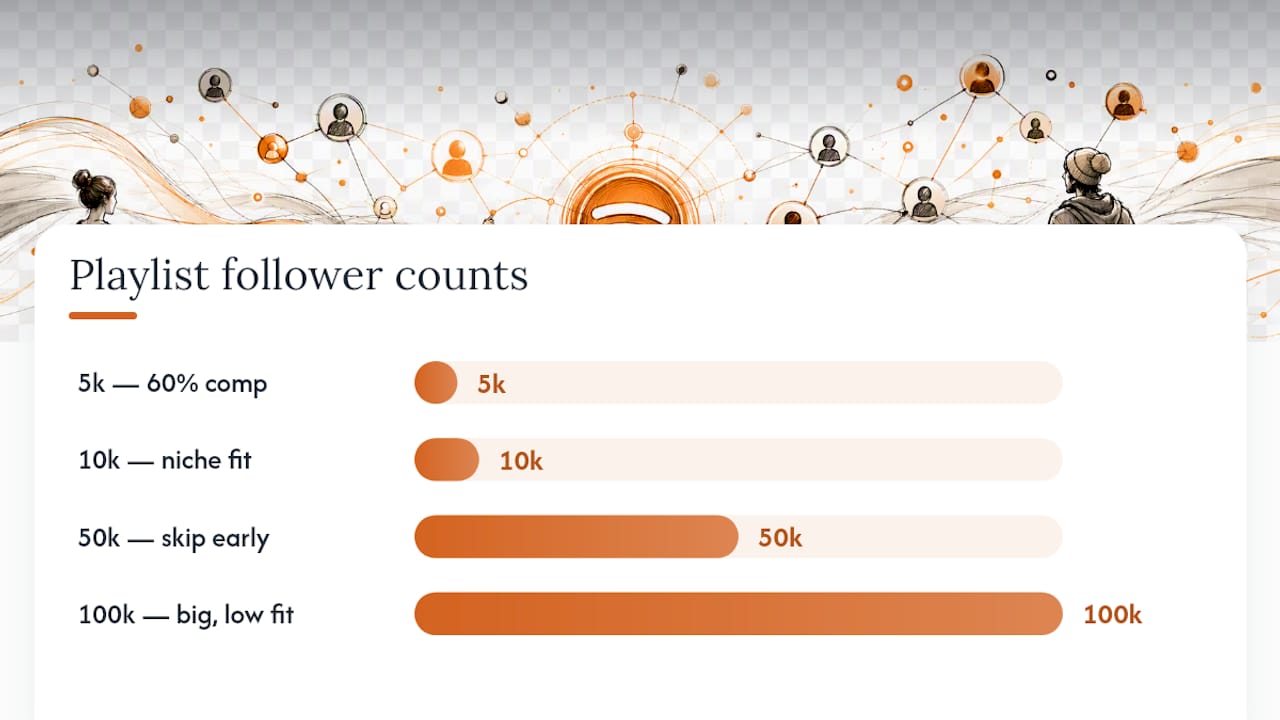
Independent curator playlists vary enormously. A 10,000-follower playlist with a highly engaged niche audience can outperform a 100,000-follower playlist where listeners skip your genre. Audience fit matters more than follower count. Streams per placement depend on how often the playlist is listened to, how many tracks are in it, and whether your track appears near the top.
A few practical rules of thumb:
- A placement on a 5,000-follower playlist with a 60% completion rate beats a placement on a 50,000-follower playlist where your track gets skipped at the 30-second mark.
- Saves generated from a playlist placement carry more algorithmic weight than streams alone.
- One editorial placement can trigger a cascade of algorithmic placements. One independent curator placement rarely does on its own.
- Track which playlists actually drive returning listeners. Those are the relationships worth maintaining.
A concise campaign playbook you can run this month
This is a 30-to-60-day sequence for a solo artist or small team. Adjust budget bands to your situation.
Pre-release (weeks 1–4 before release):
- Submit your editorial pitch through Spotify for Artists at least 3–4 weeks before release. Include mood, instrumentation, and the specific playlist context.
- Set up a pre-save campaign and capture email/SMS at the same time. Given the six-month reauth rule, owned contacts are your insurance policy.
- Identify two or three independent curators whose playlists fit your track’s co-listing context. Reach out with personalized pitches, not mass emails.
- If using Intonality, submit your track at least two weeks before release to allow curator outreach to align with your release window.
Release week (days 0–7):
- Activate Discovery Mode on your lead single if eligible.
- Promote any confirmed playlist placements on your own channels. Cross-promotion increases the chance of future placements and drives real listeners to the playlist.
- Monitor saves and playlist adds daily. If saves are climbing, the algorithm is receiving the right signals.
Post-release (days 8–28):
- At day 14, read Campaign Lift. If it’s positive and saves are up, continue Discovery Mode. If Campaign Lift is flat and saves are low, pivot to a different track or adjust targeting.
- If you have a budget for display, run a short Marquee campaign targeting listeners who streamed but didn’t save. Keep it to 7–14 days to contain spend.
- At day 28, pull historical lift and compare returning listeners to new listeners. A rising returning-listener count means the campaign is building real fans.
Budget bands:
- Low (under $200): Focus entirely on editorial pitching (free) and Discovery Mode (royalty-rate tradeoff, no upfront cash). Use Intonality’s entry-tier curator campaign for one track.
- Medium ($200–$600): Add a short Marquee or Showcase campaign after Discovery Mode confirms engagement. Expand curator outreach to two tracks.
- High ($600+): Run Discovery Mode and display in parallel, use Campaign Lift to cut underperformers at day 14, and run Intonality’s higher-tier campaign for broader curator reach.
Pivot budget to the track showing the strongest lift-to-saves correlation.
What are the submission windows and typical campaign costs?
Timing:
- Editorial pitch: 3–4 weeks before release is the recommendation; 7 days is the hard minimum. Earlier is always better.
- Discovery Mode test: run for 14–28 days to collect enough data for a meaningful Campaign Lift reading. Shorter tests produce noisy results.
- Display campaigns (Marquee/Showcase): typically 7–28 days depending on budget. A 7-day Marquee around release week is a common starting point.
- Curator outreach campaigns: allow 1–2 weeks for curator review and placement decisions. Some curators respond within days; others take longer.
Cost factors for paid campaigns:
- Geography and audience targeting: US-targeted campaigns cost more per impression than broader international targeting.
- Placement type: Marquee (full-screen) typically costs more per action than Showcase (Home feed card).
- Campaign length: longer campaigns spread budget across more days but require a larger total spend to maintain visibility.
- Curator service tier: DIY outreach costs only time; vetted curator services charge a flat campaign fee that varies by the number of curators pitched and the level of reporting provided.
For submitting your track through a vetted service, the cost depends on how many curators are pitched and what reporting you receive. Intonality’s campaigns range across tiers, with the entry level targeting a smaller curator pool and the higher tiers expanding reach and placement volume.
What affects your cost-per-result more than anything else: audience fit. A campaign pitched to genre-matched curators at a lower price point will outperform a broad, untargeted campaign at a higher spend.
What tactics actually build lasting algorithmic reach?
Raw stream counts are a lagging indicator. The signals that compound over time are saves, playlist adds, completion rates, and follower growth. Here’s how to build toward them deliberately.
Co-listing fit over follower count. Data-driven marketers track co-listing fit, meaning how often your track appears alongside compatible artists, as a stronger signal for long-term algorithmic traction than genre-only matching. When pitching curators, look at who else is on their playlists. If your track fits contextually with those artists, the placement will generate better engagement signals than a placement on a larger but mismatched list.
Grow your follower base as a controlled variable. Followers get your new releases into Release Radar automatically. Every follower you gain during a campaign is a listener you can reach again without spending on display. Encourage follows explicitly in your social posts, email campaigns, and live shows.
Saves and completion rates are the algorithm’s currency. A listener who saves your track is voting for it in Spotify’s recommendation system. Encourage saves directly: mention it in your social posts, your email list, and any video content around the release. Don’t be shy about it. Artists who ask for saves get more saves.

Build your own artist playlists. Curating a playlist of tracks that fit alongside yours serves two purposes: it gives your audience a listening experience to return to, and it generates co-listing data that strengthens your contextual fit signal. The best playlist marketing shifts from pitching a single track to promoting a listening experience. An artist playlist with 20 well-chosen tracks and a few hundred followers is a real asset.
Priority action sequence:
- Immediate: Submit editorial pitch, activate Discovery Mode, ask for saves in every channel.
- Mid-term (weeks 2–6): Build curator relationships, promote placements publicly, grow email/SMS list.
- Long-term (months 2–6): Maintain artist playlists, track co-listing fit, reinvest in tracks with rising returning-listener counts.
Pro Tip: When you build an artist playlist, add your own track in a contextually natural position, not at the top. Listeners who discover the playlist organically and reach your track mid-listen are generating a more authentic engagement signal than listeners who click directly to your track from a promotional post.
How do you vet playlist curators and spot the red flags?
The playlist promotion space has a real fraud problem. Fake streams can get your account flagged by Spotify, and low-quality placements waste money without producing any algorithmic benefit. Here’s a short checklist before you pay anyone.
Checklist for vetting a curator:
- Does the playlist update regularly? A playlist that hasn’t added new tracks in three months is likely inactive.
- Do the follower growth curves look natural? Sudden spikes of thousands of followers in a single day are a bot signal. Check the playlist’s history if you can.
- Is there a real curator identity? A name, a social profile, or a website. Anonymous services with no contact information are a red flag.
- Can the curator show you listener demographics or past campaign results? Legitimate curators can describe their audience. Vague answers about “organic reach” without specifics are a warning sign.
- Does the service provide written feedback on placement decisions? Services that provide per-curator written feedback and real-time updates are more credible than opaque services that only report a final placement count.
Red flags:
- Payment required with no reporting, no feedback, and no replacement policy if placements underperform.
- Guaranteed placement numbers with no mention of genre fit or curator vetting.
- Sudden follower spikes on the playlists they’re promoting.
- No curator identity or audience evidence.
- Inconsistent track-adding patterns (50 tracks added in one day, then nothing for weeks).
Practical verification steps:
- Stream-check a playlist by listening to a few tracks. If the other artists on the list sound nothing like you, the placement won’t generate useful engagement signals regardless of follower count.
- Search the curator’s name or service online. Legitimate services have reviews, social presence, or industry mentions.
- Ask for a sample listener demographic breakdown and a replacement policy in writing before you pay.
For a deeper look at how to identify fake-stream activity in your own Spotify for Artists dashboard, the fake streams guide covers the specific signals to watch for.
How does Intonality run playlist campaigns and what makes it different?
Intonality’s approach is built around one premise: a personalized pitch to a genre-matched, vetted curator produces better results than a mass submission to an unfiltered list. Every campaign starts with curator matching based on genre, mood, and co-listing fit, not just follower count.
How a campaign works:
- You submit your track, release date, target territories, and campaign goals.
- Intonality pitches your track to vetted curators whose playlists fit your sound.
- Every curator decision, whether a placement or a pass, comes with written feedback. You know exactly why a curator accepted or declined.
- A real-time dashboard shows campaign progress as it happens, not just a final report after the campaign closes.
- Campaigns deliver an average of 4–11 playlist placements depending on the service tier.
Integrating with Spotify’s reporting tools:
The cleanest way to use Intonality alongside Campaign Kit is to run your Intonality campaign first, then activate Discovery Mode after you have confirmed placements. That sequence lets you use Campaign Lift to measure the incremental impact of Discovery Mode on top of the curator-driven baseline, rather than trying to separate two simultaneous signals. If you run both at the same time, tag the start dates in your Spotify for Artists dashboard so you can account for the overlap when reading historical lift.
A note on placement quality: Because Intonality matches by genre and co-listing fit, the placements tend to generate higher save rates and better completion rates than placements on mismatched lists. Those signals are exactly what feeds the algorithmic reach described earlier in this article. A placement that drives saves is worth more than a placement that drives streams alone. For artists who want to see how Intonality compares to other curator submission approaches, the playlist promotion overview covers the methodology in detail.
When would I spend money vs. do it myself?
The honest answer depends on three variables: your budget, the importance of the release, and how much time you can realistically spend on outreach.
Spend on a vetted service when:
- The release is a priority single or album where placement quality matters more than cost.
- You’ve already run Discovery Mode and confirmed the track has positive Campaign Lift. You know the song works; now you want to scale reach.
- You don’t have time to research curators, write personalized pitches, and follow up. Outreach done badly produces worse results than no outreach at all.
DIY when:
- You’re testing a new track and want to validate it before spending. Run Discovery Mode for 14 days, read Campaign Lift, and only invest in curator outreach if the signal is positive.
- You’re building long-term curator relationships in a specific niche. A few genuine personal connections with curators who love your genre are worth more than a hundred cold submissions.
- Your budget is genuinely tight. In that case, the editorial pitch (free) and Discovery Mode (royalty tradeoff, no cash) are your best tools.
Three quick scenarios:
- Solo artist, low budget: Submit the editorial pitch, run Discovery Mode for 14 days, build your email list, and reach out personally to three or four curators whose playlists you’ve actually listened to.
- Growth-focused indie with some budget: Use Intonality for curator outreach on your lead single, run Discovery Mode in parallel, and use Campaign Lift to decide whether to add a Marquee campaign in week three.
- Catalog rejuvenation: Skip editorial (ineligible for older tracks), run Discovery Mode on your top three catalog tracks, use historical lift to find the one gaining new listeners, then run an Intonality campaign targeting curators who playlist that era or sound.
Ready to run a vetted playlist campaign with Intonality?
If you’ve read this far, you have a clear picture of what the new reporting tools can tell you and what a well-sequenced campaign looks like. The next step is putting a real track in front of real curators.
Intonality handles the curator research, personalized pitching, and written feedback so you can focus on the music. You provide your release date, target songs, target territories, artist bio, and campaign goals. Intonality matches your track to vetted, genre-matched curators, pitches them personally, and delivers written feedback on every decision, whether a placement or a pass. The dashboard updates in real time, so you’re never waiting for a final report to know how the campaign is going.
To get the cleanest Campaign Lift data, submit to Intonality before activating Discovery Mode or Marquee. That way, curator-driven placements establish your baseline, and Spotify’s tools measure what they add on top. When you’re ready, submit your track and choose the service tier that fits your release goals. Campaigns average 4–11 placements depending on tier, with written curator feedback included at every level.
Sources
The claims in this article draw on the following sources:
- How to Meet Your Music Goals with Campaign Kit – Spotify for Artists
- 3 New Spotify Updates That Are Changing Music Marketing
- Spotify updates Discovery Mode reports with new campaign insights - RouteNote Blog
- Spotify playlist pitching strategy 2026 | Tools4Music
- How to Promote Your Music Using Playlists: A Complete Guide | Tunepact


