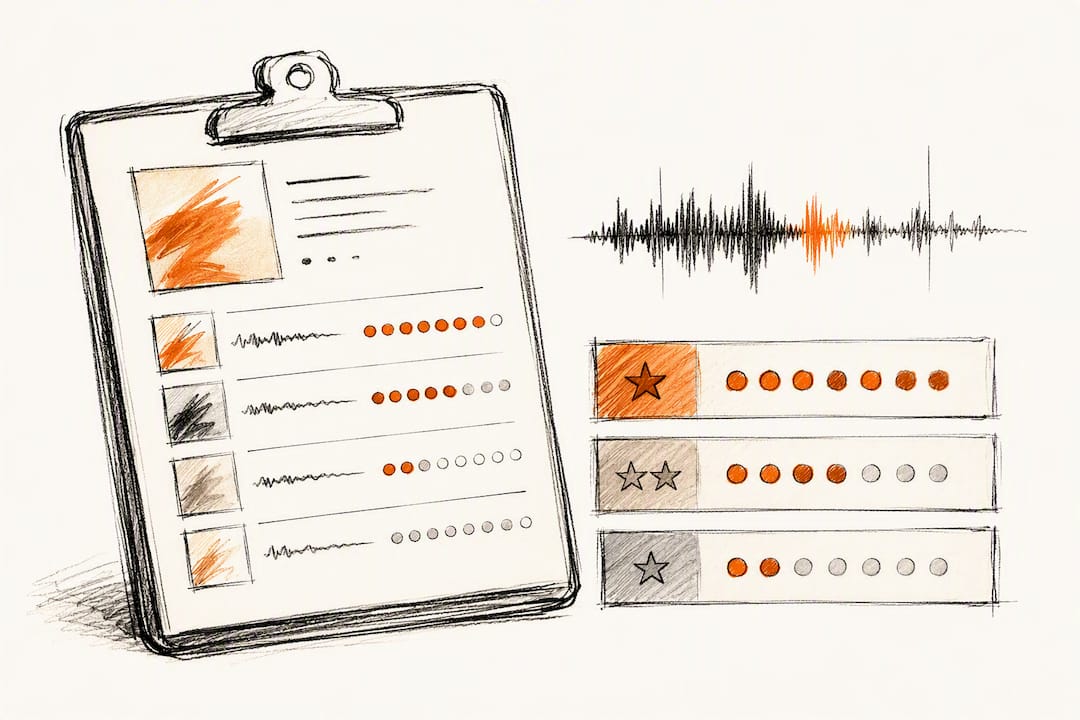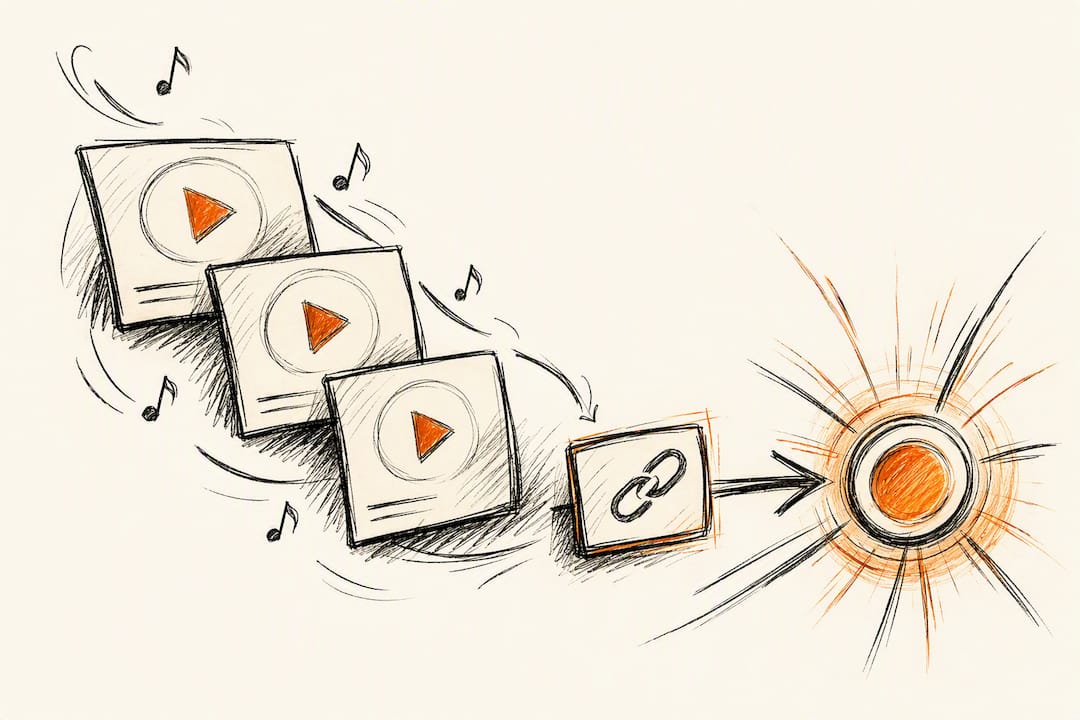
The workflow that actually builds curator relationships is simple to describe and hard to skip steps on: research and vet 30 to 50 curators in your genre lane, send a personalized 80 to 150 word pitch 7 to 14 days before release, follow up once at the 7 to 10 day mark if you hear nothing, then log every response and act on the feedback. Do this consistently across releases and you stop being a stranger in someone’s inbox. You become a name they recognize, and that recognition is what turns a single placement into a standing relationship.
TL;DR:
- Successful outreach relies on vetting curators based on recent activity, follower ratios, and genuine engagement, targeting 30 to 50 leads per release.
- The ideal pitch is brief, personalized, referencing a specific track on the playlist, with a clear link, release date, and a low-pressure closing statement.
- Pitching should be done 7 to 14 days before release, with one polite follow-up at 7 to 10 days if no response, avoiding pressure or multiple follow-ups.
- Tracking all responses and placements in a spreadsheet is essential, with follow-up promotion and sharing of placements to build relationship equity.
- Managed curator campaigns offer a streamlined alternative to DIY outreach, providing personalized pitches, vetting, and feedback-driven results.
Table of Contents
- Find and Vet the Right Curators to Build Curator Relationships
- Write the Pitch That Gets Read
- When Should You Send Your Curator Pitch?
- Track Every Placement and Turn It Into Relationship Equity
- How Do You Keep a Curator Relationship Going?
- What I’ve Learned Building Curator Relationships at Scale
- Skip the Legwork With a Managed Curator Campaign
- Sources
- FAQ
Find and Vet the Right Curators to Build Curator Relationships
Most artists waste their outreach on the wrong list. They pitch big-name playlists that get 500 submissions a day, or they pitch dead playlists that haven’t been touched since last year. The fix is reverse-engineering: pull up three or four artists who sound like you, check what playlists their songs sit on, and start there. Then run long-tail searches on Spotify itself, things like “midwest emo late night” or “bedroom pop coffee shop,” instead of broad genre tags that every submission bot already floods.
Once you have candidates, vet them before you write a single word. A curator worth pitching usually shows:
- Updated within the last two to four weeks
- A follower-to-track-count ratio that suggests real listeners, not a bloated shell
- A visible contact method (email, submission form, or social handle in the bio)
- No obvious bot-follower patterns or engagement that looks purchased
MusicPulse’s research on independent curators recommends building a pool of 30 to 50 leads per release, then narrowing to the 15 to 25 you’ll actually contact based on genre fit and activity. That narrowing step matters more than the size of the initial list. A separate vetting breakdown from Dynamoi flags the same red flags: stale update dates and suspicious follower ratios are the two fastest ways to spot a playlist not worth your time.
Pro Tip: Keep a “cold” and “warm” tag on every curator lead from day one. A cold curator gets your best first pitch. A warm one, someone who’s engaged with your music before, gets a shorter, more familiar message. Treating them the same wastes the relationship you already have.
Write the Pitch That Gets Read
Curators read pitches on their phones between other tasks, often in under fifteen seconds. That means structure beats charm. Use four lines, in this order:
- A personal opener naming the playlist and one specific track already on it.
- One line describing your song’s sound, with a “sounds like” comparison to an artist the curator already features.
- A single clean streaming link plus your release date.
- A short, low-pressure close. No demands, no urgency language.
Keep the whole thing between 80 and 150 words. Rolling Stone’s reporting on playlist submissions found that pitches in this range, referencing a specific track already on the list, get read at higher rates than longer, bio-heavy messages. PlaylistSupply’s contact guide backs the same structure and calls it the standard for pitches that consistently generate replies.
Skip the attachments. Skip the three-paragraph origin story. Skip anything that sounds like you’re offering money for a spot, since that’s a fast way to get blocked rather than added. A workable template: “Hey [name], loving what you’re doing with [playlist] lately, especially [track]. My new single ‘[song]’ has that same [mood/genre] feel, think [comp artist] meets [comp artist]. Here’s the link: [URL]. Out [date]. Appreciate you taking a listen either way.” Building a one clean playlist pitch link instead of a scattered set of files or profiles removes friction the curator would otherwise have to work around.
Pro Tip: Write your one-sentence artist bio once, polish it until it’s tight, and reuse it across every pitch. A ready-made short bio template saves you from rewriting the same sentence fifty times a release cycle.
When Should You Send Your Curator Pitch?
The window that works for independent curators is 7 to 14 days before release, not sooner and not on drop day. Pitch three weeks out and you risk being forgotten by the time the song is live. Pitch the day it drops and you’re buried under submissions from artists who did the same thing.
- Send your first pitch 7 to 14 days pre-release.
- Follow up once, politely, at the 7 to 10 day mark if you haven’t heard back.
- A second follow-up is only worth sending if you have genuinely new information, a placement on another list, a music video, a press mention.
- If the track is already live, shift language from “coming out” to “just released” and keep everything else the same.
- Editorial Spotify pitching runs through Spotify for Artists and follows separate timing rules from independent curator outreach, since Spotify’s own editors have explained that in-app submission is the correct channel for that track.
Beyond one follow-up, move on. Chasing a non-response past that point reads as pressure, and pressure is exactly what makes a curator stop opening your emails. A dedicated follow-up guide walks through the exact phrasing that keeps a second message light instead of nagging.
Track Every Placement and Turn It Into Relationship Equity
A spreadsheet does more for your campaign than most artists give it credit for. Track playlist name, curator contact, follower count, pitch date, response, placement status, and any notes the curator gave you. That last field, curator notes, is the one artists skip and shouldn’t.
- The moment you land a placement, share it publicly and tag the curator by name.
- Run a small amount of targeted promotion toward that playlist to boost its performance, since a curator notices when a track they added is pulling engagement.
- Use the placement as proof point in your next pitch: “This track is currently on [playlist]” tells a new curator you’re not a cold, unproven submission.
PlaylistSupply’s research on independent outreach found that acceptance rates climb noticeably after a first placement, because the artist is no longer a stranger. That’s the entire logic of relationship equity: cold outreach is transactional, but a second pitch to a curator who already added you once is a conversation, not a cold call.
Pro Tip: If a curator declines but leaves feedback, treat it as free A&R. “Vocals sit too low in the mix” or “not quite our tempo range” tells you exactly what to fix before your next release, not just for that curator, but for every pitch after.
How Do You Keep a Curator Relationship Going?
Most artists disappear the second they get a yes or a no. Don’t be most artists. The curators worth keeping are the ones you treat as ongoing contacts, not one-time transactions.
- Share their playlists on your own channels occasionally, with no ask attached.
- Recommend other artists you genuinely think fit their playlist, even when it doesn’t benefit you directly.
- Send a short public or direct thank-you after every placement.
- Only reach out between releases when you have something genuinely relevant, a new single, a milestone, a feature, never just to “check in.”
- Once a curator has added you two or three times, it’s reasonable to ask if they’d like a heads-up on future releases before you submit publicly. That’s the point a curator becomes a repeat contact instead of a cold lead.
Respect the boundary once you’re there. A repeat curator relationship still runs on professionalism, not familiarity that turns into over-messaging.
What I’ve Learned Building Curator Relationships at Scale
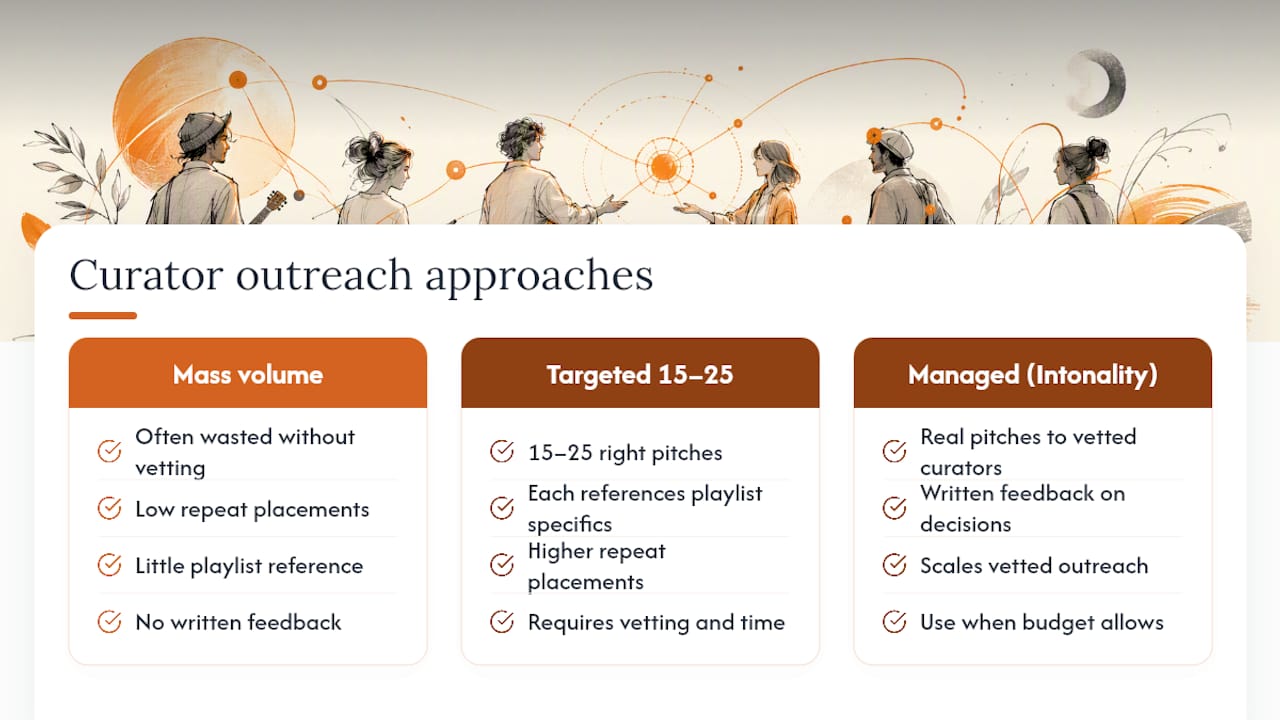
Running personalized outreach across genre-matched curators for a living teaches you fast that volume without vetting is wasted effort. The artists who see repeat placements aren’t the ones sending the most pitches. They’re the ones sending the right 15 to 25, each one referencing something specific about that playlist.
At Intonality, that’s the whole model: real pitches to real, vetted curators, with written feedback on every decision. Whether you run this process yourself or hand it to a managed campaign comes down to time and budget, not which approach works.
— Einars
Skip the Legwork With a Managed Curator Campaign
Intonality is the alternative to spreadsheet-and-cold-email outreach for artists who’d rather spend their time writing music than chasing playlist bios. Every pitch goes to a real, genre-matched curator who has been manually vetted, not an automated blast list, and every decision comes back with written feedback so you know exactly why a track landed or didn’t.
Campaigns typically result in multiple placements depending on the tier you choose, with a high curator reply rate within a week, reflecting what happens when outreach is personalized instead of mass-produced. You can see the vetted-curator model in action on a profile like amplaylists, one of the real curators in the network. If you’re weighing DIY outreach against a managed run, compare the Starter, Standard, Pro, and Max campaign tiers and pick the one that matches how much of this process you want off your plate.
Sources
FAQ
When Should I Pitch Curators Before a Release?
Send your pitch 7 to 14 days before release. Earlier risks being forgotten, and same-day pitches often get buried under a flood of other submissions, according to Rolling Stone’s reporting on playlist pitching.
Should I Pay Curators for a Playlist Placement?
No. Paying for placement is against Spotify’s terms and it damages trust with legitimate curators, who are far more likely to add a track based on fit than on payment. Intonality’s model works the opposite way: pitches are genre-matched to curators, never paid for.
How Many Curators Should I Pitch Per Release?
Build a list of 30 to 50 vetted leads, then prioritize 15 to 25 for actual outreach based on genre fit and recent activity. MusicPulse’s guide to independent curators recommends this range as a practical balance between volume and personalization.
How Long Should My Pitch Be?
Keep it between 80 and 150 words: one personal line, one description with a comparison artist, one clean link, and a low-pressure close. PlaylistSupply’s contact guide confirms this length consistently gets the best reply rates.
What Does Intonality Charge for a Campaign?
Intonality offers four tiers, Starter, Standard, Pro, and Max, with pricing available directly on the Intonality site. Campaigns can result in multiple playlist placements depending on the tier chosen.