

Getting on Spotify’s curated playlists, what the industry calls “Spotify radio placement,” comes down to one core action: pitch one focus track through Spotify for Artists at least 7 days before release, then run a tight week-one engagement plan to generate the saves, repeat listens, and playlist adds that algorithmic surfaces reward.
Three levers move the needle fastest:
- Timing. Deliver to your distributor 21–28 days before release. Seven days is the hard minimum for editorial and Release Radar eligibility; 14 days gives you real breathing room.
- Metadata. Genre, mood, instrument, culture, and location tags route your song to the right editorial team. Vague or invented tags waste the pitch.
- Week-one fan action. Saves and playlist adds in the first seven days are the clearest signal that a song deserves wider distribution.
Pitching never guarantees a placement. Editorial spots are competitive, and Spotify’s team makes the final call. Paid curator campaigns, like those Intonality runs, complement your pitch by connecting you to human curators outside Spotify’s editorial lane.
Pro Tip: Pick one song per release to pitch. Splitting focus across multiple tracks dilutes your metadata, your story, and your week-one push.
Key Takeaways
Pitching one focus track early through Spotify for Artists, backing it with precise metadata and a concentrated week-one engagement push, and supplementing with vetted curator outreach gives independent artists the strongest path to curated playlist placements.
| Point | Details |
|---|---|
| Deliver early | Get your track to your distributor 21–28 days before release to protect editorial eligibility. |
| Submit the pitch on time | Seven days before release is the hard minimum; 14 days gives editors more time to consider your track. |
| Use precise metadata | Genre, mood, instrument, culture, and location tags route your song to the right editorial team. |
| Prioritize week-one saves | Saves and low skip rate in the first seven days are the strongest signals for algorithmic discovery. |
| Intonality for curator access | Intonality pitches your track to vetted, genre-matched curators and delivers written feedback on every decision. |
Table of Contents
- How do you submit a pitch inside Spotify for Artists?
- Release timeline checklist: from 28 days out to week one
- How to write the 500-character pitch and choose tags that work
- What to do in week one to earn algorithmic and playlist discovery
- When should you add a paid curator campaign to your plan?
- How to spot fake playlist services before you pay
- Intonality connects your track to real curators who actually listen
- What our team checks before every outreach campaign
- Sources
How do you submit a pitch inside Spotify for Artists?
The pitch form lives inside your Spotify for Artists dashboard. Here’s the exact path and what each step requires.
- Log in at Artists.
- Navigate to Music → Upcoming and select the unreleased track you want to pitch.
- Open the pitch form. You’ll see fields for genre, mood, instruments, culture, location, and a 500-character story field.
- Complete every field. Incomplete forms are weaker submissions, not neutral ones.
- Submit before the 7-day minimum. Earlier is better.
Before you open the form, confirm these preconditions:
- Your Spotify for Artists profile is claimed and you have Admin or Editor access.
- Your distributor has delivered the track and it appears in the Upcoming tab. If it isn’t there yet, you cannot pitch.
- Metadata is clean: artist name, song title, featured artists, ISRC, explicit flag, artwork, and release date are all verified and correct. Errors here block editorial eligibility.
One operational note: song pitches and video pitches run through separate flows with different eligibility rules. You can pitch only one song per release, and edits after submission may not be seen by the editorial team before they make their decision.
Release timeline checklist: from 28 days out to week one
A clean release timeline removes every obstacle between your track and an editorial review. Miss a window and you lose eligibility, not just priority.
| Milestone | Action |
|---|---|
| 28–21 days before release | Deliver to your distributor. This buffer covers encoding delays and metadata fixes. |
| 14 days before release | Confirm the track appears in Spotify for Artists Upcoming tab. Start drafting your pitch. |
| 10–14 days before release | Complete and submit the pitch form with all tags and the 500-character story. |
| 7 days before release | Hard deadline. Pitching after this point loses Release Radar eligibility. |
| Release day | Post across all channels. Send fans directly to the Spotify release page, not your profile. |
| Week one | Monitor saves, playlist adds, and follower conversion inside Spotify for Artists analytics. |
After release, watch these signals closely:
- Saves per listener (the single strongest algorithmic signal)
- Playlist adds from listeners, not just editorial
- Skip rate on the first 30 seconds
- Follower conversion from new listeners
How to write the 500-character pitch and choose tags that work
The pitch form is not a marketing brief. It’s a routing tool. Editors and Spotify’s internal systems use your tags to send the song to the right team, so specificity matters more than creativity here.
Choosing tags:
- Genre: Pick the closest real genre, not an invented hybrid. “Indie pop” routes correctly. “Cinematic dream-folk” routes nowhere.
- Mood: Think about the listener’s state, not the song’s emotional arc. “Workout,” “late night,” and “focus” are useful. “Transcendent” is not.
- Instruments: List what’s actually prominent. A piano-forward track with no guitar shouldn’t list guitar.
- Culture and location: Use these when they’re genuinely accurate. A track recorded in Nashville with country roots should say so. Fabricating cultural context to seem more interesting hurts discoverability.
Writing the 500-character story:
Lead with the song’s concrete context: what it’s about, where it fits in a listener’s day, and any real campaign hooks (a music video dropping simultaneously, a tour, press coverage). Real metrics help if you have them. “Our last single hit 40,000 streams in two weeks” is useful context. “This song will change lives” is noise.
Poor pitch: “This is our most emotional song yet. It comes from the heart and we think listeners everywhere will connect with it.”
Stronger pitch: “A late-night breakup track built around a single piano loop and layered vocals. Fits playlists like ‘sad indie’ and ‘heartbreak songs.’ Video drops on release day; we have a 10-date East Coast tour starting the following week.”
Pro Tip: Read your pitch aloud. If it sounds like a press release, rewrite it as if you’re explaining the song to a curator over coffee.
For deeper guidance on selecting genre tags and writing pitch copy, Intonality’s blog covers both in detail.
What to do in week one to earn algorithmic and playlist discovery
Editorial pitching is the opening move. Week one is where the game is actually played. Strong early engagement signals tell Spotify’s algorithm that a song deserves wider distribution, and they create a second-chance path to editorial surfaces even if the initial pitch didn’t land a placement.
The metrics that matter most are saves, repeat listens, low skip rate, playlist adds, and geographic concentration.
Tactics that generate those signals:
- Send fans to the specific release URL, not your artist page. Every click should land on the song.
- Time short-form video clips to the track’s strongest hook, ideally within the first 15 seconds.
- Use email, SMS, and fan community channels on release day, not the day after.
- Ask collaborators and featured artists to post on the same day to concentrate geographic signals.
Release Radar functions as a clean first test for pitched songs. If your pitch was submitted on time, your followers see the track there automatically. Their behavior in that first week, whether they save it, skip it, or add it to a playlist, feeds directly into whether algorithmic surfaces like Discover Weekly pick it up later.
Use Spotify for Artists analytics to track saves, playlist adds, and follower conversion daily during week one. A drop in saves after day three usually means your promotional push has stalled.
When should you add a paid curator campaign to your plan?
Editorial pitching and paid curator outreach are not competing strategies. They operate on different tracks and serve different goals.
Editorial playlists cannot be bought. Spotify’s in-house team makes those decisions independently. Paid curator campaigns reach independent playlist curators, the people running genre-specific playlists with real, engaged audiences outside Spotify’s editorial system.
Add a paid curator campaign when:
- Your internal reach is limited and you need genre-specific curator access you don’t have organically.
- You want written curator feedback to understand how your track is landing with real listeners.
- You need transparent, dashboard-level reporting on placements, not just a stream count.
What a reputable service should deliver: genre-matched curator outreach, written responses from every curator who reviews the track, real playlist placements (not inflated follower counts), and engagement metrics you can verify inside Spotify for Artists.
Acceptance rates are low across all paid curator platforms. A service that matches your track carefully to genre-appropriate curators will always outperform one that blasts it to hundreds of mismatched playlists.
Paid curator campaigns work best as amplification, not as a substitute for a clean editorial pitch and a strong week-one push. The artists who get the most from curator outreach are the ones who’ve already done the foundational work: a polished profile, precise metadata, and a release plan that concentrates early engagement.
Evaluate ROI by placements per campaign, follower conversion from those playlists, and whether the playlist audiences actually match your genre. Raw stream counts without engagement context tell you almost nothing useful.
How to spot fake playlist services before you pay
The playlist promotion space has real operators and outright scams. The difference is usually visible before you spend a dollar.
Red flags to walk away from:
- Any guarantee of placements or a specific stream count. Reputable providers don’t guarantee editorial placements and won’t promise curator acceptance.
- Opaque curator lists with no verifiable playlist URLs.
- Sudden spikes in listener counts from countries unrelated to your genre or fan base.
- No written curator feedback, just a number.
- Requests to run fake saves or bot streams alongside the campaign.
Questions to ask before you pay:
- Can you show me recent curator responses for tracks in my genre?
- Do your placements convert to saves and follower growth I can verify in Spotify for Artists?
- How do you match genre and audience, specifically?
A service that can’t answer those three questions clearly is telling you everything you need to know. Transparency about curator identity, playlist audience, and reporting methodology is the baseline, not a premium feature.
Suspicious reporting patterns include inflated follower counts on playlists with no engagement history, placements on playlists that disappear within 48 hours, and stream spikes that don’t appear in your Spotify for Artists geographic breakdown. For a detailed breakdown of fake stream patterns and what suspicious activity looks like in your analytics, Intonality’s guide covers the technical signals specifically.
Before paying any service, search the playlist URLs they’ve provided, check the curator’s submission history on platforms like QuickRapReview, and verify that the playlists have real followers and recent activity.
Intonality connects your track to real curators who actually listen
Real curator access, without the guesswork, is what separates a campaign that moves your numbers from one that just moves your budget.
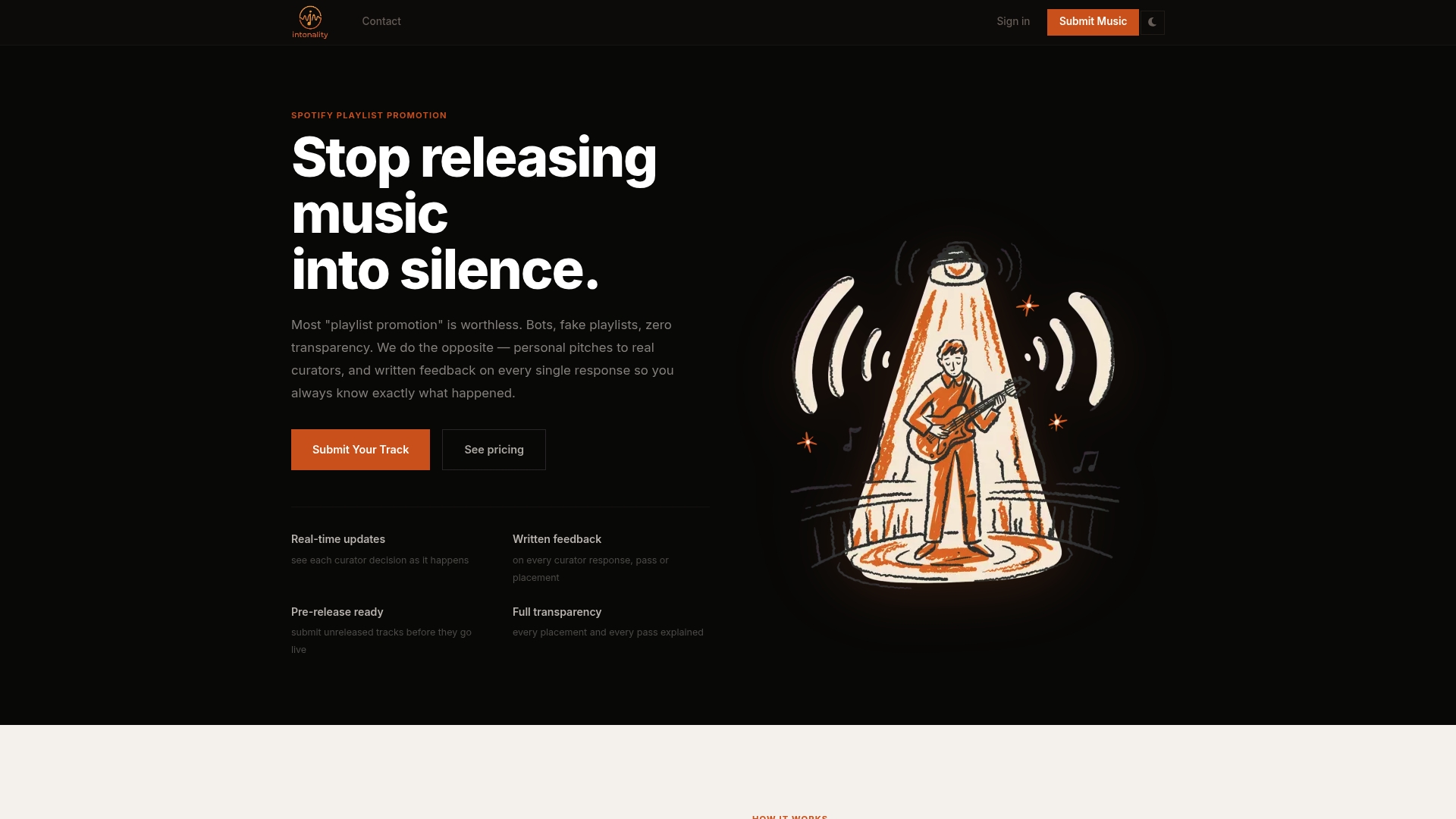
Intonality pitches your track personally to vetted, genre-matched human curators, not an automated blast to a generic list. Every curator decision comes with written feedback, so you understand exactly why a track was accepted or passed on. The campaign dashboard gives you real-time updates throughout the process, and placements average 4 to 11 per campaign depending on the tier you choose.
The workflow fits directly into your editorial pitch plan: submit your track to Intonality before or around your release date, run your Spotify for Artists pitch in parallel, and use the curator feedback to sharpen your next campaign. It’s playlist promotion built for independent artists who want real results and real data, not inflated metrics.
Submit your track at Intonality and choose the campaign tier that matches your release goals.
What our team checks before every outreach campaign
The artists who get the most from curator campaigns are the ones who treat the pitch as the last step, not the first.
Before any outreach, the checklist we run at Intonality covers four things: profile polish (bio, photos, recent activity all current), a single confirmed focus track, verified distributor delivery with clean metadata, and at least three short-form video clips ready to deploy on release day. Curators assess artist profiles before they accept a track. A sparse or outdated profile is a quiet rejection before the song even plays.
When prioritizing curators, genre fit comes first, then recent engagement on the playlist, then audience quality. A playlist with 2,000 engaged listeners in your genre is worth more than one with 50,000 followers who haven’t saved a track in six months.
The real trade-off in curator outreach is broad versus deep. Sending to 200 loosely matched curators generates noise. Sending to 40 tightly matched ones generates data you can use. Cost per curator matters less than conversion per placement, and knowing when to pause a campaign, usually when placements stop converting to saves, is as important as knowing when to launch one.
Sources
- Pitching music and videos to Spotify playlist editors - Spotify
- How to Get on Spotify Playlists: A Practical Guide for Independent Artists - RouteNote - Radar
- spotify-playlist-submission-guide - Orphiq
- How to Get on Playlists on Spotify in 2026 - The Hype Magazine


