

The fastest, correct way to pitch an unreleased song is to submit it through Spotify for Artists for editorial consideration and Release Radar, then run parallel outreach to vetted independent curators. Pitch at least 7 days before release, though 14 to 21 days gives you more room for editors to review it. Pair that official pitch with personalized outreach using private streaming links, and make sure your metadata and demo are ready before you submit anything.
TL;DR:
- Pitch your unreleased song at least 7 days before release, with 14 to 21 days providing better chances for playlist placement and editorial review.
- Ensure your release is fully processed, metadata is accurate, and your artist profile is up to date before submitting your pitch.
- Use specific, factual information in your pitch, focusing on genre, mood, instrumentation, and audience, to improve matching with playlists.
- Reach out to independent curators with private links and personalized messages, and track their responses to build genuine relationships.
- For larger or more complex campaigns, consider using a managed service that provides personalized curator outreach and detailed feedback.
Table of Contents
- Where to submit your Spotify pitch and when to send it
- Get your release and profile ready before you pitch
- What to put in the Spotify pitch box, with an example
- How to pitch independent curators outside Spotify’s own tool
- Finding curators worth your time
- Reading momentum and avoiding costly mistakes
- Intonality’s approach to genre-matched curator pitching
- Best practices for pitching to record labels and A&R
- Using industry contacts and networking to pitch unreleased tracks
- Legal considerations before you share unreleased music
- Writing pitch emails and messages beyond the Spotify form
- Pitching outside Spotify: SoundCloud and direct submissions
- Choosing between doing it yourself and using a managed service
- Submit your track through a managed pitching campaign
- Sources
- FAQ
Where to submit your Spotify pitch and when to send it
Spotify pitching happens inside your Spotify for Artists dashboard, not through a public form or a general inbox. Log into the dashboard, go to the Music tab, select Upcoming, choose the unreleased track, and fill out the pitch form with details about the song’s story, genre, mood, and instrumentation, as Spotify’s own pitching guidance lays out.

Timing is the part artists get wrong most often. Spotify requires the pitch at least 7 days before release to be eligible for both editorial playlist consideration and automatic inclusion in your followers’ Release Radar. Industry guidance suggests pitching 14 to 21 days ahead when possible, since that gives editors more lead time to listen and slot your track into a themed playlist before release day.
It helps to know what pitching actually guarantees versus what it doesn’t:
- Pitching at least 7 days early adds your song to your followers’ Release Radar automatically.
- Editorial playlist placement is never guaranteed. Editors choose which songs from your release fit their playlists, if any.
- Release Radar only includes one song per artist per week, and it skips tracks a listener has already heard.
- Once submitted, most pitch details can’t be edited, so accuracy matters the first time.
Missing the window doesn’t just cost you a shot at an editorial playlist. It also means your existing fans might not see the new song surface automatically in their Release Radar, which is often a bigger loss for an independent artist than editorial exposure itself.
Get your release and profile ready before you pitch
A pitch is only as strong as the release behind it. Editors and curators judge quickly, so the groundwork matters more than the wording of your pitch.
- Deliver your masters and metadata to your distributor early enough that the release is fully processed before your pitch deadline.
- Confirm the release is showing correctly in your Spotify for Artists dashboard before you submit the pitch.
- Embed accurate metadata (title, writer credits, ISRC, contact info) directly into your audio files, since this data follows the track through licensing and discovery systems, a point echoed in guidance on sync licensing that treats metadata as essential for any professional pitch.
- Update your Spotify artist profile: a current bio, a high-quality image, accurate genre tags, and an active Artist Pick showing the new release.
- Run the song past a few trusted listeners first. If it doesn’t get a genuine, unprompted “wow,” it may not be ready for a direct pitch yet.
That last point matters more than most artists admit. SongTown’s guidance on submitting songs recommends a ladder: test the song in low-stakes feedback settings first, then professional feedback, then direct pitches, since a weak demo pitched too early can cost you a curator’s future attention.
Pro Tip: Play your unreleased track for someone outside your immediate circle without any context. Their first ten seconds of reaction tell you more than a week of your own second-guessing.
What to put in the Spotify pitch box, with an example
The pitch form rewards specificity, not enthusiasm. Editors read hundreds of these, so the fields that matter most are the ones that tell them exactly where your song fits: genre, mood, instrumentation, and who the audience is.
- Story: one or two sentences on what inspired the song or what makes this release notable, stated plainly.
- Genre and mood: pick the closest match rather than stacking five genres, since vague tagging makes your song harder to slot into a themed playlist.
- Instrumentation: name the standout elements (a specific synth line, a string arrangement, a vocal treatment) rather than a generic “acoustic” or “produced.”
- Audience and comparable artists: describe who the song is for and name one or two comparable artists for context, without claiming your song will outperform them.
A short template that adapts well to the pitch box:
“[Song title] is a [genre] track about [one-line story], built around [instrumentation detail]. It should appeal to listeners of [comparable artist(s)] and fits well in [mood] playlists. [Optional: one line about touring, prior placements, or momentum].”
Detailed pitch fields and audience framing directly affect whether your track gets matched to the right editorial lane, a point covered in Intonality’s guidance on tailoring Spotify pitch copy, which walks through choosing categories that fit your genre and mood description.
Keep the tone factual. Overhyping (“this will be huge”) reads as inexperience to an editor who has heard that line thousands of times. A grounded pitch with a clear hook and honest context tends to land better than one leaning on adjectives.
How to pitch independent curators outside Spotify’s own tool
Spotify’s pitch form only reaches Spotify’s internal editors. Independent playlist curators, the people running genre-specific playlists with real followings, need a separate, more personal approach.
- Use a private link rather than a public one: a Spotify for Artists private streaming link, a private SoundCloud link, or a passworded page keeps the track off public radar until release day.
- Research the curator before reaching out: listen to their playlist, note the mood and pacing, and check whether your track actually fits before you send anything.
- Write a short, personalized message that includes the track title, genre, release date, a private link, and one specific sentence on why the song fits their playlist.
- Send one follow-up message if you haven’t heard back within a week or two, phrased as a polite check-in rather than a repeat pitch.
A workable outreach template: “Hi [name], I’ve been listening to [playlist name] and think [song title] would fit well alongside [track you noticed on their list]. It’s a [genre/mood] track releasing [date]. Here’s a private link if you’d like a listen: [link]. Thanks for considering it.”
Cliff Goldmacher’s guide to pitching music recommends limiting how many songs you pitch to any one contact at once and staying professional even after a pass, since curators remember artists who follow up gracefully far more than artists who don’t follow up at all.
Finding curators worth your time
Not every playlist labeled “indie” or “chill” is run by someone actively curating it. Before you pitch, check a few signals.
- Compare a playlist’s follower count against its actual engagement: a large following with almost no listens on individual tracks is a warning sign.
- Read the curator’s bio and check whether they post consistently on social platforms tied to the playlist, since an active presence usually means a real, engaged audience.
- Watch for inconsistent follower-to-listen ratios or sudden follower spikes, which often point to bot activity rather than organic growth.
- Score each prospect quickly on three things: genre fit, engagement level, and how credible the curator’s presence looks across platforms.
- Keep a simple tracker (a spreadsheet works fine) logging who you’ve pitched, when, and their response, so you’re not guessing which curators are worth a second pitch later.
Intonality’s guide to winning editorial playlist categories breaks down how playlist lanes are organized by genre and mood, which is useful background when you’re trying to match your own release to the right kind of independent playlist as well.
Reading momentum and avoiding costly mistakes
Once your pitch is in and the release is live, your early streaming numbers become a signal, not just a scoreboard. Watch how the track performs in Release Radar during its first week: strong retention and repeat listens tell you the song is landing with your existing audience, which is useful information whether or not an editorial placement follows.
If a curator does add your track, thank them, and use that placement as social proof in future outreach to other curators. If editorial placement doesn’t happen this time, that’s normal. Most releases don’t land an editorial slot, and the smarter move is folding the release into your broader plan rather than treating one pitch as a verdict.
A few mistakes come up constantly: pitching before the track or profile is actually ready, leaning on hype language instead of specifics, and paying for guaranteed streams or fake playlist placements, which can violate platform terms and rarely produce real listeners.
Pro Tip: Treat your first week of Release Radar data as a test, not a report card. A quiet week doesn’t mean the song failed, it means you have real numbers to work with for your next pitch.
Intonality’s approach to genre-matched curator pitching
Some artists want the outreach handled for them rather than building curator relationships from scratch. Intonality runs personalized pitching campaigns to real, manually screened Spotify curators, matched to your genre rather than blasted to a generic list. Every curator decision comes back with written feedback, so you see why a track was accepted or passed on, along with real-time updates through a dashboard as the campaign runs.
Campaigns can result in multiple playlist placements, depending on the service tier chosen. That kind of managed route tends to make sense when you’re short on time to research curators yourself, want direct feedback instead of silence, or are pitching a release where you’d rather have curated introductions than cold outreach.
Best practices for pitching to record labels and A&R
Pitching a label or an A&R representative is a different exercise than pitching a curator. Labels are evaluating whether they can build a career around you, not just whether one song fits a playlist. Lead with a tight, professional package: a strong demo, a clear one-paragraph artist story, and evidence that you already have some audience traction, even a modest one.
Keep the pitch short. A&R representatives receive large volumes of submissions, so an email with a clear subject line, one or two links, and a two- or three-sentence pitch performs better than a long biography. Mention specifics: your genre lane, comparable artists, any prior placements or press, and what you’re specifically asking for (a meeting, feedback, consideration for a specific imprint).
Timing and readiness matter as much here as with curator pitching. Cliff Goldmacher’s pitching guide warns that pitching material before it’s genuinely ready can burn a relationship you may want to use again later. A&R representatives tend to remember artists who pitched something half-finished, and that memory works against you the next time you have something worth their attention.
Never send a mass, identical email to a list of labels. A generic pitch signals you haven’t done the homework on who that label signs and why your sound fits their roster.
Using industry contacts and networking to pitch unreleased tracks
A warm introduction beats a cold pitch nearly every time, because a referral carries someone else’s credibility. Build relationships before you need them: attend local showcases, connect with other artists in your genre, and stay in touch with producers, engineers, or managers you’ve worked with, since any of them may know a curator, A&R contact, or blog editor who’s a genuine fit for your sound.
When you do have a contact, ask for an introduction rather than the contact’s information alone. “Would you be comfortable introducing me to [person]?” respects their relationship and gives them an easy way to vouch for you if they choose to.
Local scenes matter more than artists sometimes assume. Playing shows, collaborating with other independent musicians, and showing up consistently at industry events builds the kind of reputation that eventually turns into someone else pitching your music on your behalf, without you asking.
Treat every professional interaction, even a short one, as a possible future connection. A sound engineer today might be running a label’s A&R department in five years, and how you handled that first interaction tends to stick.
Legal considerations before you share unreleased music
Sharing an unreleased track, even privately, comes with a few things worth locking down first. Make sure you actually hold the rights you’re pitching. If the song has co-writers, producers, or samples involved, confirm ownership splits and clearances before you send it anywhere, since a pitch that leads to interest can move fast, and unresolved rights questions can stall or kill a deal.
Metadata plays a role here too. Embedding your name, ISRC code, and contact details directly into the audio file protects your claim to the work and makes licensing conversations easier if a curator, supervisor, or label wants to move forward, a point that guidance on sync licensing treats as a basic requirement before pitching for any professional placement.
If you’re sharing an unreleased track with a label or a company under a formal negotiation, an NDA can be appropriate, particularly if the conversation involves specific business terms rather than a general listen. For most curator pitches and casual industry outreach, an NDA is unnecessary and can even come across as distrustful. Reserve it for situations where real commercial terms are on the table.
When in doubt about ownership splits or contract language, a music attorney or a rights organization in your country is a better source than general advice, since ownership and licensing rules vary depending on where you and your collaborators are based.

Writing pitch emails and messages beyond the Spotify form
Not every pitch happens inside a form. Blogs, podcasts, radio shows, and independent playlist curators are usually reached by email or direct message, and the format rewards brevity over the kind of long artist bio many musicians default to.
Open with the one sentence that matters: what the song is, the genre, and why you’re reaching out to this specific person. Skip the life story. A curator or blog editor deciding whether to click a link in the next five seconds doesn’t need your creative journey, they need enough context to know if the track fits what they cover.
Include a private streaming link, the release date, and one line of comparable context (an artist, a mood, a scene) rather than a paragraph of description. Close with a clear, low-pressure ask: a listen, a consideration for a specific playlist or feature, nothing more demanding.
Personalization is what separates a pitch that gets opened from one that gets deleted. Reference something specific about their playlist, blog, or show, one track they’ve featured recently, a description on their page, anything that proves you didn’t copy-paste the same message to fifty contacts. Velveteen notes that blind, generic pitching is one of the most common reasons tracks get ignored, and that pattern holds just as true for email outreach as it does for the Spotify form itself.
Pitching outside Spotify: SoundCloud and direct submissions
Spotify isn’t the only place to build momentum before release. SoundCloud remains a common tool for sharing unreleased tracks privately with curators, bloggers, and other artists, since its private link and repost features make it easy to share a track without making it public.
Direct submissions to music blogs, podcasts, and independent radio shows work similarly to curator outreach: research who covers your genre, personalize the message, and include a private link rather than a public one until the release is out. Many blogs list submission guidelines directly on their site, and following those instructions exactly tends to matter more than the pitch’s polish.
Paid promotional tools can also fit into a broader release plan, though they work best as a supplement rather than a substitute for direct outreach. A course on promoting music through Facebook Ads is one example of a resource artists use to build pre-release awareness through paid social reach, separate from curator or editorial pitching entirely.
Whatever combination you use, building momentum before and after release tends to matter more than any single pitch, since editors and curators are more likely to notice a track that already shows signs of traction elsewhere.
Choosing between doing it yourself and using a managed service
If you’re early in your career, doing the outreach yourself teaches you things a managed service can’t: how curators think, what your genre lane actually sounds like, and which pitches get ignored. That knowledge compounds over releases.
If you’re past the learning phase and short on time, a managed service trades some of that hands-on learning for speed, curated introductions, and structured feedback you’d otherwise spend months collecting yourself.
A rough guide: if you’re releasing your first few songs, pitch yourself and build the skill. If you’re releasing consistently and need to protect your time, a managed route with real feedback is worth the cost. If you’re scaling toward label or sync interest, combine both: keep your own curator relationships while using a managed campaign to widen reach.
— Einars
Submit your track through a managed pitching campaign
If curator outreach sounds worth doing but not worth doing alone, Intonality runs the pitching for you: personalized submissions to real, genre-matched curators, with written feedback on every decision and real-time updates as your campaign runs.
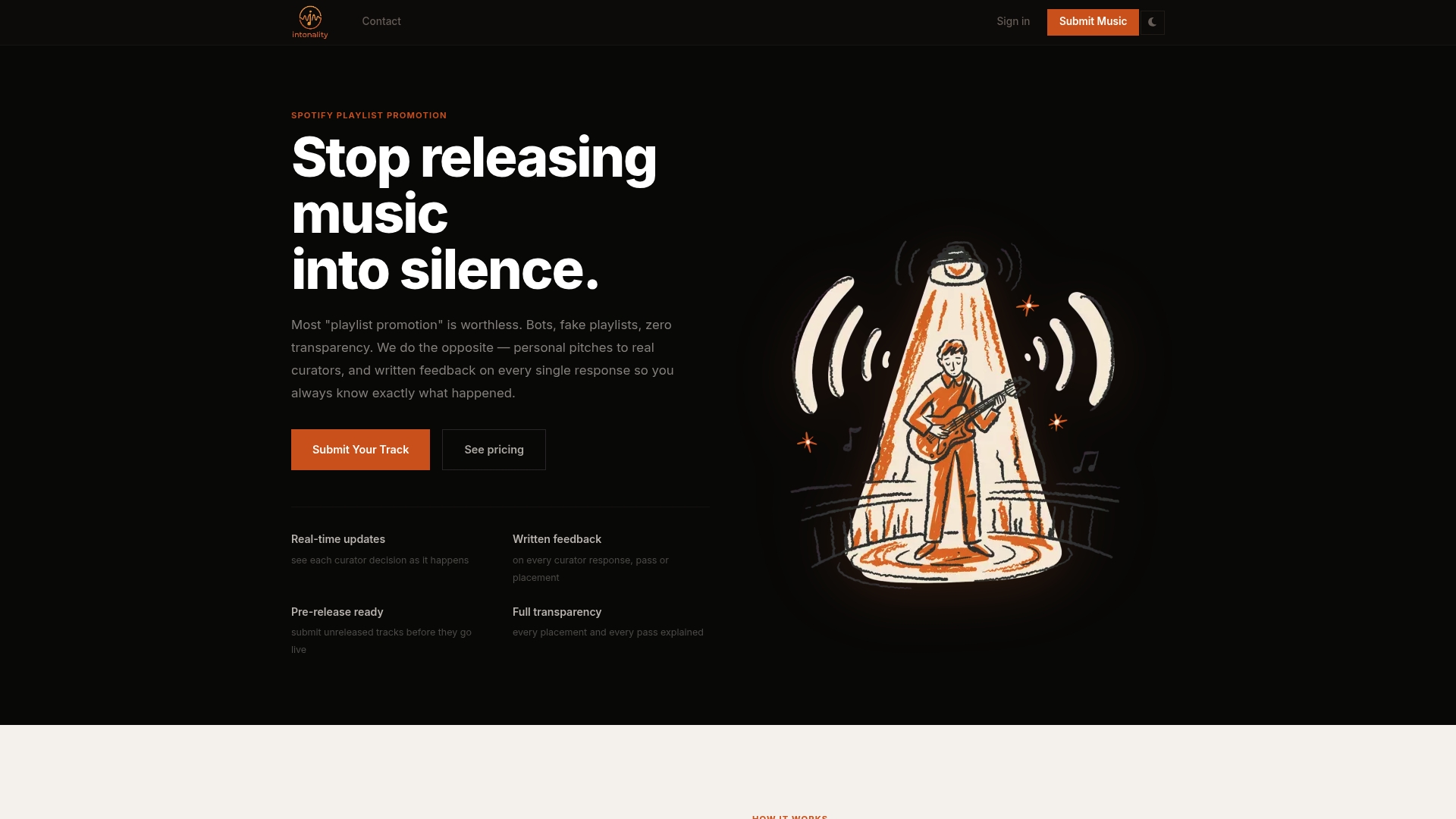
This suits artists who want curated introductions and honest feedback rather than a guessing game of cold emails, without the fake streams or bot playlists that some cheaper services rely on. Campaigns run across multiple tiers with pricing details available on the company’s website. Submit your track to start a campaign, or visit Intonality to compare what each tier includes.
Sources
- Spotify for Artists – Get started
- Pitching music and videos to Spotify playlist editors - Spotify
- The DIY Guide to Pitching Songs to Anyone in the Music Industry - Cliff Goldmacher
- How do I submit a song as a songwriter? - SongTown
FAQ
Is it illegal to listen to unreleased songs?
Listening to an unreleased song is not illegal on its own, but obtaining or sharing it without the artist’s permission can violate copyright law. Unreleased tracks are protected the same way finished releases are, so leaked or pirated files still belong to the songwriter and any co-owners.
Can you pitch an already released song on Spotify?
No. Spotify’s pitching tool is built for unreleased tracks pitched before their release date, since the process is tied to editorial consideration and Release Radar inclusion that only apply before a song goes live. Once a song is released, that pitching window closes for that track.
How can I find unreleased songs?
Unreleased songs are typically shared privately by the artist through private SoundCloud links, password-protected pages, or direct submissions to curators, blogs, and labels, rather than posted publicly. Outside of an artist’s own private sharing, there’s no legitimate public source for unreleased music.
What is the 80/20 rule in songwriting?
Definitions of the so-called “rule” vary across songwriting discussions, and no single authoritative version applies universally. A common interpretation suggests that a small portion of a song’s elements, often the hook or chorus, carries most of its impact, but this isn’t a fixed industry standard.


