TikTok and Spotify promotion do different jobs. TikTok is where people stumble on a song. Spotify is where a song becomes a habit, a save, a repeat listen and a royalty. For most independent artists the answer is not one or the other. It is TikTok for reach, Spotify playlists for listeners who stay, and a clear order of operations so neither effort is wasted.
This guide compares the two on discovery, conversion, cost and risk, then gives you a simple way to decide what to do first for your next release.
TL;DR
- TikTok is strong at discovery, but attention there often does not turn into long-term listening. Spotify is where repeat listeners are built.
- Research shows virality is concentrated in a small share of songs, so do not plan around a hit.
- Spotify promotion works best through real playlist curators and your own release tools, never through bought streams or bots.
- Run both as one chain: short video, Spotify visit, save, return. Measure each link, not just views.
- If you already have a finished release and a genre, start with curator pitching. If you have no audience at all, test content on TikTok in parallel.
What each platform actually does for a song
TikTok is a feed. People do not search for your track; the algorithm puts it in front of them inside someone else’s video. That makes it excellent for exposure and weak for commitment. A listener may love a 15-second clip and never hear the rest of the song.
Spotify is a library. Listeners save songs, build playlists and come back. A placement on a playlist that matches your genre puts the full track in front of people who chose to listen to that kind of music.
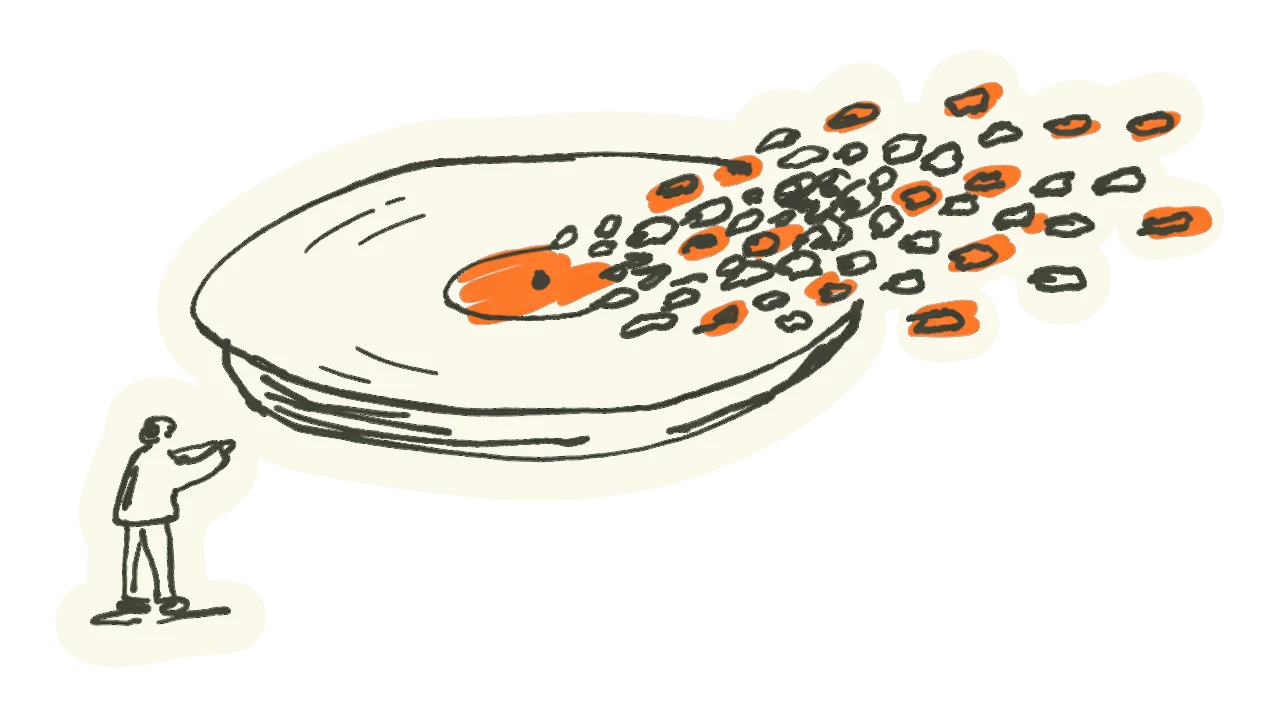
An academic study of the two platforms found that removing TikTok access lowered aggregate Spotify demand for major-label titles, but the losses were concentrated among viral songs, while the long tail showed little economically meaningful change. The same study reports that the top 10% of songs produced 96% of TikTok creations and 76% of Spotify streams in its data. In plain terms: TikTok helps the songs that already break out, and most songs never do.
Discovery versus conversion
The most useful number in this comparison is not about reach at all. MIDiA Research reported in September 2025 that 87% of consumers hear music on social media, yet more than half often heard it somewhere else first. Streaming platforms were named among the top three discovery sources by 40% of consumers, against 37% for TikTok and 52% for YouTube (MIDiA Research).
The same research found that 74% of consumers who prefer streaming as a discovery source go on to stream more music from that artist, compared with 48% of consumers who prefer TikTok. Discovery on a streaming service tends to lead to more listening afterwards.
| Factor | TikTok | Spotify |
|---|---|---|
| Main strength | Fast, wide exposure | Repeat listening and saves |
| How people find you | Algorithmic feed, sounds, trends | Playlists, search, algorithmic mixes |
| Typical listener intent | Passive scrolling | Active listening |
| What you create | Videos, trends, a recognizable hook | Pitches, profile, release strategy |
| Main risk | Views that never become listeners | Paying for fake streams or empty placements |
| Best at | Reaching strangers | Keeping them |
Is TikTok promotion worth it for music?
It can be, but it is a lottery with uneven odds. Billboard reported in December 2024 that 24 songs on the TikTok Billboard Top 50 later reached the Hot 100 in roughly the first 11 months of that year, while more than 600 songs had appeared on the TikTok chart. Prominence on TikTok did not reliably translate into broad listening (Billboard).
The cost side matters too. Billboard quoted managers and marketers saying creator and influencer campaigns had become expensive and often ineffective, because a flat-fee creator is paid the same whether a video gets two views or two million.
RouteNote’s summary of Duetti research makes the same point with numbers: fewer than 1% of TikTok songs met the report’s definition of viral, and only 15% of those saw long-term Spotify streaming growth, defined as more than 30% higher average streams four months later (RouteNote).
What this means for you:
- Posting your own content costs time, not much money. That is a fair bet.
- Paying creators a flat fee is the expensive version of the same bet.
- Plan for a clip that earns a modest number of saves, not for a breakout.
Video costs can add up too. If you plan to use AI tools for visuals, it helps to understand how AI video credits work and what they cost before you build a content calendar around them.
Is paying for Spotify promotion worth it?
It depends entirely on what you are paying for. Spotify’s own guidance says that paid third-party services guaranteeing streams or playlist placement in exchange for money violate its terms. It also says it removes artificial streams and may charge labels and distributors per track when artificial streaming is high (Spotify support). So the safe version of Spotify promotion is one with no guarantees, no bots and no purchased plays, where real people decide whether your song fits their playlist.
That is the line we draw at Intonality. If you want the full picture of how to spot the unsafe kind, read our guides on fake streams on Spotify and playlist promotion scams. To judge whether the money is justified, see our honest look at whether playlist promotion is worth it.
There are also Spotify’s own paid tools. Marquee, for example, is described by one distributor’s help page as requiring at least 5,000 streams in the last 28 days in an eligible market, at least 1,000 followers and a minimum budget of $100 to $250 (Kycker). That makes it a tool for artists who already have traction, not for a first release.
Why a playlist placement is worth more than a view
A stream from a playlist listener is a different thing from a view. HypeBot reported that Spotify’s Fresh Finds playlists generated more than 65 million artist discoveries in 2024, with nearly 70% of their streams being first-time discoveries. Artists’ new listeners and international streams more than doubled on average a month after a first placement (HypeBot).
The same analysis, citing Spotify audience segmentation, says monthly active listeners average 33% of an artist’s Spotify audience but generate 60% of streams and 80% of merchandise purchases through Spotify. The takeaway is that the listeners who come back are the ones who pay your bills. Raw reach is not.
This is why curator pitching exists: a genre-matched placement puts the track in front of people who already like that sound, and the saves and repeat plays that follow can signal to Spotify’s recommendation systems that the song deserves wider distribution. We cover that mechanism in how to trigger the Spotify algorithm with curator pitching.
Which should you do first?
Use your situation, not a trend, to decide.
If you have a release date and no audience
Pitch before launch. Spotify lets artists submit unreleased music to its editorial team through Spotify for Artists (Spotify for Artists), and you can do the same with independent curators. Meanwhile, start posting short clips of the hook so there is something to point people to on release day.
If a TikTok clip is already doing numbers
Make the Spotify step as easy as possible. Spotify’s integration lets US and UK listeners save a song they hear on TikTok straight to their Liked Songs (Spotify Newsroom). Pin a comment, keep the song name in your bio and make sure your Spotify profile is ready for visitors.
If you have steady listeners but they are not growing
Playlist placement is usually the better lever. Match the track to curators in your exact genre rather than chasing every list. Our guide to Spotify marketing strategy for independent artists walks through the sequence.
If your budget is small
Spend time on TikTok and money on Spotify. Content costs hours, and a well-targeted pitch campaign is the more predictable use of cash. For a framework, see promotion budget allocation for independent musicians.
Treat both as one chain
HypeBot’s analysis argues that campaigns should be judged as a chain: TikTok exposure, a Spotify visit, a save, catalogue exploration and a return, rather than as separate view and stream totals. That is a practical way to work.
A simple weekly routine:
- Post two or three short clips built around the strongest 15 seconds of the song.
- Put the Spotify link everywhere a viewer might look.
- Run a genre-matched curator campaign for the same track.
- Check Spotify for Artists for saves, listeners and where streams come from.
- Repeat what the numbers support and drop what they do not.
What to measure when comparing the two
Views and streams alone say little. Track these instead:
- Save rate: saves divided by listeners. It shows whether people want to hear the song again.
- Listeners versus streams: a high number of streams from few listeners suggests looping, not growth.
- Source of streams: playlists, your profile, search or algorithmic recommendations.
- Followers gained per campaign: a direct sign of whether a placement built a base.
- Cost per placement or per follower: divide your spend, in money and in hours, by what you got.
There is no fixed number of views or streams that guarantees a specific income. The study mentioned earlier estimated roughly $9 to $10 million in forgone Spotify royalties during the TikTok withdrawal window, but that was concentrated in viral titles (Springer). Per-stream payouts vary by listener country, subscription type and your distributor’s terms, so use your own statements for estimates. Our guide on verifying promotion with Spotify for Artists analytics shows where to look.
Perspective
We built Intonality around a simple observation: the artists we talk to rarely lack attention. They lack listeners who stay. A video can be seen a million times and leave nothing behind, while a placement on the right playlist can put a song in front of people who already like that genre.
That is why we pitch to real curators who are manually screened and genre-matched, and why every decision comes back with written feedback. A decline tells you something. A placement tells you what worked. Both are published, so you can see what happened to your song instead of guessing.
We do not use fake streams or bots, and we do not think any artist should. Our approach is to give your track a fair hearing from the people who run the lists, then let you use TikTok, your socials and your live shows to carry the momentum. The two platforms work best when the first creates curiosity and the second gives it somewhere to land.
Einārs
How Intonality fits into the plan
If Spotify is your next step, Intonality sends personalized pitches for your track to vetted, genre-matched curators. You get real-time campaign updates and written feedback on every curator decision, and you can submit before release. Our Starter, Standard, Pro and Max tiers are described on our main page, and the company reports an average of 4 to 11 playlist placements per campaign depending on the tier. Results are never guaranteed.
You can also browse public campaigns with real curator feedback to see how curators respond to different tracks, or read our comparison of the best Spotify playlist promotion for independent artists before you choose.
FAQ
Is it better to promote on Spotify or TikTok first?
Promote on both, but pitch Spotify first if your song is finished and you have little audience. Playlists build listeners who stay, while TikTok content can run alongside at low cost. If a clip is already spreading, send that traffic to Spotify immediately.
Is TikTok promotion worth it for music?
Organic posting usually is, because it costs time rather than money. Paid creator campaigns are riskier, since flat fees do not depend on results. Research shows only a small share of TikTok songs achieve lasting streaming growth, so treat it as reach, not a guarantee.
Is paying for Spotify promotion worth it?
It can be when you pay for real curator pitching with no guaranteed streams, bots or purchased plays. Spotify’s guidance prohibits services that guarantee streams or placement for money. Judge any campaign by the saves, listeners and followers it produces in Spotify for Artists.
How many streams do you need on Spotify to make $10,000?
There is no fixed number, because payouts depend on where listeners are, their plan type and your distribution deal. Check your own distributor statements to see your average per-stream rate, then divide. Treat any universal figure with caution.
Sources
- Does TikTok promote or cannibalize music streaming? (Springer)
- New MIDiA Research Data Shows Why Virality Is Not Building Fandom
- Marketing Music on TikTok: Why It’s Not Working as Well (Billboard)
- Does TikTok drive viral music? (RouteNote)
- Third-party services that guarantee streams (Spotify support)
- Spotify Marquee (Kycker)
- A Stream Is Not a Fan (HypeBot)
- Share New Music for Playlist Consideration (Spotify for Artists)
- Save songs to Spotify from TikTok (Spotify Newsroom)
- AI Video Credits: How They Work and What They Cost