
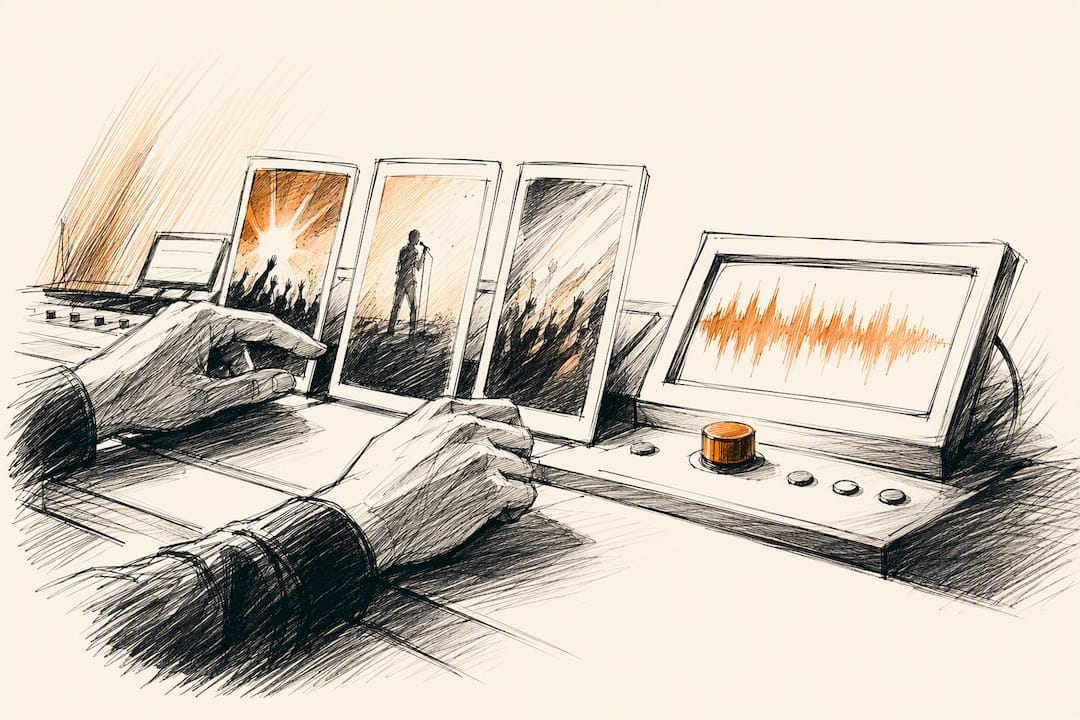
In 2026, the smartest music promotion play prioritizes short-form discovery, owned-audience infrastructure, and a release funnel built to convert, not one-off virality. Streaming still drives the business, with global recorded music revenue hitting US$31.7 billion in 2025, but the artists gaining ground are the ones pairing platform tactics with real fan ownership. Pick one goal, one audience, one format, one owned channel, then let week-one data tell you whether to scale or pivot.
TL;DR:
- Testing multiple hooks across short-form platforms and focusing on owned channels helps build authentic fan relationships and reduce platform dependency.
- Spending should be directed toward organic signals like saves and playlist adds, not just raw stream counts, to better measure true fan engagement.
- Campaigns must have a clear goal, audience, and format, with decisive week-one rules to scale or pivot based on actual performance data.
- AI tools aid productivity but pose risks if used to fake signals, so authenticity and manual oversight remain crucial in 2026.
- Building a consistent story through community, IRL activations, and fan-driven content deepens engagement beyond fleeting virality.
Table of Contents
- Top Music Promotion Trends Shaping 2026
- How Should You Divide Responsibilities Across Platforms?
- A Repeatable Campaign Framework: One Goal, One Audience, One Format, One Channel
- Pre-Release Setup, Pitching, and Sync Readiness
- Making Fans Part of the Story: Community and IRL Integration
- Finding Real Signals in Manufactured Engagement
- A Practical Checklist for Running a 2026 Release Campaign
- How Curator-Led Playlist Promotion Fits the 2026 Funnel
- Where Do AI Tools Fit in Music Promotion Right Now?
- Are Virtual and Augmented Reality Experiences Worth Pursuing?
- Do Micro-Influencers Actually Move Music Discovery?
- How Do Privacy Rules Change the Way You Promote Music?
- Beyond Streaming: NFTs, Fan Tokens, and New Revenue Paths
- Author Perspective: What Actually Separates Winners in 2026
- Ready to Add Curator-Led Placements to Your Funnel?
- Sources
- FAQ
Top Music Promotion Trends Shaping 2026
Short-form platforms like TikTok, Reels, and Shorts remain the primary discovery engine for new music, but the game has changed: posting once and hoping isn’t a strategy anymore. Artists winning attention in 2026 test multiple hooks, formats, and edits against the same song before committing budget to any single clip. What worked in 2023, one post, one caption, one shot at virality, has given way to a testing mindset borrowed straight from performance marketing.
Streaming subscription revenue grew 8.8% in 2025, and streaming now accounts for roughly 69.6% of global recorded music income. That growth isn’t evenly spread. Latin America led all regions with 17.1% growth in 2025, compared to 3.5% in North America, a reminder that discovery and promotion increasingly cross borders rather than staying locked to one home market.
The other major shift: fans want a story, not just a song. Music Ally’s trend analysis points to world-building, mystery campaigns, and IRL-plus-digital integration are defining tactics of 2026 campaigns, alongside continued momentum for owned channels.
Here’s the ranked reality for where to spend your energy:
- Short-form discovery — still the top funnel, but only effective when you test hooks rather than post once.
- Owned channels — email, SMS, and Discord protect you from algorithm swings and platform risk.
- World-building and IRL activation — deepens fan investment far beyond a single stream.
- Sync and creator partnerships — high-leverage multipliers that compound existing momentum rather than create it from scratch.
How Should You Divide Responsibilities Across Platforms?
A campaign that gives every platform the same job is a campaign with no strategy. Magnetic Magazine’s 2026 framework recommends assigning each platform one specific role, then connecting discovery to conversion to retention in a straight line instead of a scattered mess of posts.
- TikTok, Reels, and Shorts function as discovery labs. Track completion rate and shares more closely than raw views. Test three to five hook variations before deciding which one earns paid support.
- Spotify works best as a capture and retention layer once a track already shows momentum. Pitch for editorial playlists early, and treat Marquee or Discovery Mode as amplification tools for songs that are already converting, not a fix for songs that aren’t.
- Paid ads should only go behind hooks that already proved themselves organically. Route traffic to a landing page with pixel tracking so you can retarget anyone who engaged but didn’t convert.
- Email, SMS, and Discord are long-term assets. Segment early fans by engagement level (streamers versus buyers versus repeat listeners) so your messaging matches where they actually are.
- Press, playlisting, and sync work as proof points and scale levers late in the funnel, not as the first thing you chase.
A Repeatable Campaign Framework: One Goal, One Audience, One Format, One Channel
Chasing five tactics at once is how most independent budgets get wasted. A tighter framework, one that Magnetic Magazine and other 2026 strategy guides both point toward, forces clarity before you spend a dollar.
- Define one release objective and its measurable conversion event. Is success a pre-save, an email signup, a merch sale? Pick one and design everything else around it.
- Profile your primary audience and build three to five hook tests. Don’t guess who’s listening; use your existing Spotify for Artists data or past post performance to inform the profile.
- Choose your primary content format, then map variants for each platform. A vertical performance clip might become a Reel, a Short, and a TikTok with three different captions, not three different pieces of content.
- Design the funnel and the owned-channel capture mechanism. Every ad or organic post needs somewhere to send people that isn’t just “more content.”
- Set week-one decision rules before you launch. If saves-per-stream and click-through on your landing page hit your threshold, scale spend. If they don’t, pivot the hook, not the whole campaign.
This structure keeps a two-person team from burning a month’s budget on five different half-measures.
Pre-Release Setup, Pitching, and Sync Readiness
Execution separates campaigns that convert from campaigns that just make noise. A few non-negotiables for release week and the weeks before it:
- Build a countdown or pre-save landing page with pixel tracking installed before you post a single teaser. You cannot retarget an audience you never tagged.
- Prepare your Spotify editorial pitch at least four weeks ahead, and only lean on Marquee or Showcase once a track shows organic traction. These tools amplify existing signal; they don’t create it.
- Run a short-form ad test plan: small budget, three to five hook variants, then funnel the winner through a simple ad-to-landing-page-to-retarget sequence rather than one giant campaign with no feedback loop.
- Have a rapid follow-up plan ready in case a sync placement lands unexpectedly. Speed matters more than perfection: push short-form content tied to the sync immediately, turn on geo-targeted ads, and open a merch or ticket offer for the territories reacting fastest, a tactic practitioner interviews consistently point to as the difference between a placement that fades and one that compounds.
Making Fans Part of the Story: Community and IRL Integration
World-building doesn’t require a big budget, it requires a consistent idea fans can attach to. Music Ally’s roundup of 2026 campaign submissions shows mystery mechanics and small IRL activations outperforming expensive one-off stunts.
- Build a simple micro-world around a single release: a symbol, a ritual, or a repeatable action fans can participate in across posts.
- Add mystery mechanics, passworded Discord channels, hidden clues, or a physical mailer only true fans receive, to deepen investment beyond passive listening.
- Seed local IRL activations (a pop-up, a listening party, a flash meetup) with a handful of creators, then let user-generated content carry it to a wider audience.
- Personalize cheaply: a handwritten note in merch packaging or a voice memo sent to your top 50 email subscribers scales fan loyalty without scaling cost.
Finding Real Signals in Manufactured Engagement
Raw stream counts lie more often than artists want to admit. AI-driven and manufactured engagement is distorting traditional metrics badly enough that Forbes’ coverage of the issue frames it as an industry-wide credibility problem, with platforms actively removing spam accounts and inflated streams.
- Watch for streams that spike without matching growth in saves, shares, or profile visits, a classic sign of bot activity or fake streaming schemes.
- Prioritize saves-per-stream, playlist adds, and profile visits over total plays. These are harder to fake and better predict long-term retention.
- Track how many ad viewers actually convert to pre-saves or email signups, not just impressions or click volume.
- Cross-check any playlist placement or promotional claim against your own Spotify for Artists dashboard data before trusting a report from a third party.
A Practical Checklist for Running a 2026 Release Campaign
- Four to six weeks out: build your landing page, launch pre-save incentives, and start outreach to 10 to 20 aligned micro-creators.
- Release week: run your short-form hook tests live, and only activate Spotify promotional tools once real engagement signals appear.
- Post-release: retarget engaged non-converters, offer merch or experiences to your top fans, and pursue sync or press opportunities once you have proof of traction.
- Budget rule for indie campaigns: small, controlled tests beat one expensive bet. A modest spread across several micro-creators plus a functioning owned-channel funnel tends to outperform a single pricey placement.
How Curator-Led Playlist Promotion Fits the 2026 Funnel
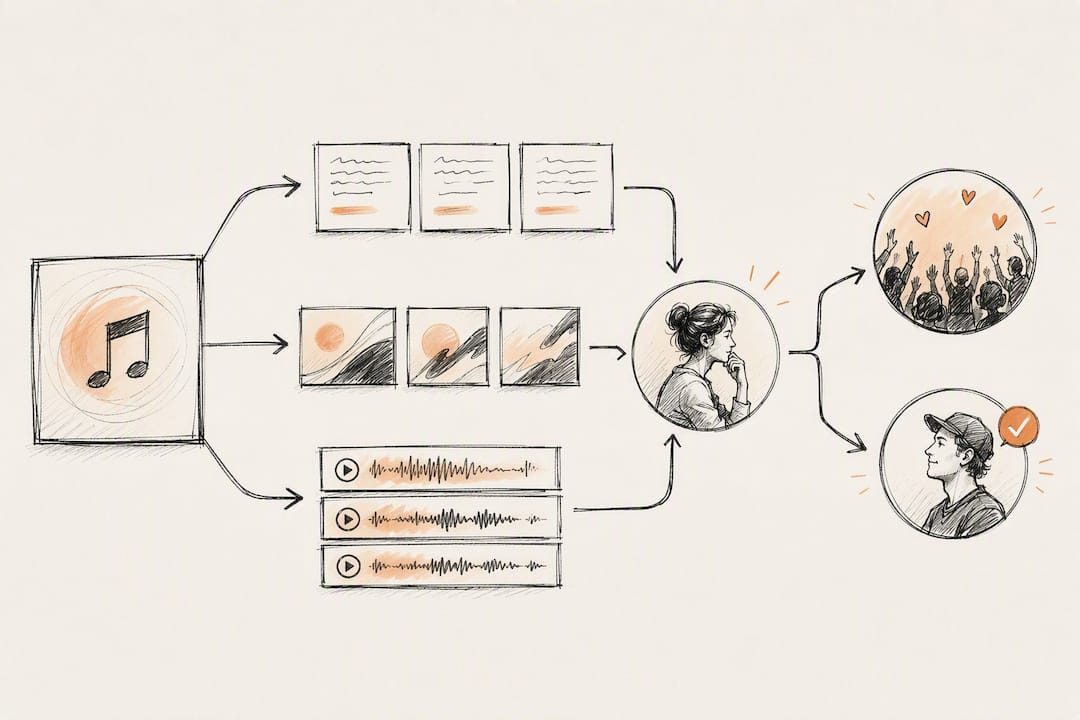
Curator-based playlist promotion earns its place in this framework when it’s paired with owned-channel follow-up, not treated as the whole strategy. Intonality’s model sends personalized pitches to real, genre-matched curators instead of automated blasts or fake playlists, and every decision comes back with real-time updates and written feedback. Campaigns often aim to achieve multiple playlist placements, with the actual number depending on the service level chosen. Placements matter most when they feed a landing page or email capture already built to hold the new listeners they send.
Where Do AI Tools Fit in Music Promotion Right Now?
AI tools are moving from novelty to infrastructure across music marketing. Artists now use generative tools for rough content drafts, caption variations, and rapid mockups of cover art or teaser visuals, then apply real editing judgment before anything goes public. Automated scheduling and basic audience segmentation have also matured, letting a solo artist manage a posting cadence that once required a small team.
The bigger shift is on the platform side. Streaming services are using AI-driven detection to flag manufactured streams and spam accounts, part of the same push toward authentic engagement that Forbes describes as reshaping how fans choose who matters. That cuts both ways for independent artists: AI tools lower the cost of producing content, but AI-powered fraud detection also means shortcuts like bot streams or purchased engagement carry more risk of getting flagged than ever.
Use AI where it saves real time, drafting captions, testing thumbnail variations, transcribing clips for repurposing, but treat it as a production aid, not a promotion strategy. The artists getting burned right now are the ones using AI to fake signal instead of using it to move faster on real content. Curator feedback and direct fan response still can’t be faked convincingly, which is exactly why manual, human-reviewed processes hold value as automated noise increases.
Are Virtual and Augmented Reality Experiences Worth Pursuing?
Virtual and augmented reality fan experiences remain a niche tactic for independent artists in 2026, valuable for a specific kind of moment, not a baseline expectation. AR filters tied to a single release, an Instagram or Snapchat effect referencing a lyric or visual motif, cost little to produce and can extend a song’s life across fan-generated content for weeks after release.
Full virtual concerts or VR listening experiences sit at the other end of the spectrum: expensive, technically demanding, and generally better suited to artists with label or platform backing than to a self-funded release. For most independent musicians, the more useful application is smaller and more accessible: a 360-degree behind-the-scenes clip, an AR-enabled merch drop, or a simple filter that turns a listening session into something shareable.
The honest read is that immersive tech augments an already-working campaign; it doesn’t rescue a weak one. If your short-form hooks aren’t converting and your email list is thin, an AR filter won’t fix that. Save the immersive investment for a release that already has proven traction and an audience large enough to make the production cost worthwhile. Treat it as a retention and novelty layer for your most engaged fans, not a discovery tool for new ones.
Do Micro-Influencers Actually Move Music Discovery?
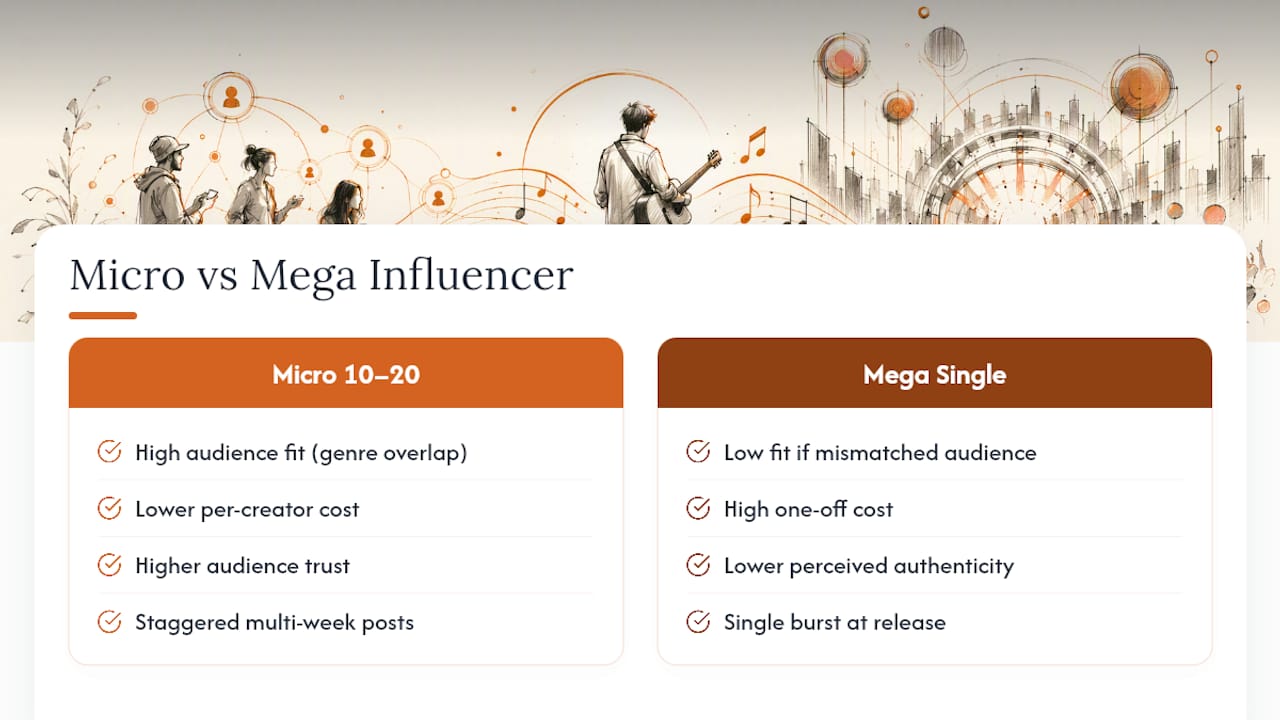
Yes, and increasingly more than mega-influencers do for independent budgets. Small, aligned creator outreach, working with 10 to 20 micro-creators whose audience genuinely overlaps with your genre, tends to produce better long-term return than a single expensive placement with a creator whose audience barely matches yours, according to practitioner guidance on indie campaign budgets.
The mechanics are straightforward: micro-creators charge less, their audiences trust their recommendations more because the relationship feels personal, and their content usually reads as native rather than sponsored. A creator with 15,000 highly engaged followers in your specific subgenre will often outperform a creator with 500,000 followers who has no real connection to your sound.
The trend for 2026 is coordination over volume. Rather than a single burst of influencer posts timed to a release date, artists are running staggered creator content across several weeks, treating each post as a fresh discovery test rather than a one-time push. Pay attention to which creators’ audiences actually convert to streams or saves, then build repeat relationships with those specific creators instead of running one-off transactions with a new roster every release.
How Do Privacy Rules Change the Way You Promote Music?
Data privacy regulation is tightening the room for aggressive retargeting, and that changes how promotional funnels need to be built in 2026. Rules like GDPR in the European Union and various US state-level privacy laws restrict how third-party ad platforms track users across sites, which makes the old model, blast broad ads and retarget everyone who clicked, less reliable than it used to be.
The practical shift is toward first-party data: information fans give you directly through email signups, SMS opt-ins, or Discord memberships, rather than data scraped from third-party trackers. This is one more reason owned channels matter more in 2026 than they did five years ago. A fan’s email address or phone number is yours regardless of what any platform changes about tracking permissions, while a pixel-based retargeting list can shrink overnight if a browser update blocks third-party cookies.
Build consent into your funnel from day one: clear opt-ins on your landing page, honest language about what a signup gets someone (early access, exclusive content, tour news), and a simple way to unsubscribe. Fans who opt in deliberately convert better and stay longer than names harvested passively, and a compliant funnel protects you from the platform-level disruptions that keep hitting ad-based targeting.
Beyond Streaming: NFTs, Fan Tokens, and New Revenue Paths
Streaming still dominates revenue, but MIDiA’s forecasting work points to an expanding fan economy, merch, expanded rights, and new digital ownership models, as a growing piece of the picture through 2033, described in MIDiA Research’s global music forecasts.
NFTs and fan tokens had a rocky reputation after the speculative boom and bust of the early 2020s, but the surviving use cases are more modest and more useful: limited-edition digital collectibles tied to a specific release, token-gated access to a Discord community, or tiered fan memberships that unlock early listens and merch discounts. The successful versions treat the token as a membership card, not an investment pitch.
For independent artists, the realistic play isn’t launching a token and hoping it appreciates. It’s using tiered access, Patreon-style memberships, gated Discord tiers, or limited digital collectibles, as another way to convert your most engaged fans into recurring revenue. Pair any of these with the owned-channel infrastructure already discussed: a fan who joined your email list from a pre-save campaign is a much better candidate for a paid membership tier than a stranger scrolling past an ad.
Author Perspective: What Actually Separates Winners in 2026
Ownership and funnel discipline beat chasing viral moments, full stop. A single viral clip with no landing page behind it is a wasted spike. Playlist campaigns, curator-led or otherwise, work best as one component in a system, not a rescue plan for a release with no funnel underneath it. Set realistic expectations, test relentlessly, and double down only on the engagement you can actually verify.
— Einars
Ready to Add Curator-Led Placements to Your Funnel?
Playlist campaigns work best when they’re feeding an audience you can actually keep, not just a stream count that disappears once the campaign ends. Intonality is built around that principle: personalized pitches sent to real, genre-matched curators instead of automated systems or fake playlists, with real-time updates and written feedback on every decision so you know exactly why a curator said yes or no.
Intonality’s Starter, Standard, Pro, and Max campaign tiers are designed to slot directly into the framework covered above: use placements to build momentum, then route that new attention into the email list, SMS group, or Discord you’ve already set up to catch it. Browse public campaigns with real curator feedback to see how placements and declines get reported transparently, then pick the tier that matches your release goal and get your pitch moving before your next release date locks in.
Sources
- IFPI/global recorded music revenue report (via MusicWeek)
- 2026 music marketing trends: World-building, mystery campaigns, IRL activations and more - Music Ally
- How To Build An Effective Music Marketing Strategy In 2026 - Magnetic Magazine
- AI may not kill the music industry but it could change how fans choose who matters - Forbes
FAQ
What Are the Major Music Trends Expected in 2026?
Short-form discovery, owned-channel growth, world-building and mystery campaigns, and stricter measurement of real engagement are the dominant trends shaping music promotion in 2026. Sync placements and micro-influencer partnerships are also playing a larger role as momentum multipliers rather than standalone tactics.
How Do I Promote My Music in 2026?
Start with one clear goal, one target audience, one primary content format, and one owned channel to capture the fans that format brings in. Test short-form hooks cheaply before spending on ads, and use tools like Spotify for Artists analytics to confirm which signals are real before scaling any campaign.
What Are the Advertising Trends for 2026?
Ad strategy in 2026 leans heavily on testing multiple short-form hooks before committing budget, then retargeting engaged viewers toward a specific conversion event like a pre-save or email signup. Privacy regulation has also pushed advertisers toward first-party data collected through owned channels rather than relying solely on third-party tracking.
How Does Intonality Fit Into a 2026 Promotion Strategy?
Intonality sends personalized pitches to real, genre-matched Spotify curators and reports back with written feedback on every decision, averaging multiple playlist placements per campaign depending on the tier. It works best as one piece of a broader funnel that includes owned-channel follow-up, not as a standalone growth plan.
How Can I Tell If Streaming Engagement Is Real or Manufactured?
Check whether stream spikes match growth in saves, playlist adds, and profile visits. If plays jump but those secondary signals stay flat, that’s a strong indicator of fake or manufactured streaming activity rather than genuine listener interest.


