
Independent artists land on meaningful editorial playlists roughly 1 to 5 percent of the time, according to industry data from Dynamoi, no matter what a promotion service’s homepage claims. Services quoting placement rates much higher than typical usually count something broader, like any playlist add rather than genuine editorial or curator flagship placements. If you take one action from this article, make it timing: deliver your finished track and pitch assets 31 to 40 days before release, since that window shows measurably higher acceptance than last minute submissions.
TL;DR:
- Most genuine editorial playlist placements for independent artists occur at acceptance rates between 1 and 5 percent, not the higher rates often claimed by promotion services.
- Timing plays a critical role, with submissions delivered 31 to 40 days before release significantly increasing acceptance chances over last-minute pitches.
- A high acceptance rate often includes small or algorithmic playlists, which do not typically lead to meaningful audience growth or sustained engagement.
- Factors like adding a Spotify Canvas, precise genre tagging, and accumulating more than 1,000 pre-saves can boost acceptance likelihood and playlist quality.
- Rejections and feedback provide more insight into genre fit than acceptance percentages, making targeted, well-informed pitches more effective than mass submissions.
Table of Contents
- What Is a Realistic Playlist Acceptance Rate for Independent Artists?
- How Do You Compare Acceptance-Rate Claims Across Services?
- What Factors Actually Move Your Acceptance Rate?
- Step-by-Step: Raising Your Acceptance Rate for Your Next Release
- What Should You Ask a Playlist Submission Service Before You Pay?
- Which Approach Fits Your Situation Right Now?
- How Intonality Runs Curator Campaigns
- What Rules and Standards Govern Playlist Submissions?
- The Data Says Something Different Than Most Marketing Copy
- A More Transparent Way to Pitch Your Music
- Sources
- FAQ
What Is a Realistic Playlist Acceptance Rate for Independent Artists?
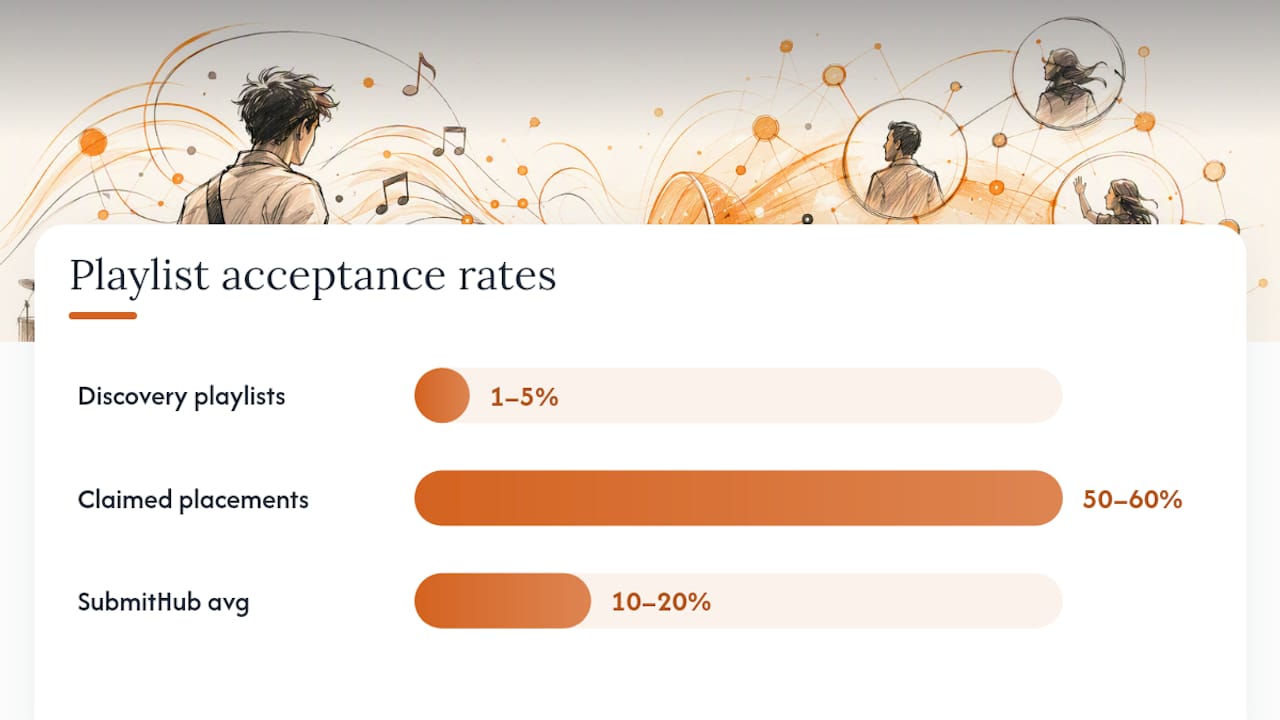
The gap between what services advertise and what artists experience comes down to definitions. When a company says it delivers a 50 to 60 percent placement rate, that figure often includes small user-curated playlists with a few hundred followers, not the flagship editorial lists that actually move the needle. When Dynamoi’s industry analysis narrows the scope to playlists that genuinely matter for discovery, independent artists land somewhere between 1 and 5 percent.
That is not a discouraging number. It is a realistic one, and it should shape how you evaluate any service or strategy.
Here is how the market breaks down for artists trying to shortlist an approach:
- Playlist Push runs as a curator marketplace: you pay for a campaign, and your track gets reviewed by a network of curators. Some sources cite placement metrics in the 50 to 60 percent range, though that figure typically reflects any accepted placement across the curator pool rather than high follower editorial lists.
- SubmitHub works on a per submission model. You pay per pitch, get a guaranteed listen and written feedback, and platform wide acceptance estimates commonly land in the 10 to 20 percent range, though results swing heavily based on genre fit and which curators you target.
- Spotify editorial, pitched through Spotify for Artists, costs nothing but limits you to one pitch per release and comes with no guarantee of any kind. Spotify’s own documentation states plainly that pitching does not guarantee placement, and editors may even select a different song than the one you submitted.
- Agency and managed campaigns sit at the high end of cost and typically bundle playlist pitching with broader marketing, which makes isolating a true acceptance rate difficult.
| Option | Claimed placement rate | Pricing model | Curator vetting & transparency | Feedback policy | Typical placements per campaign |
|---|---|---|---|---|---|
| Playlist Push | ~50 to 60% (varies by definition) | Paid campaign tiers | Curator network, vetting details vary by tier | Reporting on accepted/declined tracks | Varies by campaign size |
| SubmitHub | ~10 to 20% platform average | Pay per submission | Open marketplace, curator quality varies widely | Written feedback guaranteed on paid tiers | Depends on volume of submissions |
| Spotify editorial | Not published; no guarantee | Free | Internal Spotify process, not visible to artists | No feedback provided | 0 or 1, all or nothing |
Read every claimed acceptance percentage with one question in mind: accepted onto what? A service that will not define its own numbers is telling you something.
How Do You Compare Acceptance-Rate Claims Across Services?
Three different sources report acceptance data, and each one carries its own bias. Spotify’s own statements describe pitching mechanics, not outcomes. Independent datasets, like Wiseband’s analysis of 800-plus accepted placements, track what actually got accepted and why. Service dashboards report what that specific vendor counts as a win, which is exactly where the definitional slippage happens.
A single acceptance rate hides more than it reveals. Consider two artists who each get “accepted” once:
- Artist A lands on a playlist with 1 million followers and heavy algorithmic weight behind it.
- Artist B lands on 40 separate playlists that each have around 1,000 followers.
Both count as “placements.” Only one of them meaningfully expands a listener base.
That is why the acceptance rate itself matters less than what happens after. Save rate, listener retention past the first 30 seconds, and follower quality tell you whether a placement built real audience or just inflated a stream count for a week. RouteNote’s 2026 analysis found that engagement, not raw placement count, predicts whether curated exposure turns into lasting algorithmic momentum.
Pro Tip: Before you sign up for any paid campaign, ask what percentage of their “placements” went to playlists with fewer than 5,000 followers. If they won’t answer, assume it’s most of them.
What Factors Actually Move Your Acceptance Rate?
Timing produces the largest measurable swing in the data. The Wiseband dataset of 800-plus successful pitches found that submitting 31 to 40 days before release correlated with meaningfully higher acceptance than pitching one to three days out, when most editorial calendars are already locked.
Assets matter almost as much as timing. The same dataset reported specific uplifts tied to individual factors:
- Adding a Spotify Canvas correlated with a 27% higher acceptance rate.
- Accurate, narrow genre tagging correlated with a 23% lift.
- Pre-save counts showed a stepwise relationship with acceptance, climbing toward roughly 31% at the 2,500-plus pre-save threshold.
Momentum compounds. An insight from the same Wiseband research points to 1,000-plus pre-saves as a meaningful signal of audience interest, one that curators and editors read as proof a track already has traction before they take a chance on it.
Genre mismatch remains one of the most common, most avoidable rejection reasons. A curator who runs a strict dream-pop list will decline a track tagged as indie rock even if the song itself would fit, simply because the metadata told them not to look twice. Prior editorial history helps too. Artists with a previous accepted placement tend to see friendlier odds on subsequent releases, since curators and editors build informal trust in what an artist delivers.
Step-by-Step: Raising Your Acceptance Rate for Your Next Release
- 31 to 40 days out, deliver your final track to your distributor, set up your Spotify for Artists pitch, and build your Canvas and any video assets.
- Push your pre-save campaign hard enough to clear a real threshold, ideally 1,000 or more pre-saves, before you submit anywhere.
- Write a pitch between 100 and 150 words. Lead with a one-line credibility marker (a stream count, a placement history, a press mention), name two or three comparable artists, and confirm your genre tags match the track, not your aspirations.
- Submit narrow, not wide. Ten to twenty carefully targeted pitches to curators whose existing playlists genuinely fit your sound will outperform blasting two hundred generic submissions.
- Track every response. Curators who reply, even with a decline, are worth re-approaching on your next release; that relationship compounds over time.
- After placement, drive saves. Ask your existing fans to save the track, since a low skip rate and high save-per-stream ratio is what convinces Spotify’s algorithm to keep recommending it beyond the initial placement window.
Pro Tip: Track save-per-stream for each playlist that adds you. It tells you which curators are worth pitching again, turning your placement history into a targeting list instead of a scoreboard.
What Should You Ask a Playlist Submission Service Before You Pay?
Any service publishing an acceptance rate should be able to answer basic questions about what that number means. Ask what counts as “accepted”: any playlist add, or specifically editorial and high-follower placements? Ask for the sample size and timeframe behind the published figure.
Request recent examples. A legitimate service can show you actual playlists it placed tracks on recently, including a breakdown of follower sizes, not just a testimonial page. Ask directly about curator vetting: how are curators selected, and what stops a bad actor from running a bot-inflated playlist inside the network?
Confirm the feedback and refund policy in writing before you commit. MusicPulse’s ranking criteria treats very-high blanket acceptance percentages as a red flag, not a selling point, since legitimate curator relationships involve real rejection rates. If a service won’t show you curator examples or can’t explain its own follower numbers, treat that refusal as your answer.
Which Approach Fits Your Situation Right Now?
If you’re an emerging artist with no release history, spend your limited budget on organic momentum and targeted outreach before you consider any paid campaign. An expensive mass blast won’t fix a genre mismatch or a thin pre-save count.
If you’ve built some momentum, meaning 1,000 or more pre-saves or at least one prior editorial placement, a curated marketplace or a small paid campaign starts to make sense. Established acts with real budgets can consider managed campaigns at scale, but insist on a transparent curator list and written feedback regardless of price.
Whatever path you choose, watch one number after placement: saves per stream. It’s the clearest proxy for whether a playlist built real audience or just inflated a stream count for a week, and it should guide which curators you approach again.
How Intonality Runs Curator Campaigns
Intonality pairs each submitted track with manually vetted, genre-matched curators and sends real-time updates plus written feedback on every decision, whether it’s an add or a pass. The company reports an average of 4 to 11 placements per campaign, depending on tier, a figure the company provides rather than an industry-wide guarantee.
In a case study the company calls “Scorecard, Not Spikes,” the emphasis lands on tracking outcomes over time rather than chasing a single viral placement, a philosophy documented by Intonality’s editorial contributor Einars.
What Rules and Standards Govern Playlist Submissions?
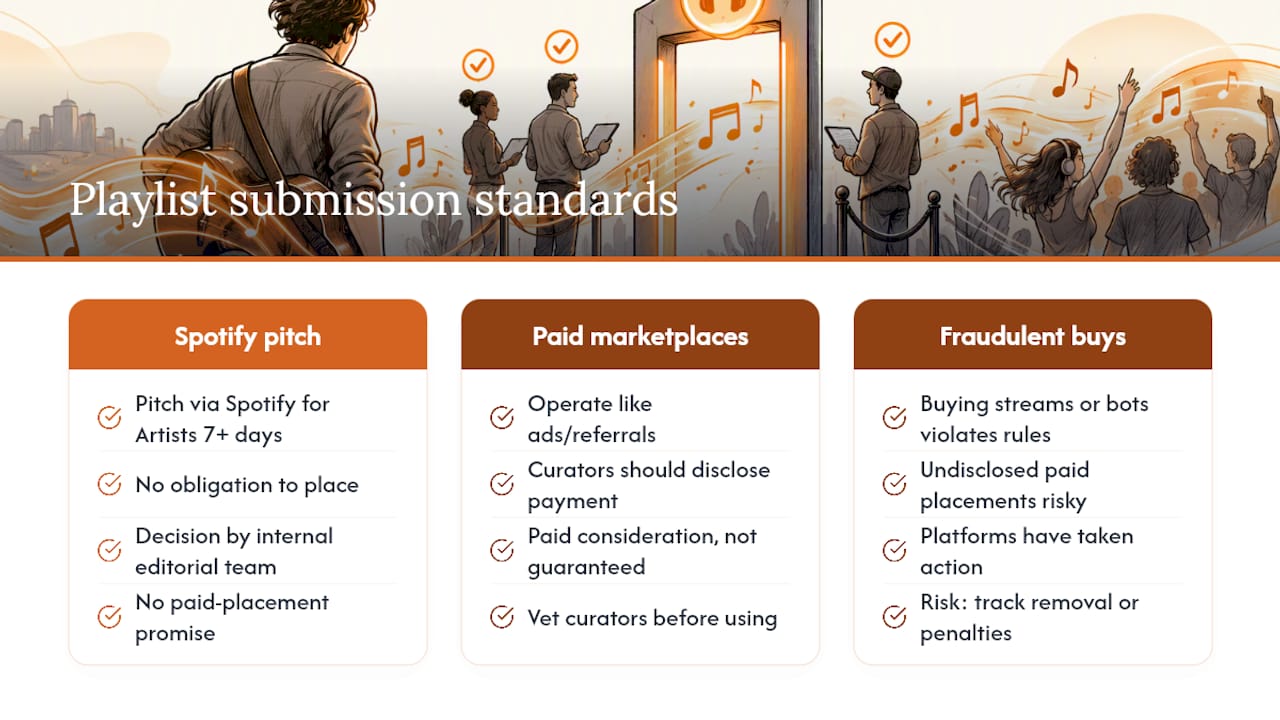
Playlist submission carries fewer formal regulations than most artists assume, but that doesn’t mean anything goes. Spotify’s own policy requires artists to pitch through Spotify for Artists at least seven days before release, and it explicitly states that submitting a pitch creates no obligation on Spotify’s part to place the track. That single sentence is worth internalizing: no legitimate channel, free or paid, can promise editorial placement, because the decision sits entirely with Spotify’s internal editorial team.
Paid marketplaces operate under a different standard entirely, closer to an advertising or referral relationship between artist and curator. Reputable curators disclose that they’re being paid to consider a track, and a curator adding a track for payment without disclosure edges toward the kind of undisclosed paid promotion that platforms like Spotify have taken action against in the past when it involves fraudulent streaming activity. Buying streams, bots, or fake playlist placements violates Spotify’s platform rules outright and risks track removal or account penalties.
The safest standard for artists: work with services that vet curators, publish real written feedback, and never guarantee a specific outcome. Anyone offering a guaranteed editorial placement, at any price, is not operating within how the platform actually works.
The Data Says Something Different Than Most Marketing Copy
Most advice about playlist acceptance treats the acceptance rate as the finish line. It isn’t. The datasets in this article, from Wiseband’s timing analysis to Dynamoi’s realistic benchmark, point toward a different conclusion: placement is a filter, not a reward, and what happens in the weeks after a track gets added matters more than the add itself.
The conventional advice, submit to as many curators as possible, gets the volume math backward. Ten targeted pitches to curators whose existing playlists match your sound will beat two hundred generic submissions, because acceptance without fit produces placements that don’t convert to saves or follows.
What should change first for most artists: stop treating a rejection as failure and start treating it as data. A curator’s written decline, when you get one, tells you more about your genre fit than a vague acceptance ever will. Prioritize the feedback loop over the placement count, and the acceptance rate will follow.
— Einars
A More Transparent Way to Pitch Your Music
Playlist Push and SubmitHub both give artists a route into curator networks, but neither publishes a breakdown of curator vetting alongside its acceptance figures the way Intonality does. Intonality builds every campaign around manually screened, genre-matched curators, and every single decision, accepted or declined, comes back to you with written feedback so you know exactly why a curator passed.
Campaigns start at competitive price points, and some services back weak reviews with automatic refunds, offering accountability in a market full of vague blanket percentages. If you want to see what real curator decisions look like before committing, browse public campaigns with actual curator feedback, then submit your track or explore current campaign tiers to find the option that fits your release.
Sources
- Pitching music and videos to playlist editors — Spotify for Artists
- How to Get on Spotify Editorial Playlists: Analysis of 800+ Successful Pitches (Wiseband Data)
- Playlist Pitching Success Rate: 1-5% for Indies Data — Dynamoi
- The 10 Best Playlist Submission Services Ranked — MusicPulse
FAQ
What Is the Top 0.005% on Spotify?
That figure typically refers to artists ranked in the top tier of monthly listeners globally, a threshold that shifts as Spotify’s user base grows. It reflects overall popularity and stream volume rather than playlist acceptance rate specifically, so an artist can sit well outside that percentile while still landing consistent curator placements.
How Much Does Spotify Pay for $1,000,000 in Streams?
Spotify’s per-stream payout varies by market, subscription mix, and royalty agreements, and the company does not publish one fixed rate. This question sits outside playlist acceptance data specifically, so treat any flat per-stream figure you see elsewhere with caution.
Is Playlist Push Better Than SubmitHub?
They solve different problems: Playlist Push runs as a curator network with campaign-based pricing, while SubmitHub charges per submission and guarantees a written response on paid tiers, with platform-wide acceptance commonly cited around 10 to 20 percent. Neither publishes a fully transparent, independently audited acceptance rate, which is why checking curator examples and follower distribution before paying matters more than the headline percentage.
Is 50,000 Monthly Listeners on Spotify Good?
For an independent artist, solid, real traction is often built through a mix of playlist placements, organic sharing, and consistent releases. It’s not a benchmark tied directly to acceptance rate, but artists with prior streaming history typically find curators more receptive because it signals lower risk.
What Counts as a Good Playlist Acceptance Rate for an Independent Artist?
A realistic range for meaningful editorial playlists sits around 1 to 5 percent, well below the 50 percent or higher figures some services advertise. Intonality reports an average of 4 to 11 placements per campaign, a company-provided figure based on its own vetted curator network rather than a platform-wide statistic.


