A good playlist pitch subject line names the artist, the track and the genre, points to a specific playlist, and stays short enough to read on a phone. It tells the curator what is inside the email before they open it. Everything else, the clever hook, the exclamation mark, the “you need to hear this”, works against you, because curators see that pattern daily and have learned to delete it.
This guide gives you the formulas, the length limits, ready-to-adapt examples for different genres and release stages, and a list of wording that gets pitches ignored. It also covers what happens when the subject line is not the thing standing between your song and a playlist: the fit between your track and the curator’s list. That is the part we built Intonality around, with personalized pitches to genre-matched, manually screened curators and a written reason for every decision.
TL;DR
- Put artist name, track title and genre in the subject line, and keep it under about 50 characters.
- Name the playlist or the sound it fits. “Check out my new single” describes every email a curator got that day.
- Front-load the useful words: phone mail apps cut subject lines off after roughly 30 to 41 characters.
- Skip all caps, stacked punctuation, fake urgency and vague teasers. They read as mass outreach.
- A subject line only gets the email opened. Genre fit decides the placement, so choose playlists before you polish wording.
What a curator decides in the subject line
Curators who take submissions listen to a lot of music each week and develop filters to cope. Wisseloord’s pitching guide says genre fit comes first and that a subject line carrying artist name, track title and genre signals a targeted email rather than a mass one.
Think of the subject line as a label on a box. The curator should know three things without opening it:
- Who it is from. The artist name, so it does not look like an anonymous blast.
- What it is. A track title and the genre or mood, so the curator can match it to a playlist in a second.
- Why it is in this inbox. The playlist name, or a clear sound reference, so it reads as meant for them.
If the subject line delivers all three, the open is a low-risk decision for the curator. If it delivers none, the safest choice for them is delete.
How long a subject line should be
The common guideline is 30 to 50 characters, roughly six to ten words. MailNéo’s subject line guide adds the practical reason: iPhone Mail in portrait cuts a subject off around 41 characters, and some Android clients cut it around 30. Anything past that wraps or ends in an ellipsis.
The working rule follows directly: whatever must be seen goes first. Compare two versions of the same pitch:
- Hoping you might consider my new track for your playlist, Mara Vale
- Mara Vale: “Glasshouse” (indie-pop)
On a phone, the first one shows “Hoping you might consider my new track f…”. The curator learns nothing. The second shows the artist, the track and the genre in full, in about 35 characters.
Wisseloord’s guide lands in the same place: under 50 characters, with a plain line such as “New indie-pop single from [Artist Name]” beating anything overly creative.
Five subject line formulas that work
Each formula below is a pattern you can fill in. The examples are written for illustration, so swap in your own details.
1. Artist, track, genre
The simplest and safest. Use it when you are sending to a curator whose playlist you have not studied in depth but whose genre clearly matches.
- Nova Reyes: “Static Bloom” (dream pop)
- The Harbor Lights, “Slow Dive” | indie rock
2. Playlist-first
Lead with the playlist name when your pitch is aimed at one specific list. This tells the curator you did your homework.
- For “Late Night Drive”: “Neon Road” by Kit Alder
- “Sunday Folk” fit? Jo Marlow, “Cedar Lane”
3. Sound reference
Useful when the curator’s playlist features artists you resemble. Name two at most, and only ones you honestly sound like.
- New single for fans of Phoebe Bridgers and Big Thief
- “Cedar Lane” (RIYL: Gregory Alan Isakov, Hozier)
4. Release context
For a new release, say so with the date or the month. Pre-release pitches are normal, so mention timing in a way that helps the curator plan.
- New release Friday: Jo Marlow, “Cedar Lane”
- Out March 6: “Static Bloom” (dream pop)
5. Plain question
Use this only when you are asking something real, such as whether the curator takes submissions. The subject must be a truthful preview of what the email asks.
- Quick question about submissions for “Late Night Drive”
You will see these same shapes in most good guidance, because they work for the same reason: each one is a truthful preview of the email.
Examples by genre, mood and release stage
Genre and mood change what the curator needs to see. Here is how the same structure bends for different pitches.
| Situation | Example subject line | Why it works |
|---|---|---|
| Indie-pop single | Nova Reyes: “Static Bloom” (indie-pop) | Artist, track and genre in under 40 characters |
| Hip-hop, mood-led | “Night Shift” by Dre Valen, melodic trap | Subgenre is specific, not just “hip-hop” |
| Acoustic or folk | For “Sunday Folk”: Jo Marlow, “Cedar Lane” | Names the playlist, signals a targeted send |
| Electronic, tempo-led | “Pulse” for your deep house list, 122 BPM | Tempo helps a curator judge fit at a glance |
| Study or focus playlist | Instrumental piano for focus: “Low Tide” | Names the use case the playlist serves |
| Pre-release | Out March 6: “Static Bloom” (dream pop) | Gives the curator a date to plan around |
| Follow-up on a sent pitch | Re: “Static Bloom” for “Late Night Drive” | Keeps the thread and the context together |
Genre labels carry more weight than most artists expect. If you are unsure which labels describe your track, our guide to Spotify pitch genres walks through how to choose them, and playlist genre targeting shows how to match those labels to the lists worth pitching.
How to personalize without sounding generic
Personalization in a subject line should be one concrete detail, not flattery. The playlist name is usually enough. If you have room, a second detail, such as a track already on the list, can sit in the opening line of the email instead of the subject.
A few rules keep it honest:
- Use the exact playlist name. A misspelled or paraphrased name looks like a mail merge gone wrong.
- Skip “love your playlist” in the subject. Praise belongs in the body, and only if it is specific.
- Do not use the curator’s first name in the subject unless you know them. It can come across as overly familiar from a stranger.
- Keep the same facts in subject and body. If the subject says “synth-pop” and the email says “alt-rock”, the curator stops trusting the rest.
The body of the email carries the rest of the personalization. For what to write there, our playlist pitch examples show full pitches, and the 500 character pitch guide covers the one-sentence bio and short templates.
Wording that gets a pitch deleted
The fastest way to lose a curator is to sound like a campaign. DJBooth’s best-practices piece tells artists to be concise and specific, to avoid clichés such as “check out my new hit single” or “hot new music alert”, and to avoid all caps and excessive punctuation, which look unprofessional.
Avoid these patterns:
- Manufactured urgency: “You NEED to hear this!!!”, “Last chance”, “Don’t miss out”.
- Vague intrigue: “Something I think you’ll love”, “Quick favor?”, “Thoughts?”.
- Claims in the subject: “The next big thing”, “Going viral”, “Guaranteed hit”.
- Fake threads: “Re:” or “Fwd:” on a first email. It is misleading, and it burns trust before the music plays.
- Generic marketing language: “New music submission” with no artist, genre or track.
- Emoji strings and all caps: they read as promotional mail and can trigger spam filters.
The common thread is honesty. A subject line should preview exactly what the email contains. If it promises more than the email delivers, or hides what the email is, the curator learns to ignore your name.
A short checklist before you hit send
- Does it include your artist name, the track title and a specific genre or mood?
- Is the most important information inside the first 30 to 40 characters?
- Does it name the playlist or a sound the curator’s list actually covers?
- Is it free of all caps, exclamation marks and hype words?
- Would the curator be able to tell what the email is without opening it?
- Does the Spotify link sit at the top of the email body, so the first click goes to the music?
One more point on following up: a single, polite follow-up is normal, but repeated nudges read as spam and can damage the relationship for your next release. Treat the first pitch as the one that counts.
Why the subject line is the smaller problem
A perfect subject line gets a clean open. It does not make your track fit a playlist it does not fit. Most pitches that get ignored fail on fit, not wording: the wrong genre, the wrong energy, a playlist that has not added a new track in months.
That is why the order of work matters:
- Choose playlists by fit. Listen to the list the way a curator would and check whether your track could sit between two of its existing songs. Our fit-scoring guide shows how to score it, and prioritizing the strongest matches saves you from wasting pitches.
- Write the subject and the pitch for that list. Use the formulas above.
- Read the response. A decline with a reason teaches you more than silence.
Step three is where most outreach falls apart. Cold emails often get no answer at all, so you never learn whether the problem was the subject, the genre, the mix or the timing. For the common mistakes behind ignored pitches, our breakdown of playlist pitching mistakes is a good next read, and what curators want shows the pitch from their side of the inbox.
Where Intonality fits

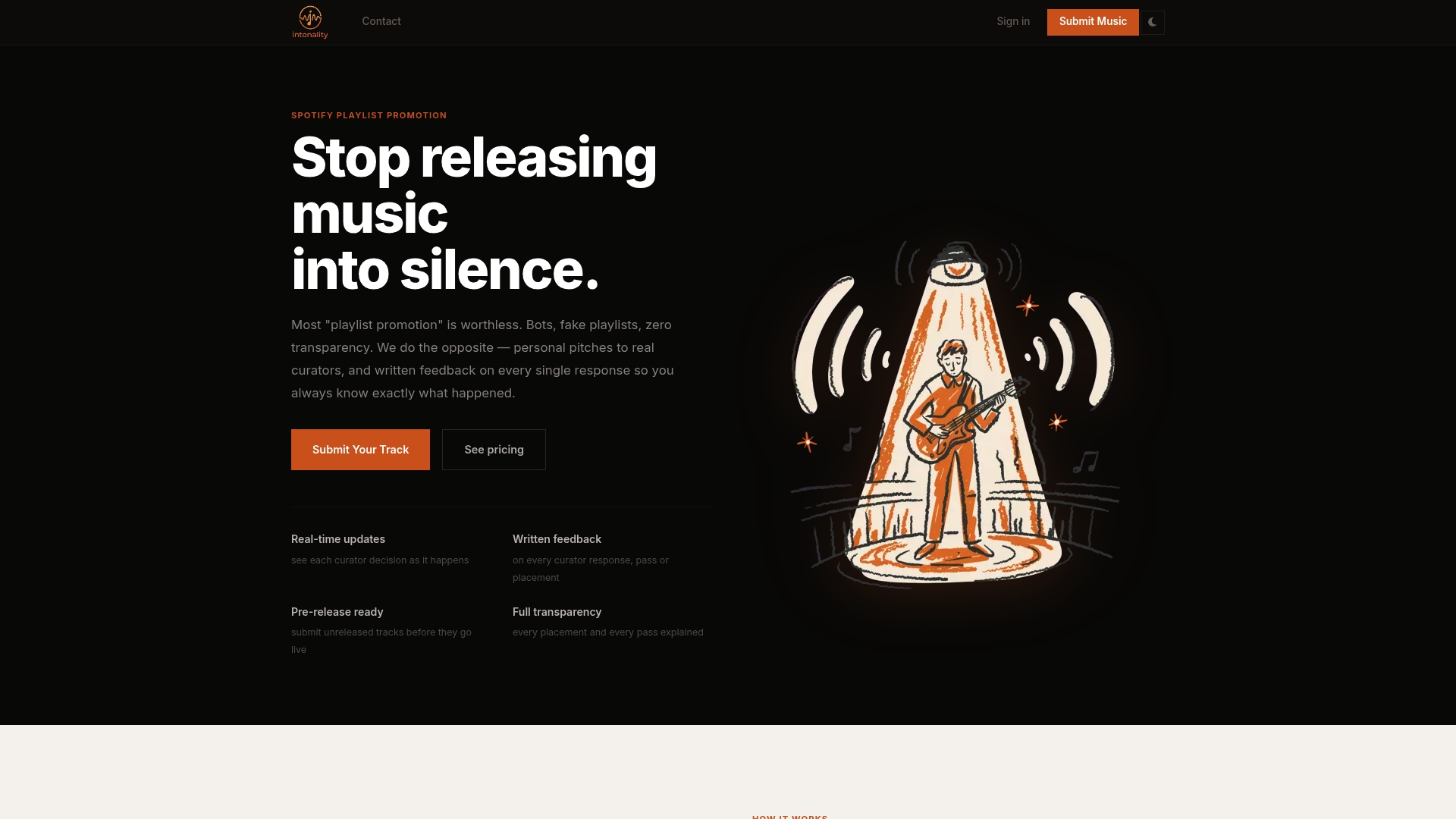
If you would rather spend your time on the music than on drafting subject lines for dozens of inboxes, this is the work we do. Intonality sends personalized pitches for your track to real Spotify playlist curators who are manually screened and matched to your genre. We do not use bots or fake streams.
Every curator decision comes back with written feedback, and you follow the campaign in real time. Placements and declines are published, so you see exactly what happened. You can also submit pre-release, which suits the release-timing approach described above. We state that campaigns average 4 to 11 playlist placements depending on the service tier you choose: Starter, Standard, Pro or Max.
You can see how it works on our public campaigns with real curator feedback, compare tiers on the Intonality homepage, or read how genre-matched outreach leads to placements. If you are weighing us against another playlist promotion service, our Playlist Push alternative page lays out the differences, including the automatic refunds we offer for inadequate reviews.
Our perspective
We have one conviction about playlist pitching: the best subject line in the world cannot rescue a mismatched song, and a well-matched song rarely needs a clever subject line.
That is why we built Intonality around fit. Our curators are manually screened and matched to your genre before your track ever reaches them. The pitch is personalized, and the answer is never a silent no. Every decision comes with written feedback, and placements and declines are published, so an artist can learn from each response rather than guess.
We think artists deserve to know why a curator said yes or no. Feedback on the sound, the mix or the genre label is worth more than any open-rate trick, because it changes what you release next. And because we do not rely on bots or fake streams, the listeners who find your track come from playlists real people maintain.
If you want your subject lines to matter, start by making sure the right curators are reading them.
Einārs
Subject lines and the Spotify algorithm
Many artists chase playlists because they hope for algorithmic momentum. The subject line plays no part in that directly. What matters is that real listeners save and replay the track after a placement. That is another reason to target playlists whose audience genuinely likes your genre: engagement from the right listeners is what helps a track travel. For more on that angle, see our guide on getting on Spotify Radio.
The same goes for how your release looks. Curators see your cover before they hit play, and our cover art guide explains how it shapes first impressions in a pitch.
FAQ
What is a good subject line for pitching a song to a playlist curator?
Use artist name, track title and genre, for example “Nova Reyes: ‘Static Bloom’ (dream pop)”. If you are targeting one list, lead with its name instead: “For ‘Late Night Drive’: ‘Neon Road’ by Kit Alder”. Keep it under about 50 characters so a phone shows all of it.
How long should a playlist pitch subject line be?
Aim for 30 to 50 characters, around six to ten words. MailNéo’s guidance notes that iPhone Mail cuts subjects off around 41 characters in portrait and some Android clients around 30. Put the artist, track and genre at the start.
Should I put the playlist name in the subject line?
Yes, when you are pitching one specific playlist and you can spell the name exactly. It shows the email was written for that curator. If you are asking about several lists at once, use the artist, track and genre pattern instead.
Can I use emojis, caps or urgent wording?
It is better not to. DJBooth’s guidance names all caps, excessive punctuation and clichéd hype lines as things that look unprofessional. Plain, specific wording reads as more credible.
Do I need a subject line at all if I use Intonality?
Your campaign goes out as a personalized pitch to genre-matched curators, so you focus on the track, the genre choices and the pitch text. The formulas in this guide still help you describe your music clearly in a way curators understand.